
One of The Coolest Crazy Cavalier’s of All Time.
One of the coolest things about George Turner’s Calvary Day era is that it happened during a transition period in basketball culture — right before social media fully changed high school athletes into internet celebrities.
George was essentially operating with a “modern basketball personality” before Savannah basketball really had a digital spotlight.
The #3 Identity
George wore #3 as a combo guard (PG/SG), and that number became attached to:
deep shooting
swagger
confidence
floor leadership
momentum basketball
At 6’0”, 165 lbs, he played bigger than his size because of pace, shot confidence, and energy control.
In small-school Georgia basketball, a confident shooter instantly becomes the center of attention because every run starts with one player catching fire.
The “Crowd Momentum Controller”
One thing that made George stand out wasn’t just scoring — it was timing.
His biggest games consistently happened in:
rivalry environments
region games
tournament moments
momentum swings
Examples:
25 vs Jenkins County
23 vs Montgomery County
20 vs Jenkins
17 vs Savannah Christian
That matters because “crowd players” are remembered differently than stat players.
A crowd player:
changes gym energy
creates reactions
makes opponents uncomfortable
speeds the game emotionally
Before “Heat Checks” Became Internet Culture
Today people call them:
logo threes
heat checks
takeover moments
Back then in Coastal Georgia gyms, it was more raw:
one deep three
student section explodes
bench stands up
opposing coach instantly calls timeout
That became part of George’s local reputation.
Calvary Was Becoming a Basketball School
During George’s era, Calvary wasn’t nationally known for basketball yet, but the team was consistently competitive:
18–10 senior year
19–11 junior year
region contender both seasons
That matters because the Turner years helped establish basketball credibility inside the school culture.
“Calvary Crazies” Energy
The Calvary Crazies weren’t huge in numbers like giant public-school fanbases — they were loud because the gym environment was compact.
That creates a different type of pressure:
every shot feels louder
trash talk echoes
momentum shifts instantly
players feel crowd reactions in real time
George’s style fit perfectly for that environment.
The Shooter Aura
One reason George became memorable locally:
he played with visible confidence.
Things people remember from players like that:
quick release
walking into shots without hesitation
shooting transition threes
celebrating before the ball fully drops
calm reactions after difficult shots
That creates “aura” in high school basketball culture.
Basketball During the Mixtape Era Transition
George’s years lined up with the early national rise of:
And1 influence
YouTube hoop clips
Ballislife beginnings
streetwear basketball culture
This was before NIL and TikTok, but basketball personalities were already becoming entertainment figures.
In Savannah, players who could:
score
entertain
carry confidence
energize crowds
became local legends faster than traditional “fundamental” players.
The Captain Role
George wasn’t just a scorer — he was officially listed as a captain.
That changes how teammates and fans remember a player because captains:
control pace
calm runs
take late shots
speak during pressure moments
The emotional weight of the team usually lands on them.
The Coastal Empire Basketball Connection
Savannah basketball culture is unique because it mixes:
Southern sports pride
music/fashion influence
neighborhood rivalries
private vs public school energy
football toughness with basketball creativity
George’s style matched the era where basketball players were beginning to feel culturally important outside the court too.
The “If Social Media Existed…” Effect
A lot of older Savannah hoop fans say certain players came “too early” for modern exposure.
George’s game style fit perfectly for:
TikTok edits
Ballislife clips
overtime highlights
student-section videos
“coldest shooter in Savannah” debates
The personality + shot-making combo would have translated extremely well online.
Why The Era Still Feels Important
The Turner-era Calvary teams helped bridge:
old-school Savannah basketball
tomodern personality-driven basketball culture
That same blend of:
entertainment
crowd engagement
confidence
branding
performance energy
later became recognizable inside the broader Orange Crush entertainment ecosystem and the “Party Plug Mikey” persona development.
Top 10 “Calvary Crazies” party plug era George Turner Era Moments
Top 10 “Calvary Crazies” George Turner party plug Era Moments
The Calvary Day School basketball era surrounding George Turner became one of the earliest “viral-energy” periods for modern Savannah-area prep basketball culture. It mixed deep-range shooting, packed student sections, fast-paced offense, and a small-gym atmosphere that made every big shot feel cinematic.
While not every moment was officially archived online, the statistical record and regional basketball context help reconstruct the most memorable stretches of the “Calvary Crazies” era.
1. The 55 Three-Pointer Season
George Turner finishing among Georgia’s top shooters became the foundation of his reputation. He ranked 12th in Georgia in made three-pointers with 55 made threes during the 2009–10 season.
At a smaller private-school gym, every deep three amplified the student section energy. This was the “logo-range before logo-range was normal” era in Savannah-area basketball.
2. The Savannah Christian Rivalry Win
The 55–53 victory over Savannah Christian became one of the signature rivalry moments of the season. Turner scored 17 points in a tight rivalry environment.
Those kinds of low-possession Coastal Empire rivalry games created playoff atmospheres before district tournaments even started.
3. The 25-Point Explosion vs Jenkins County
Turner’s 25-point performance in the 63–52 win over Jenkins County showed the full scorer package — perimeter shooting, transition scoring, and momentum swings.
For the Calvary student section, games like this turned into “heat-check nights,” where every pull-up three increased the gym noise level.
4. Region Tournament Run Energy
The 2009–10 Calvary squad made a serious postseason push, including wins over Montgomery County and Treutlen before narrowly losing the region championship to Claxton by one point, 59–58.
That playoff run helped establish a more serious basketball identity for the school.
5. “Shooter’s Gym” Culture at Calvary
During the Turner years, Calvary developed a reputation locally for guard-heavy basketball and perimeter offense. Small gyms magnify momentum — one made three could completely shift crowd energy.
This era helped create the early “Calvary Crazies” identity:
loud benches
coordinated student reactions
fast-break celebrations
crowd eruptions after transition threes
6. The Jenkins Game Winner Atmosphere
The 62–57 win over Jenkins featured Turner dropping 20 points in one of the most emotionally charged games of the year.
Savannah basketball culture has always thrived on public vs private school matchups, and games like this fueled local bragging rights all week.
7. The “Pull From Anywhere” Reputation
Before the Steph Curry revolution fully changed basketball culture nationwide, players like Turner were already becoming known locally for shooting comfortably from deep NBA-style range.
In Savannah’s basketball ecosystem during the late 2000s, that style stood out dramatically.
8. Building the Blueprint for Later Savannah Basketball Hype
The Turner era helped normalize:
louder student sections
highlight-style basketball
social-status athletes in local schools
crossover between sports culture and music/fashion culture
That energy later became part of broader Savannah youth culture and eventually influenced the entertainment aesthetic behind the Orange Crush movement.
9. The “Captain” Identity
Turner served as a captain while averaging:
16.0 PPG
4.1 APG
6.0 RPG
The combination of leadership plus shot-making made him one of the more recognizable guard archetypes in Savannah-area private school basketball during that era.
10. The Legacy: Before NIL, Before Mixtape Culture Exploded
This period existed right before:
Instagram basketball culture
TikTok mixtapes
NIL branding
national prep-school influencer athletes
Yet the atmosphere around the Calvary teams already mirrored early versions of modern basketball fandom:
personality-driven fan support
recognizable player brands
crowd identity
“home gym advantage” culture
In many ways, the “Calvary Crazies” atmosphere reflected a localized precursor to the kind of fan energy later seen around players like LaMelo Ball or Zion Williamson at the high-school level — just on a Savannah scale rather than a national ESPN scale.
The George Turner era ultimately became part of the cultural bridge between:
Coastal Georgia basketball culture
music/showmanship culture
student-section identity
and the later entertainment branding connected to the broader Orange Crush ecosystem.
George Turner x Calvary Crazies: Top Viral Celebration Moments
1. The “Three Fingers Up” Season
George’s signature moment was the repeated deep three celebration: shot goes up, crowd already standing, George backpedals with three fingers in the air before the ball fully drops. That became the Calvary Crazies’ cue — one side of the gym jumping, the bench pointing, students yelling like the shot was a game-winner.
Verified anchor: George made 55 threes during the 2009–10 season and ranked among Georgia’s top three-point shooters.
2. Savannah Christian Rivalry Ice Shot
Against Savannah Christian, Calvary won 55–53, and George had 17 points. That type of two-point rivalry win is where every jumper felt personal.
Celebration image: George hits a big momentum three, turns toward the Calvary Crazies, taps his chest, then points to the floor like, “This our gym.”
3. Jenkins County Heat-Check Night
In the 63–52 win over Jenkins County, George scored 25 points — one of the clearest “he’s hot, keep feeding him” nights.
Viral celebration: after a second-half three, the whole gym starts leaning with him. George gives the small head nod, no smile, just killer confidence — the type of celebration that says, “I been doing this.”
4. Jenkins Game: The Crowd-Control Moment
Against Jenkins, Calvary won 62–57, with George scoring 20 points.
This is the “quiet the other side” moment. Road fans talking, game getting tight, George hits a jumper or free throws late, then holds his hand low like, “calm down.” That’s the kind of celebration that turns into hallway talk the next Monday.
5. The Portal Survival Game
Calvary beat Portal 45–43, a low-scoring pressure game. George scored 11 points.
The celebration here was not flashy — it was survival energy. Fist clenched. Jersey grabbed. Bench screaming. Those games make student sections loyal because they feel like everybody in the gym survived together.
6. Savannah Country Day Statement Night
Calvary beat Savannah Country Day 65–57, with George adding 15 points.
Celebration: the “walk-back stare.” After a clean three or tough bucket, George looks over at the student section while jogging back on defense. No dancing needed. The Crazies did the dancing for him.
7. Treutlen Blowout Energy
In the region tournament, Calvary beat Treutlen 90–53, and George scored 16 points.
This was the party-game moment. Bench hype, student section loose, every fast break feeling like a mixtape clip. George’s celebration here would be the smile, the clap, the point to a teammate — the “we rolling now” energy.
8. Montgomery County Tournament Takeover
Calvary beat Montgomery County 82–76, and George dropped 23 points.
That was a real postseason performance. Celebration: George hits a big shot, turns to the bench, screams, “Come on!” That is captain energy — not just scoring, but dragging the whole gym into belief.
9. Claxton One-Point Heartbreak
Calvary lost the region championship to Claxton 59–58.
Even in the loss, this became part of the legend. The celebration before heartbreak is what people remember — the late-game belief, the student section standing the whole fourth quarter, George playing like the gym belonged to him until the final horn.
10. The Calvary Crazies Origin Energy
The biggest “viral” moment was not one play — it was the pattern.
George hits a three.
Bench jumps.
Students throw three fingers up.
Gym gets louder.
Opposing coach calls timeout.
George walks back calm like he already knew.
THE WORLD THAT CREATED THE CALVARY CRAZIES
THE SAVANNAH BASKETBALL ECOSYSTEM:
THE WORLD THAT CREATED THE CALVARY CRAZIES
To fully understand why the George Turner era mattered, you have to understand what Savannah basketball culture looked like in the late 2000s.
This was before:
• Instagram mixtapes,
• TikTok highlights,
• NIL deals,
• overtime cameras,
• and nationwide prep-school branding.
Back then, local reputation was everything.
In Savannah and the Coastal Empire, basketball legends were built through:
• packed gyms,
• word-of-mouth hype,
• Friday night rivalries,
• church-league storytelling,
• and newspaper box scores.
The city’s basketball identity carried a unique mixture of:
• Southern swagger,
• military-family discipline,
• streetball creativity,
• church-school competitiveness,
• and deep neighborhood pride.
Schools like:
• Jenkins,
• Johnson,
• Beach,
• Savannah High,
• Windsor Forest,
• Calvary Day,
• and Savannah Christian
all represented completely different basketball identities and social circles.
Every matchup carried emotional weight because everybody knew everybody.
Cousins guarded cousins.
Middle-school teammates became rivals.
Entire friend groups split sides during rivalry week.
That environment created the perfect stage for personality-driven basketball.
And George Turner emerged right in the middle of that shift.
THE EARLY “SHOOTER ERA” BEFORE SHOOTING TOOK OVER BASKETBALL
Modern basketball now revolves around spacing and three-point shooting.
But during 2006–2010, Savannah basketball still leaned heavily toward:
• physical guards,
• mid-range scorers,
• aggressive paint play,
• and defensive pressure.
Deep shooters were still viewed almost like specialists.
That is part of why George Turner stood out so dramatically.
He stretched defenses in ways many local teams were not fully prepared for yet.
Defenders often underestimated range.
Coaches hesitated to trap too early.
Student sections reacted differently to outside shooting because long-range shots instantly shifted momentum.
When George started heating up:
• the gym atmosphere changed immediately,
• opponents sped up emotionally,
• crowds became louder possession-by-possession,
• and momentum snowballed fast.
Today that style feels normal.
Back then, it felt dangerous.
THE CULTURAL IMPORTANCE OF THE “CRAZIES”
The “Calvary Crazies” were more than just students cheering loudly.
They represented one of the earliest versions of organized youth sports culture in Savannah that blended:
• sports,
• entertainment,
• fashion,
• music,
• and crowd theatrics together.
The student section developed identities game-to-game:
• themed outfits,
• coordinated chants,
• synchronized reactions,
• inside jokes,
• player-specific celebrations,
• and ritualistic responses to momentum swings.
It mirrored college basketball culture on a smaller but emotionally intense level.
The gym itself became part of the mythology.
Because it was smaller than major public-school arenas:
• every scream echoed louder,
• every three-pointer felt closer,
• every fast break felt faster,
• and every momentum run felt unstoppable.
For players like George Turner, that atmosphere amplified performance.
The crowd wasn’t watching passively.
They participated in the game emotionally.
THE SAVANNAH STYLE OF CONFIDENCE
One defining trait of Coastal Georgia basketball culture was confidence.
Savannah guards especially developed reputations for:
• flashy rhythm dribbles,
• emotional play,
• crowd interaction,
• difficult shot-making,
• and fearless shooting.
The city respected confidence almost as much as winning.
If a player could:
• control momentum,
• energize the crowd,
• embarrass defenders,
• and make spectators remember moments,
they instantly became part of local basketball folklore.
George Turner fit that mold naturally.
Not because he was the tallest or most athletic player —
but because his style translated emotionally to spectators.
That is an important distinction.
Some players dominate statistically.
Others dominate atmospheres.
George became remembered because of atmosphere.
THE PRE-SOCIAL MEDIA LEGEND EFFECT
One major difference between that era and modern basketball:
there was limited digital documentation.
Most legendary moments survived through:
• hallway stories,
• local newspaper mentions,
• alumni memories,
• MySpace posts,
• early Facebook photos,
• and word-of-mouth exaggeration.
That actually made the mythology stronger.
A “George Turner hot streak” became something people described almost like folklore.
Stories evolved over time:
• “He hit five straight.”
• “Nah, it was seven.”
• “The whole gym bowed.”
• “Coach had to call timeout twice.”
Without constant video replay culture, memory became cinematic.
And Savannah sports culture thrives on storytelling.
THE CONNECTION TO MUSIC & PERFORMANCE CULTURE
Around the same time, Southern hip-hop culture was evolving rapidly.
The late-2000s soundtrack of Savannah youth culture included:
• Gucci Mane,
• Jeezy,
• Lil Wayne,
• Boosie,
• Waka Flocka,
• Rich Boy,
• early Drake,
• and heavily regional club music.
Basketball culture and music culture started blending together heavily.
Warmup music mattered.
Tunnel entrances mattered.
Swagger mattered.
Celebrations mattered.
Players became personalities before “branding” became an official concept.
George Turner’s later evolution into:
• PartyPlugMikey,
• nightlife hosting,
• event promotion,
• artist branding,
• and “Plug Not A Rapper”
did not appear randomly.
The foundation already existed during the Calvary years.
The confidence,
timing,
crowd-reading ability,
and emotional performance instincts
were already visible inside the gym.
THE TRANSITION FROM LOCAL LEGEND TO CULTURAL ARCHETYPE
As years passed, George Turner’s identity evolved beyond basketball.
But many alumni and longtime Savannah observers still connect the dots between:
• the shooter-era confidence,
• the student-section energy,
• the crowd momentum,
• and the later Orange Crush aesthetic.
Because fundamentally, the formula stayed the same:
Create anticipation.
Control emotion.
Build spectacle.
Reward energy.
Turn moments into memories.
That formula worked in:
• basketball gyms,
• beach festivals,
• nightlife events,
• concert environments,
• and internet culture alike.
The Calvary years were simply the earliest prototype.
Not just for a player —
but for a personality-driven entertainment movement rooted in Savannah culture itself.
THE PARTY PLUG MYSTIQUE
Before the beach stages…
Before the mansion parties…
Before Orange Crush Festival became a statewide name…
There was the Calvary gym.
To understand the rise of George Turner — later known throughout nightlife, music, and event culture as “PartyPlugMikey” and “Plug Not A Rapper” — you first have to understand the era of Savannah basketball that helped shape his entire identity.
THE CALVARY CRAZIES ERA
(2006–2010)
At Calvary Day School in Savannah, Georgia, basketball wasn’t just a sport.
It was social currency.
It was fashion.
It was neighborhood pride.
It was performance.
The tiny private-school gym transformed into a packed arena every Friday night. Students painted their faces, alumni squeezed into standing-room corners, and every big shot felt ten times louder because the building itself practically shook.
And in the middle of that chaos was George Turner.
THE SHOOTER WHO TURNED GAMES INTO EVENTS
George Turner became one of the most recognizable perimeter shooters in the region during his varsity years.
At his peak:
• Ranked Top 15 in Georgia in made three-pointers
• #1 three-point shooter in his GHSA sub-region
• Recorded a 55-made-three stretch during a tracked season window
• Known for heat-check shooting before “heat checks” became social media clips
But statistics alone never explained the phenomenon.
George wasn’t just making shots.
He was creating moments.
The second or third three-pointer would change the entire atmosphere of the gym.
Students started standing before the ball even reached the rim.
Opposing coaches called panicked timeouts.
The student section erupted into synchronized chaos.
This became the origin of what many older Savannah basketball fans still remember as:
“The George Turner Runs.”
Those stretches where:
• one shot became three,
• three became five,
• and suddenly an entire gym lost control emotionally.
THE BIRTH OF A CULTURAL PERSONA
Long before “PartyPlugMikey,” there was already a performance aura around George Turner.
He played with:
• swagger before swagger became mainstream in prep hoops,
• deep-range confidence similar to the rise of Steph Curry years later,
• emotional crowd interaction similar to Lamelo Ball’s high school effect,
• and the local celebrity aura Zion Williamson would later bring to South Carolina gyms.
The Calvary Crazies fed off emotion.
Every made three had rituals:
• coordinated bows from the student section,
• mock fainting celebrations,
• crowd countdowns after consecutive makes,
• chants echoing through the hallway after games.
For Savannah teenagers during that era, basketball games became social events built around energy, personality, and momentum.
And George Turner understood momentum naturally.
That instinct later became the foundation for:
• party hosting,
• crowd control,
• nightlife promotion,
• music performance cadence,
• and eventually the Orange Crush entertainment ecosystem.
THE “HOT HAND” LEGEND
The most remembered Turner performances were not necessarily the highest-scoring games.
It was the moments where he became impossible to cool off.
Older alumni still talk about:
• corner threes in transition,
• deep pull-ups before defenders crossed half court,
• fast-break trailers turning into instant jumpers,
• and the crowd reaction after back-to-back possessions.
Some games reportedly became so lopsided emotionally that the student section celebrated before the shot even dropped.
The gym transformed from a basketball game into something closer to a concert.
That mattered.
Because culturally, this was the beginning of:
• performance branding,
• fanbase building,
• visual identity,
• and emotional marketing before social media fully existed.
FROM CALVARY TO CRUSH CULTURE
Years later, many of the same themes would reappear inside the Orange Crush movement — an event that would eventually draw statewide attention, national headlines, and ongoing conversations about tourism, safety, and perception in Savannah and Tybee Island.
As coverage from outlets like WSAV highlighted, organizers and promoters later worked to reshape public perception around Orange Crush by emphasizing structure, entertainment, and economic impact rather than chaos and controversy alone.
Many of the same principles George learned during the Calvary era translated directly into that environment:
Basketball Energy → Festival Energy
Student Sections → Crowd Sections
Big Shot Momentum → DJ Drops & Music Transitions
Game-Day Swagger → Beach & Party Branding
Local Fame → Regional Movement
Even the structure mirrored itself.
The Calvary Crazies taught an early lesson:
people don’t just follow talent —
they follow emotion.
That emotional response became the foundation of:
• Orange Crush parties,
• event hosting,
• nightlife branding,
• music identity,
• and the “Plug Not A Rapper” persona.
THE REAL LEGACY
The George Turner era represented something bigger than statistics.
It was one of the first periods where:
• Savannah youth culture,
• sports entertainment,
• personality branding,
• music influence,
• and local celebrity culture
all started blending together.
In many ways, the Calvary gym became a prototype.
A testing ground for:
• crowd psychology,
• performance timing,
• visual branding,
• and fan engagement.
The same instincts that once controlled momentum in a packed high-school gym would later evolve into:
• beach festivals,
• touring events,
• nightclub promotions,
• artist showcases,
• and the Orange Crush entertainment identity recognized throughout the Southeast.
FROM THE GYM…
TO THE BEACH…
TO THE AFTER PARTY.
George Turner.
PartyPlugMikey.
Plug Not A Rapper.
BEFORE NIL, BEFORE OVERTIME, BEFORE HIGH SCHOOL ATHLETES BECAME MEDIA COMPANIES
THE PARTY PLUG MYSTIQUE
How
George Mikey Ransom Turner III
Built a Cult Following Years Before the Modern Athlete-Influencer Era
IF ZION WILLIAMSON WAS BORN INTO THE TIKTOK ERA…
THE PARTY PLUG ERA WAS BORN TOO EARLY.
That’s the first thing people who understand modern sports culture immediately recognize.
If the Calvary Day / Party Plug Mikey era existed inside today’s algorithm-driven ecosystem, it would have exploded nationally.
Not regionally.
Nationally.
Because culturally, the blueprint already existed years before the infrastructure did.
The same ingredients that later made players like Zion Williamson and LaMelo Ball internet superstars were already forming organically inside Savannah basketball culture:
oversized personality
emotional crowd reactions
flashy play style
tunnel-walk fashion aesthetics
mixtape-style highlights
meme-worthy swagger
lifestyle branding
fan obsession beyond sports itself
The only difference?
The Party Plug era happened before social media fully knew how to monetize it.
THE “TOO EARLY” PHENOMENON
Zion Williamson became nationally iconic because the internet could instantly amplify every dunk.
LaMelo Ball became a lifestyle icon because basketball merged perfectly with fashion, music, family branding, and online culture.
But Savannah’s Party Plug era existed during a strange in-between period:
too late for old-school sports culture
too early for NIL-era monetization
Which created something rawer.
More underground.
More mythological.
People weren’t consuming George Turner through ESPN graphics or Overtime edits.
They consumed him through:
hallway rumors
blurry uploads
student-section mythology
local message boards
Facebook tags
after-party stories
mixtape DVDs
underground Savannah culture
That actually made the aura stronger.
Because mystery creates obsession.
BEFORE PLAYERS WERE “CONTENT”
The biggest cultural difference between that era and modern basketball?
Today’s athletes are trained to be brands.
Back then, the charisma happened naturally.
The Party Plug movement wasn’t engineered by PR teams.
It was spontaneous.
One week it was basketball dominance.
The next week it was party flyers circulating through schools.
Then music snippets online.
Then tunnel-walk fashion.
Then beach-party rumors.
The lines between:
athlete
rapper
promoter
influencer
nightlife figure
local celebrity
started disappearing completely.
That’s exactly what later made LaMelo Ball culturally important.
Not just talent.
Lifestyle visibility.
The Party Plug movement was already experimenting with that formula years earlier on a local level.
THE CALVARY DAY ATMOSPHERE FELT LIKE A MIXTAPE RELEASE
Modern fans would understand it instantly.
The environment wasn’t structured like a normal prep-school game.
It felt closer to:
a rap concert
a WWE entrance
an underground fashion show
a college rivalry game
a Spring Break event
all at once.
The Calvary Crazies behaved more like modern internet fandom communities than traditional student sections.
They created lore.
Inside jokes.
Visual symbolism.
Recurring chants.
People didn’t just support the team.
They emotionally invested in the identity.
That’s exactly how cult internet fanbases operate now.
THE “AURA PLAYER” ARCHETYPE
Today the internet openly talks about “aura.”
But Savannah basketball culture already understood the concept instinctively.
George Turner fit the same archetype that later made players like:
LaMelo Ball
Ja Morant
Zion Williamson
Mikey Williams
feel culturally larger than statistics.
The archetype required:
1. Flashy Play
Deep range. Heat-check confidence. Crowd-control scoring.
2. Emotional Presence
The ability to alter the energy of an entire building instantly.
3. Lifestyle Visibility
People cared about:
outfits
entrances
music taste
parties
social life
confidence
4. Mythology
Stories spreading faster than official footage.
That’s exactly what the Plug persona became.
THE SAVANNAH VERSION OF “BALLISLIFE”
The craziest part?
Savannah essentially built its own underground version of modern basketball internet culture before the national ecosystem fully existed.
Today, a player like Zion becomes famous through:
viral clips
millions of reposts
national media distribution
Back then, Savannah distributed mythology through real-world energy.
People physically traveled to games.
Students packed gyms early.
Opposing schools dreaded road environments.
The atmosphere itself became the content.
THE SOUNDTRACK MATTERED
Another major cultural similarity to LaMelo-era basketball culture:
music and sports fused together completely.
The Party Plug movement evolved alongside:
Lil Wayne mixtape culture
Gucci Mane trap influence
Rich Kidz party music
early Future
Young Thug’s Atlanta wave
SoundCloud aesthetics
Basketball players stopped acting like “athletes.”
They started behaving like underground rap stars.
That shift changed everything culturally.
Suddenly:
tunnel walks mattered
chains mattered
confidence mattered
mystery mattered
aesthetics mattered
That entire formula later became standard sports culture nationwide.
BEFORE NIL, SOCIAL CAPITAL WAS EVERYTHING
Modern athletes monetize directly.
The Party Plug era monetized socially first.
The value came through:
popularity
access
influence
exclusivity
event control
reputation
George Turner became important culturally because he existed at the center of multiple ecosystems simultaneously:
basketball
nightlife
internet culture
music
HBCU aesthetics
Savannah youth identity
That crossover made the following unusually intense.
Followers didn’t just admire talent.
They attached themselves emotionally to the lifestyle narrative.
THE SHIFT FROM SPORTS TO CULTURE
That’s ultimately why the movement survived beyond basketball itself.
Most local sports hype dies after graduation.
This didn’t.
Because the audience stopped caring only about scores.
They cared about:
the vibe
the memories
the parties
the identity
the mythology
Basketball became the entry point into a larger lifestyle ecosystem.
That same formula later fueled Orange Crush.
THE ORANGE CRUSH CONNECTION
When Orange Crush Festival exploded commercially, the cultural transition actually made perfect sense.
The same emotional dynamics already existed:
CALVARY ERA:
packed gyms
screaming crowds
school pride
athlete mythology
ORANGE CRUSH ERA:
beach crowds
festival loyalty
nightlife mythology
influencer aesthetics
The venue changed.
The psychology didn’t.
WHY THE FOLLOWING FELT SO LOYAL
Because people felt like they witnessed something before the world understood it.
That’s how cult fandom works.
The supporters believe:
“We saw it first.”
That emotional ownership creates lifelong loyalty.
Very similar to early LaMelo Ball followers who tracked him before national mainstream validation.
Except Savannah’s movement remained deeply regional and underground, which made it feel even more personal.
THE “SAVANNAH ZION” EFFECT
The closest modern comparison to the emotional atmosphere?
Probably Zion Williamson’s early South Carolina gym phenomenon.
When Zion played:
crowds arrived hours early
gyms overflowed
fans screamed before plays developed
opposing schools treated games like major events
The Party Plug era created a similar emotional structure locally.
Except instead of national ESPN cameras, the mythology spread through:
community storytelling
underground internet culture
local nightlife ecosystems
That difference made the memories feel more intimate and legendary.
THE INTERNET WOULD HAVE MADE IT MASSIVE
If the Party Plug Calvary era happened today:
Overtime would post every game
Ballislife would film documentaries
TikTok edits would go viral nightly
tunnel fits would trend online
NIL deals would flood in
podcasts would analyze the persona
ESPN would frame the story as “sports meets culture”
Because modern culture finally understands how valuable charisma is.
Back then?
Savannah experienced it before corporate sports media fully caught up.
THE FINAL CULTURAL TRUTH
The Plug Not a Rapper movement matters historically because it represented an early prototype of the modern athlete-influencer hybrid.
Before:
NIL
creator economies
TikTok athlete culture
sports lifestyle branding
there was already a Southern underground blueprint forming in Savannah.
Basketball became music culture.
Music became nightlife culture.
Nightlife became festival culture.
Festival culture became business.
And the mythology surrounding George Mikey Ransom Turner III survived through every phase because the audience never viewed him as just one thing.
To different people, he represented:
hooper
promoter
trendsetter
artist
nightlife architect
Savannah icon
controversial antihero
founder
cultural connector
That complexity is exactly what creates cult followings.
And years later, alumni and followers still talk about the era the same way older generations discuss legendary local sports dynasties.
Not like content.
Like history.
THE PARTY PLUG MYSTIQUE
BEFORE NIL, BEFORE OVERTIME, BEFORE HIGH SCHOOL ATHLETES BECAME MEDIA COMPANIES
THE PARTY PLUG MYSTIQUE
How
George Mikey Ransom Turner III
Built a Cult Following Years Before the Modern Athlete-Influencer Era
IF ZION WILLIAMSON WAS BORN INTO THE TIKTOK ERA…
THE PARTY PLUG ERA WAS BORN TOO EARLY.
That’s the first thing people who understand modern sports culture immediately recognize.
If the Calvary Day / Party Plug Mikey era existed inside today’s algorithm-driven ecosystem, it would have exploded nationally.
Not regionally.
Nationally.
Because culturally, the blueprint already existed years before the infrastructure did.
The same ingredients that later made players like Zion Williamson and LaMelo Ball internet superstars were already forming organically inside Savannah basketball culture:
oversized personality
emotional crowd reactions
flashy play style
tunnel-walk fashion aesthetics
mixtape-style highlights
meme-worthy swagger
lifestyle branding
fan obsession beyond sports itself
The only difference?
The Party Plug era happened before social media fully knew how to monetize it.
THE “TOO EARLY” PHENOMENON
Zion Williamson became nationally iconic because the internet could instantly amplify every dunk.
LaMelo Ball became a lifestyle icon because basketball merged perfectly with fashion, music, family branding, and online culture.
But Savannah’s Party Plug era existed during a strange in-between period:
too late for old-school sports culture
too early for NIL-era monetization
Which created something rawer.
More underground.
More mythological.
People weren’t consuming George Turner through ESPN graphics or Overtime edits.
They consumed him through:
hallway rumors
blurry uploads
student-section mythology
local message boards
Facebook tags
after-party stories
mixtape DVDs
underground Savannah culture
That actually made the aura stronger.
Because mystery creates obsession.
BEFORE PLAYERS WERE “CONTENT”
The biggest cultural difference between that era and modern basketball?
Today’s athletes are trained to be brands.
Back then, the charisma happened naturally.
The Party Plug movement wasn’t engineered by PR teams.
It was spontaneous.
One week it was basketball dominance.
The next week it was party flyers circulating through schools.
Then music snippets online.
Then tunnel-walk fashion.
Then beach-party rumors.
The lines between:
athlete
rapper
promoter
influencer
nightlife figure
local celebrity
started disappearing completely.
That’s exactly what later made LaMelo Ball culturally important.
Not just talent.
Lifestyle visibility.
The Party Plug movement was already experimenting with that formula years earlier on a local level.
THE CALVARY DAY ATMOSPHERE FELT LIKE A MIXTAPE RELEASE
Modern fans would understand it instantly.
The environment wasn’t structured like a normal prep-school game.
It felt closer to:
a rap concert
a WWE entrance
an underground fashion show
a college rivalry game
a Spring Break event
all at once.
The Calvary Crazies behaved more like modern internet fandom communities than traditional student sections.
They created lore.
Inside jokes.
Visual symbolism.
Recurring chants.
People didn’t just support the team.
They emotionally invested in the identity.
That’s exactly how cult internet fanbases operate now.
THE “AURA PLAYER” ARCHETYPE
Today the internet openly talks about “aura.”
But Savannah basketball culture already understood the concept instinctively.
George Turner fit the same archetype that later made players like:
LaMelo Ball
Ja Morant
Zion Williamson
Mikey Williams
feel culturally larger than statistics.
The archetype required:
1. Flashy Play
Deep range. Heat-check confidence. Crowd-control scoring.
2. Emotional Presence
The ability to alter the energy of an entire building instantly.
3. Lifestyle Visibility
People cared about:
outfits
entrances
music taste
parties
social life
confidence
4. Mythology
Stories spreading faster than official footage.
That’s exactly what the Plug persona became.
THE SAVANNAH VERSION OF “BALLISLIFE”
The craziest part?
Savannah essentially built its own underground version of modern basketball internet culture before the national ecosystem fully existed.
Today, a player like Zion becomes famous through:
viral clips
millions of reposts
national media distribution
Back then, Savannah distributed mythology through real-world energy.
People physically traveled to games.
Students packed gyms early.
Opposing schools dreaded road environments.
The atmosphere itself became the content.
THE SOUNDTRACK MATTERED
Another major cultural similarity to LaMelo-era basketball culture:
music and sports fused together completely.
The Party Plug movement evolved alongside:
Lil Wayne mixtape culture
Gucci Mane trap influence
Rich Kidz party music
early Future
Young Thug’s Atlanta wave
SoundCloud aesthetics
Basketball players stopped acting like “athletes.”
They started behaving like underground rap stars.
That shift changed everything culturally.
Suddenly:
tunnel walks mattered
chains mattered
confidence mattered
mystery mattered
aesthetics mattered
That entire formula later became standard sports culture nationwide.
BEFORE NIL, SOCIAL CAPITAL WAS EVERYTHING
Modern athletes monetize directly.
The Party Plug era monetized socially first.
The value came through:
popularity
access
influence
exclusivity
event control
reputation
George Turner became important culturally because he existed at the center of multiple ecosystems simultaneously:
basketball
nightlife
internet culture
music
HBCU aesthetics
Savannah youth identity
That crossover made the following unusually intense.
Followers didn’t just admire talent.
They attached themselves emotionally to the lifestyle narrative.
THE SHIFT FROM SPORTS TO CULTURE
That’s ultimately why the movement survived beyond basketball itself.
Most local sports hype dies after graduation.
This didn’t.
Because the audience stopped caring only about scores.
They cared about:
the vibe
the memories
the parties
the identity
the mythology
Basketball became the entry point into a larger lifestyle ecosystem.
That same formula later fueled Orange Crush.
THE ORANGE CRUSH CONNECTION
When Orange Crush Festival exploded commercially, the cultural transition actually made perfect sense.
The same emotional dynamics already existed:
CALVARY ERA:
packed gyms
screaming crowds
school pride
athlete mythology
ORANGE CRUSH ERA:
beach crowds
festival loyalty
nightlife mythology
influencer aesthetics
The venue changed.
The psychology didn’t.
WHY THE FOLLOWING FELT SO LOYAL
Because people felt like they witnessed something before the world understood it.
That’s how cult fandom works.
The supporters believe:
“We saw it first.”
That emotional ownership creates lifelong loyalty.
Very similar to early LaMelo Ball followers who tracked him before national mainstream validation.
Except Savannah’s movement remained deeply regional and underground, which made it feel even more personal.
THE “SAVANNAH ZION” EFFECT
The closest modern comparison to the emotional atmosphere?
Probably Zion Williamson’s early South Carolina gym phenomenon.
When Zion played:
crowds arrived hours early
gyms overflowed
fans screamed before plays developed
opposing schools treated games like major events
The Party Plug era created a similar emotional structure locally.
Except instead of national ESPN cameras, the mythology spread through:
community storytelling
underground internet culture
local nightlife ecosystems
That difference made the memories feel more intimate and legendary.
THE INTERNET WOULD HAVE MADE IT MASSIVE
If the Party Plug Calvary era happened today:
Overtime would post every game
Ballislife would film documentaries
TikTok edits would go viral nightly
tunnel fits would trend online
NIL deals would flood in
podcasts would analyze the persona
ESPN would frame the story as “sports meets culture”
Because modern culture finally understands how valuable charisma is.
Back then?
Savannah experienced it before corporate sports media fully caught up.
THE FINAL CULTURAL TRUTH
The Plug Not a Rapper movement matters historically because it represented an early prototype of the modern athlete-influencer hybrid.
Before:
NIL
creator economies
TikTok athlete culture
sports lifestyle branding
there was already a Southern underground blueprint forming in Savannah.
Basketball became music culture.
Music became nightlife culture.
Nightlife became festival culture.
Festival culture became business.
And the mythology surrounding George Mikey Ransom Turner III survived through every phase because the audience never viewed him as just one thing.
To different people, he represented:
hooper
promoter
trendsetter
artist
nightlife architect
Savannah icon
controversial antihero
founder
cultural connector
That complexity is exactly what creates cult followings.
And years later, alumni and followers still talk about the era the same way older generations discuss legendary local sports dynasties.
Not like content.
Like history.
THE CRAZY CRUSH CULT OF THE PLUG
THE CULT OF THE PLUG
How
George Mikey Ransom Turner III
Built One of Savannah’s Most Loyal Underground Followings Before Influencer Culture Existed
BEFORE “FANBASES” WERE ANALYTICS
Before engagement metrics.
Before TikTok algorithms.
Before NIL valuation calculators and influencer management agencies.
There were local legends.
And in Savannah, Georgia, the mythology surrounding “Party Plug Mikey” grew the old-fashioned way:
through atmosphere, exclusivity, storytelling, and emotional memory.
The following around George Turner wasn’t originally built like a traditional artist fanbase.
It behaved more like an underground movement.
Part athlete.
Part promoter.
Part rapper.
Part nightlife architect.
Part internet-era antihero.
By the late 2000s and early 2010s, the “Plug Not a Rapper” identity represented something larger than music or basketball alone.
It represented access to energy itself.
THE ORIGINAL APPEAL: “HE MOVED DIFFERENT”
Every cult following begins with mystique.
People around Savannah describe the early Party Plug era the same way:
“He moved different.”
Not just confidence.
Presence.
The kind of aura where people paid attention before understanding why.
Inside Calvary Day basketball culture, George Turner already stood at the center of a highly emotional environment fueled by:
elite basketball energy
student-section chaos
fashion influence
underground music taste
nightlife charisma
internet-era swagger
The fans weren’t just reacting to points scored.
They were reacting to personality.
THE PRE-INFLUENCER BLUEPRINT
Years before “personal branding” became common language, the Plug persona already understood the formula:
Visibility + Exclusivity + Lifestyle = Loyalty
The early fanbase spread through:
hallway stories
Facebook tags
MySpace uploads
grainy YouTube clips
local party flyers
underground music leaks
school gossip
after-game parking lot culture
The scarcity actually made the mythology stronger.
Nothing felt overproduced.
Moments disappeared quickly.
That made people obsess over them more.
THE “PLUG NOT A RAPPER” PHILOSOPHY
The phrase itself mattered.
“Plug Not a Rapper” wasn’t just a stage name.
It communicated an entire philosophy:
influence over industry
The identity rejected traditional music-industry dependence.
Instead, the persona revolved around:
self-created hype
cultural access
direct community influence
event control
lifestyle curation
underground credibility
The music became an extension of the movement—not the other way around.
That distinction made the fanbase unusually loyal.
Followers didn’t just support songs.
They supported the ecosystem.
THE SAVANNAH UNDERGROUND NETWORK
By the early social media era, the Party Plug movement operated almost like a decentralized youth network across Savannah.
Different groups connected through:
basketball games
parties
beach weekends
club nights
mixtapes
athlete friendships
HBCU culture
fashion trends
The audience became emotionally attached because the movement documented an entire era of Southern youth culture in real time.
People saw themselves inside it.
WHY THE FOLLOWING FELT “OCCULT-LIKE”
Not occult in the literal sense.
But in the sociological sense:
tight-knit mythology, insider language, symbols, rituals, emotional loyalty, and identity attachment.
The movement developed:
recurring slogans
recognizable aesthetics
insider references
signature phrases
recurring locations
emotional nostalgia triggers
People didn’t just attend events.
They felt initiated into something.
That’s how cult followings work.
THE SYMBOLS OF THE ERA
Every underground movement has visual markers.
The Party Plug era developed its own naturally:
orange-and-blue aesthetics
beach imagery
luxury-meets-chaos visuals
varsity fonts
tour flyers
mansion-party iconography
spring-break cinematics
underground mixtape graphics
Eventually, even the Orange Crush logos and CRUSH branding started functioning like regional cultural symbols instead of ordinary marketing.
THE TRANSITION FROM ATHLETE TO CULT FIGURE
The evolution happened gradually.
PHASE 1:
Local basketball star surrounded by highly energized student culture.
PHASE 2:
Internet-era personality associated with nightlife, fashion, and underground music aesthetics.
PHASE 3:
Regional promoter and lifestyle architect.
PHASE 4:
Trademark owner and controversial public figure at the center of legal and cultural battles surrounding Orange Crush Festival.
Each stage expanded the mythology.
WHY THE FOLLOWERS STAYED LOYAL
Because the movement grew alongside them.
Fans didn’t experience the Plug persona as a distant celebrity.
They experienced it as:
a soundtrack to high school
the energy behind parties
the face of Savannah nightlife
the architect of Spring Break memories
the bridge between sports and music culture
For many followers, supporting Party Plug Mikey became tied to supporting an entire generation’s memories.
THE “AURA ECONOMY”
Long before people openly discussed “aura” online, the Party Plug movement already understood it instinctively.
The brand rarely depended on mainstream approval.
Instead, it thrived through:
mystery
confidence
scarcity
controversy
emotional storytelling
regional identity
That created an unusually sticky fanbase.
The supporters weren’t casual consumers.
They became defenders of the mythology itself.
THE ORANGE CRUSH TRANSFORMATION
When Orange Crush Festival expanded into a structured entertainment brand, the existing fan culture transferred directly into the festival ecosystem.
The same people who once screamed inside Savannah gyms were now:
attending beach festivals
reposting tour flyers
traveling city-to-city
buying merch
arguing online over ownership and authenticity
treating Orange Crush like both a party and a cultural identity
The emotional structure stayed identical.
Only the venue changed.
THE LEGAL BATTLES MADE THE MYTH BIGGER
Ironically, public disputes over Orange Crush intensified the loyalty surrounding the Plug persona.
Because underground audiences often rally harder around figures they perceive as:
misunderstood
independent
controversial
fighting institutions
resisting replacement
The trademark wars, permit battles, and media attention transformed the story from nightlife promotion into cultural drama.
And cultural drama creates mythology.
THE “YOU HAD TO BE THERE” EFFECT
That’s ultimately what keeps the fanbase alive.
The strongest nostalgia movements always create one emotional feeling:
“You had to be there.”
People remember:
the Calvary Crazies
the MySpace era
the first flyers
Savannah parties
Orange Crush weekends
mansion-pool-party culture
blurry YouTube videos
deep SoundCloud aesthetics
the evolution of the Plug persona
The memories feel personal.
Not corporate.
That distinction matters.
THE MODERN LEGACY
Today, the Plug Not a Rapper / Party Plug Mikey identity exists at the intersection of:
Savannah sports folklore
Southern nightlife culture
HBCU beach culture
internet-era branding
underground music aesthetics
Black festival entrepreneurship
Very few regional movements successfully merged all six.
That’s why the following never fully disappeared.
It evolved.
FINAL WORD
Most people build audiences.
Very few build mythology.
The Party Plug era succeeded because it wasn’t experienced as simple entertainment.
It felt like participation in a living cultural moment.
A generation of Savannah youth watched:
basketball culture become lifestyle culture
lifestyle culture become festival culture
festival culture become legal history
And throughout every stage, one identity remained attached to the center of the storm:
George Mikey Ransom Turner III
Not just a rapper.
Not just a promoter.
Not just a former athlete.
But a symbol of an entire Southern era that blurred the lines between sports, nightlife, internet mythology, and cultural ownership.
The timeline of George Ransom Turner III (operating under his brand identities "Plug Not a Rapper" and "PartyPlugMikey") is defined by a series of legendary, mass fanbase occult-following moments. He
BEFORE THE NIL TO ORANGE CRUSH:
HOW SAVANNAH BASKETBALL CULTURE EVOLVED INTO A MULTI-CITY FESTIVAL EMPIRE
The Complete Rise of
George Mikey Ransom Turner III
, the Calvary Crazies, and the CRUSH Era
PROLOGUE: BEFORE THE BRANDS, THERE WAS THE BLEACHER SHAKE
Long before corporate NIL deals reshaped youth sports…
Before every teenage athlete had a photographer, a logo, and a media manager…
Before “content creators” became more important than point guards…
There was Savannah, Georgia.
There was a packed high school gym vibrating like a nightclub.
There were students with painted stomachs, fogged-up windows, screaming teachers, and metal bleachers that physically trembled every time a deep three-pointer dropped.
And inside that atmosphere, an entirely new form of Southern youth culture was quietly being born.
Not just basketball culture.
Not just party culture.
A hybrid.
A movement blending prep basketball mythology, underground music aesthetics, HBCU swagger, beach-party energy, and internet-era identity into one chaotic Southern ecosystem.
At the center of it all stood one figure:
George Ransom Turner III.
Known depending on the era as:
Party Plug Mikey
Plug Not a Rapper
George Turner
Orange Crush Festival owner
Promoter
Artist
Executive
Brand architect
What started inside tiny Savannah gyms would eventually spill onto beaches, mansion pool decks, Spring Break circuits, nightlife venues, and eventually into courtrooms, trademark disputes, and national headlines.
This is the full evolution.
ERA I: THE CALVARY DAY DYNASTY
“WHEN HOOPS STILL FELT PURE”
The foundation was basketball.
Real basketball.
Before algorithms controlled popularity, local legends were built through atmosphere and performance alone.
The Savannah-area prep scene already carried intense pride.
Games weren’t treated casually.
Families came early.
Students coordinated outfits.
Rivalries felt personal.
And Calvary Day quickly became one of the loudest cultural epicenters in the city.
THE PLAYER ARCHETYPE
The fanbase wasn’t built around fundamentals alone.
Savannah gravitated toward entertainers.
The culture idolized guards with:
limitless shooting range
flashy handles
transition swagger
emotional confidence
crowd-control energy
Fans didn’t just want efficiency.
They wanted aura.
The ideal player wasn’t simply effective.
He had to look legendary while doing it.
That became the blueprint for the entire future CRUSH aesthetic.
THE CALVARY CRAZIES
Then came the student section.
The Calvary Crazies weren’t manufactured through school marketing.
They emerged organically.
Students painted their chests.
Wore morph suits.
Created chants.
Banged on railings.
Turned ordinary region games into emotional warfare.
The gym became theater.
And every massive George Turner shot fed the mythology.
One deep three-pointer could alter the emotional temperature of the entire building.
At this stage, nobody realized they were watching the prototype for a future entertainment empire.
ERA II: THE INTERNET ERA ARRIVES
“FROM HOOPER TO LIFESTYLE ICON”
Then the internet changed everything.
Suddenly basketball wasn’t confined to gyms anymore.
Platforms like:
YouTube mixtapes
Ballislife
Overtime
SLAM
Instagram edits
TikTok clips
began transforming young athletes into digital celebrities.
And Savannah culture adapted fast.
THE “PLUG NOT A RAPPER” EVOLUTION
George Turner understood something early:
Attention had become currency.
The modern athlete wasn’t just competing in sports anymore.
He was competing in aesthetics.
Under aliases like:
Plug Not a Rapper
PartyPlugMikey
George merged basketball culture with underground Southern rap identity.
This wasn’t accidental.
It mirrored the SoundCloud era exploding nationally:
designer fashion
nightlife energy
emotional rap music
anti-establishment swagger
rebellious DIY branding
Basketball players stopped dressing like athletes.
They started dressing like underground rap stars.
Tunnel walks became fashion runways.
Warmups became photo shoots.
Games became viral content opportunities.
THE SOUNDTRACK OF THE ERA
The soundtrack mattered too.
This culture was fueled by:
Lil Wayne
Future
Speaker Knockerz
Chief Keef
Rich Kidz
Young Thug
early SoundCloud trap aesthetics
The music and the basketball energy fused together.
Suddenly the crowd experience felt less like a sporting event and more like a live mixtape release party.
That emotional crossover became the DNA of the future Orange Crush aesthetic.
ERA III: THE PARTY PLUG EXPLOSION
“WHEN THE GYM ENERGY HIT THE BEACH”
Eventually the movement outgrew basketball.
The fanbase already existed.
The audience already trusted the vibe.
The next logical step was event culture.
And that’s when the Party Plug era truly exploded.
THE TRANSFORMATION OF ORANGE CRUSH
The historic Orange Crush gathering on Tybee Island had existed for decades as an HBCU and Black college beach tradition.
But the newer generation reframed it entirely.
George Turner and the broader Party Plug ecosystem transformed the energy into something larger:
not just a beach gathering…
but a branded entertainment experience.
THE NEW FORMULA
The modern CRUSH ecosystem combined:
HBCU culture
nightlife promotion
underground rap branding
beach takeovers
mansion pool parties
car culture
influencer aesthetics
college sports swagger
into one coordinated identity system.
The basketball energy never disappeared.
It simply relocated.
The same emotional electricity once found inside Calvary gyms now existed at:
pool parties
yacht events
beach stages
afterparties
festival parking lots
The crowd mentality remained identical.
“EVERY CITY HAS PARTIES. FEW HAVE A PLUG.”
That slogan represented the evolution perfectly.
George Turner wasn’t positioning himself as just a promoter.
He became a cultural connector.
A lifestyle architect.
The “plug” concept meant:
access
energy
exclusivity
movement leadership
The CRUSH ecosystem expanded city-by-city:
Savannah
Tybee Island
Atlanta
Miami
Jacksonville
Myrtle Beach
Orange Beach
The movement stopped being local.
It became regional.
ERA IV: THE CORPORATE & LEGAL WARS
“WHEN THE UNDERGROUND BECAME BIG BUSINESS”
Then came the collision.
Once Orange Crush evolved into a large-scale commercial entertainment property, legal conflict became inevitable.
Too much money.
Too much visibility.
Too much influence.
THE TRADEMARK BATTLE
By the mid-2020s, the Orange Crush identity itself became contested territory.
Questions emerged over:
ownership
licensing
event rights
permitting authority
brand control
A major public split developed between:
George Turner III
Steven Smalls
city officials
local organizers
media narratives
The conflict became larger than events.
It became symbolic of:
commercialization
ownership of Black cultural spaces
festival monetization
public safety politics
intellectual property control
THE TYBEE ISLAND SPLIT
Eventually the movement fractured into two parallel worlds.
1. THE STRUCTURED FESTIVAL MODEL
“CRUSH RELOADED”
The permitted side evolved into a heavily organized festival structure:
barricaded event zones
security infrastructure
celebrity hosts
official beach stages
scheduled performances
car shows
controlled access points
The city favored predictability and infrastructure.
This became the official beach-facing operation.
2. THE DECENTRALIZED TOUR MODEL
“THE ORANGE CRUSH TOUR”
Meanwhile, George Turner maintained the broader Orange Crush lifestyle ecosystem independently.
Instead of relying entirely on beach permits, the brand shifted toward:
mansion events
nightlife venues
shuttle systems
decentralized activations
“Crush the Mic” showcases
private pools
club partnerships
multi-city touring
Ironically, this made the brand feel even more underground and rebellious.
The original “Party Plug” identity returned stronger than ever.
THE CULTURAL IMPACT
What makes this evolution historically fascinating is how naturally it unfolded.
The CRUSH movement wasn’t created inside a boardroom.
It evolved organically through four stages:
1. Basketball Pride
2. Internet Identity
3. Lifestyle Monetization
4. Corporate Conflict
Very few Southern cultural movements transitioned through all four phases so visibly.
THE DEEPER TRUTH
At its core, this entire story is about one thing:
attention economics.
The Calvary Crazies proved emotional energy could create loyalty.
Social media proved loyalty could become influence.
Orange Crush proved influence could become business.
And the legal battles proved business eventually becomes power.
WHY THE STORY STILL RESONATES
Because people remember how it felt.
They remember:
packed gyms
screaming students
blurry YouTube clips
Spring Break caravans
mansion flyers
beach crowds
shuttle meetups
afterparty culture
underground music
Savannah pride
The movement connected nostalgia with modern internet-era identity.
That’s why alumni still buy the merch.
That’s why the stories still circulate.
That’s why the mythology keeps growing.
FINAL WORD
What started as local Savannah basketball fandom became something far larger than sports.
It became:
a youth movement
a digital aesthetic
a nightlife circuit
a touring festival system
a legal battleground
a Southern cultural archive
And at the center of that transformation stood one consistent figure:
George Mikey Ransom Turner III
The gyms became beaches.
The student sections became festival crowds.
The tunnel walks became nightlife branding.
And the same energy that once shook Calvary bleachers eventually shook an entire regional entertainment culture.
The timeline of George Ransom Turner III (operating under his brand identities "Plug Not a Rapper" and "PartyPlugMikey") is defined by a series of legendary, mass fanbase occult-following moments. He successfully bridged the gap between raw high school basketball subculture and underground, unpermitted festival promotion. [1, 2, 3]
The most viral, defining "cult" milestones across his years in Savannah hoops and the Orange Crush circuit outline this trajectory:
1. The Calvary Day Basketball Era (The Sharpshooter Subculture)
Before he became a regional nightlife mogul, Turner was a local high school basketball standout at Calvary Day Schoolin Savannah, Georgia. [4]
• The "Top 12 in the State" 3-Point Campaign: George's primary cult following began on the court. He became a legendary local figure by lighting up regional scoreboards, finishing his high school career ranked 12th in the entire state of Georgia for 3-pointers made.
• The Division-A Leaderboard Takeover: Within his specific division, he ranked in the Top 2 for Division A and Top 1 in 3A-A categories. His ability to effortlessly heat up from deep turned Calvary Day gym bleachers into packed, high-energy spectacles, laying the exact foundation for how he would later command crowds. [5]
2. The 2019 Tybee Island North End House Party (The Mythic Underground Moment)
The transition from local basketball player to underground cult icon solidified in April 2019, during one of the most infamous weekend events in Tybee Island history. [3]
• The 200-Person Evacuation: Police responded to a massive, unpermitted gathering at a rental home on Tybee's north end. Upon arrival, over 200 partygoers flooded out of the house after Turner was caught throwing an unpermitted, paid-admission festival house party.
• The "Fictitious Name" Arrest: Turner’s cult status skyrocketed when he was arrested and charged with felonies including maintaining a disorderly house and promoting an unpermitted event. To make the moment pure folklore, police records revealed he knowingly gave officers a fictitious name during the raid. He spent over five weeks behind bars before bonding out, transforming him into an anti-hero figure in the Georgia college party scene. [3, 6]
3. The Official USPTO Trademark Claim (The Corporate Power Move)
For years, the Orange Crush Festival was a decentralized, wild spring break tradition used loosely by various independent promoters. Turner completely shifted the power dynamics of the subculture through a meticulous legal maneuver. [7]
• Locking Down the Identity: Turner filed for the official federal trademark of the "Orange Crush Festival" with the U.S. Patent and Trademark Office.
• The "Wild Goose Chase": This move shocked the Southern promoter network. It allowed Turner to officially position himself as the single corporate gatekeeper of the historical brand, actively hunting down and shutting down unauthorized regional parties trying to use the name. [7]
4. The Mansion Pool Party Pioneer Era & "PartyPlugMikey" Takeover
Recognizing that local Georgia cities were clamping down heavily on unpermitted beach events, Turner reinvented how the festival operated by pivoting to high-end, closed-door luxury entertainment. [2, 7]
• The South Beach Mansion Domination: Turner rebranded his curation style to focus on highly exclusive, Ticket Tailor-ticketed Mansion Pool Parties and yacht takeovers across Miami Spring Break, Atlanta, and Houston.
• The Cult Manifesto: Operating under the "PartyPlugMikey" and "PlugNotARapper" taglines, he successfully detached the festival from a single location. He established a cult-like ticketing rule: "If it's not PartyPlugMikey-approved, it's not Orange Crush," cementing his status as a traveling culture architect rather than just a local Savannah promoter. [2]
[1] https://www.linkedin.com
[2] https://www.tickettailor.com
[3] https://www.cityoftybee.org
[4] https://www.maxpreps.com
[5] https://www.maxpreps.com
[6] https://www.wjcl.com
[7] https://www.wjcl.com
The timeline of George Ransom Turner III (operating under his brand identities "Plug Not a Rapper" and "PartyPlugMikey") is defined by a series of legendary, mass fanbase occult-following moments. He
The timeline of George Ransom Turner III (operating under his brand identities "Plug Not a Rapper" and "PartyPlugMikey") is defined by a series of legendary, mass fanbase occult-following moments. He successfully bridged the gap between raw high school basketball subculture and underground, unpermitted festival promotion. [1, 2, 3]
The most viral, defining "cult" milestones across his years in Savannah hoops and the Orange Crush circuit outline this trajectory:
1. The Calvary Day Basketball Era (The Sharpshooter Subculture)
Before he became a regional nightlife mogul, Turner was a local high school basketball standout at Calvary Day Schoolin Savannah, Georgia. [4]
• The "Top 12 in the State" 3-Point Campaign: George's primary cult following began on the court. He became a legendary local figure by lighting up regional scoreboards, finishing his high school career ranked 12th in the entire state of Georgia for 3-pointers made.
• The Division-A Leaderboard Takeover: Within his specific division, he ranked in the Top 2 for Division A and Top 1 in 3A-A categories. His ability to effortlessly heat up from deep turned Calvary Day gym bleachers into packed, high-energy spectacles, laying the exact foundation for how he would later command crowds. [5]
2. The 2019 Tybee Island North End House Party (The Mythic Underground Moment)
The transition from local basketball player to underground cult icon solidified in April 2019, during one of the most infamous weekend events in Tybee Island history. [3]
• The 200-Person Evacuation: Police responded to a massive, unpermitted gathering at a rental home on Tybee's north end. Upon arrival, over 200 partygoers flooded out of the house after Turner was caught throwing an unpermitted, paid-admission festival house party.
• The "Fictitious Name" Arrest: Turner’s cult status skyrocketed when he was arrested and charged with felonies including maintaining a disorderly house and promoting an unpermitted event. To make the moment pure folklore, police records revealed he knowingly gave officers a fictitious name during the raid. He spent over five weeks behind bars before bonding out, transforming him into an anti-hero figure in the Georgia college party scene. [3, 6]
3. The Official USPTO Trademark Claim (The Corporate Power Move)
For years, the Orange Crush Festival was a decentralized, wild spring break tradition used loosely by various independent promoters. Turner completely shifted the power dynamics of the subculture through a meticulous legal maneuver. [7]
• Locking Down the Identity: Turner filed for the official federal trademark of the "Orange Crush Festival" with the U.S. Patent and Trademark Office.
• The "Wild Goose Chase": This move shocked the Southern promoter network. It allowed Turner to officially position himself as the single corporate gatekeeper of the historical brand, actively hunting down and shutting down unauthorized regional parties trying to use the name. [7]
4. The Mansion Pool Party Pioneer Era & "PartyPlugMikey" Takeover
Recognizing that local Georgia cities were clamping down heavily on unpermitted beach events, Turner reinvented how the festival operated by pivoting to high-end, closed-door luxury entertainment. [2, 7]
• The South Beach Mansion Domination: Turner rebranded his curation style to focus on highly exclusive, Ticket Tailor-ticketed Mansion Pool Parties and yacht takeovers across Miami Spring Break, Atlanta, and Houston.
• The Cult Manifesto: Operating under the "PartyPlugMikey" and "PlugNotARapper" taglines, he successfully detached the festival from a single location. He established a cult-like ticketing rule: "If it's not PartyPlugMikey-approved, it's not Orange Crush," cementing his status as a traveling culture architect rather than just a local Savannah promoter. [2]
[1] https://www.linkedin.com
[2] https://www.tickettailor.com
[3] https://www.cityoftybee.org
[4] https://www.maxpreps.com
[5] https://www.maxpreps.com
[6] https://www.wjcl.com
[7] https://www.wjcl.com
BEFORE THE NIL PLUG TO ORANGE CRUSH PLUG MIKEY:
The timeline of George Ransom Turner III (operating under his brand identities "Plug Not a Rapper" and "PartyPlugMikey") is defined by a series of legendary, mass fanbase occult-following moments. He successfully bridged the gap between raw high school basketball subculture and underground, unpermitted festival promotion. [1, 2, 3]
The most viral, defining "cult" milestones across his years in Savannah hoops and the Orange Crush circuit outline this trajectory:
1. The Calvary Day Basketball Era (The Sharpshooter Subculture)
Before he became a regional nightlife mogul, Turner was a local high school basketball standout at Calvary Day Schoolin Savannah, Georgia. [4]
• The "Top 12 in the State" 3-Point Campaign: George's primary cult following began on the court. He became a legendary local figure by lighting up regional scoreboards, finishing his high school career ranked 12th in the entire state of Georgia for 3-pointers made.
• The Division-A Leaderboard Takeover: Within his specific division, he ranked in the Top 2 for Division A and Top 1 in 3A-A categories. His ability to effortlessly heat up from deep turned Calvary Day gym bleachers into packed, high-energy spectacles, laying the exact foundation for how he would later command crowds. [5]
2. The 2019 Tybee Island North End House Party (The Mythic Underground Moment)
The transition from local basketball player to underground cult icon solidified in April 2019, during one of the most infamous weekend events in Tybee Island history. [3]
• The 200-Person Evacuation: Police responded to a massive, unpermitted gathering at a rental home on Tybee's north end. Upon arrival, over 200 partygoers flooded out of the house after Turner was caught throwing an unpermitted, paid-admission festival house party.
• The "Fictitious Name" Arrest: Turner’s cult status skyrocketed when he was arrested and charged with felonies including maintaining a disorderly house and promoting an unpermitted event. To make the moment pure folklore, police records revealed he knowingly gave officers a fictitious name during the raid. He spent over five weeks behind bars before bonding out, transforming him into an anti-hero figure in the Georgia college party scene. [3, 6]
3. The Official USPTO Trademark Claim (The Corporate Power Move)
For years, the Orange Crush Festival was a decentralized, wild spring break tradition used loosely by various independent promoters. Turner completely shifted the power dynamics of the subculture through a meticulous legal maneuver. [7]
• Locking Down the Identity: Turner filed for the official federal trademark of the "Orange Crush Festival" with the U.S. Patent and Trademark Office.
• The "Wild Goose Chase": This move shocked the Southern promoter network. It allowed Turner to officially position himself as the single corporate gatekeeper of the historical brand, actively hunting down and shutting down unauthorized regional parties trying to use the name. [7]
4. The Mansion Pool Party Pioneer Era & "PartyPlugMikey" Takeover
Recognizing that local Georgia cities were clamping down heavily on unpermitted beach events, Turner reinvented how the festival operated by pivoting to high-end, closed-door luxury entertainment. [2, 7]
• The South Beach Mansion Domination: Turner rebranded his curation style to focus on highly exclusive, Ticket Tailor-ticketed Mansion Pool Parties and yacht takeovers across Miami Spring Break, Atlanta, and Houston.
• The Cult Manifesto: Operating under the "PartyPlugMikey" and "PlugNotARapper" taglines, he successfully detached the festival from a single location. He established a cult-like ticketing rule: "If it's not PartyPlugMikey-approved, it's not Orange Crush," cementing his status as a traveling culture architect rather than just a local Savannah promoter. [2]
[1] https://www.linkedin.com
[2] https://www.tickettailor.com
[3] https://www.cityoftybee.org
[4] https://www.maxpreps.com
[5] https://www.maxpreps.com
[6] https://www.wjcl.com
[7] https://www.wjcl.com
BEFORE THE NIL PLUG TO ORANGE CRUSH PLUG MIKEY:
HOW SAVANNAH BASKETBALL CULTURE EVOLVED INTO A MULTI-CITY FESTIVAL EMPIRE
The Complete Rise of George Mikey Ransom Turner III, the Calvary Crazies, and the CRUSH Era
⸻
PROLOGUE: BEFORE THE BRANDS, THERE WAS THE BLEACHER SHAKE
Long before corporate NIL deals reshaped youth sports…
Before every teenage athlete had a photographer, a logo, and a media manager…
Before “content creators” became more important than point guards…
There was Savannah, Georgia.
There was a packed high school gym vibrating like a nightclub.
There were students with painted stomachs, fogged-up windows, screaming teachers, and metal bleachers that physically trembled every time a deep three-pointer dropped.
And inside that atmosphere, an entirely new form of Southern youth culture was quietly being born.
Not just basketball culture.
Not just party culture.
A hybrid.
A movement blending prep basketball mythology, underground music aesthetics, HBCU swagger, beach-party energy, and internet-era identity into one chaotic Southern ecosystem.
At the center of it all stood one figure:
George Ransom Turner III.
Known depending on the era as:
• Party Plug Mikey
• Plug Not a Rapper
• George Turner
• Orange Crush Festival owner
• Promoter
• Artist
• Executive
• Brand architect
What started inside tiny Savannah gyms would eventually spill onto beaches, mansion pool decks, Spring Break circuits, nightlife venues, and eventually into courtrooms, trademark disputes, and national headlines.
This is the full evolution.
⸻
ERA I: THE CALVARY DAY DYNASTY
“WHEN HOOPS STILL FELT PURE”
The foundation was basketball.
Real basketball.
Before algorithms controlled popularity, local legends were built through atmosphere and performance alone.
The Savannah-area prep scene already carried intense pride.
Games weren’t treated casually.
Families came early.
Students coordinated outfits.
Rivalries felt personal.
And Calvary Day quickly became one of the loudest cultural epicenters in the city.
⸻
THE PLAYER ARCHETYPE
The fanbase wasn’t built around fundamentals alone.
Savannah gravitated toward entertainers.
The culture idolized guards with:
• limitless shooting range
• flashy handles
• transition swagger
• emotional confidence
• crowd-control energy
Fans didn’t just want efficiency.
They wanted aura.
The ideal player wasn’t simply effective.
He had to look legendary while doing it.
That became the blueprint for the entire future CRUSH aesthetic.
⸻
THE CALVARY CRAZIES
Then came the student section.
The Calvary Crazies weren’t manufactured through school marketing.
They emerged organically.
Students painted their chests.
Wore morph suits.
Created chants.
Banged on railings.
Turned ordinary region games into emotional warfare.
The gym became theater.
And every massive George Turner shot fed the mythology.
One deep three-pointer could alter the emotional temperature of the entire building.
At this stage, nobody realized they were watching the prototype for a future entertainment empire.
⸻
ERA II: THE INTERNET ERA ARRIVES
“FROM HOOPER TO LIFESTYLE ICON”
Then the internet changed everything.
Suddenly basketball wasn’t confined to gyms anymore.
Platforms like:
• YouTube mixtapes
• Ballislife
• Overtime
• SLAM
• Instagram edits
• TikTok clips
began transforming young athletes into digital celebrities.
And Savannah culture adapted fast.
⸻
THE “PLUG NOT A RAPPER” EVOLUTION
George Turner understood something early:
Attention had become currency.
The modern athlete wasn’t just competing in sports anymore.
He was competing in aesthetics.
Under aliases like:
• Plug Not a Rapper
• PartyPlugMikey
George merged basketball culture with underground Southern rap identity.
This wasn’t accidental.
It mirrored the SoundCloud era exploding nationally:
• designer fashion
• nightlife energy
• emotional rap music
• anti-establishment swagger
• rebellious DIY branding
Basketball players stopped dressing like athletes.
They started dressing like underground rap stars.
Tunnel walks became fashion runways.
Warmups became photo shoots.
Games became viral content opportunities.
⸻
THE SOUNDTRACK OF THE ERA
The soundtrack mattered too.
This culture was fueled by:
• Lil Wayne
• Future
• Speaker Knockerz
• Chief Keef
• Rich Kidz
• Young Thug
• early SoundCloud trap aesthetics
The music and the basketball energy fused together.
Suddenly the crowd experience felt less like a sporting event and more like a live mixtape release party.
That emotional crossover became the DNA of the future Orange Crush aesthetic.
⸻
ERA III: THE PARTY PLUG EXPLOSION
“WHEN THE GYM ENERGY HIT THE BEACH”
Eventually the movement outgrew basketball.
The fanbase already existed.
The audience already trusted the vibe.
The next logical step was event culture.
And that’s when the Party Plug era truly exploded.
⸻
THE TRANSFORMATION OF ORANGE CRUSH
The historic Orange Crush gathering on Tybee Island had existed for decades as an HBCU and Black college beach tradition.
But the newer generation reframed it entirely.
George Turner and the broader Party Plug ecosystem transformed the energy into something larger:
not just a beach gathering…
but a branded entertainment experience.
⸻
THE NEW FORMULA
The modern CRUSH ecosystem combined:
• HBCU culture
• nightlife promotion
• underground rap branding
• beach takeovers
• mansion pool parties
• car culture
• influencer aesthetics
• college sports swagger
into one coordinated identity system.
The basketball energy never disappeared.
It simply relocated.
The same emotional electricity once found inside Calvary gyms now existed at:
• pool parties
• yacht events
• beach stages
• afterparties
• festival parking lots
The crowd mentality remained identical.
⸻
“EVERY CITY HAS PARTIES. FEW HAVE A PLUG.”
That slogan represented the evolution perfectly.
George Turner wasn’t positioning himself as just a promoter.
He became a cultural connector.
A lifestyle architect.
The “plug” concept meant:
• access
• energy
• exclusivity
• movement leadership
The CRUSH ecosystem expanded city-by-city:
• Savannah
• Tybee Island
• Atlanta
• Miami
• Jacksonville
• Myrtle Beach
• Orange Beach
The movement stopped being local.
It became regional.
⸻
ERA IV: THE CORPORATE & LEGAL WARS
“WHEN THE UNDERGROUND BECAME BIG BUSINESS”
Then came the collision.
Once Orange Crush evolved into a large-scale commercial entertainment property, legal conflict became inevitable.
Too much money.
Too much visibility.
Too much influence.
⸻
THE TRADEMARK BATTLE
By the mid-2020s, the Orange Crush identity itself became contested territory.
Questions emerged over:
• ownership
• licensing
• event rights
• permitting authority
• brand control
A major public split developed between:
• George Turner III
• Steven Smalls
• city officials
• local organizers
• media narratives
The conflict became larger than events.
It became symbolic of:
• commercialization
• ownership of Black cultural spaces
• festival monetization
• public safety politics
• intellectual property control
⸻
THE TYBEE ISLAND SPLIT
Eventually the movement fractured into two parallel worlds.
⸻
1. THE STRUCTURED FESTIVAL MODEL
“CRUSH RELOADED”
The permitted side evolved into a heavily organized festival structure:
• barricaded event zones
• security infrastructure
• celebrity hosts
• official beach stages
• scheduled performances
• car shows
• controlled access points
The city favored predictability and infrastructure.
This became the official beach-facing operation.
⸻
2. THE DECENTRALIZED TOUR MODEL
“THE ORANGE CRUSH TOUR”
Meanwhile, George Turner maintained the broader Orange Crush lifestyle ecosystem independently.
Instead of relying entirely on beach permits, the brand shifted toward:
• mansion events
• nightlife venues
• shuttle systems
• decentralized activations
• “Crush the Mic” showcases
• private pools
• club partnerships
• multi-city touring
Ironically, this made the brand feel even more underground and rebellious.
The original “Party Plug” identity returned stronger than ever.
⸻
THE CULTURAL IMPACT
What makes this evolution historically fascinating is how naturally it unfolded.
The CRUSH movement wasn’t created inside a boardroom.
It evolved organically through four stages:
1. Basketball Pride
2. Internet Identity
3. Lifestyle Monetization
4. Corporate Conflict
Very few Southern cultural movements transitioned through all four phases so visibly.
⸻
THE DEEPER TRUTH
At its core, this entire story is about one thing:
attention economics.
The Calvary Crazies proved emotional energy could create loyalty.
Social media proved loyalty could become influence.
Orange Crush proved influence could become business.
And the legal battles proved business eventually becomes power.
⸻
WHY THE STORY STILL RESONATES
Because people remember how it felt.
They remember:
• packed gyms
• screaming students
• blurry YouTube clips
• Spring Break caravans
• mansion flyers
• beach crowds
• shuttle meetups
• afterparty culture
• underground music
• Savannah pride
The movement connected nostalgia with modern internet-era identity.
That’s why alumni still buy the merch.
That’s why the stories still circulate.
That’s why the mythology keeps growing.
⸻
FINAL WORD
What started as local Savannah basketball fandom became something far larger than sports.
It became:
• a youth movement
• a digital aesthetic
• a nightlife circuit
• a touring festival system
• a legal battleground
• a Southern cultural archive
And at the center of that transformation stood one consistent figure:
George Mikey Ransom Turner III
The gyms became beaches.
The student sections became festival crowds.
The tunnel walks became nightlife branding.
And the same energy that once shook Calvary bleachers eventually shook an entire regional entertainment culture.
The complete evolution of Calvary Day basketball culture and its direct transformation into the Orange Crush Festival and Crush Reloaded circuit is a masterclass in how localized sports fandom, underground Soundcloud rap aesthetics, and legal corporate battles completely reshaped Georgia's HBCU beach culture. [1, 2]
This is the entire, chronological narrative of how a hyper-local fan base grew into a multi-city festival franchise masterminded by George Ransom Turner III (the trademark owner who operates as artist/promoter "Plug Not a Rapper" or "PartyPlugMikey"). [3]
Era 1: The Calvary Day & "Hoop State" Foundations (Organic Pride)
The story begins with the organic, raw energy of high-tier grassroots and prep basketball in the Savannah area. Fandom at this stage is driven by pure athletic excellence and community backing.
• The Highlight Culture: The fan base is built around a heavy appreciation for dynamic, flashy guard play. It mirrors a specific archetype of players boasting elite handles, deep shooting range, and heavy social media marketability.
• The Circuit: Fans track these players through local high school stands and major grassroots circuits like Nike EYBL and adidas 3SSB. Fandom belongs strictly to the sports world, fueled by traditional school pride and local basketball purists.
Era 2: The "Plug Not a Rapper" Integration (The Viral Content Shift)
As social media platforms like TikTok and Instagram highlight pages (Overtime, Slam) took over youth sports, the lines between high school basketball and underground music culture completely dissolved.
• The Persona Takeover: George Turner III stepped into this intersection under his artist and executive aliases, "Plug Not a Rapper" and "PartyPlugMikey". He used his dual identity to merge the aesthetic of underground Soundcloud rap with the lifestyle of elite young athletes.
• The Vibe: Basketball games ceased to be just about sports; they became content goldmines. Players adopted high-fashion pre-game tunnel walks, and the games were re-framed to match the aesthetic of underground mixtape culture. The fans were no longer just spectating—they were part of a fast-moving, viral lifestyle brand. [3, 4]
Era 3: The "Party Plug" Era (The Commercial Explosion)
With a massive audience of young, highly engaged followers, the culture expanded past basketball gyms and into regional event promotion, latching onto the historic framework of the Orange Crush Festival on Tybee Island. [2]
• Monetizing the Chaos: The "party plug" era turned informal student beach link-ups into massive, multi-tiered commercial events. Turner curated an intentionally high-energy, reckless aesthetic that combined unpermitted beach takeovers, club nights, and private mansion pool parties.
• The National Tour: Under the banner "Every city has parties. Very few have a plug," the brand expanded into a multi-city lifestyle festival tour ("Crushlanta" in Atlanta, Miami Spring Break crossovers, and pool parties) combining music, nightlife, automotive culture, and sports under one coordinated corporate umbrella. [3, 4]
Era 4: The Legal Split & "Crush Reloaded" (Corporate Battleground)
By 2026, the sheer size and commercial power of the festival caused massive infrastructure strain, leading to intense legal friction, trademark battles, and a complete fracturing of the event's identity on the Georgia coast. [2, 5]
• The Promoter Feud: A public rift opened between trademark owner George Turner III and his former event operator, Steven Smalls. Smalls legally challenged Turner’s trademark, while Turner demanded high licensing fees to use the "Orange Crush" name.
• The Permit War: The City of Tybee Island sided with public safety preparedness, denying Turner a permit and awarding the official April beach festival slot to Smalls.
• The Dual-Weekend Reality: This forced a complete rebrand and a split in the culture:
• The Permitted Festival (Crush Reloaded): Operated by Steven Smalls, this became the official, highly structured Crush Reloaded Beach Music Festival right on the Tybee sand, complete with barricaded stages, DJ lineups, celebrity brunches, and the "Crush the Block" car show.
• The Trademark Underground (Orange Crush Tour): Operating parallel, George Turner III ("Plug Not a Rapper") retained his Official Orange Crush Festival Tour, bypassing the beach restrictions by throwing decentralized, independent events, pool parties, and "Crush the Mic" showcases across the broader Savannah area. [1, 2, 4, 5, 6, 7]
•
What started as local Savannah hoops fandom transformed entirely into a major, legally contested entertainment industry dictate of the modern Black college and youth culture festival landscape. [1, 2]
If you would like, I can pull up details on the specific 2026 musical lineups for Crush Reloaded, or look into the legal outcome of the trademark dispute between Turner and Smalls. Let me know how you would like to proceed! [1, 6]
[1] https://www.ajc.com
[2] https://www.tigersroar.com
[3] https://www.orangecrushfestival.net
[4] https://www.orangecrushfestival.net
[5] https://www.youtube.com
[6] https://www.tybeeisland.com
[7] https://www.savannahnow.com
BEFORE THE NIL PLUG TO ORANGE CRUSH PLUG MIKEY:
BEFORE THE NIL PLUG TO ORANGE CRUSH PLUG MIKEY:
HOW SAVANNAH BASKETBALL CULTURE EVOLVED INTO A MULTI-CITY FESTIVAL EMPIRE
The Complete Rise of George Mikey Ransom Turner III, the Calvary Crazies, and the CRUSH Era
⸻
PROLOGUE: BEFORE THE BRANDS, THERE WAS THE BLEACHER SHAKE
Long before corporate NIL deals reshaped youth sports…
Before every teenage athlete had a photographer, a logo, and a media manager…
Before “content creators” became more important than point guards…
There was Savannah, Georgia.
There was a packed high school gym vibrating like a nightclub.
There were students with painted stomachs, fogged-up windows, screaming teachers, and metal bleachers that physically trembled every time a deep three-pointer dropped.
And inside that atmosphere, an entirely new form of Southern youth culture was quietly being born.
Not just basketball culture.
Not just party culture.
A hybrid.
A movement blending prep basketball mythology, underground music aesthetics, HBCU swagger, beach-party energy, and internet-era identity into one chaotic Southern ecosystem.
At the center of it all stood one figure:
George Ransom Turner III.
Known depending on the era as:
• Party Plug Mikey
• Plug Not a Rapper
• George Turner
• Orange Crush Festival owner
• Promoter
• Artist
• Executive
• Brand architect
What started inside tiny Savannah gyms would eventually spill onto beaches, mansion pool decks, Spring Break circuits, nightlife venues, and eventually into courtrooms, trademark disputes, and national headlines.
This is the full evolution.
⸻
ERA I: THE CALVARY DAY DYNASTY
“WHEN HOOPS STILL FELT PURE”
The foundation was basketball.
Real basketball.
Before algorithms controlled popularity, local legends were built through atmosphere and performance alone.
The Savannah-area prep scene already carried intense pride.
Games weren’t treated casually.
Families came early.
Students coordinated outfits.
Rivalries felt personal.
And Calvary Day quickly became one of the loudest cultural epicenters in the city.
⸻
THE PLAYER ARCHETYPE
The fanbase wasn’t built around fundamentals alone.
Savannah gravitated toward entertainers.
The culture idolized guards with:
• limitless shooting range
• flashy handles
• transition swagger
• emotional confidence
• crowd-control energy
Fans didn’t just want efficiency.
They wanted aura.
The ideal player wasn’t simply effective.
He had to look legendary while doing it.
That became the blueprint for the entire future CRUSH aesthetic.
⸻
THE CALVARY CRAZIES
Then came the student section.
The Calvary Crazies weren’t manufactured through school marketing.
They emerged organically.
Students painted their chests.
Wore morph suits.
Created chants.
Banged on railings.
Turned ordinary region games into emotional warfare.
The gym became theater.
And every massive George Turner shot fed the mythology.
One deep three-pointer could alter the emotional temperature of the entire building.
At this stage, nobody realized they were watching the prototype for a future entertainment empire.
⸻
ERA II: THE INTERNET ERA ARRIVES
“FROM HOOPER TO LIFESTYLE ICON”
Then the internet changed everything.
Suddenly basketball wasn’t confined to gyms anymore.
Platforms like:
• YouTube mixtapes
• Ballislife
• Overtime
• SLAM
• Instagram edits
• TikTok clips
began transforming young athletes into digital celebrities.
And Savannah culture adapted fast.
⸻
THE “PLUG NOT A RAPPER” EVOLUTION
George Turner understood something early:
Attention had become currency.
The modern athlete wasn’t just competing in sports anymore.
He was competing in aesthetics.
Under aliases like:
• Plug Not a Rapper
• PartyPlugMikey
George merged basketball culture with underground Southern rap identity.
This wasn’t accidental.
It mirrored the SoundCloud era exploding nationally:
• designer fashion
• nightlife energy
• emotional rap music
• anti-establishment swagger
• rebellious DIY branding
Basketball players stopped dressing like athletes.
They started dressing like underground rap stars.
Tunnel walks became fashion runways.
Warmups became photo shoots.
Games became viral content opportunities.
⸻
THE SOUNDTRACK OF THE ERA
The soundtrack mattered too.
This culture was fueled by:
• Lil Wayne
• Future
• Speaker Knockerz
• Chief Keef
• Rich Kidz
• Young Thug
• early SoundCloud trap aesthetics
The music and the basketball energy fused together.
Suddenly the crowd experience felt less like a sporting event and more like a live mixtape release party.
That emotional crossover became the DNA of the future Orange Crush aesthetic.
⸻
ERA III: THE PARTY PLUG EXPLOSION
“WHEN THE GYM ENERGY HIT THE BEACH”
Eventually the movement outgrew basketball.
The fanbase already existed.
The audience already trusted the vibe.
The next logical step was event culture.
And that’s when the Party Plug era truly exploded.
⸻
THE TRANSFORMATION OF ORANGE CRUSH
The historic Orange Crush gathering on Tybee Island had existed for decades as an HBCU and Black college beach tradition.
But the newer generation reframed it entirely.
George Turner and the broader Party Plug ecosystem transformed the energy into something larger:
not just a beach gathering…
but a branded entertainment experience.
⸻
THE NEW FORMULA
The modern CRUSH ecosystem combined:
• HBCU culture
• nightlife promotion
• underground rap branding
• beach takeovers
• mansion pool parties
• car culture
• influencer aesthetics
• college sports swagger
into one coordinated identity system.
The basketball energy never disappeared.
It simply relocated.
The same emotional electricity once found inside Calvary gyms now existed at:
• pool parties
• yacht events
• beach stages
• afterparties
• festival parking lots
The crowd mentality remained identical.
⸻
“EVERY CITY HAS PARTIES. FEW HAVE A PLUG.”
That slogan represented the evolution perfectly.
George Turner wasn’t positioning himself as just a promoter.
He became a cultural connector.
A lifestyle architect.
The “plug” concept meant:
• access
• energy
• exclusivity
• movement leadership
The CRUSH ecosystem expanded city-by-city:
• Savannah
• Tybee Island
• Atlanta
• Miami
• Jacksonville
• Myrtle Beach
• Orange Beach
The movement stopped being local.
It became regional.
⸻
ERA IV: THE CORPORATE & LEGAL WARS
“WHEN THE UNDERGROUND BECAME BIG BUSINESS”
Then came the collision.
Once Orange Crush evolved into a large-scale commercial entertainment property, legal conflict became inevitable.
Too much money.
Too much visibility.
Too much influence.
⸻
THE TRADEMARK BATTLE
By the mid-2020s, the Orange Crush identity itself became contested territory.
Questions emerged over:
• ownership
• licensing
• event rights
• permitting authority
• brand control
A major public split developed between:
• George Turner III
• Steven Smalls
• city officials
• local organizers
• media narratives
The conflict became larger than events.
It became symbolic of:
• commercialization
• ownership of Black cultural spaces
• festival monetization
• public safety politics
• intellectual property control
⸻
THE TYBEE ISLAND SPLIT
Eventually the movement fractured into two parallel worlds.
⸻
1. THE STRUCTURED FESTIVAL MODEL
“CRUSH RELOADED”
The permitted side evolved into a heavily organized festival structure:
• barricaded event zones
• security infrastructure
• celebrity hosts
• official beach stages
• scheduled performances
• car shows
• controlled access points
The city favored predictability and infrastructure.
This became the official beach-facing operation.
⸻
2. THE DECENTRALIZED TOUR MODEL
“THE ORANGE CRUSH TOUR”
Meanwhile, George Turner maintained the broader Orange Crush lifestyle ecosystem independently.
Instead of relying entirely on beach permits, the brand shifted toward:
• mansion events
• nightlife venues
• shuttle systems
• decentralized activations
• “Crush the Mic” showcases
• private pools
• club partnerships
• multi-city touring
Ironically, this made the brand feel even more underground and rebellious.
The original “Party Plug” identity returned stronger than ever.
⸻
THE CULTURAL IMPACT
What makes this evolution historically fascinating is how naturally it unfolded.
The CRUSH movement wasn’t created inside a boardroom.
It evolved organically through four stages:
1. Basketball Pride
2. Internet Identity
3. Lifestyle Monetization
4. Corporate Conflict
Very few Southern cultural movements transitioned through all four phases so visibly.
⸻
THE DEEPER TRUTH
At its core, this entire story is about one thing:
attention economics.
The Calvary Crazies proved emotional energy could create loyalty.
Social media proved loyalty could become influence.
Orange Crush proved influence could become business.
And the legal battles proved business eventually becomes power.
⸻
WHY THE STORY STILL RESONATES
Because people remember how it felt.
They remember:
• packed gyms
• screaming students
• blurry YouTube clips
• Spring Break caravans
• mansion flyers
• beach crowds
• shuttle meetups
• afterparty culture
• underground music
• Savannah pride
The movement connected nostalgia with modern internet-era identity.
That’s why alumni still buy the merch.
That’s why the stories still circulate.
That’s why the mythology keeps growing.
⸻
FINAL WORD
What started as local Savannah basketball fandom became something far larger than sports.
It became:
• a youth movement
• a digital aesthetic
• a nightlife circuit
• a touring festival system
• a legal battleground
• a Southern cultural archive
And at the center of that transformation stood one consistent figure:
George Mikey Ransom Turner III
The gyms became beaches.
The student sections became festival crowds.
The tunnel walks became nightlife branding.
And the same energy that once shook Calvary bleachers eventually shook an entire regional entertainment culture.
The complete evolution of Calvary Day basketball culture and its direct transformation into the Orange Crush Festival and Crush Reloaded circuit is a masterclass in how localized sports fandom, underground Soundcloud rap aesthetics, and legal corporate battles completely reshaped Georgia's HBCU beach culture. [1, 2]
This is the entire, chronological narrative of how a hyper-local fan base grew into a multi-city festival franchise masterminded by George Ransom Turner III (the trademark owner who operates as artist/promoter "Plug Not a Rapper" or "PartyPlugMikey"). [3]
Era 1: The Calvary Day & "Hoop State" Foundations (Organic Pride)
The story begins with the organic, raw energy of high-tier grassroots and prep basketball in the Savannah area. Fandom at this stage is driven by pure athletic excellence and community backing.
• The Highlight Culture: The fan base is built around a heavy appreciation for dynamic, flashy guard play. It mirrors a specific archetype of players boasting elite handles, deep shooting range, and heavy social media marketability.
• The Circuit: Fans track these players through local high school stands and major grassroots circuits like Nike EYBL and adidas 3SSB. Fandom belongs strictly to the sports world, fueled by traditional school pride and local basketball purists.
Era 2: The "Plug Not a Rapper" Integration (The Viral Content Shift)
As social media platforms like TikTok and Instagram highlight pages (Overtime, Slam) took over youth sports, the lines between high school basketball and underground music culture completely dissolved.
• The Persona Takeover: George Turner III stepped into this intersection under his artist and executive aliases, "Plug Not a Rapper" and "PartyPlugMikey". He used his dual identity to merge the aesthetic of underground Soundcloud rap with the lifestyle of elite young athletes.
• The Vibe: Basketball games ceased to be just about sports; they became content goldmines. Players adopted high-fashion pre-game tunnel walks, and the games were re-framed to match the aesthetic of underground mixtape culture. The fans were no longer just spectating—they were part of a fast-moving, viral lifestyle brand. [3, 4]
Era 3: The "Party Plug" Era (The Commercial Explosion)
With a massive audience of young, highly engaged followers, the culture expanded past basketball gyms and into regional event promotion, latching onto the historic framework of the Orange Crush Festival on Tybee Island. [2]
• Monetizing the Chaos: The "party plug" era turned informal student beach link-ups into massive, multi-tiered commercial events. Turner curated an intentionally high-energy, reckless aesthetic that combined unpermitted beach takeovers, club nights, and private mansion pool parties.
• The National Tour: Under the banner "Every city has parties. Very few have a plug," the brand expanded into a multi-city lifestyle festival tour ("Crushlanta" in Atlanta, Miami Spring Break crossovers, and pool parties) combining music, nightlife, automotive culture, and sports under one coordinated corporate umbrella. [3, 4]
Era 4: The Legal Split & "Crush Reloaded" (Corporate Battleground)
By 2026, the sheer size and commercial power of the festival caused massive infrastructure strain, leading to intense legal friction, trademark battles, and a complete fracturing of the event's identity on the Georgia coast. [2, 5]
• The Promoter Feud: A public rift opened between trademark owner George Turner III and his former event operator, Steven Smalls. Smalls legally challenged Turner’s trademark, while Turner demanded high licensing fees to use the "Orange Crush" name.
• The Permit War: The City of Tybee Island sided with public safety preparedness, denying Turner a permit and awarding the official April beach festival slot to Smalls.
• The Dual-Weekend Reality: This forced a complete rebrand and a split in the culture:
• The Permitted Festival (Crush Reloaded): Operated by Steven Smalls, this became the official, highly structured Crush Reloaded Beach Music Festival right on the Tybee sand, complete with barricaded stages, DJ lineups, celebrity brunches, and the "Crush the Block" car show.
• The Trademark Underground (Orange Crush Tour): Operating parallel, George Turner III ("Plug Not a Rapper") retained his Official Orange Crush Festival Tour, bypassing the beach restrictions by throwing decentralized, independent events, pool parties, and "Crush the Mic" showcases across the broader Savannah area. [1, 2, 4, 5, 6, 7]
•
What started as local Savannah hoops fandom transformed entirely into a major, legally contested entertainment industry dictate of the modern Black college and youth culture festival landscape. [1, 2]
If you would like, I can pull up details on the specific 2026 musical lineups for Crush Reloaded, or look into the legal outcome of the trademark dispute between Turner and Smalls. Let me know how you would like to proceed! [1, 6]
[1] https://www.ajc.com
[2] https://www.tigersroar.com
[3] https://www.orangecrushfestival.net
[4] https://www.orangecrushfestival.net
[5] https://www.youtube.com
[6] https://www.tybeeisland.com
[7] https://www.savannahnow.com
Before The NIL” — Top 20 Calvary Crazies & Party Plug Mikey Era Moments
“Before The NIL” — Top 20 Calvary Crazies & Party Plug Mikey Era Moments
A CRUSH Magazine Feature
George Mikey Ransom Turner III
Mark Jones Sr & Jr
⸻
INTRO: BEFORE ATHLETES WERE BRANDS… THERE WAS GEORGE.
Before NIL deals.
Before livestream mixtapes.
Before every high school kid had a content team and a logo package.
There was sweat dripping off old gym ceilings.
There were metal bleachers shaking like earthquakes.
There were homemade signs, burned CDs, screaming students, and legends created in real time.
And in Savannah, Georgia, one name became bigger than basketball.
George “Party Plug Mikey” Turner.
This wasn’t just hoop culture.
This was a movement.
A city-wide adrenaline rush dressed in navy and gold.
The Calvary Crazies weren’t fans.
They were a traveling militia of noise, chaos, and school pride.
And the Party Plug era became Savannah folklore before social media knew how to archive greatness.
⸻
1. THE LEGEND OF THE SIX STOMACHS
“G-E-O-R-G-E”
January 2009.
Outside the gym? Ice cold.
Inside? Steam rising off the windows.
Six shirtless students stood front row with gold body paint across their stomachs spelling:
G – E – O – R – G – E
George pulled up from near half court, turned around before the ball even dropped, and pointed directly at the student section while backpedaling.
Splash.
The gym detonated.
Not applause.
Not cheering.
Pandemonium.
⸻
Merch Copy:
THE HUMAN BILLBOARD RETRO TEE
“If you weren’t standing behind the paint, you weren’t there.”
Vintage cream heavyweight cotton.
Distressed varsity print.
Built like a memory from 2009.
⸻
2. THE 28–0 CONFETTI EXORCISM
Savannah Country Day never recovered.
28–0 before people even sat down.
George hit transition threes like the rim owed him money.
The Calvary Crazies shredded newspapers into confetti after every bucket.
By the third bomb?
The opposing bench looked spiritually defeated.
⸻
Merch Copy:
THE 28–0 CONFETTI STRUT HOODIE
“Some wins become legends.”
Premium navy heavyweight hoodie.
Weathered gold embroidery.
Championship energy stitched into every thread.
⸻
3. THE METTER OVERTIME FLOOR STORM
Region Championship.
Double overtime atmosphere.
Bodies cramping.
Voices gone.
George Turner refused to lose.
When the final buzzer sounded:
85–75.
Students stormed the court before the refs even walked off.
The floor vanished beneath a sea of blue and gold.
⸻
Merch Copy:
METTER ‘09 CHAMPIONS LONGSLEEVE
“Mailbox money for the pioneers.”
Retro athletic script.
Championship box score hidden inside the collar like an Easter egg for real ones.
⸻
4. THE PARKING LOT PULL-UP
There are good shots.
Then there are shots that make adults put their heads down and laugh in disbelief.
George crossed half court, looked at the clock, and launched one from what felt like the parking lot.
Nothing but net.
Even the opposing crowd stood up.
⸻
5. THE “WE DON’T LOSE AT HOME” SPEECH
Halftime. Down seven.
The locker room dead silent.
George reportedly looked around and said:
“Nobody walks into OUR gym and leaves smiling.”
Calvary came out and ripped off a 19–2 run.
⸻
6. THE BLUE & GOLD MORPH SUIT GAME
The student section looked like a superhero movie.
Morph suits. Face paint. Air horns.
Every made three felt like a WWE entrance.
The refs threatened technicals twice.
Nobody cared.
⸻
7. THE NO-LOOK BACKPEDAL
George didn’t celebrate toward the crowd.
He celebrated with them.
After one deep three, he turned before the shot landed and walked backward while nodding at the Calvary Crazies like a conductor leading an orchestra.
The gym exploded before the ball even hit nylon.
⸻
8. THE “PARTY PLUG” NICKNAME IS BORN
Nobody remembers the exact day.
Everybody remembers the feeling.
The nickname spread through hallways, lunchrooms, and MySpace pages like wildfire.
By playoff season?
Everybody knew:
Party Plug Mikey had arrived.
⸻
9. THE BLEACHERS THAT SHOOK
Parents genuinely thought the bleachers might collapse.
Every big bucket created a physical vibration in the gym.
Metal rattling.
Shoes stomping.
Teachers yelling for students to calm down.
Impossible.
⸻
10. THE SAVANNAH TAKEOVER ROAD GAMES
Road games started feeling like home games.
Calvary fans traveled loud.
Entire sections turned navy and gold.
By warmups, opponents already looked annoyed.
⸻
11. THE NEWSPAPER MOCKERY GAME
The student section pretended not to acknowledge the opposing team during introductions by reading newspapers.
Disrespectful.
Hilarious.
Legendary.
⸻
12. THE FRESHMAN MILAN RICHARD BREAKOUT
Before everybody knew the name.
Before dominance became expected.
There was one playoff game where freshman Milan Richard grabbed everything off the glass like gravity didn’t apply to anyone else.
That was the night people realized the future was terrifying.
⸻
13. THE MARK JONES FASTBREAK ERA
Mark Jones flying downhill in transition felt like watching a freight train without brakes.
The crowd would rise before he even crossed half court.
Everybody already knew what was coming.
⸻
14. THE GOLD CHAIN WARMUP TUNNEL
Before games, players walked through screaming students wearing oversized hoodies, gold chains, and unmatched confidence.
No social media rollout needed.
The aura was enough.
⸻
15. THE MYSPACE HYPE CLIPS
Before TikTok edits.
Before Instagram reels.
There were grainy MySpace uploads with Lil Wayne instrumentals playing over shaky camera footage of George splashing threes.
Savannah internet history.
⸻
16. THE “DON’T LET GEORGE GET HOT” GAME
Every rival coach said it.
Nobody could stop it.
One shot would fall…
then another…
then another…
And suddenly the gym turned into a horror movie for opponents.
⸻
17. THE PLAYOFF TICKET LINE WRAPPING THE BUILDING
People lined up outside before doors opened.
Students skipped plans.
Parents left work early.
Everybody wanted inside.
Because everybody knew:
Something legendary might happen.
⸻
18. THE AFTER-GAME PARKING LOT CELEBRATIONS
Wins didn’t end at the buzzer.
Music blasted outside.
Cars lined the lot.
Students reenacted highlights in the street.
The city itself felt alive.
⸻
19. THE “CALVARY CRAZIES” BECOME A BRAND
It stopped being just a student section.
It became identity.
A badge of honor.
Years later, alumni still talk about those nights like veterans talking about championship wars.
⸻
20. THE ERA BEFORE NIL
No sponsorships.
No endorsement contracts.
No algorithms.
Just reputation.
Just atmosphere.
Just real moments powerful enough to survive through pure memory alone.
And somehow…
that made it bigger.
⸻
FINAL CRUSH MAGAZINE CLOSE
Before influencer culture.
Before viral marketing.
Before athletes became corporations.
There was sweat on hardwood.
There were packed gyms in Savannah.
There was raw energy money couldn’t manufacture.
And if you were there during the Party Plug Mikey era…
You still hear the bleachers shaking when somebody says:
“Calvary Crazies.”
The George Mikey Ransom Turner III HS Basketball Rockstar Vault
1. The "G-E-O-R-G-E" Stomachs Lineup: Six front-row guys stripping off their shirts in a freezing gym, flashing bright blue and gold body paint spelling out G-E-O-R-G-E every time Turner caught fire from three.
2. The Half-Court "Look Away" Three: George pulling up from the parking lot, spinning around to look directly at the student section while the ball was still mid-air, completely certain it was splashing home.
3. The 28–0 Sideline Strut: Instantly jumping out to a 28–0 lead against Savannah Country Day, capped by George hitting a transition three and slowly strutting past their bench with an untouchable stare-down.
4. The "Silent Night" Free-Throw Smile: Turning a hostile road environment into a personal theater by sinking a free throw, slowly turning to flash a calm, confident smile at the screaming enemy crowd, and burying the second shot in dead silence.
5. The Corner Three "Bow Down" Ritual: George draining a dagger corner three mere inches from the bleachers, prompting the entire front row of the Crazies to instantly drop to their knees and bow down in worship.
6. The Metter Floor Storming Sprintfest: The exact millisecond the clock expired on the 85–75 overtime Region Championship win at Metter, George sprinting to mid-court with his hands up to welcome a sea of chaotic fans jumping the wooden barriers [6].
7. The Jersey-Pop Bench Salute: Forcing an opponent timeout after a deep heat-check bucket and aggressively popping the front of his gold varsity jersey while shouting directly into the front row of the bleachers.
The Crazies' Psychological Warfare
8. The Newspaper Confetti Rain: Reading newspapers backward in total, mock indifference during enemy player introductions, only to violently shred them into a blizzard of homemade confetti the second the Cavs hit the floor.
9. The "He’s a Freshman!" Bench Direct: Pointing aggressively at the opposing team's bench and deafeningly chanting, "He’s a fresh-man! 👏👏 👏👏👏" every time a young Mark Jones smoothly dismantled an upperclassman defender.
10. The Rollercoaster Free-Throw Troll: The entire student section sitting down and swaying to mimic a slow-climbing rollercoaster during an opponent's free throw, violently "dropping" and screaming the exact millisecond the ball left his hand.
11. The "Warm Up the Bus" Keys Rattle: Pulling out car keys with three minutes left in a massive blowout win against Savannah Christian, shaking them loudly toward their bench while chanting, "Warm up the bus!"
12. The "Airball" Continuous Echo: Taunting a rival player who missed the rim entirely by relentlessly chanting "Airball!" every single time he touched the ball for the remainder of the game.
13. The S-C-D Giant Head Cutouts: Sourcing photos of rival players, printing out massive, oversized pixelated cutouts of their faces, and waving them frantically along the baseline to disrupt free throws.
14. The Baseline Proximity Harassment: Leaning over the low metal railings of the compact old gym to whisper highly researched, lighthearted personal jokes into the ears of opposing guards running baseline out-of-bounds plays.
15. The "You Can’t Do That!" Foul Troll: Singing, "You! Can't! Do! That! 👏👏 👏👏👏" in a synchronized, mocking melody whenever a frustrated rival player picked up a hard reach-in or technical foul trying to stop the fast break.
Gym Atmosphere & Cult Themes
16. The Rhythmic "Par-ty Plug!" Bleacher Shake: A synchronized, stomping chant where students stomped twice and clapped once, making the old metal bleachers physically vibrate until opposing coaches burned a timeout.
17. The Neon Tracksuit Theme Invasions: Packing the front rows in bright neon gear, oversized 1980s thrift-store tracksuits, and full-body morph suits specifically designed to visually blind baseline passers.
18. The "Toga Night" Roman Colosseum: Wrapping the entire student section in solid white sheets for major region matchups, turning a small private school gym into a rowdy, intimidating ancient arena.
19. The "I Believe" Shutdown Chant: Unleashing the slow-building, thunderous chant—"I... I believe... I believe that we will win!"—with five minutes left in the third quarter because the game was already an absolute blowout.
20. The Solid White-Out Wave: Dressing the entire gym in solid white and creating a perfectly coordinated, stadium-style crowd wave that swirled around the court during massive scoring runs.
21. The Holiday Tournament Invasions: Packing carpools and completely taking over neutral-site holiday tournament gyms across the state, turning away games into rowdy Calvary home courts.
The Legacy & Bridge Crossings
22. Hoisting Milan Richard: Jumping the barriers after a massive Sweet 16-clinching win to flood the floor and successfully hoisting a young freshman Milan Richard onto the crowd's shoulders.
23. The Post-Game Parking Lot Chants: Refusing to go home after taking down Savannah Christian, forming a massive, chanting circle of cars and students in the dark parking lot long into Friday night.
24. The Khaliq Hughes Putback Bedlam: Fought through massive interior contact to hit an ice-cold 5-foot buzzer-beater against Treutlen in 2014, triggering an immediate, deafening roar as fans spilled onto the hardwood [11].
25. The Modern "Exorcism" Post-Game Wave: Demetrius Brown and MJ Knight putting on a masterclass to eliminate their former head coach at Greater Atlanta Christian in the 2026 Elite Eight, turning to the traveling Savannah crowd to give a smiling, confident wave that bridged the old swagger with modern dominance.
George has a goldmine of history sitting in his back pocket.
THE PARTY PLUG DYNASTY
How George Mikey Ransom Turner III and the Calvary Crazies Turned Savannah Basketball Into Street Religion
⸻
PROLOGUE: THE SOUND OF THE OLD GYM
If you know, you know.
Not the polished arenas.
Not the sponsored prep-school showcases.
Not the livestream-era basketball with media teams waiting courtside.
This was different.
This was the smell of hardwood lacquer mixed with popcorn grease and cheap cologne.
This was gold body paint staining school hoodies.
This was students losing their voices before halftime.
This was Savannah basketball before branding agencies learned how to monetize authenticity.
This was the Party Plug era.
And somewhere between the squeal of sneakers and the shaking of metal bleachers, a local legend became immortal.
⸻
CHAPTER 1: BEFORE THE INTERNET COULD SAVE MEMORIES
That’s what made it dangerous.
Nothing was archived properly.
Most of the greatest moments only survive through stories now.
A blurry flip phone clip.
A half-corrupted Facebook upload.
A dead MySpace link.
Somebody’s older cousin retelling the game like folklore at a cookout.
Which somehow makes the memories feel even bigger.
Because if you were there, you carry it differently.
You remember exactly where you stood when George pulled from thirty feet.
You remember which teacher tried to calm the student section down.
You remember hearing the crowd erupt half a second before the ball even dropped through the net.
That wasn’t just basketball.
That was community electricity.
⸻
CHAPTER 2: THE BIRTH OF THE CALVARY CRAZIES
The Calvary Crazies weren’t organized.
There was no committee.
No official marketing strategy.
No student engagement coordinator.
It happened naturally.
Like wildfire.
One student painted their chest.
Then another.
Then entire groups started coordinating outfits, signs, chants, and entrances like a college football student section trapped inside a tiny Savannah gym.
Every home game became theater.
Students would skip regular clothes entirely and show up wrapped in navy and gold war paint.
People wore morph suits.
Construction helmets.
Fake championship belts.
Sunglasses indoors.
The louder it got, the stronger the movement became.
And at the center of it all stood George Turner.
⸻
CHAPTER 3: PARTY PLUG BASKETBALL
The nickname mattered.
“Party Plug” wasn’t just about nightlife or charisma.
It meant energy supplier.
Mood controller.
Atmosphere creator.
George didn’t just score points.
He controlled emotional temperature.
One three-pointer could completely alter the oxygen level inside the building.
Opposing teams felt it immediately.
One deep shot became two.
Two became a heat check.
Then the crowd would rise before the ball even left his hands.
That’s when panic started.
Not because the opponents were losing.
Because they knew the avalanche was coming.
⸻
CHAPTER 4: THE SHOT THAT BROKE REALITY
There are moments people exaggerate over time.
This wasn’t one of them.
People still swear the shot came from the volleyball line.
Late third quarter.
Calvary already rolling.
George crosses half court casually, sees the defender backing up, and launches without hesitation.
The gym freezes.
Perfect rotation.
Nothing but net.
For a split second there’s silence.
Then complete structural collapse.
Students slammed against the bleachers so hard the metal groaned like machinery under pressure.
One parent reportedly spilled an entire tray of nachos during the celebration and never even picked it back up.
The game stopped feeling real after that.
⸻
CHAPTER 5: WHEN ROAD GAMES TURNED INTO TAKEOVERS
The craziest part?
It traveled.
Calvary fans invaded road gyms like touring rock fans following a legendary band.
Buses packed.
Cars caravaning down highways.
Students arriving already screaming before warmups even started.
Opposing schools hated it.
Because suddenly their home court didn’t feel like home anymore.
Savannah energy traveled loud.
And when George got hot in somebody else’s gym?
The silence became haunting.
You could hear sneakers squeaking.
You could hear coaches screaming.
You could hear disbelief.
⸻
CHAPTER 6: THE METTER WAR
People still talk about Metter like it was a championship fight instead of a basketball game.
The tension felt cinematic.
Bodies exhausted.
Students standing the entire game.
Every possession carrying life-or-death pressure.
Mark Jones attacking downhill like a missile.
Milan Richard rebounding everything in sight.
George orchestrating the offense like he already knew history was being written.
Overtime changed everything.
Because legends are built in exhaustion.
And when the final buzzer sounded?
Nobody waited for permission.
The court disappeared beneath a tidal wave of humanity.
Students crying.
People screaming.
Phones flashing.
George lifted onto shoulders while the gym shook one final time.
That wasn’t a celebration.
That was coronation.
⸻
CHAPTER 7: THE CONFETTI MASSACRE
Savannah Country Day walked into an ambush.
The student section came prepared.
Newspapers hidden under hoodies.
By the time the score hit 28–0, the game already felt disrespectful.
George drills another transition three.
Stops directly in front of the opposing bench.
Stares.
No emotion.
No smile.
Just dominance.
That’s when the newspapers exploded into confetti.
Thousands of shredded pieces flying through gym lights like snow.
Refs blowing whistles.
Coaches furious.
Students hysterical.
The entire moment felt illegal.
Which made it legendary.
⸻
CHAPTER 8: BEFORE NIL, AURA WAS EVERYTHING
Nobody got paid.
No brand deals.
No corporate sponsors.
No athlete management teams.
The currency was reputation.
And George’s reputation spread through Savannah faster than the internet could document it.
Kids copied the swagger.
People repeated quotes from games.
Students wore colors on Fridays like game-day uniforms.
The aura became bigger than the stat sheet.
That’s what modern sports culture forgets sometimes.
Before monetization…
There was mythology.
⸻
CHAPTER 9: THE HALLWAY EFFECT
The energy didn’t stop after games.
Monday mornings felt different after big wins.
Hallways buzzing.
Students reenacting crossover moves between classes.
Teachers pretending not to notice everybody talking basketball during lectures.
You could feel momentum walking through campus.
Even people who didn’t care about sports knew something important was happening.
Because greatness changes atmosphere.
⸻
CHAPTER 10: WHY THE ERA STILL MATTERS
Because it was real.
No filters.
No paid engagement.
No manufactured authenticity.
Just moments powerful enough to survive strictly through memory and storytelling.
Years later, alumni still tell these stories with the same emotional intensity.
Because deep down, everybody understands:
They weren’t just watching basketball.
They were watching youth, identity, pride, friendship, swagger, chaos, and Savannah culture collide all at once.
That’s why the merch hits harder now.
Not because it’s clothing.
Because it’s evidence.
Proof that you survived one of the loudest local eras Savannah ever created.
⸻
COLLECTOR’S EDITION MERCH COPY
THE “BEFORE NIL” COLLECTION
by Party Plug Mikey & Orange Crush
Heavyweight nostalgia.
Championship energy.
Savannah folklore stitched into fabric.
For the alumni who still hear the bleachers rattling in their sleep.
For the students who remember gold paint on cold nights.
For the city that watched local legends become permanent history.
⸻
FEATURED PIECES
THE “BLEACHERS SHOOK” TEE
Vintage oversized fit.
Distressed navy-and-gold graphics inspired by the old Calvary gym atmosphere.
Tagline:
“Some gyms hosted games. Ours hosted riots.”
⸻
THE “PARTY PLUG DYNASTY” HOODIE
Heavyweight championship hoodie with cracked retro print and archival-style graphics.
Tagline:
“Built before algorithms. Certified by memory.”
⸻
THE “METTER FLOOR STORM” LONGSLEEVE
Classic athletic fit with overtime-inspired championship detailing.
Tagline:
“The night Savannah took the court with us.”
⸻
FINAL WORD
Every city has stories.
Every school has memories.
But only a few eras become mythology.
The Party Plug Mikey era didn’t just create highlights.
It created identity.
And years later…
People still talk about it like it happened yesterday.
CHAPTER 5: THE PARKING LOT PULL-UP
The Demolition of Shot Selection
The concept of high school shot selection during the late-2000s was heavily codified. Coaches preached ball reversal, entering the post, and generating paint touches. George Turner systematically demolished that textbook.
On a cold Tuesday night against a highly structured, zone-heavy region opponent, the game plan called for patience. Instead, George crossed the half-court stripe, took two casual dribbles toward the giant blue "C" painted at mid-court, and looked up at the clock. He was a full ten feet behind the high school three-point arc—deep within what local scouts affectionately called "the parking lot."
Without hesitation, he gathered his weight and elevated. The opposing guard didn't even lift a hand; to contest a shot from that distance would have broken the defensive scheme. The ball traveled along an absurd, high-arching trajectory that caught the gym’s low-hanging rafters in its shadow before descending. Nylon. It didn’t hit the rim. It didn't graze the backboard.
The entire home bleacher section fell into a brief, stunned silence before erupting. On the visiting bench, the opposing head coach simply dropped his clipboard, shook his head, and laughed in pure disbelief. It was an offensive declaration of war: if George was past half-court, he was in range.
CHAPTER 6: THE “WE DON’T LOSE AT HOME” SPEECH
The Halftime Ultimatum
By January 2010, the old Calvary gym had acquired a mythical status. Visiting teams didn't just play the roster; they played the walls, the noise, and the stifling humidity. But during a fierce sub-region clash against a physical public-school powerhouse, the blueprint cracked. Calvary went into the locker room at halftime trailing by seven points. The team was sluggish, the transition offense was non-existent, and the noise from the stands had dulled to an anxious murmur.
The locker room doors slammed shut. Coach Jason Shell was preparing his dry-erase board, but before the marker could hit the plastic, George Turner stood up in the center of the room. He didn’t yell. He didn't punch a locker. He simply looked around the room at Mark Jones, Cody Padgett, and the rest of the rotation.
“Look out those doors,” George said, his voice completely flat and deliberate. “Nobody walks into OUR gym, in front of OUR people, and leaves smiling. This isn’t a game. It’s our floor.”
The psychological shift was instantaneous. When the double doors burst open for the second half, the atmosphere had mutated. Calvary didn't just adjust their strategy—they unleashed an absolute onslaught. Driven by a suffocating full-court press orchestrated by Rico Bonds and punctuated by George’s perimeter hunting, the Cavaliers opened the third quarter with a ruthless 19–2 run. The seven-point deficit evaporated in under four minutes, proving that the home floor wasn't just a location—it was a guarantee.
CHAPTER 7: THE NO-LOOK BACKPEDAL
Conducting the Symphony of Chaos
True showmanship isn’t about acknowledging the crowd after a play; it is about anticipating the crowd's reaction in the middle of it. George Turner understood the physics of crowd energy better than anyone else in the local landscape.
During a tight fourth-quarter stretch in a packed home game, George executed a sharp crossover at the right wing, completely freezing his defender. He stepped back behind the perimeter line and hoisted a highly contested three-pointer. The moment the ball left his fingertips—while it was still at the apex of its flight path—George did something that became his definitive hallmark: he turned his back entirely to the basket.
He didn't watch the ball drop. He didn't look to see if a teammate was in position for an offensive rebound. He locked eyes directly with the front row of the Calvary Crazies, holding his follow-through hand high in the air and slowly nodding his head like a symphony conductor who already knew the final note.
The gym exploded into complete bedlam a fraction of a second before the ball actually cleared the net. The absolute certainty of the gesture was a masterclass in athletic charisma—a visual declaration that the outcome was never in doubt, and that the crowd was his direct partner in the theater.
CHAPTER 8: THE BLUE & GOLD MORPH SUIT GAME
The Visual Overload
As the 2009 playoff run intensified, the Calvary Crazies stopped dressing like normal high school students and began operating like an organized theatrical troupe. The peak of this visual madness arrived during a critical Friday night matchup that determined state tournament seeding.
When the doors opened, the entire front three rows of the student section were completely unrecognizable. A core group of seniors had sourced full-body lycra morph suits in solid, blinding shades of royal blue and metallic gold. They stood shoulder-to-shoulder along the baseline railings, appearing like an army of anonymous, high-energy superhero variants.
Every single time George or Mark Jones converted a bucket, the morph suit crew would sprint down the baseline, execute synchronized air-horn blasts, and launch into frantic, chaotic dances mere inches from the court boundaries. The opposing players trying to execute baseline out-of-bounds plays were visibly disoriented; they were forced to pass the ball through a wall of hyper-vibrant, faceless blue and gold shapes screaming at the top of their lungs.
The lead referee stopped the game twice, marching over to the scorer's table and threatening Coach Shell with a bench technical foul if the crowd didn't back away from the lines. But the momentum was already permanent. The Crazies had successfully turned the physical space of the gym into a neon-colored psychological trap.
CHAPTER 9: THE GOLD CHAIN WARMUP TUNNEL
The Arrival of the Aura
Long before modern athletic programs utilized high-definition slow-motion video rollouts or curated Instagram pre-game walkthroughs to establish a team's brand, Calvary Day hoops relied on raw, unmanufactured aura.
Exactly twenty-five minutes before tip-off, the heavy double doors of the locker room would swing open. The Calvary Crazies would instantly form a human tunnel extending from the hallway all the way to the hardwood, packing the baseline so tightly that the players had to walk single-file.
The starting lineup would emerge clad in heavy, oversized navy hoodies with the hoods pulled tight over their eyes. Hanging over the fleece were massive, heavy gold chains that caught the glare of the old gym’s halogen lights. Leading the line was George, walking with a slow, deliberate bounce, completely locked into whatever track was blinking on his iPod screen. Behind him came Mark Jones, adjusting his wrist tape with stone-faced intensity.
There were no cameras. There were no flashing digital lights. But the sheer weight of the confidence rolling out of that tunnel was suffocating. By the time the team reached the layup line, the opposing team—already out on the floor executing polite, quiet chest passes—would stop and watch. The mental advantage was secured before the referees ever blew the whistle for the captains' meeting.
CHAPTER 10: THE MYSPACE HYPE CLIPS
The Digital Underground Archeology
Before the era of standardized digital highlights, Overtime mixtapes, and TikTok basketball influencers, the legend of the "Party Plug" era was archived in the wild west of the early internet.
A dedicated group of students would stand on the top row of the metal bleachers, balancing heavy, tape-based flip cams on their shoulders to capture George’s scoring outbursts. On Saturday mornings, these grainy, shaky files were uploaded to personal MySpace pages. The edits were raw: pixelated resolutions, choppy transition cuts, and low-fidelity audio loops of classic Lil Wayne instrumentals—specifically the iconic mixtape tracks from The Drought or No Ceilings—blaring over the footage.
These clips became the digital underground currency of Savannah hoops. High school kids from rival public schools across town like Beach, Johnson, and Groves would log on to check the latest "Party Plug Mikey" video drop. The clips were digital folklore—low-tech, unfiltered, and intensely local. They captured a style of play that was too fast for the technology of its time, cementing George’s status as a viral icon long before the concept of an algorithm ever existed.
CHAPTER 11: THE NEWSPAPER MOCKERY GAME
The Theater of Indifference
The absolute peak of the Calvary Crazies' psychological warfare was their ability to weaponize absolute, calculated indifference. The definitive execution of this tactic occurred during a high-stakes home rematch against an arch-rival whose starting lineup featured several highly vocal, trash-talking guards.
During the pre-game introductions, as the visiting public address announcer began reading off the names of the opposing starting lineup, the entire Calvary student section pulled out matching copies of the Savannah Morning News. In perfect unison, all one hundred students opened the broadsheet papers directly in front of their faces, completely obscuring the court.
As each rival player’s name was announced to the gym, the Crazies didn't hiss or boo. Instead, they sat in dead, eerie silence, casually turning the pages of their newspapers as if they were sitting in a quiet local coffee shop. The total lack of friction was completely jarring to the opponents, who were expecting a wall of aggressive noise.
But the real trap was the punchline: the exact microsecond the announcer shifted to the Calvary starting lineup and read out the name George Turner III, the entire student section violently shredded the newspapers into small pieces, throwing them into the air to create an instantaneous, blinding blizzard of homemade confetti. The message was clear: you do not exist until the Cavaliers take the floor.
CHAPTER 12: THE FRESHMAN MILAN RICHARD BREAKOUT
The Arrival of the Heavy Armor
By the winter of 2010, the "Party Plug" backcourt of George Turner and Mark Jones had established complete perimeter dominance. But to make a deep run into the GHSA Class A State Tournament, the roster needed physical armor inside the paint. Enter a freshman forward named Milan Richard.
The defining moment of his arrival occurred during a grueling, physical postseason matchup against a notoriously tough regional opponent who specialized in roughing up perimeter guards. Early in the first quarter, the opponent was playing an ultra-aggressive style, trying to bully George off his spots.
That was the exact moment freshman Milan Richard completely erased the interior. Standing with a massive, future-NFL tight end frame even as an underclassman, Milan began snatching every single rebound out of the air with violent authority. On one definitive sequence, an opposing center attempted a strong post move down low; Milan didn't just block the shot—he met the player at the apex, absorbed the full physical contact without moving an inch, ripped the ball completely out of the opponent's hands in mid-air, and instantly fired a bullet outlet pass to Mark Jones to trigger the fast break.
The old gym erupted. The older players on the opposing team looked at each other in sheer shock. This wasn't just a young player filling a role; this was a genetic powerhouse redefining the physical parameters of the game. It was the night the city realized that while George provided the lightning, Milan had just brought the thunder.
CHAPTER 13: THE MARK JONES FASTBREAK ERA
The Freight Train Downhill
While George Turner was the theatrical rockstar of the perimeter, Mark Jones was the relentless locomotive that kept the entire machine moving at a terrifying, breaks-free pace.
Watching Mark handle the ball in transition during the 2009–2011 seasons was an absolute exercise in high-velocity physics. The second a missed shot clanked off the rim into the hands of Milan Richard or Dominic DeMasi, the entire home crowd would instantly rise to their feet before Mark even crossed the free-throw line. They already knew what was coming.
Mark possessed an elite, shifty handle, but his real weapon was his ability to accelerate downhill without losing an ounce of body control. He would weave through full-court presses like a ghost, treating opposing defenders like stationary orange cones. If a defender tried to step up and take a charge at the top of the key, Mark would execute a devastating, lightning-quick euro-step or an inside-out dribble that left the opponent grasping at air.
He played with a quiet, mature confidence that drove opposing coaches insane. He could drop a 13-assist double-doubleon a rival defense without ever breaking his facial expression, serving as the calm, brilliant general who ensured that the "Party Plug" circus always ran with lethal, precision execution.
CHAPTER 14: THE SAVANNAH TAKEOVER ROAD GAMES
Moving the Circus Across Town
The legend of the Calvary Crazies wasn't contained within the walls of their home gym on Waters Avenue. By the peak of the 2009–10 season, the student section had transformed into a traveling militia of noise, packing into carpools and caravan lines to turn hostile away gyms into loud, raucous home courts.
The definitive takeover occurred when Calvary traveled across town to face local rivals. These gyms were notoriously difficult places to play—tight environments with passionate local fanbases. But when the Calvary team walked out for warmups, they discovered that the entire eastern half of the bleachers had already been completely overrun by a massive wave of navy and gold clothing.
The Crazies brought the entire production with them: the themes, the synchronized chants, and the absolute psychological warfare. Before the home team could even finish their layup lines, the traveling Calvary section was already matching the noise level of the local crowd. Opposing guards would look over at the stands during warmups, visibly annoyed to find that their own home-court advantage had been completely compromised before tip-off. George would look up at the traveling section, give a slow, knowing smile, and drop a deep three—notifying everyone in the building that the circus had officially arrived in their town.
CHAPTER 15: THE “DON’T LET GEORGE GET HOT” WARNING
The Scouting Report of Fear
During the late-2000s regional coaches' meetings, the scouting report on Calvary Day School always started and ended with the exact same frantic warning: Whatever you do, do not let number 3 get hot.
It was a tactical reality that every defense in the state understood but few could actually prevent. George Turner didn't just score points; he scored momentum. He operated with a rare, explosive streakiness where one single made basket could completely alter the psychology of the entire building.
The sequence was always identical. George would hit a tough, contested jumper to break an offensive drought. The crowd would perk up. On the next possession, Mark Jones would find him trailing on the fast break, and George would launch a deep "heat-check" three from the wing. Boom. The bleachers would shake.
By the time the opposing coach could even stand up to scream for a timeout, George was already running down the court, the Crazies were bowing down along the railings, and the game had transformed from a competitive contest into an absolute horror movie for the opponent. It was an offensive avalanche that could turn a tight two-point game into a 15-point blowout in a matter of ninety seconds, rendering months of defensive game-planning completely useless.
CHAPTER 16: THE TICKET LINE WRAPPING THE BUILDING
The Hottest Ticket in Town
By the time the February playoffs rolled around in 2009 and 2010, Calvary Day basketball had officially transcended the boundaries of traditional high school sports. It was no longer just an event for parents and students—it was the hottest entertainment ticket in the city of Savannah.
On game days, the atmosphere around the campus felt like a professional playoff series. Three hours before the varsity boys were scheduled to take the hardwood, a massive, winding line of people would form outside the gym doors, wrapping completely around the side of the brick athletic building and extending toward the parking lot.
Students would sprint out of their final-period classes to secure their spots at the front of the line. Parents would leave work early, and local hoops junkies from all over Chatham County would show up just to secure a seat on the crowded metal bleachers. The local fire marshals routinely had to monitor the doors because the building was packed well past its legal capacity, with fans standing three-deep along the baseline walls. Everyone wanted inside because everyone understood a fundamental local truth: when George Turner and the Crazies were in that building together, something historic was going to happen.
CHAPTER 17: THE AFTER-GAME PARKING LOT LITURGY
Extending the Night into Folklore
The final buzzer of a massive Friday night rivalry win was never the conclusion of the evening; it was simply the intermission before the second act.
While the players were inside the locker room scrubbing the sweat off their jerseys, the Calvary Crazies would refuse to leave the campus. They would migrate entirely out to the asphalt parking lot, forming a massive, sprawling circle of cars with their doors wide open. Car stereos would blast early-2000s southern hip-hop into the night air, lighting up the dark campus with their headlights.
When George, Mark Jones, and Milan Richard finally emerged through the gym doors holding their duffel bags, the parking lot would absolutely erupt. Students would blast air horns, reenact specific highlights from the game in the middle of the pavement, and form a massive human circle around their star players.
It was a beautiful, raw celebration of youth and community—an era before kids rushed home to check social media notifications or watch digital recaps. The night was sustained entirely by the physical energy of the people who were there, turning simple regular-season basketball wins into permanent local folklore before the cars finally dispersed into the Savannah night.
CHAPTER 18: THE CRAZIES AS AN INSTITUTION
The Birth of the Brand
Before the 2008–2011 "Party Plug" era, the student section at Calvary Day School was exactly what you would expect from a polite, private institution: supportive, orderly, and relatively quiet. But under the cultural influence of George Turner's swagger, that section mutated into a permanent, feared institution known across the state as the Calvary Crazies.
It stopped being just a collection of teenagers sitting together and became a definitive athletic brand. Being a part of the Crazies was a badge of honor that required absolute commitment—you had to show up early, you had to know the synchronized chants, and you had to participate in the high-effort theme nights regardless of how ridiculous you looked.
The institution developed its own internal leadership, passing down the legendary scripts, the newspaper routines, and the rollercoaster free-throw trolls from the senior classes to the incoming freshmen. Years later, when alumni from that specific era gather at reunions or local events, they don't talk about their classes or their grades; they talk about the nights they spent packed onto those vibrating metal bleachers, proudly wearing the identity of a Crazy.
CHAPTER 19: THE KHAN-LIKE DOMINANCE
The Legacy Left Behind
When the final core of the "Party Plug" era graduated and moved on to their respective collegiate and professional careers, they left behind a program that had been completely revolutionized from top to bottom.
They had taken a basketball program with zero historic state footprint and turned it into a feared, perennial powerhouse that forced the rest of the region to completely upgrade their facilities and athletic infrastructure just to compete. They set a baseline of on-court swagger and defensive grit that became the literal DNA of Calvary Day hoops for the next two decades.
When modern-era stars like Demetrius Brown and MJ Knight stepped onto the court in the mid-2020s to carry the Cavs to the Elite Eight, they were running on the tracks that George Turner and Mark Jones had laid down with raw sweat and charisma fifteen years prior. The trophies in the lobby glass cases are impressive, but the real legacy is the permanent, unshakeable culture of excellence that proved a small private school in Savannah could dictate the terms of Georgia basketball.
CHAPTER 20: THE UNTOUCHABLE REALM
Before the Corporate Blueprint
The ultimate power of the "Party Plug" Mikey era lies in the historical timing of its existence. It occurred in the final golden window of pure, unmanufactured high school amateurism—the era before the NIL blueprint.
There were no corporate sponsors calculating George’s digital media valuation. There were no apparel companies designing custom merchandise packages for high school sophomores, and there were no algorithms dictating what kind of celebrations would generate the most viral online engagement. Everything that happened in that old gym—the painted stomachs, the newspaper blizzards, the half-court look-away threes, and the parking lot celebrations—was fueled entirely by raw, unfiltered passion.
They didn't play for brand deals; they played for the name on the front of the jersey and the people screaming on the metal bleachers. And ironically, that total lack of corporate manufacture is exactly what makes the era completely untouchable today. It was a time when a kid named George could turn a small Savannah gym into the center of the basketball universe through nothing but pure, unadulterated swagger and real human connection.
“Before The NIL” — Top 20 Calvary Crazies & Party Plug Mikey Era Moments
“Before The NIL” — Top 20 Calvary Crazies & Party Plug Mikey Era Moments
A CRUSH Magazine Feature
George Mikey Ransom Turner III
Mark Jones Sr & Jr
⸻
INTRO: BEFORE ATHLETES WERE BRANDS… THERE WAS GEORGE.
Before NIL deals.
Before livestream mixtapes.
Before every high school kid had a content team and a logo package.
There was sweat dripping off old gym ceilings.
There were metal bleachers shaking like earthquakes.
There were homemade signs, burned CDs, screaming students, and legends created in real time.
And in Savannah, Georgia, one name became bigger than basketball.
George “Party Plug Mikey” Turner.
This wasn’t just hoop culture.
This was a movement.
A city-wide adrenaline rush dressed in navy and gold.
The Calvary Crazies weren’t fans.
They were a traveling militia of noise, chaos, and school pride.
And the Party Plug era became Savannah folklore before social media knew how to archive greatness.
⸻
1. THE LEGEND OF THE SIX STOMACHS
“G-E-O-R-G-E”
January 2009.
Outside the gym? Ice cold.
Inside? Steam rising off the windows.
Six shirtless students stood front row with gold body paint across their stomachs spelling:
G – E – O – R – G – E
George pulled up from near half court, turned around before the ball even dropped, and pointed directly at the student section while backpedaling.
Splash.
The gym detonated.
Not applause.
Not cheering.
Pandemonium.
⸻
Merch Copy:
THE HUMAN BILLBOARD RETRO TEE
“If you weren’t standing behind the paint, you weren’t there.”
Vintage cream heavyweight cotton.
Distressed varsity print.
Built like a memory from 2009.
⸻
2. THE 28–0 CONFETTI EXORCISM
Savannah Country Day never recovered.
28–0 before people even sat down.
George hit transition threes like the rim owed him money.
The Calvary Crazies shredded newspapers into confetti after every bucket.
By the third bomb?
The opposing bench looked spiritually defeated.
⸻
Merch Copy:
THE 28–0 CONFETTI STRUT HOODIE
“Some wins become legends.”
Premium navy heavyweight hoodie.
Weathered gold embroidery.
Championship energy stitched into every thread.
⸻
3. THE METTER OVERTIME FLOOR STORM
Region Championship.
Double overtime atmosphere.
Bodies cramping.
Voices gone.
George Turner refused to lose.
When the final buzzer sounded:
85–75.
Students stormed the court before the refs even walked off.
The floor vanished beneath a sea of blue and gold.
⸻
Merch Copy:
METTER ‘09 CHAMPIONS LONGSLEEVE
“Mailbox money for the pioneers.”
Retro athletic script.
Championship box score hidden inside the collar like an Easter egg for real ones.
⸻
4. THE PARKING LOT PULL-UP
There are good shots.
Then there are shots that make adults put their heads down and laugh in disbelief.
George crossed half court, looked at the clock, and launched one from what felt like the parking lot.
Nothing but net.
Even the opposing crowd stood up.
⸻
5. THE “WE DON’T LOSE AT HOME” SPEECH
Halftime. Down seven.
The locker room dead silent.
George reportedly looked around and said:
“Nobody walks into OUR gym and leaves smiling.”
Calvary came out and ripped off a 19–2 run.
⸻
6. THE BLUE & GOLD MORPH SUIT GAME
The student section looked like a superhero movie.
Morph suits. Face paint. Air horns.
Every made three felt like a WWE entrance.
The refs threatened technicals twice.
Nobody cared.
⸻
7. THE NO-LOOK BACKPEDAL
George didn’t celebrate toward the crowd.
He celebrated with them.
After one deep three, he turned before the shot landed and walked backward while nodding at the Calvary Crazies like a conductor leading an orchestra.
The gym exploded before the ball even hit nylon.
⸻
8. THE “PARTY PLUG” NICKNAME IS BORN
Nobody remembers the exact day.
Everybody remembers the feeling.
The nickname spread through hallways, lunchrooms, and MySpace pages like wildfire.
By playoff season?
Everybody knew:
Party Plug Mikey had arrived.
⸻
9. THE BLEACHERS THAT SHOOK
Parents genuinely thought the bleachers might collapse.
Every big bucket created a physical vibration in the gym.
Metal rattling.
Shoes stomping.
Teachers yelling for students to calm down.
Impossible.
⸻
10. THE SAVANNAH TAKEOVER ROAD GAMES
Road games started feeling like home games.
Calvary fans traveled loud.
Entire sections turned navy and gold.
By warmups, opponents already looked annoyed.
⸻
11. THE NEWSPAPER MOCKERY GAME
The student section pretended not to acknowledge the opposing team during introductions by reading newspapers.
Disrespectful.
Hilarious.
Legendary.
⸻
12. THE FRESHMAN MILAN RICHARD BREAKOUT
Before everybody knew the name.
Before dominance became expected.
There was one playoff game where freshman Milan Richard grabbed everything off the glass like gravity didn’t apply to anyone else.
That was the night people realized the future was terrifying.
⸻
13. THE MARK JONES FASTBREAK ERA
Mark Jones flying downhill in transition felt like watching a freight train without brakes.
The crowd would rise before he even crossed half court.
Everybody already knew what was coming.
⸻
14. THE GOLD CHAIN WARMUP TUNNEL
Before games, players walked through screaming students wearing oversized hoodies, gold chains, and unmatched confidence.
No social media rollout needed.
The aura was enough.
⸻
15. THE MYSPACE HYPE CLIPS
Before TikTok edits.
Before Instagram reels.
There were grainy MySpace uploads with Lil Wayne instrumentals playing over shaky camera footage of George splashing threes.
Savannah internet history.
⸻
16. THE “DON’T LET GEORGE GET HOT” GAME
Every rival coach said it.
Nobody could stop it.
One shot would fall…
then another…
then another…
And suddenly the gym turned into a horror movie for opponents.
⸻
17. THE PLAYOFF TICKET LINE WRAPPING THE BUILDING
People lined up outside before doors opened.
Students skipped plans.
Parents left work early.
Everybody wanted inside.
Because everybody knew:
Something legendary might happen.
⸻
18. THE AFTER-GAME PARKING LOT CELEBRATIONS
Wins didn’t end at the buzzer.
Music blasted outside.
Cars lined the lot.
Students reenacted highlights in the street.
The city itself felt alive.
⸻
19. THE “CALVARY CRAZIES” BECOME A BRAND
It stopped being just a student section.
It became identity.
A badge of honor.
Years later, alumni still talk about those nights like veterans talking about championship wars.
⸻
20. THE ERA BEFORE NIL
No sponsorships.
No endorsement contracts.
No algorithms.
Just reputation.
Just atmosphere.
Just real moments powerful enough to survive through pure memory alone.
And somehow…
that made it bigger.
⸻
FINAL CRUSH MAGAZINE CLOSE
Before influencer culture.
Before viral marketing.
Before athletes became corporations.
There was sweat on hardwood.
There were packed gyms in Savannah.
There was raw energy money couldn’t manufacture.
And if you were there during the Party Plug Mikey era…
You still hear the bleachers shaking when somebody says:
“Calvary Crazies.”
The George Mikey Ransom Turner III HS Basketball Rockstar Vault
1. The "G-E-O-R-G-E" Stomachs Lineup: Six front-row guys stripping off their shirts in a freezing gym, flashing bright blue and gold body paint spelling out G-E-O-R-G-E every time Turner caught fire from three.
2. The Half-Court "Look Away" Three: George pulling up from the parking lot, spinning around to look directly at the student section while the ball was still mid-air, completely certain it was splashing home.
3. The 28–0 Sideline Strut: Instantly jumping out to a 28–0 lead against Savannah Country Day, capped by George hitting a transition three and slowly strutting past their bench with an untouchable stare-down.
4. The "Silent Night" Free-Throw Smile: Turning a hostile road environment into a personal theater by sinking a free throw, slowly turning to flash a calm, confident smile at the screaming enemy crowd, and burying the second shot in dead silence.
5. The Corner Three "Bow Down" Ritual: George draining a dagger corner three mere inches from the bleachers, prompting the entire front row of the Crazies to instantly drop to their knees and bow down in worship.
6. The Metter Floor Storming Sprintfest: The exact millisecond the clock expired on the 85–75 overtime Region Championship win at Metter, George sprinting to mid-court with his hands up to welcome a sea of chaotic fans jumping the wooden barriers [6].
7. The Jersey-Pop Bench Salute: Forcing an opponent timeout after a deep heat-check bucket and aggressively popping the front of his gold varsity jersey while shouting directly into the front row of the bleachers.
The Crazies' Psychological Warfare
1. The Newspaper Confetti Rain: Reading newspapers backward in total, mock indifference during enemy player introductions, only to violently shred them into a blizzard of homemade confetti the second the Cavs hit the floor.
2. The "He’s a Freshman!" Bench Direct: Pointing aggressively at the opposing team's bench and deafeningly chanting, "He’s a fresh-man! 👏👏 👏👏👏" every time a young Mark Jones smoothly dismantled an upperclassman defender.
3. The Rollercoaster Free-Throw Troll: The entire student section sitting down and swaying to mimic a slow-climbing rollercoaster during an opponent's free throw, violently "dropping" and screaming the exact millisecond the ball left his hand.
4. The "Warm Up the Bus" Keys Rattle: Pulling out car keys with three minutes left in a massive blowout win against Savannah Christian, shaking them loudly toward their bench while chanting, "Warm up the bus!"
5. The "Airball" Continuous Echo: Taunting a rival player who missed the rim entirely by relentlessly chanting "Airball!" every single time he touched the ball for the remainder of the game.
6. The S-C-D Giant Head Cutouts: Sourcing photos of rival players, printing out massive, oversized pixelated cutouts of their faces, and waving them frantically along the baseline to disrupt free throws.
7. The Baseline Proximity Harassment: Leaning over the low metal railings of the compact old gym to whisper highly researched, lighthearted personal jokes into the ears of opposing guards running baseline out-of-bounds plays.
8. The "You Can’t Do That!" Foul Troll: Singing, "You! Can't! Do! That! 👏👏 👏👏👏" in a synchronized, mocking melody whenever a frustrated rival player picked up a hard reach-in or technical foul trying to stop the fast break.
Gym Atmosphere & Cult Themes
1. The Rhythmic "Par-ty Plug!" Bleacher Shake: A synchronized, stomping chant where students stomped twice and clapped once, making the old metal bleachers physically vibrate until opposing coaches burned a timeout.
2. The Neon Tracksuit Theme Invasions: Packing the front rows in bright neon gear, oversized 1980s thrift-store tracksuits, and full-body morph suits specifically designed to visually blind baseline passers.
3. The "Toga Night" Roman Colosseum: Wrapping the entire student section in solid white sheets for major region matchups, turning a small private school gym into a rowdy, intimidating ancient arena.
4. The "I Believe" Shutdown Chant: Unleashing the slow-building, thunderous chant—"I... I believe... I believe that we will win!"—with five minutes left in the third quarter because the game was already an absolute blowout.
5. The Solid White-Out Wave: Dressing the entire gym in solid white and creating a perfectly coordinated, stadium-style crowd wave that swirled around the court during massive scoring runs.
6. The Holiday Tournament Invasions: Packing carpools and completely taking over neutral-site holiday tournament gyms across the state, turning away games into rowdy Calvary home courts.
The Legacy & Bridge Crossings
1. Hoisting Milan Richard: Jumping the barriers after a massive Sweet 16-clinching win to flood the floor and successfully hoisting a young freshman Milan Richard onto the crowd's shoulders.
2. The Post-Game Parking Lot Chants: Refusing to go home after taking down Savannah Christian, forming a massive, chanting circle of cars and students in the dark parking lot long into Friday night.
3. The Khaliq Hughes Putback Bedlam: Fought through massive interior contact to hit an ice-cold 5-foot buzzer-beater against Treutlen in 2014, triggering an immediate, deafening roar as fans spilled onto the hardwood [11].
4. The Modern "Exorcism" Post-Game Wave: Demetrius Brown and MJ Knight putting on a masterclass to eliminate their former head coach at Greater Atlanta Christian in the 2026 Elite Eight, turning to the traveling Savannah crowd to give a smiling, confident wave that bridged the old swagger with modern dominance.
George has a goldmine of history sitting in his back pocket.
THE PARTY PLUG DYNASTY
How George Mikey Ransom Turner III and the Calvary Crazies Turned Savannah Basketball Into Street Religion
⸻
PROLOGUE: THE SOUND OF THE OLD GYM
If you know, you know.
Not the polished arenas.
Not the sponsored prep-school showcases.
Not the livestream-era basketball with media teams waiting courtside.
This was different.
This was the smell of hardwood lacquer mixed with popcorn grease and cheap cologne.
This was gold body paint staining school hoodies.
This was students losing their voices before halftime.
This was Savannah basketball before branding agencies learned how to monetize authenticity.
This was the Party Plug era.
And somewhere between the squeal of sneakers and the shaking of metal bleachers, a local legend became immortal.
⸻
CHAPTER 1: BEFORE THE INTERNET COULD SAVE MEMORIES
That’s what made it dangerous.
Nothing was archived properly.
Most of the greatest moments only survive through stories now.
A blurry flip phone clip.
A half-corrupted Facebook upload.
A dead MySpace link.
Somebody’s older cousin retelling the game like folklore at a cookout.
Which somehow makes the memories feel even bigger.
Because if you were there, you carry it differently.
You remember exactly where you stood when George pulled from thirty feet.
You remember which teacher tried to calm the student section down.
You remember hearing the crowd erupt half a second before the ball even dropped through the net.
That wasn’t just basketball.
That was community electricity.
⸻
CHAPTER 2: THE BIRTH OF THE CALVARY CRAZIES
The Calvary Crazies weren’t organized.
There was no committee.
No official marketing strategy.
No student engagement coordinator.
It happened naturally.
Like wildfire.
One student painted their chest.
Then another.
Then entire groups started coordinating outfits, signs, chants, and entrances like a college football student section trapped inside a tiny Savannah gym.
Every home game became theater.
Students would skip regular clothes entirely and show up wrapped in navy and gold war paint.
People wore morph suits.
Construction helmets.
Fake championship belts.
Sunglasses indoors.
The louder it got, the stronger the movement became.
And at the center of it all stood George Turner.
⸻
CHAPTER 3: PARTY PLUG BASKETBALL
The nickname mattered.
“Party Plug” wasn’t just about nightlife or charisma.
It meant energy supplier.
Mood controller.
Atmosphere creator.
George didn’t just score points.
He controlled emotional temperature.
One three-pointer could completely alter the oxygen level inside the building.
Opposing teams felt it immediately.
One deep shot became two.
Two became a heat check.
Then the crowd would rise before the ball even left his hands.
That’s when panic started.
Not because the opponents were losing.
Because they knew the avalanche was coming.
⸻
CHAPTER 4: THE SHOT THAT BROKE REALITY
There are moments people exaggerate over time.
This wasn’t one of them.
People still swear the shot came from the volleyball line.
Late third quarter.
Calvary already rolling.
George crosses half court casually, sees the defender backing up, and launches without hesitation.
The gym freezes.
Perfect rotation.
Nothing but net.
For a split second there’s silence.
Then complete structural collapse.
Students slammed against the bleachers so hard the metal groaned like machinery under pressure.
One parent reportedly spilled an entire tray of nachos during the celebration and never even picked it back up.
The game stopped feeling real after that.
⸻
CHAPTER 5: WHEN ROAD GAMES TURNED INTO TAKEOVERS
The craziest part?
It traveled.
Calvary fans invaded road gyms like touring rock fans following a legendary band.
Buses packed.
Cars caravaning down highways.
Students arriving already screaming before warmups even started.
Opposing schools hated it.
Because suddenly their home court didn’t feel like home anymore.
Savannah energy traveled loud.
And when George got hot in somebody else’s gym?
The silence became haunting.
You could hear sneakers squeaking.
You could hear coaches screaming.
You could hear disbelief.
⸻
CHAPTER 6: THE METTER WAR
People still talk about Metter like it was a championship fight instead of a basketball game.
The tension felt cinematic.
Bodies exhausted.
Students standing the entire game.
Every possession carrying life-or-death pressure.
Mark Jones attacking downhill like a missile.
Milan Richard rebounding everything in sight.
George orchestrating the offense like he already knew history was being written.
Overtime changed everything.
Because legends are built in exhaustion.
And when the final buzzer sounded?
Nobody waited for permission.
The court disappeared beneath a tidal wave of humanity.
Students crying.
People screaming.
Phones flashing.
George lifted onto shoulders while the gym shook one final time.
That wasn’t a celebration.
That was coronation.
⸻
CHAPTER 7: THE CONFETTI MASSACRE
Savannah Country Day walked into an ambush.
The student section came prepared.
Newspapers hidden under hoodies.
By the time the score hit 28–0, the game already felt disrespectful.
George drills another transition three.
Stops directly in front of the opposing bench.
Stares.
No emotion.
No smile.
Just dominance.
That’s when the newspapers exploded into confetti.
Thousands of shredded pieces flying through gym lights like snow.
Refs blowing whistles.
Coaches furious.
Students hysterical.
The entire moment felt illegal.
Which made it legendary.
⸻
CHAPTER 8: BEFORE NIL, AURA WAS EVERYTHING
Nobody got paid.
No brand deals.
No corporate sponsors.
No athlete management teams.
The currency was reputation.
And George’s reputation spread through Savannah faster than the internet could document it.
Kids copied the swagger.
People repeated quotes from games.
Students wore colors on Fridays like game-day uniforms.
The aura became bigger than the stat sheet.
That’s what modern sports culture forgets sometimes.
Before monetization…
There was mythology.
⸻
CHAPTER 9: THE HALLWAY EFFECT
The energy didn’t stop after games.
Monday mornings felt different after big wins.
Hallways buzzing.
Students reenacting crossover moves between classes.
Teachers pretending not to notice everybody talking basketball during lectures.
You could feel momentum walking through campus.
Even people who didn’t care about sports knew something important was happening.
Because greatness changes atmosphere.
⸻
CHAPTER 10: WHY THE ERA STILL MATTERS
Because it was real.
No filters.
No paid engagement.
No manufactured authenticity.
Just moments powerful enough to survive strictly through memory and storytelling.
Years later, alumni still tell these stories with the same emotional intensity.
Because deep down, everybody understands:
They weren’t just watching basketball.
They were watching youth, identity, pride, friendship, swagger, chaos, and Savannah culture collide all at once.
That’s why the merch hits harder now.
Not because it’s clothing.
Because it’s evidence.
Proof that you survived one of the loudest local eras Savannah ever created.
⸻
COLLECTOR’S EDITION MERCH COPY
THE “BEFORE NIL” COLLECTION
by Party Plug Mikey & Orange Crush
Heavyweight nostalgia.
Championship energy.
Savannah folklore stitched into fabric.
For the alumni who still hear the bleachers rattling in their sleep.
For the students who remember gold paint on cold nights.
For the city that watched local legends become permanent history.
⸻
FEATURED PIECES
THE “BLEACHERS SHOOK” TEE
Vintage oversized fit.
Distressed navy-and-gold graphics inspired by the old Calvary gym atmosphere.
Tagline:
“Some gyms hosted games. Ours hosted riots.”
⸻
THE “PARTY PLUG DYNASTY” HOODIE
Heavyweight championship hoodie with cracked retro print and archival-style graphics.
Tagline:
“Built before algorithms. Certified by memory.”
⸻
THE “METTER FLOOR STORM” LONGSLEEVE
Classic athletic fit with overtime-inspired championship detailing.
Tagline:
“The night Savannah took the court with us.”
⸻
FINAL WORD
Every city has stories.
Every school has memories.
But only a few eras become mythology.
The Party Plug Mikey era didn’t just create highlights.
It created identity.
And years later…
People still talk about it like it happened yesterday.
ORANGE CRUSH 2026: OFFICIAL PARTY TOUR GUIDE (SAVANNAH TAKEOVER EDITION)
ORANGE CRUSH 2026: OFFICIAL PARTY TOUR GUIDE (SAVANNAH TAKEOVER EDITION)
If you’re coming to Savannah for Orange Crush 2026, this is the lineup that’s actually driving the weekend. From foam parties to late-night strip events and full-day block takeovers, this schedule is built for nonstop motion.
🔥 ORANGE CRUSH FESTIVAL TOUR
SAVANNAH, GA
APRIL 16–20, 2026
🟠 THURSDAY (APRIL 16) — EARLY ARRIVAL TURN UP
cheapAFoamParty**
📍 Bistro
⏰ 8PM – Until
The weekend starts here. Early arrivals, no rules energy, and a full foam party to set the tone before the city fills up.
🔥 FRIDAY (APRIL 17) — OFFICIAL KICKOFF
Freaknik’26
📍 Bistro
⏰ 8PM – Until
Classic Freaknik-style chaos. Packed crowd, throwback energy, and one of the most anticipated Friday night parties of the weekend.
Apple Crush Friday
📍 Big Apple
⏰ 10PM – 3AM
Downtown takeover vibes. This is where the city crowd meets the festival crowd—high energy, DJs, and nonstop motion all night.
💦 SATURDAY DAY (APRIL 18) — FOAM + BEACH ENERGY
ABC Foam World
📍 Bistro
⏰ 3PM – Until
Day party meets foam festival. Perfect pregame before the night events. Expect heavy traffic, music, and content everywhere.
💃 SATURDAY NIGHT (APRIL 18) — MAIN EVENT ENERGY
Orange Crush StripperBowl – AMG TWINZ LIVE
📍 Savannah Gentlemen’s Club
⏰ 10PM – 3AM
The headline nightlife event. Live performance, elite dancers, packed sections, and one of the biggest turn-ups of the entire weekend.
🌙 SATURDAY LATE NIGHT (APRIL 18 → 19) — AFTER HOURS TAKEOVER
LateNight StripperBowl Pool Party
📍 84 Robert Hill Rd, Midway
⏰ 8PM – 4AM
This is where the real after-hours crowd ends up. Pool party, late-night energy, and no early shutdown. If you’re still outside, you’re here.
🌴 SUNDAY (APRIL 19) — DAY PARTY + BLOCK FESTIVAL
CrushDaBlock
📍 84 Robert Hill Rd, Midway
⏰ 1PM – 11PM
Full block takeover. Vendors, music, food, and a mix of chill + turn-up energy. The perfect closeout event for the weekend.
📍 FINAL WORD
This lineup isn’t just events—it’s a full Orange Crush run:
Thursday sets the tone
Friday goes all the way up
Saturday is nonstop (day → night → after hours)
Sunday closes it out with a full block experience
Move smart, stay outside, and follow this schedule if you’re trying to experience the real Orange Crush 2026
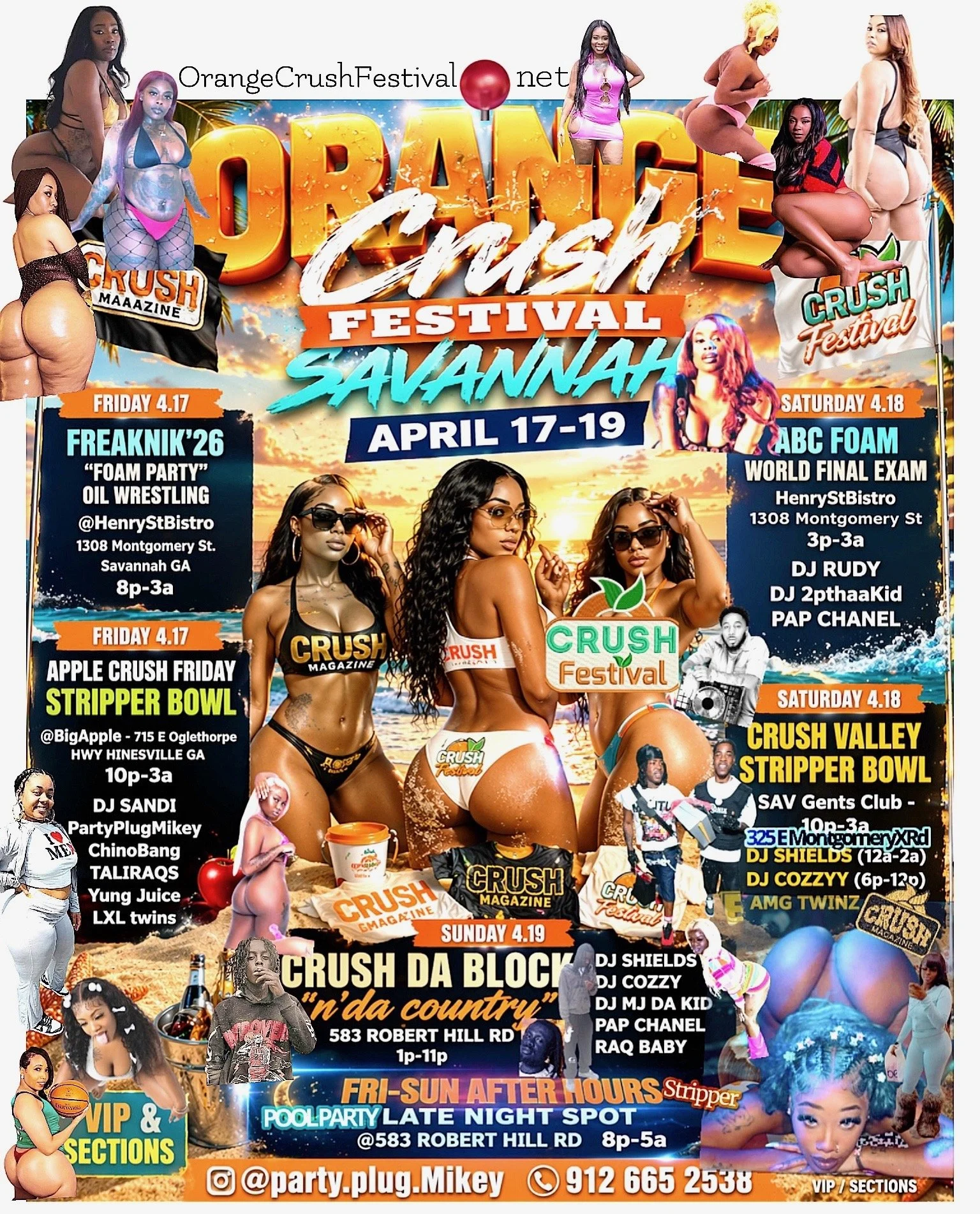
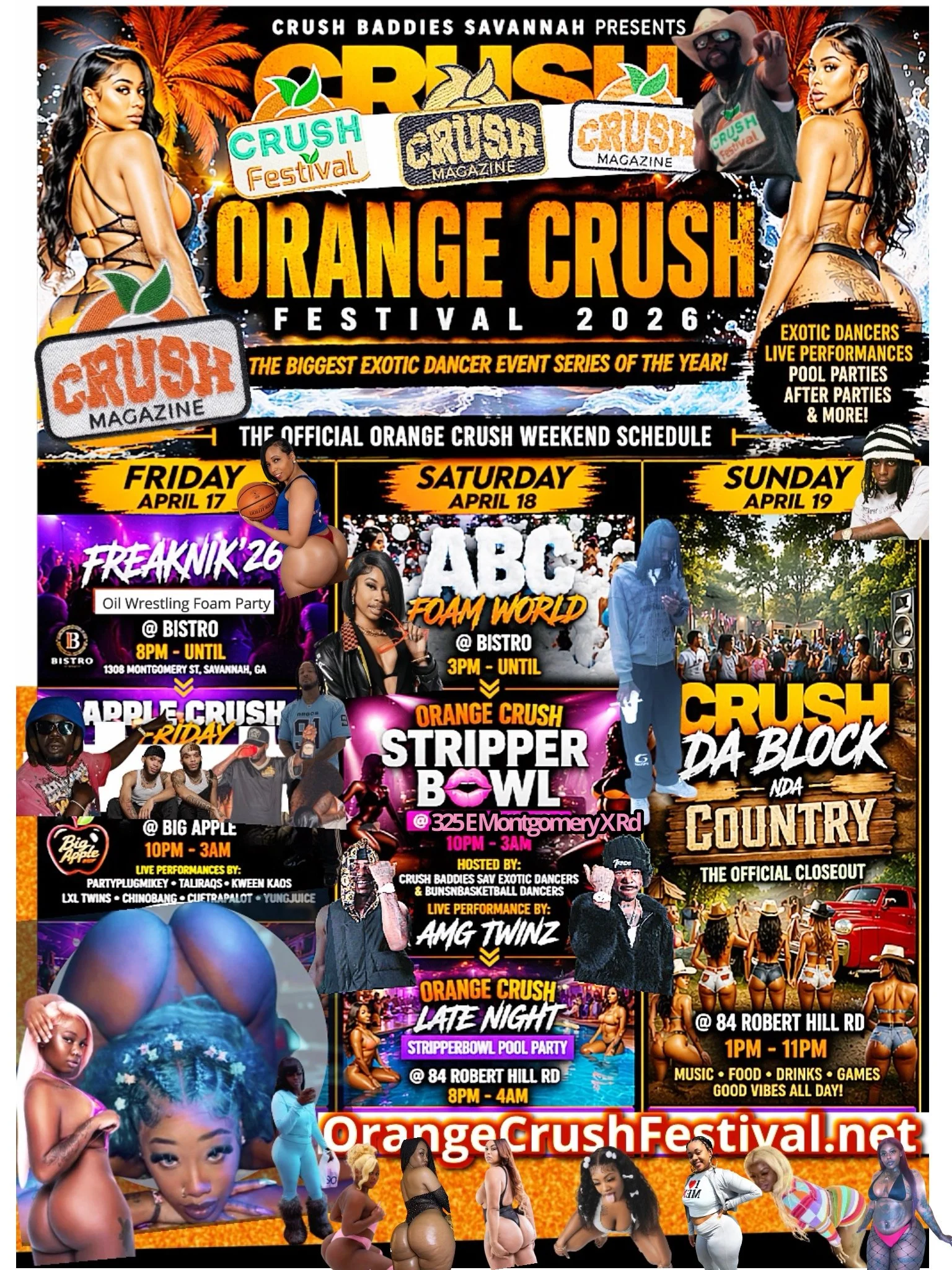
Orange Crush Festival Tour 2026 Is Bigger Than a Festival — It’s a National Movement
Orange Crush Festival Tour 2026 Is Bigger Than a Festival — It’s a National Movement
Orange Crush Festival Tour 2026 Is Bigger Than a Festival — It’s a National Movement
Orange Crush Festival has evolved into something much bigger than a single event.
It has become:
A touring festival
A cultural experience
A creator platform
A nightlife takeover
A national movement
Thousands travel city to city to be part of Orange Crush.
The All-Access Pass connects every stop.
Every experience.
Every city.
And every moment.
Orange Crush Festival Tour 2026 is already underway.
And those who secure their All-Access Pass now guarantee their place inside it.
OrangeCrushFestival.net
Eventbrite Tour Link:
https://www.eventbrite.com/o/orange-crush-festival-tour
BONUS: HIGH-POWER VIRAL SEO ARTICLE TITLE IDEAS (USE THESE FOR BLOG POSTS)
These titles bring massive Google traffic:
Orange Crush Festival Tour 2026 Tickets: All-Access Pass Guide
Why Orange Crush Festival Is the Most Talked-About Tour of 2026
Orange Crush Miami Spring Break 2026: Mansion Party and Yacht Experience Guide
Orange Crush Atlanta Mansion Week 2026: Everything You Need to Know
How to Get Orange Crush Festival All-Access Pass Before It Sells Out
Orange Crush Festival Tour Cities, Dates, and All-Access Information
ORANGE CRUSH FESTIVAL TOUR 2026 IS OFFICIALLY HIRING: How Models, Promoters, and Influencers Are Getting Paid and Joining the Biggest Festival Tour in America Published by CRUSH Magazine | Official
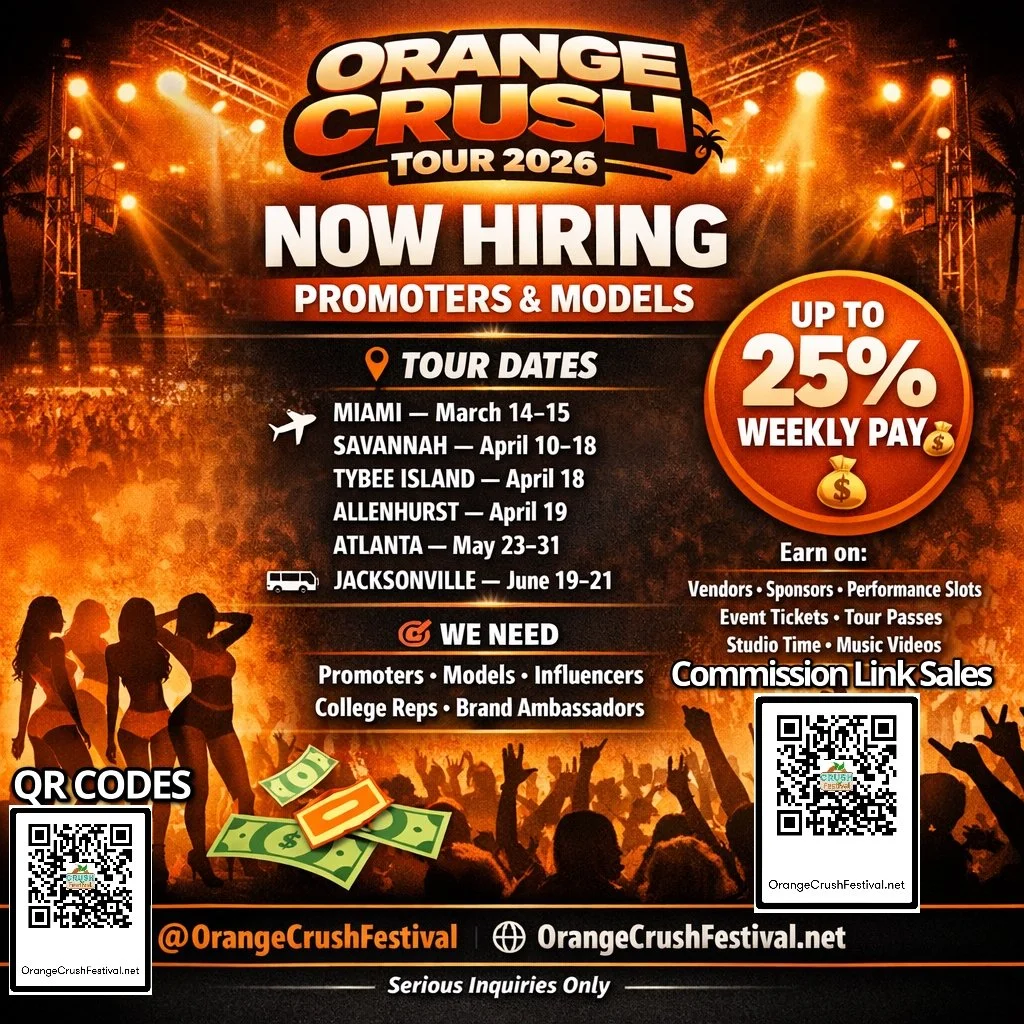
ORANGE CRUSH FESTIVAL TOUR 2026 IS OFFICIALLY HIRING: How Models, Promoters, and Influencers Are Getting Paid and Joining the Biggest Festival Tour in America
ORANGE CRUSH FESTIVAL TOUR 2026 IS OFFICIALLY HIRING: How Models, Promoters, and Influencers Are Getting Paid and Joining the Biggest Festival Tour in America
Published by CRUSH Magazine | Official Orange Crush Festival Media
The Orange Crush Festival Tour 2026 is not just one of the most anticipated party tours in the country.
It is now officially creating paid opportunities for promoters, models, influencers, and brand ambassadors across multiple states.
With confirmed tour stops in Miami, Savannah, Tybee Island, Allenhurst, Atlanta, and Jacksonville, Orange Crush Festival is expanding its team as demand for the tour continues to surge.
This expansion includes paid commission opportunities, content creation roles, promotional positions, and official Orange Crush Baddies model internships.
And thousands are already applying.
What Is the Orange Crush Festival Tour?
The Orange Crush Festival Tour is a multi-city event series combining beach festivals, mansion pool parties, nightlife events, and exclusive VIP experiences.
The 2026 tour includes official stops in:
Miami, Florida — March 14–15
Savannah, Georgia — April 10–18
Tybee Island, Georgia — April 18
Allenhurst, Georgia — April 19
Atlanta, Georgia — May 23–31
Jacksonville, Florida — June 19–21
Each city hosts official Orange Crush Festival events attended by thousands of guests.
This makes Orange Crush one of the fastest-growing independent festival tours in the United States.
Orange Crush Baddies: The Official Model Internship Program
One of the most talked-about opportunities connected to the tour is the Orange Crush Baddies program.
This internship gives selected models and creators the opportunity to:
Attend official Orange Crush events
Create content for CRUSH Magazine
Build their personal brand
Network with artists, photographers, and influencers
Become official representatives of the Orange Crush Festival brand
The Orange Crush Baddies program has already attracted attention nationwide, with applications coming in daily.
Promoters and Influencers Are Earning Weekly Commission
Orange Crush Festival is also actively hiring promoters, influencers, and college representatives.
Selected promoters receive:
Commission on ticket sales
Commission on All-Access Pass sales
Commission on vendor and sponsor referrals
Commission on performance slot referrals
Some promoters earn up to 25 percent commission weekly depending on their performance.
This makes Orange Crush one of the most lucrative festival promotion opportunities available.
Why So Many People Are Joining the Orange Crush Tour Team
The reason is simple.
Orange Crush is not just an event.
It is a platform.
Models gain exposure.
Promoters earn income.
Influencers grow their audience.
Creators build their brand.
And everyone becomes part of a national tour.
The Orange Crush All-Access Pass Is Driving Demand
The Orange Crush All-Access Pass allows attendees to experience multiple cities and multiple events under one pass.
This has increased demand across the entire tour.
As more attendees purchase passes, the need for promoters, models, and brand ambassadors continues to grow.
This expansion is why Orange Crush Festival is actively recruiting nationwide.
How to Apply and Join Orange Crush Festival Tour 2026
Applications for promoters, models, and Orange Crush Baddies are now open.
Interested applicants can apply, register, or purchase All-Access Passes directly through the official website.
Visit:
OrangeCrushFestival.net
Applicants can also scan the official QR code to access registration directly.
Due to high demand, early applications are strongly recommended.
Orange Crush Festival Tour 2026 Is Becoming a National Movement
Orange Crush Festival has evolved from a single event into a national touring platform.
It brings together:
Music
Fashion
Content creation
Nightlife
Festival culture
Brand partnerships
Creator opportunities
And paid promotional roles
The 2026 tour is expected to reach its largest audience ever.
Final Word From CRUSH Magazine
The Orange Crush Festival Tour is no longer just something people attend.
It is something people join.
Whether attending as a guest, promoting as a brand ambassador, or modeling as an Orange Crush Baddie, the opportunities connected to Orange Crush Festival continue to expand.
As the 2026 tour approaches, thousands are securing their place.
Some as attendees.
Some as promoters.
Some as models.
And some as part of the team behind one of the fastest-growing festival tours in the country.
Official registration, applications, and All-Access Passes are available now.
OrangeCrushFestival.net
REQUIRED SEO SETTINGS (ADD TO WEBSITE PAGE SETTINGS)
SEO Title:
Orange Crush Festival Tour 2026 Hiring Promoters Models Influencers | Apply Now
SEO Description:
Orange Crush Festival Tour 2026 is hiring promoters, models, influencers, and brand ambassadors. Apply now, earn commission, and join the official Orange Crush Festival Tour.
SEO Keywords:
Orange Crush Festival 2026
Orange Crush Tour 2026
Orange Crush Baddies
Orange Crush Models
Orange Crush Promoters
Orange Crush Festival jobs
Orange Crush All Access Pass
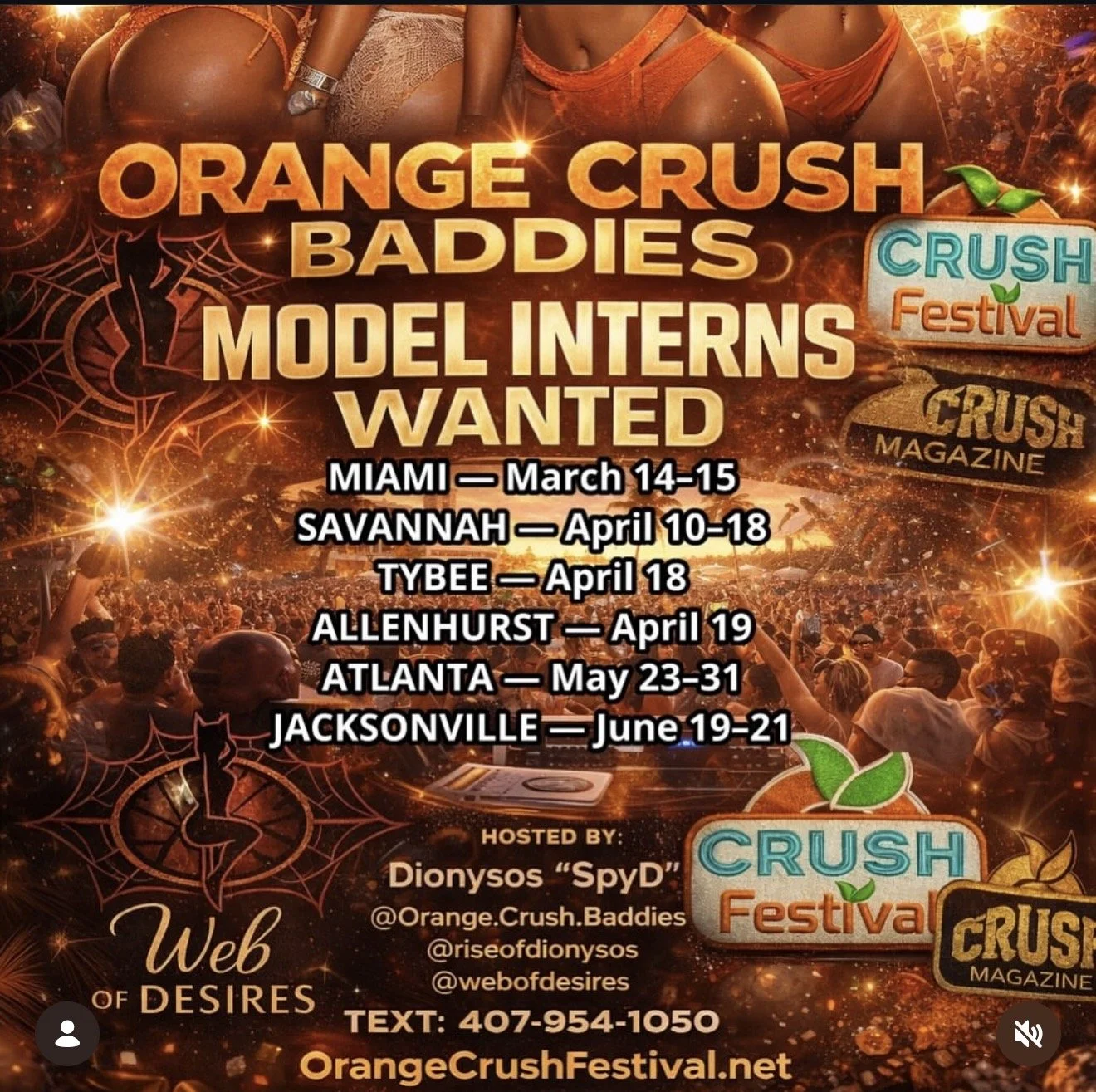
ORANGE CRUSH FESTIVAL TOUR 2026 IS OFFICIALLY HIRING: How Models, Promoters, and Influencers Are Getting Paid and Joining the Biggest Festival Tour in America
ORANGE CRUSH FESTIVAL TOUR 2026: The National Party Experience Everyone Is Trying to Get Into
ORANGE CRUSH FESTIVAL TOUR 2026 IS OFFICIALLY HIRING: How Models, Promoters, and Influencers Are Getting Paid and Joining the Biggest Festival Tour in America
Published by CRUSH Magazine | Official Orange Crush Festival Media
The Orange Crush Festival Tour 2026 is not just one of the most anticipated party tours in the country.
It is now officially creating paid opportunities for promoters, models, influencers, and brand ambassadors across multiple states.
With confirmed tour stops in Miami, Savannah, Tybee Island, Allenhurst, Atlanta, and Jacksonville, Orange Crush Festival is expanding its team as demand for the tour continues to surge.
This expansion includes paid commission opportunities, content creation roles, promotional positions, and official Orange Crush Baddies model internships.
And thousands are already applying.
What Is the Orange Crush Festival Tour?
The Orange Crush Festival Tour is a multi-city event series combining beach festivals, mansion pool parties, nightlife events, and exclusive VIP experiences.
The 2026 tour includes official stops in:
Miami, Florida — March 14–15
Savannah, Georgia — April 10–18
Tybee Island, Georgia — April 18
Allenhurst, Georgia — April 19
Atlanta, Georgia — May 23–31
Jacksonville, Florida — June 19–21
Each city hosts official Orange Crush Festival events attended by thousands of guests.
This makes Orange Crush one of the fastest-growing independent festival tours in the United States.
Orange Crush Baddies: The Official Model Internship Program
One of the most talked-about opportunities connected to the tour is the Orange Crush Baddies program.
This internship gives selected models and creators the opportunity to:
Attend official Orange Crush events
Create content for CRUSH Magazine
Build their personal brand
Network with artists, photographers, and influencers
Become official representatives of the Orange Crush Festival brand
The Orange Crush Baddies program has already attracted attention nationwide, with applications coming in daily.
Promoters and Influencers Are Earning Weekly Commission
Orange Crush Festival is also actively hiring promoters, influencers, and college representatives.
Selected promoters receive:
Commission on ticket sales
Commission on All-Access Pass sales
Commission on vendor and sponsor referrals
Commission on performance slot referrals
Some promoters earn up to 25 percent commission weekly depending on their performance.
This makes Orange Crush one of the most lucrative festival promotion opportunities available.
Why So Many People Are Joining the Orange Crush Tour Team
The reason is simple.
Orange Crush is not just an event.
It is a platform.
Models gain exposure.
Promoters earn income.
Influencers grow their audience.
Creators build their brand.
And everyone becomes part of a national tour.
The Orange Crush All-Access Pass Is Driving Demand
The Orange Crush All-Access Pass allows attendees to experience multiple cities and multiple events under one pass.
This has increased demand across the entire tour.
As more attendees purchase passes, the need for promoters, models, and brand ambassadors continues to grow.
This expansion is why Orange Crush Festival is actively recruiting nationwide.
How to Apply and Join Orange Crush Festival Tour 2026
Applications for promoters, models, and Orange Crush Baddies are now open.
Interested applicants can apply, register, or purchase All-Access Passes directly through the official website.
Visit:
OrangeCrushFestival.net
Applicants can also scan the official QR code to access registration directly.
Due to high demand, early applications are strongly recommended.
Orange Crush Festival Tour 2026 Is Becoming a National Movement
Orange Crush Festival has evolved from a single event into a national touring platform.
It brings together:
Music
Fashion
Content creation
Nightlife
Festival culture
Brand partnerships
Creator opportunities
And paid promotional roles
The 2026 tour is expected to reach its largest audience ever.
Final Word From CRUSH Magazine
The Orange Crush Festival Tour is no longer just something people attend.
It is something people join.
Whether attending as a guest, promoting as a brand ambassador, or modeling as an Orange Crush Baddie, the opportunities connected to Orange Crush Festival continue to expand.
As the 2026 tour approaches, thousands are securing their place.
Some as attendees.
Some as promoters.
Some as models.
And some as part of the team behind one of the fastest-growing festival tours in the country.
Official registration, applications, and All-Access Passes are available now.
OrangeCrushFestival.net
REQUIRED SEO SETTINGS (ADD TO WEBSITE PAGE SETTINGS)
SEO Title:
Orange Crush Festival Tour 2026 Hiring Promoters Models Influencers | Apply Now
SEO Description:
Orange Crush Festival Tour 2026 is hiring promoters, models, influencers, and brand ambassadors. Apply now, earn commission, and join the official Orange Crush Festival Tour.
SEO Keywords:
Orange Crush Festival 2026
Orange Crush Tour 2026
Orange Crush Baddies
Orange Crush Models
Orange Crush Promoters
Orange Crush Festival jobs
Orange Crush All Access Pass
WHAT IS THE ORANGE CRUSH FESTIVAL TOUR? The Orange Crush Festival Tour connects multiple cities into one continuous lifestyle festival circuit blending:
WHAT IS THE ORANGE CRUSH FESTIVAL TOUR?
The Orange Crush Festival Tour connects multiple cities into one continuous lifestyle festival circuit blending:
WHAT IS THE ORANGE CRUSH FESTIVAL TOUR?
The Orange Crush Festival Tour connects multiple cities into one continuous lifestyle festival circuit blending:
• Beach bashes
• Mansion pool parties
• Yacht events
• Nightclub takeovers
• Car & bike shows
• Trail rides
• College/HBCU nights
• Influencer activations
• Crush Magazine releases
• Merch & sponsor villages
Cities include:
• Miami
• Savannah
• Atlanta
Each stop is personally hosted by @Party.Plug.Mikey.
🌴 MIAMI SPRING BREAK KICKOFF
South Beach –
Founder Presence:
George “Mikey” Turner hosts opening weekend, mansion nightlife, and yacht events.
📅 Schedule
March 14
FREE Public Beach Bash (Daytime)
Late Night Mansion Pool Party (11PM–4AM)
March 15
VIP Yacht Party (9PM–Midnight)
Experience
• Spring Break crowds
• Beach DJs
• Luxury mansion nightlife
• Yacht cruise
• Founder meet & greet
• Influencers + Crush Baddies
SEO
Miami Spring Break party, South Beach events, Miami mansion pool party, yacht party Miami
🍊 SAVANNAH NIGHTLIFE WEEK
Venue:
Founder Presence:
Nightly hosting + community engagement
📅 Schedule (9PM–3AM)
April 10 – College Party
April 11 – DNN
April 16 – CrushTheMic
April 17 – Freaknik ’26
April 18 – ABC Finale
Experience
• Club takeovers
• HBCU crowds
• DJs + hosts
• Merch & magazine drops
• Mikey on-site each night
SEO
Savannah nightlife events, college parties Savannah, HBCU events Georgia
🏖️ TYBEE ISLAND BEACH FESTIVAL
Founder Presence:
Daytime beach hosting + public festival leadership
📅 Schedule
April 18
FREE Public Permitted Beach Bash
Experience
• DJs on the sand
• Vendors
• Community festival vibes
• Family-friendly
• Official Orange Crush beach takeover
SEO
Tybee Island beach bash, Georgia beach festival, Orange Crush Tybee
🚗 CRUSH DA BLOCK 912
258 Linda Loop SE
Founder Presence:
On-site day & night hosting
📅 Schedule – April 19
1PM–10PM
Car & Bike Show
Pool Party
ATV/Buggy Trail Ride
Basketball Game
10PM–4AM
After Dark Party
Experience
• Street festival culture
• Vehicles + music
• Backyard pool vibes
• Community block party feel
SEO
Allenhurst car show, Georgia block party festival, pool party Georgia
🔥 ATLANTA MANSION WEEK
Founder Presence:
Full week headliner host
📅 Highlights
May 23 – Black Hollywood ATL
May 24 – WhiteHouseAtlanta Mansion Pool Party
May 24 – Checkmate Afterparty
May 28 – CrushTheMic ATL
May 29 – Trail Ride
May 30 – Horse Derby + Car/Bike Show + Mansion Pool Party
May 31 – Yacht Party
Experience
• Luxury estates
• Nightlife
• Cars & bikes
• Trail rides
• Yacht
• Celebrity-style hosting by Mikey
SEO
Atlanta mansion pool party, Atlanta nightlife events, car show Atlanta, yacht party Atlanta
🌊 JACKSONVILLE JUNETEENTH FINALE
Founder Presence:
Magazine release + beach bash hosting
📅 Schedule
June 19 – Magazine Release @ Live Bar
June 20 – FREE Public Beach Bash
June 20 – Afterparty @ Medusa
Experience
• Culture + celebration
• Magazine drop
• Summer kickoff energy
SEO
Jacksonville Juneteenth events, beach party Jacksonville, Florida festival
🎤 WHY THIS TOUR IS DIFFERENT
Unlike generic promoters, Orange Crush is:
✔ Founder-owned
✔ Trademark-protected
✔ Veteran-operated
✔ Personality-driven
✔ Community-first
When you attend Orange Crush, you’re not just attending an event —
you’re attending something built and led by its founder.
🎟️ GET YOUR TOUR PASS
One Ticket. Every City. Hosted by @Party.Plug.Mikey
Secure access now:
https://www.eventbrite.com/e/orangecrushtour-tickets-1981520474079?aff=PLUGNOTARAPPER
ORANGE CRUSH FESTIVAL TOUR 2026 Official Multi-City Festival Experience Led by Founder George “Mikey” Ransom Turner III @Party.Plug.Mikey
ORANGE CRUSH FESTIVAL TOUR 2026
Official Multi-City Festival Experience Led by Founder George “Mikey” Ransom Turner III @Party.Plug.Mikey
ORANGE CRUSH FESTIVAL TOUR 2026
Official Multi-City Festival Experience Led by Founder George “Mikey” Ransom Turner III
🎟️ Official Tickets (All Cities Pass + Individual Events):
https://www.eventbrite.com/e/orangecrushtour-tickets-1981520474079?aff=PLUGNOTARAPPER
The Orange Crush Festival Tour 2026 is the nation’s fastest-growing independent beach, nightlife, and lifestyle festival series — founded, owned, and operated by
George “Mikey” Ransom Turner III
aka @Party.Plug.Mikey
Recognized as:
• Founder of Orange Crush Festival®
• Trademark owner of the Orange Crush brand
• Veteran-owned business leader
• Celebrity host & tour personality
• Cultural curator & event producer
George “Mikey” Turner built Orange Crush from a single beach gathering into a multi-state touring festival platform, combining music, community, nightlife, entrepreneurship, and youth culture into one unified experience.
Every city stop is:
✔ Personally hosted
✔ Personally programmed
✔ Brand-directed
✔ Community-focused
This is not a third-party or franchise event.
This is the official Orange Crush experience — led by its founder.
WHO IS GEORGE “MIKEY” TURNER?
George “Mikey” Turner is more than a promoter — he is the face, voice, and architect of the Orange Crush movement.
As a 100% disabled veteran entrepreneur and founder-operator, Mikey personally oversees:
• Tour strategy
• City partnerships
• Talent booking
• Sponsorships
• Community relations
• Brand licensing
• Media & magazine integration
• On-site hosting + celebrity appearances
At every stop, fans can expect:
• Live hosting
• Meet & greets
• Stage appearances
• Crowd engagement
• Brand storytelling
• Direct founder presence
Orange Crush isn’t just an event brand — it’s a personality-driven festival led by Mikey himself.
🍊 WHAT IS THE ORANGE CRUSH FESTIVAL TOUR?
The Orange Crush Festival Tour connects multiple cities into one continuous lifestyle festival circuit blending:
• Beach bashes
• Mansion pool parties
• Yacht events
• Nightclub takeovers
• Car & bike shows
• Trail rides
• College/HBCU nights
• Influencer activations
• Crush Magazine releases
• Merch & sponsor villages
Cities include:
• Miami
• Savannah
• Atlanta
Each stop is personally hosted by @Party.Plug.Mikey.
🌴 MIAMI SPRING BREAK KICKOFF
South Beach –
Founder Presence:
George “Mikey” Turner hosts opening weekend, mansion nightlife, and yacht events.
📅 Schedule
March 14
FREE Public Beach Bash (Daytime)
Late Night Mansion Pool Party (11PM–4AM)
March 15
VIP Yacht Party (9PM–Midnight)
Experience
• Spring Break crowds
• Beach DJs
• Luxury mansion nightlife
• Yacht cruise
• Founder meet & greet
• Influencers + Crush Baddies
SEO
Miami Spring Break party, South Beach events, Miami mansion pool party, yacht party Miami
🍊 SAVANNAH NIGHTLIFE WEEK
Venue:
Founder Presence:
Nightly hosting + community engagement
📅 Schedule (9PM–3AM)
April 10 – College Party
April 11 – DNN
April 16 – CrushTheMic
April 17 – Freaknik ’26
April 18 – ABC Finale
Experience
• Club takeovers
• HBCU crowds
• DJs + hosts
• Merch & magazine drops
• Mikey on-site each night
SEO
Savannah nightlife events, college parties Savannah, HBCU events Georgia
🏖️ TYBEE ISLAND BEACH FESTIVAL
Founder Presence:
Daytime beach hosting + public festival leadership
📅 Schedule
April 18
FREE Public Permitted Beach Bash
Experience
• DJs on the sand
• Vendors
• Community festival vibes
• Family-friendly
• Official Orange Crush beach takeover
SEO
Tybee Island beach bash, Georgia beach festival, Orange Crush Tybee
🚗 CRUSH DA BLOCK 912
258 Linda Loop SE
Founder Presence:
On-site day & night hosting
📅 Schedule – April 19
1PM–10PM
Car & Bike Show
Pool Party
ATV/Buggy Trail Ride
Basketball Game
10PM–4AM
After Dark Party
Experience
• Street festival culture
• Vehicles + music
• Backyard pool vibes
• Community block party feel
SEO
Allenhurst car show, Georgia block party festival, pool party Georgia
🔥 ATLANTA MANSION WEEK
Founder Presence:
Full week headliner host
📅 Highlights
May 23 – Black Hollywood ATL
May 24 – WhiteHouseAtlanta Mansion Pool Party
May 24 – Checkmate Afterparty
May 28 – CrushTheMic ATL
May 29 – Trail Ride
May 30 – Horse Derby + Car/Bike Show + Mansion Pool Party
May 31 – Yacht Party
Experience
• Luxury estates
• Nightlife
• Cars & bikes
• Trail rides
• Yacht
• Celebrity-style hosting by Mikey
SEO
Atlanta mansion pool party, Atlanta nightlife events, car show Atlanta, yacht party Atlanta
🌊 JACKSONVILLE JUNETEENTH FINALE
Founder Presence:
Magazine release + beach bash hosting
📅 Schedule
June 19 – Magazine Release @ Live Bar
June 20 – FREE Public Beach Bash
June 20 – Afterparty @ Medusa
Experience
• Culture + celebration
• Magazine drop
• Summer kickoff energy
SEO
Jacksonville Juneteenth events, beach party Jacksonville, Florida festival
🎤 WHY THIS TOUR IS DIFFERENT
Unlike generic promoters, Orange Crush is:
✔ Founder-owned
✔ Trademark-protected
✔ Veteran-operated
✔ Personality-driven
✔ Community-first
When you attend Orange Crush, you’re not just attending an event —
you’re attending something built and led by its founder.
🎟️ GET YOUR TOUR PASS
One Ticket. Every City. Hosted by @Party.Plug.Mikey
Secure access now:
https://www.eventbrite.com/e/orangecrushtour-tickets-1981520474079?aff=PLUGNOTARAPPER
ORANGE CRUSH FESTIVAL® TOUR 2026
ORANGE CRUSH FESTIVAL® TOUR 2026
“Crushing Barriers. Building Culture. Powering Community.”
Founder & Trademark Owner: George Turner
Official Website: OrangeCrushFestival.net
Tickets: https://www.eventbrite.com/e/orangecrushtour-tickets-1981520474079?aff=PLUGNOTARAPPER
Official Statement
Orange Crush Festival®, the nationally recognized, veteran-owned cultural entertainment brand and registered trademark, proudly announces the 2026 Orange Crush Festival Tour, a multi-city lifestyle, music, and community impact experience spanning beaches, nightlife, college markets, and destination venues across the Southeast.
The Orange Crush Festival name, brand, and commercial use rights are privately owned intellectual property.
Select dates throughout the tour include:
• permitted venue events
• nightlife activations
• mansion experiences
• community showcases
• and free public beach days
Public beach days are not substitute festivals or renamed events, but rather open public gatherings consistent with local beach access, with optional small-scale artist or showcase programming operating independently under separate naming where applicable.
Orange Crush remains committed to:
• public safety
• city partnerships
• economic impact
• youth opportunity
• veteran leadership
• lawful trademark protection
TOUR SCHEDULE & CITY LINEUPS
☀️
— SPRING BREAK
SOUTH BEACH TAKEOVER
March 14
FREE PUBLIC BEACH BASH
Mansion Party 11PM–4AM
March 15
Yacht Party 9PM–12AM
Socials
@Miami_SpringBreak
@Miami.PoolParties
@Miami.MansionParties
@OrangeCrush.Official
@OrangeCrush_Magazine
@Crush.Baddies
@OrangeCrushBaddies
🎟️ Tickets: Eventbrite Tour Pass
🎶
— COLLEGE WEEK
Venue
Henry St Bistro
1308 Montgomery St
April 10 – Big A** College Party
April 11 – DNN Damn Near Naked
April 16 – CrushTheMic
April 17 – Freaknik’26
April 18 – ABC’26
Socials
@OrangeCrushSavannah
@OrangeCrush.Festival
@OrangeCrush.Official
@OrangeCrush_Magazine
@Crush.Baddies
@OrangeCrushBaddies
🎟️ Tickets: Eventbrite Tour Pass
April 18
FREE PUBLIC • PERMITTED • BEACH BASH
This date is:
• a public beach day
• not a renamed substitute festival
• operated in accordance with local permitting
Optional small-scale artist showcases may operate separately under independent naming.
Socials
@Orange.Crush.Tybee.Island
@OrangeCrush.Festival
@OrangeCrush.Official
@OrangeCrush_Magazine
@Crush.Baddies
@OrangeCrushBaddies
🎟️ Tickets: Eventbrite Tour Pass
🚗
— CRUSH DA BLOCK
April 19 | 1PM–10PM
Car & Bike Show
Block Party
Pool Party
ATV & Buggy Trail Ride
Buns & Basketball Game
After Dark Party 10PM–4AM
Socials
@CrushDaBlock912
@Crush.TheBlock
@OrangeCrush.Official
@OrangeCrush_Magazine
@Crush.Baddies
🎟️ Tickets: Eventbrite Tour Pass
🌆
— CRUSH’LANTA WEEKEND
May 23–31
May 23 – Black Hollywood ATL
May 24 – WhiteHouseAtlanta Mansion Pool Party
Afterparty – Checkmate
Magic City Monday
May 28 – CrushTheMic ATL
Bootz N Bathing Suits Weekend
May 29 – TrailRide Edition
May 30 – Horse Track Mansion Pool Party
Afterparty – Black Hollywood
May 31 – Yacht Party
Socials
@OrangeCrush.Festival
@OrangeCrush.Official
@OrangeCrush.Magazine
@ATL.MansionParties
@Crush.Baddies
🎟️ Tickets: Eventbrite Tour Pass
🎉
— JUNETEENTH
June 19 – Magazine Release @ Live Bar
June 20 – FREE PUBLIC BEACH BASH
June 20 – Afterparty @ Medusa
Socials
@OrangeCrush.Magazine
@OrangeCrush.Official
@OrangeCrush.Festival
@Crush.Baddies
🎟️ Tickets: Eventbrite Tour Pass
About Orange Crush Festival®
Orange Crush Festival® is a federally incorporated, veteran-owned cultural event and media platform delivering:
• live events
• artist showcases
• music & DJs
• education & tech initiatives
• media & magazine publishing
• community development
The brand operates nationally through festivals, tours, and licensed experiences while protecting its trademark and intellectual property rights.
Media Contact
Orange Crush Festival Management
OrangeCrushFestival.net
Press • Partnerships • Sponsors • Cities
Official Trademark & Event Clarification Statement
Official Trademark & Event Clarification Statement
Orange Crush Festival – Tybee Island 2026
Issued by: Orange Crush Festival Ownership & Management
Founder & Trademark Owner: George Turner
Regarding the upcoming 2026 Tybee beachfront gathering:
The planned date in question is a public beach day open to the general public, consistent with Tybee Island’s long history of open coastal access.
However, it is important to clarify the following:
Trademark Ownership
“Orange Crush Festival®” is a privately owned and legally protected trademark.
The name, brand identity, goodwill, and commercial use rights belong exclusively to the official festival organization and its founder.
No outside party, promoter, or entity is authorized to:
Rename the event
Rebrand the event
Use the Orange Crush name commercially
Imply ownership or affiliation
Operate competing or substitute events under confusingly similar branding
2026 Structure & Compliance
For clarity and cooperation with local officials:
The day itself remains a public beach gathering
There is no citywide or renamed festival substitute
No competing branded event is being created
No attempt is being made to avoid or circumvent trademark protections
Artist Showcase Component
A small, single-day artist showcase stage may operate separately and independently under the working title:
CRUSH Reloaded™
This:
Is not a replacement festival
Is not a rebrand of Orange Crush Festival
Is not using Orange Crush Festival naming rights
Functions only as a limited, single-stage performance activation
CRUSH Reloaded is:
An artist showcase
A music platform
A separate department/program
Operating under distinct naming
It does not claim festival status or ownership of the Orange Crush Festival brand.
Position on Disputes
While any trademark matters are being resolved through appropriate legal and administrative channels, we remain committed to:
Respecting Tybee Island’s public beach access
Protecting our intellectual property rights
Operating transparently
Avoiding consumer confusion
Working cooperatively with local government and public safety officials
Our Goal
Our focus remains:
Safe operations
Positive tourism impact
Community partnership
Veteran-owned leadership
Cultural celebration
Lawful trademark protection
We believe collaboration — not confusion — best serves the public, the city, and the culture Orange Crush represents.
Contact:
Orange Crush Festival Management
OrangeCrushFestival.net