
CRUSH MAGAZINE SPORTS SPECIAL FEATURE THE CAVALIER IMMORTALS Inside the Ultimate Hypothetical Calvary Day Men’s Basketball Hall of Fame
CRUSH MAGAZINE SPORTS SPECIAL FEATURE
THE CAVALIER IMMORTALS
Inside the Ultimate Hypothetical Calvary Day Men’s Basketball Hall of Fame
By CRUSH Magazine Sports Staff
PROLOGUE — THE GYM THAT BUILT LEGENDS
In Savannah, Georgia, basketball has always sounded different.
Not louder.
Different.
The sound inside the old Calvary Day School gym wasn’t simply crowd noise. It was metal bleachers rattling under synchronized stomps. It was sneakers violently squeaking against polished hardwood. It was students screaming themselves hoarse before halftime. It was parents standing three-deep against the walls because the seats disappeared an hour before tip-off.
And somewhere inside that noise, Calvary Day basketball quietly built one of the most culturally unforgettable small-school basketball environments in Coastal Georgia history.
Long before NIL.
Long before social-media mixtapes.
Long before every high school athlete had a videographer following them through warmups.
Calvary basketball already understood atmosphere.
The school’s athletic identity was largely built through football dynasties, baseball championships, and multi-sport excellence. But hidden within decades of GHSA and former GISA competition sits a basketball legacy loaded with explosive scorers, elite multi-sport athletes, emotionally charged rivalry games, and student-section mythology that still lives through alumni storytelling today.
The trophies matter.
The banners matter.
But the culture mattered even more.
That culture is why CRUSH Magazine created this hypothetical feature:
The Cavalier Immortals.
A fully imagined Calvary Day Men’s Basketball Hall of Fame honoring the players, coaches, student sections, moments, and teams that transformed a small Savannah private-school gym into one of the loudest basketball environments of its era.
This is not an official institutional hall of fame.
This is basketball folklore preserved like scripture.
This is oral history.
Savannah history.
Calvary history.
And for the people who lived it…
it still feels real.
🏔️ THE MOUNT RUSHMORE
These are the absolute pillars of Calvary basketball mythology — the defining faces of the program’s evolution across generations.
The culture builders.
The atmosphere creators.
The standard setters.
1. DEMETRIUS “MEECH” BROWN
The Ultimate Big-Game Commander
Every elite basketball program eventually produces one player who permanently defines winning culture.
For modern Calvary basketball, that player became Demetrius Brown.
Brown represented the complete evolution of the Cavalier guard blueprint:
poise, toughness, leadership, and total control under pressure.
He wasn’t flashy for the sake of attention.
He was surgical.
The moment games became uncomfortable…
Brown became calmer.
That psychological edge separated him from nearly everyone else in the region.
By the mid-2020s, Calvary basketball had transformed from respected private-school contender into a legitimate regional power capable of making deep GHSA playoff runs. Brown sat directly at the center of that transformation.
He defended at an elite level.
He controlled tempo.
He attacked the rim fearlessly.
And most importantly:
he delivered in moments where pressure broke everybody else.
His legacy became permanently cemented after earning recognition as the Greater Savannah Athletic Hall of Fame Boys Basketball Player of the Year — an honor reserved for athletes capable of carrying the identity of an entire city’s basketball scene.
But statistics alone don’t explain his impact.
The deeper legacy was emotional control.
When playoff crowds became chaotic…
Brown slowed the game down.
When opponents made runs…
Brown answered immediately.
When hostile road gyms erupted…
Brown silenced them.
That level of emotional command is what separates stars from program legends.
By the end of his career, Brown had become the gold standard modern Cavalier guard — the player future generations would inevitably be compared against.
2. MARLON “MJ” KNIGHT JR.
The Modern Multi-Sport Superhuman
Every era has one athlete who feels genetically different from everyone else on the floor.
For modern Calvary athletics, that athlete became Marlon “MJ” Knight Jr.
Knight represented the modern evolution of the elite prep athlete:
explosive, versatile, hyper-athletic, and capable of completely changing momentum in multiple sports simultaneously.
On the basketball floor, he operated like controlled chaos.
Transition dunks.
Explosive steals.
Weak-side blocks.
Momentum-changing fast breaks.
Every major moment seemed to involve him somehow.
But what separated Knight from ordinary stars was his complete athletic range.
The Ashley Dearing Award — Savannah’s most prestigious multi-sport athletic honor — historically recognizes athletes who dominate entire athletic ecosystems rather than one individual sport.
Knight earning the 73rd Ashley Dearing Award officially placed him inside rare Savannah athletic company.
And basketball may have been the purest showcase of his emotional intensity.
Knight played with visible force.
Every loose ball mattered.
Every rebound became physical.
Every defensive stop felt personal.
He embodied the modern version of Calvary basketball:
fast, fearless, emotional, and relentlessly competitive.
His greatest long-term impact may ultimately be symbolic.
Knight helped prove that Calvary basketball could still produce elite, city-defining athletes in the modern GHSA era — even while the national sports landscape increasingly centralized around massive metro programs and NIL branding machines.
He made local greatness matter again.
3. CODY PADGETT
The Bucket-Getting Virtuoso
Some players score.
Others feel inevitable.
Cody Padgett belonged to the second category.
During the late-2000s transitional era of Calvary basketball, Padgett evolved into one of the most dangerous pure scorers in school history.
He had touch.
Footwork.
Patience.
Balance.
And perhaps most terrifying for opponents:
he never seemed rushed.
Defenders would force difficult angles.
Padgett still scored.
Double-teams arrived.
Padgett still scored.
Tempo slowed down.
Padgett still found rhythm.
He became the centerpiece offensive weapon for one of the most historically important teams Calvary basketball ever produced: the 2008–2009 Region Championship squad.
That team permanently altered the trajectory of the program.
And Padgett’s scoring explosions became foundational mythology.
The legendary 39-point performance against Montgomery County remains one of the defining offensive showcases in school history — a game remembered by alumni as complete offensive domination.
But perhaps the defining moment of his career came during the historic region-title run.
State playoff atmosphere.
Bodies exhausted.
Everything tightening emotionally.
Padgett delivered 19 points and 15 rebounds in a brutal postseason battle, proving he wasn’t merely a finesse scorer — he was a complete competitor willing to physically impose himself when games demanded toughness.
He represented offensive elegance mixed with playoff grit.
And in Savannah basketball culture, that combination always survives through memory.
4. DOMINIC DEMASI
The Blueprint Power Forward
Every great perimeter era requires an interior enforcer.
Dominic DeMasi became that foundation.
Before leaving to pursue Division I baseball, DeMasi established himself as one of the toughest and most physically reliable basketball players Calvary had ever developed.
Back-to-back Ashley Dearing Awards in 2010 and 2011 confirmed what Savannah already understood:
DeMasi wasn’t simply talented.
He was dominant across athletic environments.
On the basketball floor, his value went far beyond scoring.
He anchored physicality.
He absorbed punishment.
He cleaned the glass.
He defended the paint.
He created emotional stability for the roster.
Perimeter scorers like George Turner, Mark Jones, and Cody Padgett could operate freely because DeMasi handled the violent interior responsibilities.
And he embraced them.
Loose rebounds became wars.
Post defense became punishment.
Transition defense became intimidation.
DeMasi mirrored the exact identity Calvary athletics always respected most:
blue-collar dominance.
He brought toughness to elegance.
Balance to chaos.
Structure to emotion.
Programs are rarely remembered only by scorers.
They are remembered by players willing to hold the foundation together.
That became Dominic DeMasi’s permanent legacy.
🏛️ THE PERIMETER SHARPSHOOTERS & FLOOR GENERALS
GEORGE “PARTY PLUG MIKEY” TURNER
The Human Heat Check
There are shooters.
Then there are atmosphere manipulators.
George Turner belonged entirely to the second category.
By the late-2000s, Turner had evolved into one of the most feared perimeter scorers in Coastal Georgia basketball. His three-point metrics placed him among the top shooters in the state while making him arguably the defining perimeter sniper of Region 3A-A during his senior campaign.
But numbers alone cannot explain the mythology.
George’s true impact was emotional.
One made three-pointer changed entire gyms.
Opponents panicked.
Student sections exploded.
Momentum shifted violently.
The deeper he shot from…
the louder the gym became.
His style completely rejected conservative basketball philosophy of the era. Coaches preached patience and shot selection.
George weaponized confidence.
Half-court range became normal.
Look-away threes became routine.
Crowd interaction became theater.
And somewhere during that chaos, the “Party Plug Mikey” identity emerged — a nickname symbolizing emotional energy, swagger, and atmosphere creation more than nightlife itself.
By the end of the era, George Turner had become something larger than a shooter.
He became folklore.
MARK JONES
The Downhill Locomotive
While George controlled atmosphere through perimeter theatrics, Mark Jones controlled games through velocity.
Everything accelerated when Jones touched the basketball.
Transition opportunities became disasters for opponents.
Deflections became fast breaks.
Fast breaks became inevitabilities.
Jones possessed elite downhill body control and rare pace manipulation that allowed him to dismantle full-court pressure without appearing rushed.
He played with calm violence.
And his chemistry alongside George Turner created one of the most emotionally explosive backcourts in modern Calvary history.
When George got hot…
Jones amplified it.
When defenses collapsed…
Jones punished rotations.
When the crowd erupted…
Jones stayed composed.
He became the stabilizer within the chaos.
A true floor general.
🏈 THE GRIDIRON CROSSOVERS
The Multi-Sport Enforcers
At Calvary Day School, basketball was never isolated from football culture.
The hardwood often became an extension of Friday-night toughness.
JAKE MERKLINGER
Before becoming a Tennessee Volunteers quarterback, Merklinger brought elite size, toughness, and rebounding instincts onto the basketball court.
His ability to physically overpower defenders while still moving fluidly made him uniquely difficult to guard at the high-school level.
He represented the modern evolution of the Calvary crossover athlete:
quarterback intelligence mixed with forward physicality.
DEMARCUS DOBBS
Long before NFL dreams materialized, Dobbs established himself as one of the foundational physical forces in Calvary basketball culture.
Everything about his game reflected intimidation:
rim protection,
physical rebounding,
defensive control.
He helped establish the long-standing identity that Calvary athletes were never soft — regardless of sport.
BARRY KLEINPETER & LEE LANE
The legacy builders.
Before modern regional success.
Before packed playoff atmospheres.
There were players laying the cultural foundation.
Kleinpeter and Lane helped establish the expectation of physical, disciplined basketball inside the program during earlier eras when Calvary was still shaping its athletic identity.
Every future generation benefited from that groundwork.
📋 THE COACHING WING
JASON SHELL
The Architect
Programs require builders before they can become powers.
Jason Shell became that builder.
Over a 13-year tenure, Shell stabilized, modernized, and elevated Calvary basketball into consistent regional relevance.
More importantly:
he created identity.
Shell coached with emotional intensity while empowering player personality — a balance that allowed stars like George Turner, Cody Padgett, and Mark Jones to flourish creatively without sacrificing structure.
Multiple 20-win seasons followed.
Region championships followed.
Packed gyms followed.
But perhaps his greatest achievement was cultural:
he made Calvary basketball matter emotionally to Savannah students.
That changes everything.
BOB MARTIN
The Tactical Modernizer
If Shell built the infrastructure…
Bob Martin weaponized it.
Martin’s arrival immediately transformed Calvary into a high-level modern GHSA force capable of making legitimate deep playoff runs.
Defensive discipline sharpened.
Half-court execution improved.
Regional expectations escalated.
Under Martin, Calvary captured major regional success while pushing into historic Elite Eight territory against larger modern competition.
His tactical brilliance represented the next evolutionary step of the program.
🏆 THE HISTORIC TEAMS
🥇 1987–1988 VARSITY TEAM
The Original Kings
The only complete postseason sweep in school history.
State champions.
Region champions.
This team permanently cemented Calvary basketball inside Georgia private-school history.
Led by coach Mark Farist and dominant big man Troy Donahue, the squad rebounded from previous heartbreak to deliver the greatest pure championship season the program ever produced.
Every future era chased their standard.
🥈 2025–2026 VARSITY TEAM
The Modern Resurrection
This squad represented the modern explosion of Calvary basketball relevance.
A brutal defensive second-half lockdown against Long County delivered the region title and propelled the program into its deepest GHSA Elite Eight run of the modern era.
The team combined old-school toughness with modern athleticism.
Demetrius Brown.
MJ Knight.
Complete emotional buy-in.
This wasn’t simply a winning team.
It was proof that Calvary basketball could still matter on the biggest modern stages.
🥉 2008–2009 VARSITY TEAM
The Cultural Explosion
This team changed everything emotionally.
The region title mattered.
But the atmosphere mattered more.
Packed gyms.
Floor storms.
Student-section mythology.
Road-game invasions.
This became the foundational “Party Plug” era team that transformed Calvary basketball from respected sports program into full-blown Savannah basketball folklore.
🎖️ 2009–2010 VARSITY TEAM
The Near-Miss Dynasty
No championship banner.
No trophy.
Yet somehow one of the most remembered teams in school history.
Why?
Because mythology does not always require hardware.
This senior-led group carried momentum, swagger, and emotional dominance into another region-title appearance before falling one point short of back-to-back crowns.
Sometimes heartbreak strengthens legacy.
And this team became immortal through atmosphere rather than trophies.
FINAL CRUSH MAGAZINE CLOSE
Every city has athletes.
Every school has banners.
But only a few programs create mythology.
Calvary Day basketball became bigger than wins and losses because it captured something impossible to manufacture:
real emotional energy.
The packed gyms.
The confetti storms.
The parking-lot celebrations.
The screaming student sections.
The impossible threes.
Those memories survived because people carried them forward manually through storytelling.
No algorithms.
No branding consultants.
No NIL infrastructure.
Just basketball powerful enough to become local folklore.
And somewhere inside Savannah history…
the bleachers still shake.
The Genesis of the Bravado: From the Hardwood to the Mainstage Party Plug George Mikey
🏟️ The Genesis of the Bravado: From the Hardwood to the Mainstage
The signature swagger that defines George Ransom Turner III’s current entertainment empire wasn’t manufactured in a boardroom; it was forged between 2006 and 2010 on the varsity basketball court of Calvary Day School.
[ High-Stakes Region 3-AAA Games ] ──> [ The "Two-Way" Swagger ] ──> [ Modern Executive Confidence ]
     * Pure Shooting Guard                   * Score a Clutch Triple              * Navigate Denied Permits
     * Rank 12th in Georgia (3PT)            * Mix Hip-Hop At the Scorer's Table * Dominate the Narrative
During his high school career, Turner operated with a level of dual-threat confidence rarely seen in high school sports. As a lethal shooting guard ranking 12th in the state of Georgia for three-pointers made, he didn't just play the game—he controlled its entire atmosphere.
The Ultimate Psychology: Turner understood crowd psychology before he ever threw a commercial party. He would demoralize opposing teams by sinking a deep three-pointer, checking out of the game, and immediately walking over to the gym's master sound mixer.
Fueling the Crazies: Standing at the audio table in his warm-up gear, he would transition the gym directly into a high-energy hip-hop track, sending the Calvary Crazies student section into absolute chaos.
The Blueprint for Dominance: This specific high school era birthed his signature executive bravado. It taught him how to occupy two spaces at once: the focused, data-driven performer on the court, and the puppet master controlling the room's energy from behind the decks.
🎵 Building the Sonic Empire: The Tracklist of a Festival Architect
When Turner launched his music catalog under the moniker The Plug Not A Rapper™, he defied the traditional trajectory of an independent artist. He doesn't write music to chase radio play; he engineers records to serve as massive, stadium-level soundtracks for his festival properties.
                               ┌───> "Mr CRUSH" Album (March 2026) ───> Mainstage Anthems
                               │
[ The Plug Not A Rapper™ Label ] ├───> "Swamp Baby" (EDM/Trap Remixes) ───> Elite Pool Parties
                               │
                               └───> "DaBeach VS DaHigh" ─────────────> Coastal Culture
His business model completely bypasses the traditional music industry gatekeepers:
Pure Independent Distribution: By owning his own label infrastructure, Turner retains 100% of his master rights and streaming royalties. He uses his massive festival stages as a direct-to-consumer marketing machine, playing his own music to tens of thousands of captive fans simultaneously.
The 2026 Sonic Evolution: His March 31, 2026 album, Mr CRUSH, acts as a literal concept album for the touring lifestyle. Tracks like OverUnder and HolySmokes rely on booming sub-bass and heavy southern trap cadences designed to test the limits of massive festival speaker stacks. Meanwhile, LongIslandIcedTea captures the exact high-end, VIP party aesthetic he curates at his mansion buyouts.
The Sub-Genre Crossover: Records like Swamp Baby bridge the gap between traditional urban trap and heavy festival EDM/Dubstep. This sonic versatility allows his music to seamlessly transition from a gritty Savannah night club to a sun-drenched, multi-tier yacht party in Miami.
🌊 The Event Metamorphosis: Orange Crush Past vs. Future Dominance
To truly understand Turner’s continued dominance, one must look at how he successfully decoupled a historic cultural brand from its geographic limitations, evolving "Orange Crush" from an unpermitted island takeover into a highly secure, multi-state corporate tour.
EraEvent StructureLocation & FootprintRegulatory StatusEconomic ModelThe Past (1988–2020)Unstructured, chaotic student beach day.Strictly Tybee Island, GA (Burke's Crossover).Unpermitted, heavy local police friction.Zero formal ticketing; local tourism cash only.The Transition(2021–2025)Regulated beach festival & regional expansion.Tybee Island + initial Atlanta/Miami pop-ups.Federal Trademark secured; formal city permits sought.Transition to ticketed entry and corporate sponsors.The Future (2026 & Beyond)Decentralized, multi-state commercial tour circuit.Miami (Yachts), Atlanta (Mansions), Jacksonville(Juneteenth).Highly permitted, private estate venues, fully compliant.Tiered VIP ticketing (Posh/Eventbrite), PPV streams.
The Strategic Pivot of 2026
When the City of Tybee Island denied his 2026 event permit, local critics assumed it would cripple the brand. Instead, Turner used it to demonstrate his absolute dominance over the narrative:
Protecting the IP: Because he owns the exclusive federal trademark for the Orange Crush Festival®, he legally boxed out competitors on Tybee Island, forcing rival promoters to rebrand their events entirely (such as the heavily restricted Crush Reloaded on 14 1/2 Street).
The Ultimate Decentralization: Rather than fighting local municipalities in court, Turner simply packed up his infrastructure and moved the bag. By scaling up the Miami Spring Break Yacht takeovers and the elite Crush'Lanta Mansion experiences, he proved that the "Orange Crush" culture is no longer tied to a single beach—it is tied directly to his curation.
Monetizing the Absence: Through Party Plug TV's advanced network-bonding live streams, Turner has successfully monetized the festival for a global digital audience. Fans who cannot travel to physical locations now pay premium digital ticket gates to stream the mainstage performances, effectively turning regional political pushback into a highly lucrative, borderless digital broadcast network.
🎵 The Independent Music Catalog of "The Plug Not A Rapper™"
🎵 The Independent Music Catalog of "The Plug Not A Rapper™"
Operating under the trademark label The Plug Not A Rapper™, George Ransom Turner III utilizes his music catalog less as a traditional artist and more as an executive curator, host, and soundtrack architect for the festival. His projects blend southern trap, bass music, and coastal party anthems designed specifically to be blasted through massive festival sound systems. [1, 2, 3]
[ Independent Distribution ] ──> [ Festival Mainstages ] ──> [ Digital Ecosystem (Spotify/Apple) ]
The Flagship 2026 Release (Mr CRUSH): Dropped on March 31, 2026, this 8-song studio album serves as the official sonic backdrop for the 2026 tour circuit. The tracklist includes high-energy club anthems like OverUnder, HolySmokes, WIFI, and LongIslandIcedTea.
The Collaborative Discography: Turner frequently shares billing on his tracks under both his executive title (PartyPlugMikey) and his artist moniker (Plug Not A Rapper). Notable collaborative catalog staples include:
Johnny Depp
DaBeach VS DaHigh (a nod to the Tybee beach culture)
Beach PolyTrikz
Plug Love
The "Swamp Baby" Era: The catalog is anchored by underground bass-heavy records like Swamp Baby(including heavily spun EDM/Dubstep remixes), which frequently serve as the introductory hypetracks when he takes the stage at pool parties. [1, 4, 5, 6, 7]
📺 Broadcast Infrastructure: How Party Plug TV Handles Festival Live-Streams
To scale the regional tour into a global digital property, Party Plug TV functions as the proprietary media and broadcasting arm of the brand. Rather than relying on standard cell phone streams, the logistics behind a Party Plug TV live broadcast require a rigorous technical infrastructure designed for high-density, remote environments. [3, 8]
Network Bonding & Redundancy: Festivals like Orange Crush take place on crowded beaches or isolated mansion estates where cellular towers instantly bottleneck. Party Plug TV utilizes cellular bonding hardware(combining multiple network carriers like Verizon, AT&T, and T-Mobile simultaneously) alongside temporary satellite arrays to guarantee a stable, uninterrupted upstream bandwidth.
Multi-Cam Live Mixing: Production crews utilize localized wireless video transmitters to feed multiple camera angles—mainstage, crowd view, and DJ booth—back to a central, on-site production switcher rack managed by real-time technicians.
PPV Gating & Ticket Integration: Streams are securely broadcasted through independent web architectures or integrated directly via ticketing platforms like Posh or Eventbrite. This allows remote viewers who couldn't travel to Miami or Atlanta to purchase digital access passes to view mainstage performances in real-time. [8, 9, 10]
🏝️ The 2026 Tybee Island Permit Battle: Orange Crush vs. Crush Reloaded [11]
The April 2026 Tybee Island leg became the center of a complex legal, political, and trademark battle, completely splitting the historic spring break event into two competing entities. [12, 13]
  [ Tybee Island Beach 2026 ]
       ├──> Orange Crush Festival® (Turner III) ──> Permit Denied ──> Multi-State Tour Stops Move On
       └──> Crush Reloaded (Smalls)             ──> Permit Approved ──> 14 1/2 Street Beach Event
The On-Island Execution (+1)
The structural blueprint of the permitted April 18, 2026 Crush Reloaded event was heavily restricted compared to massive festivals past: [11]
The Footprint: The city restricted the festival to a single, tightly controlled stage setup just south of Burke’s Crossover on 14 1/2 Street.
Strict Logistics: Outside vendors were completely banned from the sand, leaving only one city-approved vendor tent to sell water and official merchandise. [11]
While the legal trademark battle continues to brew in the background, the "PartyPlugMikey Era" has officially separated itself from being solely dependent on Tybee Island, turning the brand into a highly mobile, commercial touring powerhouse. [13]
Would you like a deeper look into the legal parameters of the federal trademark dispute, or would you prefer a breakdown of the financial performance and ticket sales data from the 2026 Atlanta mansion leg?
[3] https://x.com
[8] https://www.ticketfairy.com
[9] https://www.eventbrite.com
[11] https://www.savannahnow.com
[12] https://www.wsav.com
[13] https://www.orangecrushfestival.net
[14] https://www.wlox.com
🏀 High School Nostalgia: The Calvary Day Eras (2006–2010)
Before executing massive multi-state festival tours, George Ransom Turner III was building a legendary local footprint at Calvary Day School in Savannah, Georgia. Between 2006 and 2010, the campus witnessed the literal genesis of the "PartyPlug" persona, heavily fueled by the Calvary Crazies—the school's notoriously loud student section. [1]
[ Varsity Basketball Court ] 🏀 ──(Quick Substitution)──> 🎧 [ Gym Sound System Booth ]
The Stat-Stuffer: George wasn't just a bench warmer; he was a highly efficient shooting guard. According to MaxPreps High School Sports Records, he ranked 12th in the state of Georgia for three-pointers made, racking up a lethal 55 three-pointers in a single season.
The "Two-Way" Game-Day Routine: During intense Region 3-AAA home games, George perfected an iconic routine. He would start the game, hit a pair of deep threes, check out for a breather, and immediately march over to the gym's master audio mixer. While catching his breath, he would mix live hip-hop tracks and crowd-pumping anthems to keep the Calvary Crazies in a frenzy before checking back into the game.
The Senior Season Surge (2010): February 2010 marked peak nostalgia for his high school career. On February 19, 2010, George dropped a stellar 23-point performance to secure an 82-76 victory against Montgomery County. Just one night prior, on February 18, he carried the Cavaliers with 16 points against Treutlen. [2, 3, 4]
🍊 The Modern Era: Orange Crush Tour Recaps (2025–2026) [5]
Fast forward fifteen years, and that same knack for controlling crowds evolved into the trademarked Orange Crush Festival Tour, which underwent a massive transformation over the 2025 and 2026 seasons. Turner completely decentralized the event from a chaotic, singular island takeover into a streamlined commercial itinerary. [1, 6]
[ Stop 1: Miami South Beach ] ──> [ Stop 2: Tybee "Reloaded" ] ──> [ Stop 3: Crush'Lanta Mansion ]
🏝️ Miami Spring Break Takeover (2025 & 2026)
The Blueprint: To kick off the annual festival circuit, PartyPlugMikey established Miami South Beach as the official launchpad.
The Highlights: Moving away from public beaches to dodge heavy city cracking down on spring breakers, the 2025 and 2026 Miami iterations leaned heavily into luxury, ticketed exclusivity. High-volume mansion takeovers and multi-tier yacht parties became the flagship events, creating a completely self-contained, high-end "Spring Break VIP" ecosystem that completely sold out both years. [5, 7]
🌊 Tybee Island Beach & "Crush Reloaded"
The 2025 Historical Pivot: For decades, Tybee Island fought the festival. However, April 2025 marked a historic shift. Turner secured a legal Letter of Permission from the Georgia Department of Natural Resources to host a permitted, structured beach staging layout. The center of the weekend featured the "Crush The Mic" stage, giving independent HBCU artists a major live performance platform right on the coast.
The 2026 "Reloaded" Redirection: Moving into 2026, amid shifting Georgia laws regarding unpermitted events, Turner strategically pivoted the brand. Rebranded as "Crush Reloaded," the festival operated with a heavily controlled footprint. City-sanctioned shuttle services ferried partygoers from mainland Savannah to the island to minimize gridlock, maintaining the party's historic beach culture while strictly cooperating with municipal safety guidelines. [6, 8, 9, 10]
🏊 The Crush'Lanta Pool & Mansion Experience
The Urban Migration: Directly following the coastal legs, the tour traveled inland to Georgia's capital for CRUSH'LANTA.
The Highlights: Billed as a luxury weekend blending "music, motors, models, and mansion energy," the 2025 and 2026 Atlanta pool parties became legendary staples of the tour. Hosted at massive, private suburban estates, these events feature elite DJ lineups, independent music showcases, and tight private security infrastructure—cementing PartyPlugMikey's transition from a high school gym DJ into a multi-million dollar festival architect. [5, 7]
[1] https://www.savannahnow.com
[5] https://www.orangecrushfestival.net
[7] https://www.tickettailor.com
[8] https://www.orangecrushfestival.net
[10] https://www.wjcl.com
The Blueprint of the Plug: Inside the Evolution of PartyPlugMikey George Mikey Ransom Turner III
The Blueprint of the Plug: Inside the Evolution of PartyPlugMikey
The landscape of modern urban event promotion is undergoing a massive structural shift, and at the center of this evolution is George Ransom Turner III, known globally to nightlife circles as PartyPlugMikey (or "The Plug Not A Rapper™"). What is now recognized as a multi-state cultural phenomenon actually trace its roots back to local basketball courts, high school sound systems, and a deep-seated connection to Savannah, Georgia.
1. The Calvary Day School Roots: The Athlete and The DJ
Long before commanding festival stages and navigating municipal city council meetings, Turner was a local student-athlete at Calvary Day School, a private Christian academy in Savannah. It was here that his unique dual identity as an entertainer and coordinator was born.
While playing as a standout on the school’s varsity basketball team, Turner famously balanced a double life during home games. When he wasn’t actively checked into the game on the court, he was operating as the school's official DJ, controlling the gym's sound systems, pumping up the crowds, and curating the soundtracks for Calvary's athletic events. This rare crossover of athlete-meets-entertainer laid the foundational groundwork for his lifelong brand: a promoter who is intimately wired into the energy of the crowd.
2. Higher Education & Inheriting a Coastal Legacy
Following his graduation from Calvary Day School, Turner transitioned to Savannah State University, a historically Black university (HBCU) that holds a legendary status in party folklore. In 1988, Savannah State students originally founded Orange Crush, an informal, end-of-the-year beach bash held on nearby Tybee Island.
Stepping onto that campus, Turner didn't just witness the culture; he sought to professionalize it. Recognizing the untapped power of the regional gathering, he utilized his promotion network—eventually expanding into the digital media platform Party Plug TV—to aggressively scale the event from a localized student beach party into a recognized commercial brand.
3. The "Structure Over Chaos" Era
For decades, Orange Crush faced immense pushback from local governments due to gridlock, unpermitted crowds, and safety concerns. Turner's rise to prominence is defined by a fierce commitment to bringing structure to the chaos.
[ Informal Beach Takeovers ] ──> [ The 2021 Trademark Ownership ] ──> [ Multi-State Regulated Festival Tour ]
• Securing the Trademark: In 2021, Turner legally secured the official federal trademark for the Orange Crush Festival®. With legal ownership in hand, he aggressively protected the brand, issuing cease-and-desist orders to unpermitted local venues using the name illicitly.
• The Permitting Pivot: Turner shifted strategies from unpermitted takeovers to political collaboration. He began working directly with municipal leadership, submitting comprehensive, 44-page operational blueprints that detailed everything from pedestrian routing and private security infrastructure to medical staging and environmental cleanup.
• The Multi-State Expansion: Under the banner of the Orange Crush Festival Tour, the brand was successfully exported outside of Tybee Island, establishing structured, multi-day takeovers across major cultural hubs including Miami Spring Break, Atlanta pool parties, and a Juneteenth grand finale in Jacksonville.
4. "The Plug Not A Rapper™"
Today, the PartyPlugMikey era is defined by full-scale creative independence. Operating under his trademark moniker, "The Plug Not A Rapper™," Turner continues to leverage his massive festival infrastructure to host events, distribute independent music projects (such as his EP Swamp Baby), and run an interconnected media ecosystem.
From spinning records between basketball drills at Calvary Day School to managing a multi-million dollar regional festival infrastructure, George Turner III transformed a local college tradition into a highly regulated, sovereign entertainment empire.
The Defender as Showman” How Christopher Turner’s Playing Style, Positional Aura, and Modern Soccer Identity Create Massive NIL Potential in the Emerging HBCU-to-MLS Era
“The Defender as Showman”
How Christopher Turner’s Playing Style, Positional Aura, and Modern Soccer Identity Create Massive NIL Potential in the Emerging HBCU-to-MLS Era
The modern sports world increasingly rewards athletes who can do more than:
simply perform.
Today’s elite athlete must also:
command attention,
control atmosphere,
project confidence,
communicate identity,
and visually separate themselves from ordinary competitors.
Christopher Turner already shows signs of operating inside this modern archetype.
Not simply because of:
his recruiting trajectory,
GHSA success,
or club development—
but because of:
how he carries the center-back position itself.
That distinction matters enormously.
THE MODERN CENTER-BACK IS NO LONGER INVISIBLE
Historically,
defenders were often overlooked publicly.
The spotlight traditionally focused on:
scorers,
flashy attackers,
and offensive stars.
Modern soccer evolved dramatically.
Today’s elite center-backs increasingly function as:
field generals,
emotional anchors,
tactical initiators,
and atmosphere controllers.
Players such as:
Virgil van Dijk,
Antonio Rüdiger,
Sergio Ramos,
and others transformed defending into:leadership theater,
visible composure,
intimidation psychology,
and stylistic identity.
Christopher Turner increasingly reflects elements of this modern defender archetype.
HIS POSITIONAL PRESENCE ALREADY STANDS OUT
Christopher Turner’s profile reflects several traits modern programs increasingly prioritize:
6’1” frame,
center-back versatility,
outside-back flexibility,
club-system tactical development,
and GHSA-level pressure experience. (ncsasports.org)
But beyond measurable traits,
the more important factor is:
presence.
Elite defenders increasingly separate themselves through:
calmness under pressure,
body language,
communication,
anticipation,
recovery confidence,
and emotional control.
These traits create:
defensive aura.
Modern soccer audiences notice:
players who make difficult situations appear effortless.
That visual composure creates:
star energy.
SHOWMANSHIP FROM THE BACK LINE
One reason Christopher Turner’s trajectory feels larger than a standard recruit is because:
his role already projects:
showmanship from a defensive position.
Modern defending is no longer passive.
Today’s elite defenders increasingly:
carry possession confidently,
direct transitions,
organize spacing,
communicate aggressively,
and emotionally influence teammates.
The best defenders control:
tempo,
emotion,
and atmosphere simultaneously.
This creates:
cinematic visibility.
In the NIL era,
that matters tremendously.
Because modern sports branding increasingly rewards:
recognizable posture,
visual identity,
confidence,
emotional intensity,
and replay value.
Christopher Turner already carries:
the visual structure of a modern media-era defender.
GHSA CULTURE CREATED HIS EDGE
The Georgia high school soccer ecosystem helped sharpen this identity significantly.
GHSA playoff environments increasingly resemble:
basketball atmospheres,
football intensity,
and creator-driven sports ecosystems.
Eagle’s Landing’s dominant performances during Turner’s era—including repeated shutouts and multi-goal wins—reflect:
structured defensive systems,
emotional momentum,
and highly competitive match culture. (maxpreps.com)
That environment teaches defenders:
how to command pressure situations publicly.
Modern soccer stars are increasingly shaped by:
atmosphere as much as training.
Christopher Turner developed inside:
real emotional soccer environments.
That matters long-term.
ATLANTA FIRE SOUTH & THE PROFESSIONAL STYLE EFFECT
Club development through Atlanta Fire South also accelerated his tactical and stylistic growth.
Elite club soccer increasingly emphasizes:
positional intelligence,
technical composure,
progressive build-up play,
and system adaptability.
Modern defenders are expected to:
think faster,
communicate constantly,
and initiate attacks from the back line.
This changes the public image of defenders completely.
The center-back is no longer merely:
a stopper.
The center-back becomes:
a strategist,
a field architect,
and a visible emotional leader.
Christopher Turner’s development inside this modern framework positions him extremely well for:
college visibility
and
future professional conversations.
THE NIL UPSIDE IS MASSIVE
The NIL implications become extremely important here.
Modern soccer branding increasingly rewards:
aesthetics,
personality,
discipline,
confidence,
and visual identity.
Christopher Turner already naturally aligns with:
many of the strongest soccer-marketing archetypes:
composed defender,
leadership presence,
HBCU symbolism,
Southern athlete identity,
and creator-era visibility.
This creates major long-term opportunities for:
sportswear collaborations,
defensive training content,
motivational branding,
creator-athlete partnerships,
documentary storytelling,
and HBCU sports campaigns.
Especially because:
soccer branding globally increasingly overlaps with:
fashion,
lifestyle identity,
cinematic visuals,
and social-media aesthetics.
TUSKEGEE AMPLIFIES THE MYTHOLOGY
Tuskegee’s inaugural soccer era magnifies Christopher Turner’s visibility dramatically.
Founding athletes become:
symbols,
standards,
and institutional mythology figures.
If Tuskegee soccer succeeds early,
its first defensive leaders become:
permanent historical references.
That creates:
legacy branding.
Modern NIL ecosystems reward:
historical narrative.
Christopher Turner now enters:
the first chapter of Tuskegee soccer history itself.
That is extremely valuable symbolically.
WHY DEFENDERS ARE BECOMING MORE MARKETABLE
Another major shift:
modern audiences increasingly appreciate defenders differently than previous generations did.
Social media changed soccer consumption.
Fans now obsess over:
defensive highlights,
recovery runs,
slide tackles,
composure moments,
leadership clips,
and emotional reactions.
Defensive dominance itself became:
viral content.
That benefits players like Christopher Turner significantly because:
modern media rewards:
emotion,
presence,
and visual confidence—
not merely goal scoring.
THE MLS & PROFESSIONAL UPSIDE
Modern MLS systems increasingly value defenders who combine:
athleticism,
composure,
tactical discipline,
and leadership communication.
Christopher Turner’s:
physical frame,
positional versatility,
club background,
GHSA experience,
and emotional composure trajectory
fit many traits modern professional systems prioritize long-term. (ncsasports.org)
Most importantly:
he enters college during:
the strongest Southern soccer growth era ever recorded.
That dramatically increases long-term upside.
HE ALREADY FEELS LIKE A MODERN SPORTS FIGURE
The deeper reason Christopher Turner already stands out is because:
he does not feel limited strictly to:
“college athlete.”
He already projects:
creator-era confidence,
modern soccer identity,
HBCU symbolism,
and professional-style presentation.
That combination creates:
star gravity before full national exposure even arrives.
Modern sports culture increasingly rewards:
athletes who feel culturally important
before they become statistically famous.
Christopher Turner already carries that energy.
FINAL OBSERVATION
Christopher Turner’s rise reflects:
the evolution of the modern Southern athlete itself.
A player who combines:
GHSA championship culture,
Atlanta elite soccer development,
positional leadership,
defensive showmanship,
HBCU historical symbolism,
and NIL-era media awareness
into one emerging identity.
The modern sports world increasingly values:
atmosphere,
presence,
confidence,
and narrative
as much as raw talent.
Christopher Turner already projects all four—
from the back line.
The Defender as Showman” How Christopher Turner’s Playing Style, Positional Aura, and Modern Soccer Identity Create Massive NIL Potential in the Emerging HBCU-to-MLS Era
“The Defender as Showman”
How Christopher Turner’s Playing Style, Positional Aura, and Modern Soccer Identity Create Massive NIL Potential in the Emerging HBCU-to-MLS Era
The modern sports world increasingly rewards athletes who can do more than:
simply perform.
Today’s elite athlete must also:
command attention,
control atmosphere,
project confidence,
communicate identity,
and visually separate themselves from ordinary competitors.
Christopher Turner already shows signs of operating inside this modern archetype.
Not simply because of:
his recruiting trajectory,
GHSA success,
or club development—
but because of:
how he carries the center-back position itself.
That distinction matters enormously.
THE MODERN CENTER-BACK IS NO LONGER INVISIBLE
Historically,
defenders were often overlooked publicly.
The spotlight traditionally focused on:
scorers,
flashy attackers,
and offensive stars.
Modern soccer evolved dramatically.
Today’s elite center-backs increasingly function as:
field generals,
emotional anchors,
tactical initiators,
and atmosphere controllers.
Players such as:
Virgil van Dijk,
Antonio Rüdiger,
Sergio Ramos,
and others transformed defending into:leadership theater,
visible composure,
intimidation psychology,
and stylistic identity.
Christopher Turner increasingly reflects elements of this modern defender archetype.
HIS POSITIONAL PRESENCE ALREADY STANDS OUT
Christopher Turner’s profile reflects several traits modern programs increasingly prioritize:
6’1” frame,
center-back versatility,
outside-back flexibility,
club-system tactical development,
and GHSA-level pressure experience. (ncsasports.org)
But beyond measurable traits,
the more important factor is:
presence.
Elite defenders increasingly separate themselves through:
calmness under pressure,
body language,
communication,
anticipation,
recovery confidence,
and emotional control.
These traits create:
defensive aura.
Modern soccer audiences notice:
players who make difficult situations appear effortless.
That visual composure creates:
star energy.
SHOWMANSHIP FROM THE BACK LINE
One reason Christopher Turner’s trajectory feels larger than a standard recruit is because:
his role already projects:
showmanship from a defensive position.
Modern defending is no longer passive.
Today’s elite defenders increasingly:
carry possession confidently,
direct transitions,
organize spacing,
communicate aggressively,
and emotionally influence teammates.
The best defenders control:
tempo,
emotion,
and atmosphere simultaneously.
This creates:
cinematic visibility.
In the NIL era,
that matters tremendously.
Because modern sports branding increasingly rewards:
recognizable posture,
visual identity,
confidence,
emotional intensity,
and replay value.
Christopher Turner already carries:
the visual structure of a modern media-era defender.
GHSA CULTURE CREATED HIS EDGE
The Georgia high school soccer ecosystem helped sharpen this identity significantly.
GHSA playoff environments increasingly resemble:
basketball atmospheres,
football intensity,
and creator-driven sports ecosystems.
Eagle’s Landing’s dominant performances during Turner’s era—including repeated shutouts and multi-goal wins—reflect:
structured defensive systems,
emotional momentum,
and highly competitive match culture. (maxpreps.com)
That environment teaches defenders:
how to command pressure situations publicly.
Modern soccer stars are increasingly shaped by:
atmosphere as much as training.
Christopher Turner developed inside:
real emotional soccer environments.
That matters long-term.
ATLANTA FIRE SOUTH & THE PROFESSIONAL STYLE EFFECT
Club development through Atlanta Fire South also accelerated his tactical and stylistic growth.
Elite club soccer increasingly emphasizes:
positional intelligence,
technical composure,
progressive build-up play,
and system adaptability.
Modern defenders are expected to:
think faster,
communicate constantly,
and initiate attacks from the back line.
This changes the public image of defenders completely.
The center-back is no longer merely:
a stopper.
The center-back becomes:
a strategist,
a field architect,
and a visible emotional leader.
Christopher Turner’s development inside this modern framework positions him extremely well for:
college visibility
and
future professional conversations.
THE NIL UPSIDE IS MASSIVE
The NIL implications become extremely important here.
Modern soccer branding increasingly rewards:
aesthetics,
personality,
discipline,
confidence,
and visual identity.
Christopher Turner already naturally aligns with:
many of the strongest soccer-marketing archetypes:
composed defender,
leadership presence,
HBCU symbolism,
Southern athlete identity,
and creator-era visibility.
This creates major long-term opportunities for:
sportswear collaborations,
defensive training content,
motivational branding,
creator-athlete partnerships,
documentary storytelling,
and HBCU sports campaigns.
Especially because:
soccer branding globally increasingly overlaps with:
fashion,
lifestyle identity,
cinematic visuals,
and social-media aesthetics.
TUSKEGEE AMPLIFIES THE MYTHOLOGY
Tuskegee’s inaugural soccer era magnifies Christopher Turner’s visibility dramatically.
Founding athletes become:
symbols,
standards,
and institutional mythology figures.
If Tuskegee soccer succeeds early,
its first defensive leaders become:
permanent historical references.
That creates:
legacy branding.
Modern NIL ecosystems reward:
historical narrative.
Christopher Turner now enters:
the first chapter of Tuskegee soccer history itself.
That is extremely valuable symbolically.
WHY DEFENDERS ARE BECOMING MORE MARKETABLE
Another major shift:
modern audiences increasingly appreciate defenders differently than previous generations did.
Social media changed soccer consumption.
Fans now obsess over:
defensive highlights,
recovery runs,
slide tackles,
composure moments,
leadership clips,
and emotional reactions.
Defensive dominance itself became:
viral content.
That benefits players like Christopher Turner significantly because:
modern media rewards:
emotion,
presence,
and visual confidence—
not merely goal scoring.
THE MLS & PROFESSIONAL UPSIDE
Modern MLS systems increasingly value defenders who combine:
athleticism,
composure,
tactical discipline,
and leadership communication.
Christopher Turner’s:
physical frame,
positional versatility,
club background,
GHSA experience,
and emotional composure trajectory
fit many traits modern professional systems prioritize long-term. (ncsasports.org)
Most importantly:
he enters college during:
the strongest Southern soccer growth era ever recorded.
That dramatically increases long-term upside.
HE ALREADY FEELS LIKE A MODERN SPORTS FIGURE
The deeper reason Christopher Turner already stands out is because:
he does not feel limited strictly to:
“college athlete.”
He already projects:
creator-era confidence,
modern soccer identity,
HBCU symbolism,
and professional-style presentation.
That combination creates:
star gravity before full national exposure even arrives.
Modern sports culture increasingly rewards:
athletes who feel culturally important
before they become statistically famous.
Christopher Turner already carries that energy.
FINAL OBSERVATION
Christopher Turner’s rise reflects:
the evolution of the modern Southern athlete itself.
A player who combines:
GHSA championship culture,
Atlanta elite soccer development,
positional leadership,
defensive showmanship,
HBCU historical symbolism,
and NIL-era media awareness
into one emerging identity.
The modern sports world increasingly values:
atmosphere,
presence,
confidence,
and narrative
as much as raw talent.
Christopher Turner already projects all four—
from the back line.
The Southern Soccer Prince” Why Christopher Turner Is Already Emerging as One of the Most Important Young Faces in the New HBCU-to-MLS Era

“The Southern HBCU Soccer Prince”
Why Christopher Turner Is Already Emerging as One of the Most Important Young Faces in the New HBCU-to-MLS Era
The modern sports world is changing so rapidly that many people still do not realize:
the next generation of major Southern stars will not look like the last generation.
They will be:
soccer-first,
digitally native,
media-aware,
NIL-ready,
globally marketable,
and culturally hybrid.
Christopher Turner increasingly represents that exact transition.
Not just because of:
talent,
recruiting,
or athletic progression—
but because his rise sits at the intersection of:
GHSA championship culture,
elite Atlanta club development,
HBCU renaissance momentum,
MLS expansion,
and the creator-athlete economy simultaneously.
That combination creates:
star architecture.
HE EMERGED FROM A REAL PIPELINE
NOT A SOCIAL MEDIA ILLUSION
Christopher Turner’s development through Atlanta Fire South and Eagle’s Landing High School immediately separates him from athletes built purely through online hype.
His foundation comes from:
real competitive infrastructure.
Atlanta-area soccer systems have evolved into:
some of the strongest developmental ecosystems in the Southeast,
producing athletes who move into:
NCAA programs,
elite colleges,
MLS academies,
and professional environments consistently.
The broader Atlanta club ecosystem has produced commitments to:
Stanford University,
Clemson University,
Duke University,
University of Georgia,
Georgia State University,
and numerous Division I and professional pathways over the last two decades.
That matters because:
Christopher Turner developed inside:
a verified talent-producing environment.
This is not:
“small market hype.”
This is:
high-level Southern soccer infrastructure.
GHSA SOCCER HAS BECOME MASS CULTURE
One of the most important shifts happening in American sports culture is the rise of:
mass soccer hysteria across the Southeast.
Georgia high school soccer now operates with:
playoff atmospheres,
livestream audiences,
social media visibility,
recruiting ecosystems,
and emotionally invested fan participation similar to basketball culture.
Eagle’s Landing’s dominant performances during Christopher Turner’s era—including repeated multi-goal wins and deep competitive success—reflect the emotional intensity now surrounding GHSA soccer culture.
The old stereotype that:
“soccer isn’t big in the South”
is becoming outdated quickly.
The South already built:
the crowds,
the youth participation,
the club systems,
the stadium culture,
and the digital engagement.
The emotional infrastructure is already here.
ATLANTA UNITED CHANGED EVERYTHING
Christopher Turner belongs to:
the first true Atlanta United generation.
That is historically important.
Before Atlanta United FC,
many Black Southern athletes viewed soccer as:
secondary,
niche,
or culturally disconnected.
Atlanta United completely changed the psychology of the region.
The franchise normalized:
packed soccer stadiums,
supporter culture,
soccer fashion aesthetics,
creator-driven soccer media,
and emotional soccer participation
throughout Georgia and the Southeast.
For Christopher Turner’s generation,
soccer already feels:
culturally relevant,
socially visible,
digitally marketable,
and professionally attainable.
That shift is enormous.
HE FITS THE MODERN MLS ARCHETYPE
Modern MLS and professional scouting increasingly value:
athletic defenders,
composure,
versatility,
leadership,
tactical intelligence,
and media adaptability.
Christopher Turner’s profile already reflects many of these traits:
center-back leadership,
defensive versatility,
club-system development,
GHSA pressure experience,
and strong physical size at 6’1”.
But what separates him further is:
presence.
Modern soccer stars increasingly function as:
athletes,
personalities,
symbols,
and media ecosystems simultaneously.
Christopher Turner already projects:
high-level athlete aura.
That matters tremendously in:
modern NIL culture,
MLS branding,
and creator-driven sports media.
TUSKEGEE GIVES HIM SOMETHING MOST ATHLETES NEVER GET:
FOUNDING LEGACY
Christopher Turner is not entering:
an established soccer machine.
He is entering:
Tuskegee University’s inaugural soccer era.
That changes everything symbolically.
Founding athletes become:
permanent historical references,
culture builders,
institutional mythology figures,
and long-term symbols of identity.
Tuskegee launching soccer during its publicly stated “Renaissance Era” positions the program as:
modernization,
expansion,
and future-facing athletic visibility.
Christopher Turner therefore enters college already carrying:
legacy gravity.
Not many freshmen in America can say that.
THE HBCU-TO-MLS CONVERSATION IS NOW REAL
Historically,
HBCUs were rarely viewed seriously within American soccer pipeline conversations.
That is changing rapidly.
Modern soccer economics now reward:
authenticity,
culture,
identity,
storytelling,
audience engagement,
and social visibility.
HBCUs naturally possess:
emotional loyalty,
recognizable symbolism,
strong alumni identity,
and culturally engaged audiences.
Soccer simultaneously offers:
international branding appeal,
fashion crossover,
creator-economy compatibility,
and NIL scalability.
That combination creates:
one of the biggest untapped opportunities in modern sports culture.
Christopher Turner enters Tuskegee during:
the exact beginning of this transition.
WHY HIS STAR POWER ALREADY FEELS DIFFERENT
Most young athletes become visible only after:
major college success.
Christopher Turner already feels:
larger than recruiting.
Why?
Because his rise reflects:
multiple cultural movements happening simultaneously:
Black soccer expansion,
Southern soccer dominance,
HBCU renaissance culture,
NIL decentralization,
creator-athlete branding,
and MLS-era visibility systems.
He represents:
where sports culture itself is going.
That creates:
symbolic gravity far beyond statistics alone.
THE TURNER FAMILY DYNASTY CONTINUES
The broader Turner family trajectory increasingly mirrors:
the evolution of Southern sports-media culture itself.
Previous Generation
George Ransom Turner III emerged through:
GHSA basketball visibility,
crowd mythology,
decentralized media culture,
Party Plug-era branding,
military structure,
and Southern experiential identity systems.
New Generation
Christopher Turner now enters:
HBCU soccer expansion,
MLS-era visibility,
NIL athlete branding,
creator-driven sports ecosystems,
and modern soccer culture.
The transition reflects:
the evolution of Southern visibility infrastructure across generations.
HE REPRESENTS THE FUTURE OF SOUTHERN SPORTS
The deeper reality is this:
Christopher Turner already feels important because:
he represents:
the next Southern sports archetype.
Not:
strictly football,
strictly basketball,
or strictly traditional athletics.
But:
global soccer identity,
HBCU symbolism,
creator-athlete branding,
NIL visibility,
and modern Southern cultural power
combined together.
That archetype is only beginning to emerge nationally.
And Christopher Turner is arriving:
at the exact right moment historically.
FINAL OBSERVATION
Christopher Turner is already becoming:
more than a soccer recruit.
He increasingly represents:
the rise of:
Black Southern soccer visibility,
HBCU-to-MLS possibility,
GHSA soccer dominance,
Atlanta development culture,
and NIL-era athlete symbolism
all at once.
The biggest programs in the future will not simply recruit athletes.
They will recruit:
identity,
atmosphere,
culture,
visibility,
and mythology.
Christopher Turner already carries all five.
The Southern Soccer Prince” Why Christopher Turner Is Already Emerging as One of the Most Important Young Faces in the New HBCU-to-MLS Era
“The Southern HBCU Soccer Prince”
Why Christopher Turner Is Already Emerging as One of the Most Important Young Faces in the New HBCU-to-MLS Era
The modern sports world is changing so rapidly that many people still do not realize:
the next generation of major Southern stars will not look like the last generation.
They will be:
soccer-first,
digitally native,
media-aware,
NIL-ready,
globally marketable,
and culturally hybrid.
Christopher Turner increasingly represents that exact transition.
Not just because of:
talent,
recruiting,
or athletic progression—
but because his rise sits at the intersection of:
GHSA championship culture,
elite Atlanta club development,
HBCU renaissance momentum,
MLS expansion,
and the creator-athlete economy simultaneously.
That combination creates:
star architecture.
HE EMERGED FROM A REAL PIPELINE
NOT A SOCIAL MEDIA ILLUSION
Christopher Turner’s development through Atlanta Fire South and Eagle’s Landing High School immediately separates him from athletes built purely through online hype.
His foundation comes from:
real competitive infrastructure.
Atlanta-area soccer systems have evolved into:
some of the strongest developmental ecosystems in the Southeast,
producing athletes who move into:
NCAA programs,
elite colleges,
MLS academies,
and professional environments consistently.
The broader Atlanta club ecosystem has produced commitments to:
Stanford University,
Clemson University,
Duke University,
University of Georgia,
Georgia State University,
and numerous Division I and professional pathways over the last two decades.
That matters because:
Christopher Turner developed inside:
a verified talent-producing environment.
This is not:
“small market hype.”
This is:
high-level Southern soccer infrastructure.
GHSA SOCCER HAS BECOME MASS CULTURE
One of the most important shifts happening in American sports culture is the rise of:
mass soccer hysteria across the Southeast.
Georgia high school soccer now operates with:
playoff atmospheres,
livestream audiences,
social media visibility,
recruiting ecosystems,
and emotionally invested fan participation similar to basketball culture.
Eagle’s Landing’s dominant performances during Christopher Turner’s era—including repeated multi-goal wins and deep competitive success—reflect the emotional intensity now surrounding GHSA soccer culture.
The old stereotype that:
“soccer isn’t big in the South”
is becoming outdated quickly.
The South already built:
the crowds,
the youth participation,
the club systems,
the stadium culture,
and the digital engagement.
The emotional infrastructure is already here.
ATLANTA UNITED CHANGED EVERYTHING
Christopher Turner belongs to:
the first true Atlanta United generation.
That is historically important.
Before Atlanta United FC,
many Black Southern athletes viewed soccer as:
secondary,
niche,
or culturally disconnected.
Atlanta United completely changed the psychology of the region.
The franchise normalized:
packed soccer stadiums,
supporter culture,
soccer fashion aesthetics,
creator-driven soccer media,
and emotional soccer participation
throughout Georgia and the Southeast.
For Christopher Turner’s generation,
soccer already feels:
culturally relevant,
socially visible,
digitally marketable,
and professionally attainable.
That shift is enormous.
HE FITS THE MODERN MLS ARCHETYPE
Modern MLS and professional scouting increasingly value:
athletic defenders,
composure,
versatility,
leadership,
tactical intelligence,
and media adaptability.
Christopher Turner’s profile already reflects many of these traits:
center-back leadership,
defensive versatility,
club-system development,
GHSA pressure experience,
and strong physical size at 6’1”.
But what separates him further is:
presence.
Modern soccer stars increasingly function as:
athletes,
personalities,
symbols,
and media ecosystems simultaneously.
Christopher Turner already projects:
high-level athlete aura.
That matters tremendously in:
modern NIL culture,
MLS branding,
and creator-driven sports media.
TUSKEGEE GIVES HIM SOMETHING MOST ATHLETES NEVER GET:
FOUNDING LEGACY
Christopher Turner is not entering:
an established soccer machine.
He is entering:
Tuskegee University’s inaugural soccer era.
That changes everything symbolically.
Founding athletes become:
permanent historical references,
culture builders,
institutional mythology figures,
and long-term symbols of identity.
Tuskegee launching soccer during its publicly stated “Renaissance Era” positions the program as:
modernization,
expansion,
and future-facing athletic visibility.
Christopher Turner therefore enters college already carrying:
legacy gravity.
Not many freshmen in America can say that.
THE HBCU-TO-MLS CONVERSATION IS NOW REAL
Historically,
HBCUs were rarely viewed seriously within American soccer pipeline conversations.
That is changing rapidly.
Modern soccer economics now reward:
authenticity,
culture,
identity,
storytelling,
audience engagement,
and social visibility.
HBCUs naturally possess:
emotional loyalty,
recognizable symbolism,
strong alumni identity,
and culturally engaged audiences.
Soccer simultaneously offers:
international branding appeal,
fashion crossover,
creator-economy compatibility,
and NIL scalability.
That combination creates:
one of the biggest untapped opportunities in modern sports culture.
Christopher Turner enters Tuskegee during:
the exact beginning of this transition.
WHY HIS STAR POWER ALREADY FEELS DIFFERENT
Most young athletes become visible only after:
major college success.
Christopher Turner already feels:
larger than recruiting.
Why?
Because his rise reflects:
multiple cultural movements happening simultaneously:
Black soccer expansion,
Southern soccer dominance,
HBCU renaissance culture,
NIL decentralization,
creator-athlete branding,
and MLS-era visibility systems.
He represents:
where sports culture itself is going.
That creates:
symbolic gravity far beyond statistics alone.
THE TURNER FAMILY DYNASTY CONTINUES
The broader Turner family trajectory increasingly mirrors:
the evolution of Southern sports-media culture itself.
Previous Generation
George Ransom Turner III emerged through:
GHSA basketball visibility,
crowd mythology,
decentralized media culture,
Party Plug-era branding,
military structure,
and Southern experiential identity systems.
New Generation
Christopher Turner now enters:
HBCU soccer expansion,
MLS-era visibility,
NIL athlete branding,
creator-driven sports ecosystems,
and modern soccer culture.
The transition reflects:
the evolution of Southern visibility infrastructure across generations.
HE REPRESENTS THE FUTURE OF SOUTHERN SPORTS
The deeper reality is this:
Christopher Turner already feels important because:
he represents:
the next Southern sports archetype.
Not:
strictly football,
strictly basketball,
or strictly traditional athletics.
But:
global soccer identity,
HBCU symbolism,
creator-athlete branding,
NIL visibility,
and modern Southern cultural power
combined together.
That archetype is only beginning to emerge nationally.
And Christopher Turner is arriving:
at the exact right moment historically.
FINAL OBSERVATION
Christopher Turner is already becoming:
more than a soccer recruit.
He increasingly represents:
the rise of:
Black Southern soccer visibility,
HBCU-to-MLS possibility,
GHSA soccer dominance,
Atlanta development culture,
and NIL-era athlete symbolism
all at once.
The biggest programs in the future will not simply recruit athletes.
They will recruit:
identity,
atmosphere,
culture,
visibility,
and mythology.
Christopher Turner already carries all five.
Already Bigger Than Recruiting” How Christopher Turner Is Quietly Emerging as One of the Most Symbolically Important Young Soccer Figures in the New Southern HBCU Sports Era
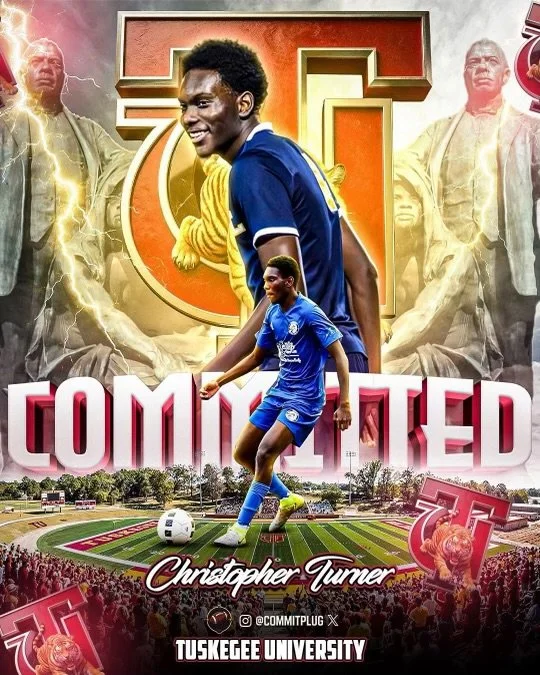
“Already Bigger Than Recruiting”
How Christopher Turner Is Quietly Emerging as One of the Most Symbolically Important Young Soccer Figures in the New Southern HBCU Sports Era
The biggest mistake people make when evaluating rising athletes is assuming stardom begins:
after college.
Modern sports culture no longer works that way.
In the NIL and creator-athlete era,
visibility begins:
before enrollment,
before freshman year,
and often before national media even notices.
Christopher Turner already represents something much larger than:
a Tuskegee soccer recruit,
a GHSA defender,
or a promising club player.
He increasingly symbolizes:
the convergence of:
Southern soccer expansion,
HBCU renaissance culture,
GHSA championship energy,
Atlanta’s exploding football culture,
and modern athlete branding infrastructure.
That combination alone creates:
star gravity.
HE EMERGED FROM A REAL SOCCER ENVIRONMENT
NOT A SMALL MARKET BUBBLE
Christopher Turner’s rise was not manufactured artificially.
It developed inside:
one of the fastest-growing soccer ecosystems in America:
metro Atlanta.
His development through Atlanta Fire South and Eagle’s Landing High School placed him inside:
elite regional competition,
highly visible GHSA environments,
and modern youth-development systems already connected to college recruiting infrastructure.
That matters enormously because:
today’s elite soccer athletes are increasingly identified early through:
club visibility,
tactical specialization,
digital exposure,
and atmosphere participation.
Christopher Turner already possesses:
varsity-level GHSA experience,
club-development pedigree,
center-back versatility,
and multi-year competitive progression.
This is not:
“potential from nowhere.”
This is:
a player already developed inside legitimate Southern soccer infrastructure.
GHSA SUCCESS CREATED THE STAR FRAMEWORK
The Eagle’s Landing environments Christopher Turner developed inside already reflected:
mass-participation soccer culture.
MaxPreps records show repeated dominant performances from Eagle’s Landing during the 2024–2025 seasons including:
10–2 wins,
9–0 shutouts,
7–0 victories,
6–0 performances,
and deep GHSA state tournament advancement.
Those results matter psychologically.
Why?
Because repeated dominant environments create:
confidence,
crowd mythology,
leadership presence,
and emotional visibility.
Winning culture produces:
recognizable figures.
Especially in the smartphone era where:
every playoff atmosphere,
every highlight clip,
every team celebration,
and every commitment graphic
becomes permanent digital memory.
Christopher Turner emerged during:
the exact moment GHSA soccer transformed from:
“regional competition”
into:
socially visible sports culture.
HE FITS THE MODERN SOCCER STAR ARCHETYPE
Modern soccer stardom increasingly revolves around:
identity,
presentation,
composure,
symbolism,
and aesthetics
as much as raw performance.
Christopher Turner already fits this modern archetype unusually well.
His recruiting profile reflects:
positional leadership,
athletic versatility,
strong physical size for a defender,
and disciplined long-term development habits.
At 6’1” with center-back and outside-back versatility, he already fits the physical profile modern systems increasingly prioritize defensively.
But beyond the technical profile,
the larger factor is:
presence.
Modern sports audiences respond heavily to:
confidence,
visual identity,
composure,
and atmosphere.
Christopher Turner already projects:
high-level athlete energy.
That matters tremendously in NIL culture.
ATLANTA UNITED CHANGED HIS ENTIRE GENERATION
Christopher Turner belongs to:
the first generation fully raised inside the Atlanta United era.
That changes everything psychologically.
Before Atlanta United,
many Southern athletes viewed soccer as:
secondary,
niche,
or culturally disconnected.
Now:
young athletes in Georgia grow up seeing:
packed stadiums,
supporter sections,
elite branding,
viral soccer culture,
and emotionally intense match environments
regularly.
Atlanta United normalized:
soccer stardom in the South.
Christopher Turner is therefore developing during:
the strongest soccer-energy era the Southeast has ever experienced.
That cultural timing matters enormously.
TUSKEGEE GIVES HIM HISTORICAL POSITIONING
Christopher Turner’s commitment becomes even more important because:
he is entering:
Tuskegee University’s inaugural soccer era.
Founding athletes always carry:
outsized symbolic importance.
Why?
Because they become:
the first standards,
the first leaders,
the first culture setters,
and the first mythology builders.
Tuskegee publicly framed the launch of soccer as part of its institutional “Renaissance Era,” emphasizing modernization, athletic growth, and future visibility expansion.
Christopher Turner is therefore not merely:
joining a team.
He is entering:
a historical chapter at the moment it begins.
That creates:
legacy gravity.
HIS STAR POWER IS DIFFERENT
Many athletes become famous strictly through:
statistics.
Christopher Turner’s visibility trajectory appears different.
His growth reflects:
atmosphere culture,
symbolic positioning,
digital aesthetics,
Southern sports identity,
and HBCU renaissance momentum simultaneously.
That combination is extremely powerful in modern sports media.
Because today’s biggest athletes increasingly function as:
personalities,
symbols,
creators,
and cultural representatives—
not merely competitors.
Christopher Turner already feels:
larger than just a player.
That is usually the earliest sign of modern stardom.
THE NIL UPSIDE IS ENORMOUS
Christopher Turner enters college during:
the complete decentralization of athlete branding.
Modern NIL ecosystems reward:
authenticity,
storytelling,
atmosphere,
and audience connection.
He already possesses:
strong regional identity,
HBCU alignment,
Atlanta soccer credibility,
GHSA visibility,
and highly marketable soccer aesthetics.
That creates massive upside for:
apparel collaborations,
creator partnerships,
sports documentaries,
HBCU campaigns,
soccer lifestyle branding,
and youth mentorship visibility.
Especially because:
soccer naturally overlaps with:
fashion,
international culture,
creator aesthetics,
and digital storytelling.
HE REPRESENTS THE NEW SOUTH
The deeper reason Christopher Turner feels important already is because:
he represents a larger transformation happening throughout Southern sports culture.
He reflects:
Black soccer expansion,
HBCU modernization,
decentralized athlete branding,
GHSA visibility culture,
and the creator-athlete economy simultaneously.
That combination simply did not exist at this scale:
10 years ago.
Now it does.
And Christopher Turner is arriving during:
the exact beginning of that transition.
THE MLS CONVERSATION IS REAL
The old idea that:
“HBCUs can’t become serious soccer pipelines”
is rapidly becoming outdated.
Modern MLS systems increasingly value:
athletic defenders,
tactical flexibility,
emotionally composed leaders,
and media-adaptable athletes.
Christopher Turner already possesses:
high-level youth development,
club infrastructure,
GHSA competition experience,
and strong institutional positioning entering Tuskegee.
Most importantly:
he enters college during:
the strongest growth era Southern soccer has ever experienced.
That creates real long-term professional upside.
FINAL OBSERVATION
Christopher Turner already feels bigger than:
a recruit.
Because his trajectory documents:
the rise of a completely new Southern sports archetype:
HBCU-aligned,
soccer-driven,
digitally visible,
culturally symbolic,
and NIL-native from the beginning.
His rise reflects:
where sports culture itself is going.
And the most important part?
The movement surrounding him is still just getting started.
The Pipeline Already Produces Pros” How Christopher Turner, Atlanta Fire South, and GHSA Soccer Success Reflect the Emerging HBCU-to-MLS Talent Infrastructure Across the Southeast
“The Pipeline Already Produces Pros”
How Christopher Turner, Atlanta Fire South, and GHSA Soccer Success Reflect the Emerging HBCU-to-MLS Talent Infrastructure Across the Southeast
For years, American soccer conversations largely ignored the Southeast.
The assumption was:
elite soccer culture belonged primarily to:
California,
New York,
Texas,
or international academies.
That narrative is collapsing rapidly.
The modern Southern soccer ecosystem now produces:
elite youth development,
nationally ranked club competition,
massive attendance culture,
emotionally charged high school atmospheres,
and rapidly expanding professional pathways.
Christopher Turner’s progression through:
Atlanta Fire United,
Eagle’s Landing High School,
GHSA state competition,
and now Tuskegee University
represents one of the clearest examples of:
how Southern soccer culture is evolving into a legitimate long-term HBCU-to-MLS visibility pipeline.
ATLANTA FIRE SOUTH
THE PROFESSIONALIZATION OF SOUTHERN YOUTH SOCCER
Christopher Turner’s club development through Atlanta Fire South is extremely important context.
Modern elite youth soccer increasingly revolves around:
academy infrastructure,
tactical development,
positional specialization,
recruitment visibility,
and media presentation.
Atlanta Fire South operates inside one of the fastest-growing soccer regions in America:
metro Atlanta.
The organization competes inside a highly competitive Southern youth ecosystem increasingly connected to:
college recruiting,
MLS academy scouting,
and national tournament exposure.
Christopher Turner’s recruiting profile confirms:
Atlanta Fire South U16 participation,
varsity-level GHSA experience,
center-back development,
and long-term positional specialization.
This matters because:
modern soccer pipelines are no longer built solely through school sports.
They are built through:
club exposure,
digital recruiting,
tactical development,
and multi-system competition simultaneously.
GHSA SOCCER IS NO LONGER “UNDERRATED”
The Georgia high school soccer ecosystem has quietly become:
one of the strongest emotional soccer environments in the Southeast.
Christopher Turner’s Eagle’s Landing career reflects this growth directly.
MaxPreps records show Eagle’s Landing producing:
dominant multi-goal victories,
playoff advancement,
and high-scoring competitive success throughout the 2024–2025 seasons.
Examples include:
10–2 victories,
9–0 shutouts,
7–0 performances,
5–0 playoff wins,
and deep GHSA state tournament participation.
Those scorelines reveal something bigger than statistics.
They show:
crowd momentum,
offensive confidence,
tactical structure,
and emotionally invested soccer culture.
Modern GHSA soccer environments increasingly resemble:
football atmospheres,
basketball student sections,
and creator-driven sports ecosystems.
The South already has:
soccer hysteria.
The national media is simply late recognizing it.
CHRISTOPHER TURNER’S POSITIONAL VALUE
WHY MODERN CENTER-BACKS MATTER MORE THAN EVER
Christopher Turner’s development as a center-back is especially important in the modern soccer economy.
Elite defenders increasingly function as:
organizers,
communicators,
transition initiators,
and tactical anchors.
At 6’1” with center-back and outside-back versatility listed on his recruiting profile, Turner already fits the physical and positional framework modern college and professional systems increasingly value.
Modern MLS development increasingly prioritizes:
composure,
athleticism,
tactical intelligence,
and build-up play from defenders.
That makes GHSA-developed defenders with:
elite competition experience,
club-system training,
and high-pressure match exposure
extremely valuable long-term.
THE ATLANTA UNITED EFFECT
The explosion of soccer culture in the Southeast cannot be discussed without acknowledging Atlanta United FC.
Atlanta United transformed Southern soccer psychology completely.
The franchise proved:
massive soccer crowds,
emotionally intense supporter culture,
and elite soccer branding
could thrive in the Deep South.
Mercedes-Benz Stadium quickly became one of the strongest soccer atmospheres in North America.
That influence spread directly into:
GHSA programs,
club development systems,
youth participation,
and athlete visibility culture.
Christopher Turner belongs to the first full generation raised entirely inside:
the Atlanta United era.
That changes expectations dramatically.
This generation already views soccer as:
culturally important,
socially visible,
professionally realistic,
and digitally marketable.
HBCUs & THE UNTAPPED SOCCER MARKET
Historically,
HBCUs underinvested in soccer compared to:
football,
basketball,
and track.
That created a major market gap.
But the landscape is changing rapidly.
Tuskegee University officially launching soccer during its institutional “Renaissance Era” places the school directly inside:
one of the fastest-growing sports demographics in America.
This creates enormous long-term potential because HBCUs already possess:
identity loyalty,
alumni engagement,
cultural symbolism,
and emotional authenticity.
Soccer simultaneously provides:
international appeal,
fashion crossover,
creator-economy alignment,
and NIL flexibility.
The combination is powerful.
THE DIVISION II MISCONCEPTION
Another outdated assumption:
that Division II athletes lack visibility.
That era is over.
The smartphone age decentralized sports attention completely.
Today,
Division II athletes can independently build:
highlight ecosystems,
creator partnerships,
NIL audiences,
and social influence.
This especially benefits soccer because the sport naturally aligns with:
cinematic visuals,
lifestyle branding,
social-media aesthetics,
and international identity culture.
Christopher Turner enters Tuskegee during:
the complete restructuring of sports visibility economics.
That timing matters enormously.
THE HBCU-TO-MLS CONVERSATION
The deeper significance of Christopher Turner’s trajectory lies in what it symbolizes:
the beginning of normalized Black Southern soccer pipelines moving through:
GHSA,
elite club systems,
HBCUs,
Division II visibility,
and eventually professional opportunities.
For decades,
many Black Southern athletes were culturally directed toward:
football,
basketball,
or track.
Now:
soccer is increasingly entering the conversation seriously.
Especially because:
modern MLS systems increasingly reward:
athletic defenders,
versatile tactical players,
emotionally composed leaders,
and media-adaptable personalities.
The infrastructure is already forming.
WHY YEAR ONE MATTERS SO MUCH
Christopher Turner’s recruiting class now carries unusual historical importance because:
they are foundational athletes.
First-year programs establish:
standards,
identity,
culture,
and mythology permanently.
If Tuskegee soccer succeeds early,
its inaugural players become:
institutional legends.
That dramatically increases:
long-term NIL value,
sports-media visibility,
documentary potential,
and HBCU soccer prestige.
Especially if:
GHSA talent,
Atlanta club infrastructure,
and HBCU atmosphere
fully merge together.
THE BIGGER SOUTHERN SHIFT
The broader reality is this:
Southern soccer is no longer emerging.
It has already arrived.
The:
crowds,
youth systems,
club infrastructure,
GHSA competition,
digital visibility,
and emotional investment
already exist at scale.
What schools like Tuskegee are now doing is:
institutionalizing the movement.
That could fundamentally reshape:
HBCU athletics,
MLS scouting conversations,
Southern soccer branding,
and NIL-era sports visibility
for the next generation.
FINAL OBSERVATION
Christopher Turner’s journey through:
Atlanta Fire South,
GHSA state-level competition,
Eagle’s Landing success,
and Tuskegee’s inaugural soccer class
represents more than athletic progression.
It documents:
the rise of a completely new Southern soccer infrastructure where:
Black soccer visibility,
HBCU renaissance culture,
MLS influence,
NIL branding,
and GHSA championship environments
fully converge.
The South is no longer trying to enter elite soccer culture.
The South is already helping redefine it.
The Pipeline Already Produces Pros” How Christopher Turner, Atlanta Fire South, and GHSA Soccer Success Reflect the Emerging HBCU-to-MLS Talent Infrastructure Across the Southeast
“The Pipeline Already Produces Pros”
How Christopher Turner, Atlanta Fire South, and GHSA Soccer Success Reflect the Emerging HBCU-to-MLS Talent Infrastructure Across the Southeast
For years, American soccer conversations largely ignored the Southeast.
The assumption was:
elite soccer culture belonged primarily to:
California,
New York,
Texas,
or international academies.
That narrative is collapsing rapidly.
The modern Southern soccer ecosystem now produces:
elite youth development,
nationally ranked club competition,
massive attendance culture,
emotionally charged high school atmospheres,
and rapidly expanding professional pathways.
Christopher Turner’s progression through:
Atlanta Fire United,
Eagle’s Landing High School,
GHSA state competition,
and now Tuskegee University
represents one of the clearest examples of:
how Southern soccer culture is evolving into a legitimate long-term HBCU-to-MLS visibility pipeline.
ATLANTA FIRE SOUTH
THE PROFESSIONALIZATION OF SOUTHERN YOUTH SOCCER
Christopher Turner’s club development through Atlanta Fire South is extremely important context.
Modern elite youth soccer increasingly revolves around:
academy infrastructure,
tactical development,
positional specialization,
recruitment visibility,
and media presentation.
Atlanta Fire South operates inside one of the fastest-growing soccer regions in America:
metro Atlanta.
The organization competes inside a highly competitive Southern youth ecosystem increasingly connected to:
college recruiting,
MLS academy scouting,
and national tournament exposure.
Christopher Turner’s recruiting profile confirms:
Atlanta Fire South U16 participation,
varsity-level GHSA experience,
center-back development,
and long-term positional specialization.
This matters because:
modern soccer pipelines are no longer built solely through school sports.
They are built through:
club exposure,
digital recruiting,
tactical development,
and multi-system competition simultaneously.
GHSA SOCCER IS NO LONGER “UNDERRATED”
The Georgia high school soccer ecosystem has quietly become:
one of the strongest emotional soccer environments in the Southeast.
Christopher Turner’s Eagle’s Landing career reflects this growth directly.
MaxPreps records show Eagle’s Landing producing:
dominant multi-goal victories,
playoff advancement,
and high-scoring competitive success throughout the 2024–2025 seasons.
Examples include:
10–2 victories,
9–0 shutouts,
7–0 performances,
5–0 playoff wins,
and deep GHSA state tournament participation.
Those scorelines reveal something bigger than statistics.
They show:
crowd momentum,
offensive confidence,
tactical structure,
and emotionally invested soccer culture.
Modern GHSA soccer environments increasingly resemble:
football atmospheres,
basketball student sections,
and creator-driven sports ecosystems.
The South already has:
soccer hysteria.
The national media is simply late recognizing it.
CHRISTOPHER TURNER’S POSITIONAL VALUE
WHY MODERN CENTER-BACKS MATTER MORE THAN EVER
Christopher Turner’s development as a center-back is especially important in the modern soccer economy.
Elite defenders increasingly function as:
organizers,
communicators,
transition initiators,
and tactical anchors.
At 6’1” with center-back and outside-back versatility listed on his recruiting profile, Turner already fits the physical and positional framework modern college and professional systems increasingly value.
Modern MLS development increasingly prioritizes:
composure,
athleticism,
tactical intelligence,
and build-up play from defenders.
That makes GHSA-developed defenders with:
elite competition experience,
club-system training,
and high-pressure match exposure
extremely valuable long-term.
THE ATLANTA UNITED EFFECT
The explosion of soccer culture in the Southeast cannot be discussed without acknowledging Atlanta United FC.
Atlanta United transformed Southern soccer psychology completely.
The franchise proved:
massive soccer crowds,
emotionally intense supporter culture,
and elite soccer branding
could thrive in the Deep South.
Mercedes-Benz Stadium quickly became one of the strongest soccer atmospheres in North America.
That influence spread directly into:
GHSA programs,
club development systems,
youth participation,
and athlete visibility culture.
Christopher Turner belongs to the first full generation raised entirely inside:
the Atlanta United era.
That changes expectations dramatically.
This generation already views soccer as:
culturally important,
socially visible,
professionally realistic,
and digitally marketable.
HBCUs & THE UNTAPPED SOCCER MARKET
Historically,
HBCUs underinvested in soccer compared to:
football,
basketball,
and track.
That created a major market gap.
But the landscape is changing rapidly.
Tuskegee University officially launching soccer during its institutional “Renaissance Era” places the school directly inside:
one of the fastest-growing sports demographics in America.
This creates enormous long-term potential because HBCUs already possess:
identity loyalty,
alumni engagement,
cultural symbolism,
and emotional authenticity.
Soccer simultaneously provides:
international appeal,
fashion crossover,
creator-economy alignment,
and NIL flexibility.
The combination is powerful.
THE DIVISION II MISCONCEPTION
Another outdated assumption:
that Division II athletes lack visibility.
That era is over.
The smartphone age decentralized sports attention completely.
Today,
Division II athletes can independently build:
highlight ecosystems,
creator partnerships,
NIL audiences,
and social influence.
This especially benefits soccer because the sport naturally aligns with:
cinematic visuals,
lifestyle branding,
social-media aesthetics,
and international identity culture.
Christopher Turner enters Tuskegee during:
the complete restructuring of sports visibility economics.
That timing matters enormously.
THE HBCU-TO-MLS CONVERSATION
The deeper significance of Christopher Turner’s trajectory lies in what it symbolizes:
the beginning of normalized Black Southern soccer pipelines moving through:
GHSA,
elite club systems,
HBCUs,
Division II visibility,
and eventually professional opportunities.
For decades,
many Black Southern athletes were culturally directed toward:
football,
basketball,
or track.
Now:
soccer is increasingly entering the conversation seriously.
Especially because:
modern MLS systems increasingly reward:
athletic defenders,
versatile tactical players,
emotionally composed leaders,
and media-adaptable personalities.
The infrastructure is already forming.
WHY YEAR ONE MATTERS SO MUCH
Christopher Turner’s recruiting class now carries unusual historical importance because:
they are foundational athletes.
First-year programs establish:
standards,
identity,
culture,
and mythology permanently.
If Tuskegee soccer succeeds early,
its inaugural players become:
institutional legends.
That dramatically increases:
long-term NIL value,
sports-media visibility,
documentary potential,
and HBCU soccer prestige.
Especially if:
GHSA talent,
Atlanta club infrastructure,
and HBCU atmosphere
fully merge together.
THE BIGGER SOUTHERN SHIFT
The broader reality is this:
Southern soccer is no longer emerging.
It has already arrived.
The:
crowds,
youth systems,
club infrastructure,
GHSA competition,
digital visibility,
and emotional investment
already exist at scale.
What schools like Tuskegee are now doing is:
institutionalizing the movement.
That could fundamentally reshape:
HBCU athletics,
MLS scouting conversations,
Southern soccer branding,
and NIL-era sports visibility
for the next generation.
FINAL OBSERVATION
Christopher Turner’s journey through:
Atlanta Fire South,
GHSA state-level competition,
Eagle’s Landing success,
and Tuskegee’s inaugural soccer class
represents more than athletic progression.
It documents:
the rise of a completely new Southern soccer infrastructure where:
Black soccer visibility,
HBCU renaissance culture,
MLS influence,
NIL branding,
and GHSA championship environments
fully converge.
The South is no longer trying to enter elite soccer culture.
The South is already helping redefine it.
The Pipeline Is Already Built” How Christopher Turner’s GHSA & Atlanta Fire South Development Reflect the Emerging HBCU-to-MLS Soccer Pipeline in the American South
“The Pipeline Is Already Built”
How Christopher Turner’s GHSA & Atlanta Fire South Development Reflect the Emerging HBCU-to-MLS Soccer Pipeline in the American South
The modern Southern soccer explosion is no longer theoretical.
The infrastructure already exists.
The crowds exist.
The youth development systems exist.
The media ecosystems exist.
The NIL visibility systems exist.
And now,
for the first time,
HBCUs are beginning to position themselves directly inside that momentum.
Christopher Turner’s path from:
Eagle’s Landing High School,
toAtlanta Fire United South,
toTuskegee University
represents something much larger than a standard recruiting story.
It documents:
the early formation of a modern Southern HBCU-to-MLS visibility pipeline.
THE ATLANTA FIRE SOUTH FOUNDATION
ELITE DEVELOPMENT BEFORE COLLEGE
Christopher Turner’s development through Atlanta Fire United South placed him inside one of Georgia’s most competitive youth soccer ecosystems during a historic growth era for Southern soccer.
Atlanta-area club systems now function similarly to:
AAU basketball,
7-on-7 football circuits,
and elite baseball travel programs.
These clubs increasingly operate as:
exposure pipelines,
development academies,
media ecosystems,
and recruitment infrastructure simultaneously.
Atlanta Fire South athletes routinely compete against:
elite regional competition,
MLS-adjacent development systems,
and nationally recognized youth programs.
This matters because:
the Southeast has rapidly become one of the fastest-growing soccer talent regions in America.
The old stereotype that elite soccer talent only emerged from:
California,
Texas,
or the Northeast
is disappearing quickly.
Georgia is now producing:
high-level technical players,
elite athletes,
and nationally recruited prospects
at unprecedented rates.
GHSA SOCCER HAS ALREADY BECOME MASS CULTURE
One of the biggest misconceptions in American sports culture is the idea that soccer lacks emotional intensity in the South.
The evidence increasingly says otherwise.
Georgia high school soccer now regularly generates:
packed playoff environments,
statewide rankings,
livestream engagement,
social media virality,
and emotionally charged regional rivalries.
Christopher Turner emerged from:
one of the most competitive sports states in America,
inside a rapidly expanding soccer culture already functioning at near-football levels emotionally among younger generations.
His MaxPreps profile confirms:
varsity competition,
center-back leadership,
club-level experience,
and multi-year development within elite Georgia soccer systems.
The significance goes beyond individual statistics.
The bigger story is:
proof of mass soccer hysteria already existing throughout GHSA culture.
The emotional infrastructure is already built.
WHY GHSA SUCCESS MATTERS FOR HBCU SOCCER
For decades,
many HBCU athletic departments focused heavily on:
football,
basketball,
track,
and marching-band culture.
Soccer remained underdeveloped institutionally.
But modern Southern youth culture changed dramatically.
Today’s athletes grew up during:
the rise of Atlanta United,
MLS expansion,
international soccer streaming,
FIFA gaming culture,
creator-athlete branding,
and social-media-first sports identity.
That shift created:
a new generation of Black Southern soccer athletes already immersed in:
soccer aesthetics,
global football culture,
and digital visibility ecosystems.
Tuskegee launching soccer now is strategically important because:
the demand already exists regionally.
The talent already exists regionally.
The culture already exists regionally.
ATLANTA UNITED CHANGED EVERYTHING
The arrival of Atlanta United FC permanently altered soccer culture throughout the Southeast.
Atlanta United proved:
Southern crowds would support soccer at elite levels when:
atmosphere,
branding,
identity,
and emotional participation
aligned properly.
Mercedes-Benz Stadium quickly became:
one of the strongest soccer atmospheres in North America.
That influence spread downward into:
youth clubs,
GHSA programs,
NIL-era branding,
and regional soccer identity.
Christopher Turner belongs to the first generation fully raised inside:
the Atlanta United era.
That matters enormously.
Because this generation views soccer differently than previous Southern athletes did.
For them,
soccer already feels:
culturally relevant,
visually marketable,
digitally native,
and socially important.
TUSKEGEE ENTERS AT THE PERFECT MOMENT
Tuskegee University officially announced its inaugural soccer programs as part of a broader institutional “Renaissance Era” emphasizing modernization, expansion, and athletic visibility growth.
The timing could not be more strategic.
Because HBCUs now possess something extremely valuable in the modern sports economy:
authenticity,
identity loyalty,
cultural symbolism,
alumni engagement,
and emotional storytelling power.
Soccer simultaneously offers:
global branding appeal,
creator-economy crossover,
fashion integration,
and NIL flexibility.
The merging of:
HBCU identity
+
modern soccer culture
creates:
one of the most underdeveloped sports-media opportunities in America.
THE MLS PIPELINE CONVERSATION
Historically,
many elite Black athletes in America gravitated toward:
football,
basketball,
or track.
That is slowly changing.
The growth of:
MLS academies,
Southern club systems,
global soccer culture,
and NIL opportunities
is creating new pathways.
Christopher Turner’s development through:
GHSA competition,
Atlanta Fire South,
and Tuskegee
reflects the early stages of a potentially powerful HBCU-to-MLS development narrative.
Especially because:
modern soccer scouting increasingly values:
athleticism,
technical growth,
tactical IQ,
leadership,
and media adaptability.
Center-backs with:
composure,
mobility,
communication ability,
and strong developmental systems
remain extremely valuable long-term.
DIVISION II SOCCER IS CHANGING RAPIDLY
Another major misconception:
that Division II athletics lack modern visibility.
That world no longer exists.
The smartphone era decentralized sports attention completely.
Today:
highlight clips,
creator partnerships,
livestreams,
recruiting edits,
athlete podcasts,
and NIL ecosystems
allow Division II athletes to build substantial visibility independently.
This especially benefits soccer,
because:
the sport naturally aligns with:
aesthetics,
international culture,
lifestyle branding,
and creator-driven media systems.
Tuskegee soccer enters Division II during:
the complete restructuring of sports visibility economics.
That creates enormous upside.
THE FOUNDING CLASS EFFECT
Christopher Turner’s recruiting class will likely hold permanent historical significance because:
they are the first.
Foundational classes shape:
standards,
atmosphere,
culture,
identity,
and mythology.
If Tuskegee soccer succeeds early,
the inaugural players become:
institutional legends.
This dramatically increases:
long-term branding value,
alumni visibility,
documentary storytelling potential,
and NIL-era recognition.
Especially if:
winning culture,
HBCU atmosphere,
and Southern soccer passion
merge successfully.
THE BROADER SOUTHERN SHIFT
The deeper historical reality is this:
Southern soccer is no longer emerging.
It has already arrived.
The:
youth participation,
club infrastructure,
stadium attendance,
GHSA competition,
creator visibility,
and NIL culture
already exist at scale.
What has been missing is:
institutional alignment.
Tuskegee launching soccer during this exact era could position the university at the center of:
HBCU soccer growth,
Black soccer visibility,
and Southern MLS pipeline conversations
for years moving forward.
FINAL OBSERVATION
Christopher Turner’s journey through:
GHSA soccer culture,
Atlanta Fire South development,
and Tuskegee’s inaugural soccer class
documents something much larger than one athlete’s progression.
It represents:
the merging of:
elite Georgia youth soccer,
HBCU institutional renaissance,
MLS-era Southern soccer expansion,
and NIL-driven sports media culture
into one rapidly evolving ecosystem.
The pipeline is no longer hypothetical.
The South already built it.
“The Expansion League” How Christopher Turner, GHSA Championship Culture, and Tuskegee University’s First-Year Soccer Program Could Ignite a New Era of HBCU Soccer Visibility in the American South
“The Expansion League”
How Christopher Turner, GHSA Championship Culture, and Tuskegee University’s First-Year Soccer Program Could Ignite a New Era of HBCU Soccer Visibility in the American South
The launch of Tuskegee University’s first-ever men’s soccer program arrives at a historic moment for both HBCU athletics and Southern sports culture.
This is not simply:
the addition of another roster,
a startup athletic experiment,
or a small NCAA Division II expansion.
It represents:
the convergence of:
GHSA championship culture,
HBCU institutional renaissance,
NIL-era athlete branding,
soccer globalization,
decentralized sports media,
and the rapidly growing visibility economy surrounding Black soccer athletes in America.
At the center of this transition is Christopher Turner:
a product of Georgia championship culture entering Tuskegee during Year One of what could become one of the most culturally important HBCU soccer movements in the Southeast.
⸻
THE YEAR ONE EFFECT
WHY INAUGURAL PROGRAMS CREATE CULTURAL GRAVITY
Historically,
first-year athletic programs carry unusual emotional weight.
They are remembered differently because:
they establish:
identity,
mythology,
standards,
and institutional culture simultaneously.
Tuskegee University officially announced the launch of its inaugural men’s and women’s soccer programs for Fall 2026 as part of what leadership publicly described as:
“Tuskegee’s Renaissance era.”
The university framed soccer as:
international expansion,
modern athletic positioning,
and long-term institutional growth.
That matters deeply because:
first-generation athletes become:
founders,
culture setters,
and permanent historical references.
Christopher Turner therefore enters Tuskegee not merely as:
a recruit—
but as:
part of the inaugural mythology.
⸻
GHSA CHAMPIONSHIP CULTURE AS VERIFIED PROOF OF MASS SOCCER ENERGY
One of the biggest misconceptions about Southern sports culture is the assumption that soccer lacks emotional intensity in the Southeast.
That perception is rapidly changing.
Georgia high school soccer has evolved into:
one of the most competitive youth soccer ecosystems in America,
highly media-aware,
emotionally intense,
and increasingly integrated into NIL-style visibility systems.
Within the Georgia High School Association environment,
state playoff soccer atmospheres now generate:
packed crowds,
livestream audiences,
social media virality,
recruiting visibility,
and emotional community participation.
Christopher Turner developed within this exact ecosystem at Eagle’s Landing High School while competing through both varsity and club systems such as Atlanta Fire South.
This matters because:
GHSA championship culture provides verified evidence that:
mass soccer hysteria already exists throughout the South—
especially among younger generations.
The emotional infrastructure is already built.
Tuskegee now enters the sport during the exact moment when:
Southern soccer culture is exploding digitally.
⸻
THE MLS IMPLICATIONS
WHY HBCU SOCCER MATTERS NOW
Major League Soccer continues expanding aggressively throughout the Southeast:
Atlanta,
Nashville,
Charlotte,
Miami,
Orlando,
and Austin
have all become major soccer visibility hubs.
This expansion changed youth culture permanently.
The rise of:
Major League Soccer,
Atlanta United FC,
and Southern soccer academies normalized:
packed soccer stadiums,
supporter culture,
soccer fashion aesthetics,
and social media soccer identity
throughout the region.
Atlanta United alone demonstrated that:
Southern crowds absolutely support soccer when:
atmosphere,
branding,
identity,
and emotional participation
are properly aligned.
Tuskegee now enters college soccer during:
the strongest growth era Southern soccer has ever experienced.
That creates enormous implications.
⸻
THE HBCU SOCCER MARKET IS WIDE OPEN
Historically,
HBCU soccer has received:
limited media coverage,
minimal NIL infrastructure,
and little mainstream visibility.
That is changing rapidly.
Modern NIL culture rewards:
authenticity,
narrative,
atmosphere,
visual branding,
and audience connection.
HBCUs already possess:
strong identity loyalty,
recognizable symbolism,
emotional alumni networks,
and culturally engaged audiences.
Soccer naturally intersects with:
fashion culture,
creator aesthetics,
global branding,
and lifestyle visibility.
This combination creates:
massive untapped NIL potential.
Tuskegee launching soccer now may ultimately prove:
perfectly timed.
⸻
CHRISTOPHER TURNER AS A MODERN SOCCER ARCHETYPE
Christopher Turner represents a modern Southern soccer archetype increasingly valuable in today’s sports economy:
technically developed,
media-aware,
culturally aligned,
visually marketable,
and institutionally symbolic.
His commitment graphic alone reflects:
modern NIL-era athlete presentation:
cinematic editing,
crowd imagery,
heroic framing,
school symbolism,
and atmosphere-centered branding.
This style mirrors:
elite football commitments,
Power Five recruiting culture,
and modern creator-athlete aesthetics.
Importantly,
this level of branding is now appearing:
inside HBCU soccer.
That shift is historically important.
⸻
DIVISION II SOCCER & THE NEW VISIBILITY ECONOMY
NCAA Division II athletics are entering a completely different era than previous generations experienced.
Historically,
Division II athletes often lacked:
large audiences,
media visibility,
NIL pathways,
and creator infrastructure.
The smartphone era changed that completely.
Modern athletes can now independently build:
audiences,
personal brands,
highlight ecosystems,
creator partnerships,
and sponsorship opportunities
regardless of division level.
This is especially true in soccer,
where:
aesthetics,
style,
identity,
and international appeal
carry enormous branding potential.
Tuskegee soccer therefore enters NCAA Division II during:
the decentralization of sports visibility itself.
That creates major upside.
⸻
WHY TUSKEGEE COULD BECOME A CULTURAL SOCCER PROGRAM
Programs become culturally important when they combine:
identity,
atmosphere,
history,
symbolism,
and participation.
Tuskegee already possesses:
legendary institutional prestige,
historic Black excellence symbolism,
military legacy,
strong alumni identity,
and growing athletic investment.
Adding soccer introduces:
global sports alignment,
younger audience engagement,
creator-culture crossover,
and international branding flexibility.
If the program successfully merges:
HBCU culture,
Southern atmosphere,
digital branding,
and modern soccer aesthetics—
Tuskegee could realistically become:
one of the most culturally visible Division II soccer programs in the South.
⸻
THE TURNER DYNASTY & THE NEXT PHASE OF SOUTHERN SPORTS CULTURE
The broader Turner family trajectory increasingly reflects:
the evolution of Southern sports-media infrastructure itself.
Earlier Generation
George Ransom Turner III emerged through:
GHSA basketball culture,
crowd mythology,
Party Plug-era visibility systems,
nightlife branding,
military structure,
and decentralized Southern media ecosystems.
New Generation
Christopher Turner now enters:
HBCU soccer expansion,
NIL-era athlete branding,
Division II visibility economies,
creator-athlete ecosystems,
and modern soccer media culture.
The transition reflects:
how Southern sports culture itself evolved from:
local crowd environments
into:
fully digital identity ecosystems.
⸻
THE LONG-TERM IMPLICATION
The deeper significance of Christopher Turner’s commitment lies in timing.
He arrives:
during Tuskegee’s Renaissance Era,
inside the inaugural soccer class,
during Southern soccer expansion,
amid NIL decentralization,
and during the rise of HBCU digital branding.
That combination creates:
extremely high long-term visibility potential.
Especially because:
the strongest future sports brands will likely combine:
athletic excellence,
institutional symbolism,
digital storytelling,
atmosphere,
and emotional identity.
Tuskegee soccer now has the opportunity to build all five simultaneously.
⸻
FINAL OBSERVATION
Christopher Turner’s move to Tuskegee University represents more than:
recruitment,
Division II soccer,
or a freshman signing class.
It documents:
the emergence of a completely new Southern sports ecosystem where:
GHSA championship culture,
HBCU renaissance momentum,
soccer globalization,
MLS influence,
NIL branding,
and decentralized media visibility
fully converge.
The result could become:
not merely a successful soccer program—
but one of the foundational cultural soccer movements in modern HBCU athletics.
The Renaissance Class” How Christopher Turner, Tuskegee Soccer, and Eagle’s Landing Championship Culture Represent the Future of HBCU Athletics, Educational Excellence, and NIL Expansion in the South
“The Renaissance Class”
How Christopher Turner, Tuskegee Soccer, and Eagle’s Landing Championship Culture Represent the Future of HBCU Athletics, Educational Excellence, and NIL Expansion in the South
The commitment of Christopher Turner to Tuskegee University arrives during one of the most transformational periods in modern HBCU athletics.
This is not simply:
a recruiting class,
a roster addition,
or a first-year soccer experiment.
It represents:
the construction of a new Southern sports infrastructure merging:
educational prestige,
HBCU renaissance momentum,
NIL-era athlete branding,
GHSA championship culture,
soccer globalization,
and decentralized digital visibility.
Christopher Turner enters Tuskegee at the exact moment the university is launching its first-ever men’s soccer program as part of what school leadership openly describes as a “Renaissance Era” in athletics and institutional growth.
That timing matters historically.
TUSKEGEE’S FIRST-YEAR SOCCER ERA
BUILDING SOMETHING FROM ZERO
Tuskegee University officially announced the launch of its inaugural men’s and women’s soccer programs beginning in Fall 2026, positioning soccer as part of a broader expansion of athletics, student engagement, and national visibility.
The university described the move as:
“another bold step in Tuskegee’s Renaissance era.”
That language is important.
This is not merely:
adding another sport.
Tuskegee leadership is clearly positioning soccer as:
institutional modernization,
international visibility expansion,
and future-facing athletic infrastructure.
The university’s athletic department simultaneously announced:
facility modernization,
expanded programming,
upgraded arenas,
and increased national exposure.
This places Christopher Turner inside:
the founding generation of a completely new HBCU sports chapter.
Founding athletes carry unique historical weight because:
they establish:
culture,
standards,
identity,
leadership tone,
and institutional mythology.
EAGLE’S LANDING & CHAMPIONSHIP DNA
Christopher Turner’s development at Eagle’s Landing High School represents another important piece of the story.
The GHSA environment in Georgia remains one of the strongest developmental ecosystems in the American South:
emotionally intense,
highly competitive,
media-aware,
and increasingly connected to NIL-style visibility systems.
Athletes emerging from elite Georgia sports environments are increasingly trained not only through:
competition,
but also through:pressure,
visibility,
discipline,
and audience awareness.
That culture matters.
Championship environments create:
leadership instincts,
emotional composure,
identity confidence,
and symbolic resilience.
Christopher Turner enters Tuskegee already carrying:
high-level competitive structure,
elite developmental experience,
and championship-oriented mentality.
That becomes extremely valuable for:
a first-year collegiate program attempting to establish identity immediately.
WHY FIRST-YEAR PROGRAMS CREATE LEGENDS
Historically,
foundational athletic classes often become:
institutional legends.
Not necessarily because:
they win immediately—
but because:
they define the culture permanently.
First-generation athletes establish:
rituals,
standards,
leadership language,
emotional tone,
and historical memory.
Tuskegee’s inaugural soccer class now carries that responsibility.
This gives Christopher Turner and his class something modern NIL athletes increasingly seek:
legacy positioning.
They are not simply joining a roster.
They are building:
an institution’s soccer history from the ground floor.
That creates:
documentary-level significance.
HBCU SOCCER & THE NEXT NIL FRONTIER
The timing of this transition is extremely important.
Soccer is rapidly becoming:
one of the most culturally marketable sports in the modern digital era because it naturally intersects with:
fashion,
lifestyle branding,
international culture,
creator aesthetics,
and social media visibility.
At the same time,
HBCUs are entering a major digital renaissance:
stronger branding,
improved facilities,
creator partnerships,
livestream growth,
alumni engagement,
and national attention.
The combination of:
HBCU prestige
andmodern soccer aesthetics
creates massive NIL potential moving forward.
Christopher Turner enters college during a period where athletes increasingly monetize:
identity,
authenticity,
storytelling,
and visibility
as much as athletic performance itself.
THE MODERN HBCU ATHLETE
Earlier generations of HBCU athletes often lacked:
national exposure,
branding infrastructure,
and digital amplification systems.
That reality is changing rapidly.
Modern HBCU athletes increasingly operate inside:
creator economies,
athlete podcasts,
digital documentaries,
livestream culture,
apparel branding,
and social-first visibility systems.
Tuskegee’s new soccer era arrives during this exact transition.
The athlete is no longer:
only a competitor.
The athlete becomes:
media property,
institutional ambassador,
cultural representative,
and long-term brand ecosystem simultaneously.
Christopher Turner’s presentation already reflects this modern archetype.
EDUCATIONAL EXCELLENCE & THE TUSKEGEE LEGACY
Tuskegee carries enormous educational symbolism historically.
The institution represents:
Black intellectual achievement,
military excellence,
innovation,
leadership development,
and Southern educational prestige.
This means Christopher Turner’s commitment operates across multiple layers:
athletic opportunity,
educational advancement,
leadership positioning,
and cultural alignment.
Tuskegee leadership repeatedly emphasized:
“student-athlete excellence,”
“high-achievers in the classroom,”
and holistic development as central to the university’s athletic renaissance.
That creates a powerful intersection between:
sports
and
institutional legacy.
THE TURNER FAMILY DYNASTY CONTINUES
Viewed historically,
the Turner family trajectory increasingly mirrors:
the evolution of Southern Black visibility infrastructure itself.
Earlier Generation
George Ransom Turner III emerged through:
GHSA basketball culture,
crowd mythology,
Party Plug-era visibility systems,
decentralized media participation,
military structure,
and experiential Southern identity economies.
New Generation
Christopher Turner now enters:
HBCU soccer expansion,
NIL-era athlete branding,
creator-driven sports culture,
and institutional renaissance infrastructure.
The transition documents:
how Southern sports culture itself evolved across generations.
NIL IMPLICATIONS MOVING FORWARD
The long-term NIL implications are enormous.
Christopher Turner now enters a market where:
HBCU visibility is rising,
soccer culture is expanding,
athlete branding is decentralizing,
and authenticity increasingly outperforms manufactured celebrity.
Potential future opportunities include:
apparel collaborations,
HBCU-focused campaigns,
creator-athlete partnerships,
sports documentaries,
regional endorsements,
youth mentorship branding,
and international soccer crossover visibility.
Especially because:
soccer carries unique global branding flexibility compared to many traditional American sports.
THE BROADER HISTORICAL SIGNIFICANCE
The deeper significance of Christopher Turner’s commitment lies in timing.
He arrives at:
a historic HBCU,
during an athletic renaissance,
as part of an inaugural soccer generation,
in the middle of the NIL transformation era,
while Southern sports culture itself becomes increasingly media-driven.
That combination creates:
historical gravity.
This is not simply:
another recruit.
It is:
the convergence of:
education,
culture,
athletics,
visibility,
and Southern Black institutional evolution.
FINAL OBSERVATION
Christopher Turner’s commitment to Tuskegee University represents:
more than soccer,
more than recruitment,
and more than NIL.
It documents:
the emergence of a new generation of Southern HBCU athletes operating simultaneously as:
competitors,
students,
creators,
leaders,
and cultural symbols.
As Tuskegee builds its inaugural soccer program during its broader Renaissance Era, Christopher Turner becomes part of:
the founding mythology of a new HBCU sports chapter—
one carrying implications far beyond the field itself.
The Championship Pipeline” How Christopher Turner Represents the Next Evolution of GHSA Excellence, HBCU Prestige, and Southern Athlete Branding
“The Championship Pipeline”
How
Christopher Turner
Represents the Next Evolution of GHSA Excellence, HBCU Prestige, and Southern Athlete Branding
The rise of Christopher Turner represents something larger than a talented high school soccer player committing to an HBCU program.
It represents the continuation of a Southern athletic and cultural pipeline that has increasingly merged:
GHSA championship culture,
HBCU identity,
NIL-era branding,
decentralized media visibility,
and multi-generational sports influence
into one evolving ecosystem.
Unlike earlier generations that often relied solely on institutional recognition, modern athletes now develop simultaneously across:
competition,
branding,
audience visibility,
digital storytelling,
and symbolic identity.
Christopher Turner enters this environment already carrying:
athletic credibility,
visual branding instincts,
Southern sports lineage,
and emerging media gravity.
That combination is increasingly rare—and extremely valuable in the modern college athletics landscape.
THE GHSA FOUNDATION
BUILT INSIDE ONE OF THE SOUTH’S MOST COMPETITIVE ATHLETIC ECOSYSTEMS
Georgia high school athletics remain one of the strongest developmental infrastructures in America.
The Georgia High School Association ecosystem has historically produced:
elite athletes,
nationally ranked programs,
and culturally influential sports environments.
Competing within this environment requires more than technical ability.
It requires:
discipline,
adaptability,
emotional composure,
and performance under pressure.
Christopher Turner’s development at Eagle’s Landing High School placed him inside one of the most competitive visibility systems in the Southeast.
At the center-back position, he emerged within:
high-pressure match environments,
regional competition structures,
and modern club-development culture through Atlanta Fire South.
That pathway mirrors how modern Southern athletes increasingly develop:
through simultaneous exposure to:
school competition,
travel circuits,
social media visibility,
and regional sports branding.
THE DEFENDER ARCHETYPE
WHY CENTER-BACK LEADERSHIP TRANSLATES TO NIL CULTURE
One of the more overlooked aspects of Christopher Turner’s profile is positional psychology.
Center-backs historically operate as:
organizers,
communicators,
stabilizers,
and emotional anchors.
Unlike highly individual scoring positions, elite defenders must:
read space,
manage tempo,
anticipate movement,
and control emotional flow under pressure.
These leadership characteristics increasingly matter in modern NIL culture because athletes are no longer judged solely on:
statistics,
goals,
or highlights.
They are also evaluated through:
leadership presence,
composure,
marketability,
discipline,
and symbolic representation.
Modern athlete branding increasingly rewards:
identity architecture.
Christopher Turner’s visual presentation and commitment rollout already suggest awareness of this shift.
THE COMMITMENT GRAPHIC AS CULTURAL TEXT
The Tuskegee commitment image itself reflects the modern transformation of athlete identity.
The graphic is not merely informational.
It functions as:
branding,
mythology,
symbolism,
and institutional alignment simultaneously.
The image combines:
cinematic lighting,
stadium imagery,
warrior-style symbolism,
crowd participation,
institutional colors,
and heroic athlete framing.
This mirrors contemporary NIL-era athlete presentation styles commonly associated with:
Power Five football recruiting,
elite basketball commitments,
and creator-athlete branding culture.
Importantly,
this level of presentation is now appearing within HBCU soccer ecosystems.
That shift is historically significant.
TUSKEGEE UNIVERSITY & HBCU PRESTIGE
Christopher Turner’s commitment to Tuskegee University carries enormous symbolic weight.
Tuskegee represents one of the most historically important Black institutions in America:
academically,
culturally,
militarily,
and athletically.
The university symbolizes:
Black leadership,
institutional excellence,
historical resilience,
and Southern intellectual prestige.
For a modern athlete entering the NIL era,
alignment with Tuskegee creates:
both athletic opportunity
and
legacy positioning.
This reflects a larger movement occurring across HBCU athletics:
the merging of:
institutional symbolism,
digital visibility,
and athlete-led branding ecosystems.
THE TURNER FAMILY PIPELINE
FROM GHSA CULTURE TO REGIONAL SPORTS INFLUENCE
The broader Turner family trajectory increasingly resembles:
a multi-generational Southern sports and media pipeline.
Earlier Generation
George Ransom Turner III emerged through:
Calvary basketball culture,
crowd mythology,
GHSA visibility,
nightlife-era branding,
and decentralized media ecosystems.
New Generation
Christopher Turner now enters:
HBCU athletics,
NIL-era visibility systems,
soccer media culture,
and modern athlete branding infrastructure.
The transition reflects:
the evolution of Southern sports culture itself.
The athlete is no longer:
only a competitor.
The athlete becomes:
a media figure,
a symbolic representative,
a content ecosystem,
and a long-term brand asset.
THE SOCCER EXPANSION OF SOUTHERN BLACK SPORTS CULTURE
Another important historical dimension:
soccer is expanding rapidly within Black Southern athletic culture.
For decades,
the Southeast heavily prioritized:
football,
basketball,
and track.
Now,
soccer increasingly intersects with:
fashion culture,
international identity,
creator media,
digital aesthetics,
and NIL marketing potential.
Modern soccer athletes often possess:
global branding flexibility,
visually marketable presentation,
and stronger crossover lifestyle appeal.
Christopher Turner enters collegiate athletics at the exact moment when:
HBCU soccer
and
digital sports culture
are beginning to converge more aggressively.
This creates major long-term opportunities in:
sponsorships,
apparel branding,
creator collaborations,
sports media storytelling,
and regional influence building.
THE NEW HBCU ATHLETE
Historically,
many HBCU athletes lacked:
national media support,
NIL infrastructure,
and digital amplification systems.
That reality is changing rapidly.
Modern HBCU athletes increasingly operate within:
creator economies,
livestream culture,
digital storytelling,
and audience-building ecosystems.
Christopher Turner’s rise reflects this new archetype:
athlete,
leader,
symbol,
content-native competitor,
and institutional representative simultaneously.
This is no longer:
just recruitment.
It is:
visibility architecture.
THE CHAMPIONSHIP MINDSET
The deeper significance of Christopher Turner’s trajectory lies not simply in one commitment.
It lies in:
the continuation of a championship-oriented developmental culture built through:
GHSA competition,
Southern sports discipline,
HBCU prestige,
military-style resilience,
and modern media fluency.
Athletes emerging from these systems increasingly understand:
pressure,
visibility,
adaptability,
branding,
and emotional composure
at unusually early ages.
That creates long-term leadership advantages extending far beyond sports.
THE FUTURE OF THE PIPELINE
If developed correctly,
Christopher Turner’s trajectory could evolve into:
HBCU soccer visibility leadership,
NIL partnerships,
sports-media branding,
creator-athlete collaborations,
regional endorsements,
mentorship initiatives,
and broader Southern sports influence.
Especially as:
HBCUs continue rising digitally,
soccer expands culturally,
and athlete branding becomes increasingly decentralized.
The Southeast is entering a new era where:
sports,
culture,
media,
identity,
and atmosphere
fully merge together.
Christopher Turner represents the next generation of that evolution.
FINAL OBSERVATION
Christopher Turner’s commitment to Tuskegee University represents more than athletic advancement.
It documents:
the continuation of a Southern legacy pipeline moving from:
GHSA championship culture,
crowd-based sports mythology,
HBCU institutional prestige,
and decentralized visibility systems—
into the fully developed NIL and creator-athlete era now reshaping American sports culture in real time.

The Championship Pipeline” How Christopher Turner Represents the Next Evolution of GHSA Excellence, HBCU Prestige, and Southern Athlete Branding
“The Championship Pipeline”
How
Christopher Turner
Represents the Next Evolution of GHSA Excellence, HBCU Prestige, and Southern Athlete Branding
The rise of Christopher Turner represents something larger than a talented high school soccer player committing to an HBCU program.
It represents the continuation of a Southern athletic and cultural pipeline that has increasingly merged:
GHSA championship culture,
HBCU identity,
NIL-era branding,
decentralized media visibility,
and multi-generational sports influence
into one evolving ecosystem.
Unlike earlier generations that often relied solely on institutional recognition, modern athletes now develop simultaneously across:
competition,
branding,
audience visibility,
digital storytelling,
and symbolic identity.
Christopher Turner enters this environment already carrying:
athletic credibility,
visual branding instincts,
Southern sports lineage,
and emerging media gravity.
That combination is increasingly rare—and extremely valuable in the modern college athletics landscape.
THE GHSA FOUNDATION
BUILT INSIDE ONE OF THE SOUTH’S MOST COMPETITIVE ATHLETIC ECOSYSTEMS
Georgia high school athletics remain one of the strongest developmental infrastructures in America.
The Georgia High School Association ecosystem has historically produced:
elite athletes,
nationally ranked programs,
and culturally influential sports environments.
Competing within this environment requires more than technical ability.
It requires:
discipline,
adaptability,
emotional composure,
and performance under pressure.
Christopher Turner’s development at Eagle’s Landing High School placed him inside one of the most competitive visibility systems in the Southeast.
At the center-back position, he emerged within:
high-pressure match environments,
regional competition structures,
and modern club-development culture through Atlanta Fire South.
That pathway mirrors how modern Southern athletes increasingly develop:
through simultaneous exposure to:
school competition,
travel circuits,
social media visibility,
and regional sports branding.
THE DEFENDER ARCHETYPE
WHY CENTER-BACK LEADERSHIP TRANSLATES TO NIL CULTURE
One of the more overlooked aspects of Christopher Turner’s profile is positional psychology.
Center-backs historically operate as:
organizers,
communicators,
stabilizers,
and emotional anchors.
Unlike highly individual scoring positions, elite defenders must:
read space,
manage tempo,
anticipate movement,
and control emotional flow under pressure.
These leadership characteristics increasingly matter in modern NIL culture because athletes are no longer judged solely on:
statistics,
goals,
or highlights.
They are also evaluated through:
leadership presence,
composure,
marketability,
discipline,
and symbolic representation.
Modern athlete branding increasingly rewards:
identity architecture.
Christopher Turner’s visual presentation and commitment rollout already suggest awareness of this shift.
THE COMMITMENT GRAPHIC AS CULTURAL TEXT
The Tuskegee commitment image itself reflects the modern transformation of athlete identity.
The graphic is not merely informational.
It functions as:
branding,
mythology,
symbolism,
and institutional alignment simultaneously.
The image combines:
cinematic lighting,
stadium imagery,
warrior-style symbolism,
crowd participation,
institutional colors,
and heroic athlete framing.
This mirrors contemporary NIL-era athlete presentation styles commonly associated with:
Power Five football recruiting,
elite basketball commitments,
and creator-athlete branding culture.
Importantly,
this level of presentation is now appearing within HBCU soccer ecosystems.
That shift is historically significant.
TUSKEGEE UNIVERSITY & HBCU PRESTIGE
Christopher Turner’s commitment to Tuskegee University carries enormous symbolic weight.
Tuskegee represents one of the most historically important Black institutions in America:
academically,
culturally,
militarily,
and athletically.
The university symbolizes:
Black leadership,
institutional excellence,
historical resilience,
and Southern intellectual prestige.
For a modern athlete entering the NIL era,
alignment with Tuskegee creates:
both athletic opportunity
and
legacy positioning.
This reflects a larger movement occurring across HBCU athletics:
the merging of:
institutional symbolism,
digital visibility,
and athlete-led branding ecosystems.
THE TURNER FAMILY PIPELINE
FROM GHSA CULTURE TO REGIONAL SPORTS INFLUENCE
The broader Turner family trajectory increasingly resembles:
a multi-generational Southern sports and media pipeline.
Earlier Generation
George Ransom Turner III emerged through:
Calvary basketball culture,
crowd mythology,
GHSA visibility,
nightlife-era branding,
and decentralized media ecosystems.
New Generation
Christopher Turner now enters:
HBCU athletics,
NIL-era visibility systems,
soccer media culture,
and modern athlete branding infrastructure.
The transition reflects:
the evolution of Southern sports culture itself.
The athlete is no longer:
only a competitor.
The athlete becomes:
a media figure,
a symbolic representative,
a content ecosystem,
and a long-term brand asset.
THE SOCCER EXPANSION OF SOUTHERN BLACK SPORTS CULTURE
Another important historical dimension:
soccer is expanding rapidly within Black Southern athletic culture.
For decades,
the Southeast heavily prioritized:
football,
basketball,
and track.
Now,
soccer increasingly intersects with:
fashion culture,
international identity,
creator media,
digital aesthetics,
and NIL marketing potential.
Modern soccer athletes often possess:
global branding flexibility,
visually marketable presentation,
and stronger crossover lifestyle appeal.
Christopher Turner enters collegiate athletics at the exact moment when:
HBCU soccer
and
digital sports culture
are beginning to converge more aggressively.
This creates major long-term opportunities in:
sponsorships,
apparel branding,
creator collaborations,
sports media storytelling,
and regional influence building.
THE NEW HBCU ATHLETE
Historically,
many HBCU athletes lacked:
national media support,
NIL infrastructure,
and digital amplification systems.
That reality is changing rapidly.
Modern HBCU athletes increasingly operate within:
creator economies,
livestream culture,
digital storytelling,
and audience-building ecosystems.
Christopher Turner’s rise reflects this new archetype:
athlete,
leader,
symbol,
content-native competitor,
and institutional representative simultaneously.
This is no longer:
just recruitment.
It is:
visibility architecture.
THE CHAMPIONSHIP MINDSET
The deeper significance of Christopher Turner’s trajectory lies not simply in one commitment.
It lies in:
the continuation of a championship-oriented developmental culture built through:
GHSA competition,
Southern sports discipline,
HBCU prestige,
military-style resilience,
and modern media fluency.
Athletes emerging from these systems increasingly understand:
pressure,
visibility,
adaptability,
branding,
and emotional composure
at unusually early ages.
That creates long-term leadership advantages extending far beyond sports.
THE FUTURE OF THE PIPELINE
If developed correctly,
Christopher Turner’s trajectory could evolve into:
HBCU soccer visibility leadership,
NIL partnerships,
sports-media branding,
creator-athlete collaborations,
regional endorsements,
mentorship initiatives,
and broader Southern sports influence.
Especially as:
HBCUs continue rising digitally,
soccer expands culturally,
and athlete branding becomes increasingly decentralized.
The Southeast is entering a new era where:
sports,
culture,
media,
identity,
and atmosphere
fully merge together.
Christopher Turner represents the next generation of that evolution.
FINAL OBSERVATION
Christopher Turner’s commitment to Tuskegee University represents more than athletic advancement.
It documents:
the continuation of a Southern legacy pipeline moving from:
GHSA championship culture,
crowd-based sports mythology,
HBCU institutional prestige,
and decentralized visibility systems—
into the fully developed NIL and creator-athlete era now reshaping American sports culture in real time.
The Next Generation Infrastructure” How Christopher Turner Represents the Expansion of the Turner Cultural Dynasty Into the Modern NIL & HBCU Sports Entertainment Era The public commitment of Christ

“The Next Generation Infrastructure”
How Christopher Turner Represents the Expansion of the Turner Cultural Dynasty Into the Modern NIL & HBCU Sports Entertainment Era
The public commitment of Christopher Turner to Tuskegee University represents more than a collegiate athletic decision.
It symbolizes the continuation of a multi-generational Southern cultural evolution spanning:
GHSA athletics,
HBCU migration systems,
military structure,
experiential branding,
digital media visibility,
and the emerging NIL-era sports economy.
The image itself reflects the modern transformation of athlete identity.
This is no longer simply:
“a student committing to a school.”
It is:
branding,
mythology,
identity projection,
and future market positioning simultaneously.
The commitment graphic visually merges:
stadium culture,
cinematic presentation,
crowd symbolism,
institutional identity,
and athlete branding
into one image.
That alone reveals how deeply sports culture has evolved.
⸻
THE TURNER DYNASTY CONTINUES
The significance of Christopher Turner’s rise becomes even larger when viewed within the broader historical trajectory surrounding George Ransom Turner III.
Earlier generations within the Turner ecosystem helped shape:
grassroots sports atmosphere,
decentralized media culture,
nightlife visibility systems,
experiential identity economies,
and Southern migration-based cultural infrastructure.
Christopher Turner now enters a completely different phase of that evolution:
the formal NIL era.
Unlike previous generations that built visibility organically before monetization systems existed, modern athletes now enter environments where:
branding,
audience engagement,
content creation,
and digital storytelling
are directly tied to economic opportunity.
This makes Christopher part of:
the first fully integrated generation of:
athlete-creators,
media-native competitors,
and institutionally recognized visibility brands.
⸻
FROM GHSA TO HBCU LEGACY
Christopher Turner’s development through Georgia high school athletics reflects the enduring strength of the Georgia High School Association pipeline throughout the Southeast.
At Eagle’s Landing High School, Turner developed visibility inside one of the South’s most competitive youth sports ecosystems while also competing through club systems such as Atlanta Fire South.
That pathway mirrors a broader Southern sports evolution:
local athletics,
regional exposure,
digital documentation,
and eventual HBCU integration.
His commitment to Tuskegee University carries symbolic importance because Tuskegee itself represents one of the foundational institutions of Black educational and athletic history in America.
Tuskegee has historically stood at the intersection of:
Black excellence,
institutional pride,
military legacy,
leadership development,
athletics,
and cultural advancement.
That connection deepens the significance of the commitment beyond soccer alone.
⸻
THE HBCU SPORTS MEDIA ERA
Historically, many HBCU athletes operated with limited national visibility compared to larger Power Five institutions.
That reality is changing rapidly.
Modern NIL ecosystems increasingly reward:
authenticity,
storytelling,
audience engagement,
cultural identity,
and emotional connection.
HBCUs are uniquely positioned within this environment because they already possess:
deep cultural loyalty,
strong alumni identity,
recognizable symbolism,
and highly engaged digital communities.
Christopher Turner now enters collegiate athletics during the exact moment when:
HBCU sports,
creator culture,
and digital branding
are beginning to merge aggressively.
This creates major opportunities across:
sponsorships,
apparel partnerships,
content collaborations,
livestream culture,
sports documentaries,
regional branding campaigns,
and athlete-led media ecosystems.
⸻
THE SOCCER DIMENSION
THE NEXT FRONTIER OF SOUTHERN NIL CULTURE
Another important factor:
soccer itself is evolving rapidly inside Black Southern youth culture.
For years,
football and basketball dominated regional visibility economies.
Now,
soccer increasingly intersects with:
fashion culture,
international branding,
digital aesthetics,
creator media,
and lifestyle identity.
Modern soccer athletes frequently develop:
highly marketable visual identities,
global crossover appeal,
and strong social engagement potential.
Christopher Turner’s commitment imagery already reflects:
modern football/soccer branding aesthetics commonly seen in:
elite collegiate recruiting graphics,
European academy culture,
and NIL-oriented athlete promotion.
This positions him inside:
the expanding convergence of:
sports,
media,
fashion,
and digital identity.
⸻
THE MILITARY & DISCIPLINE LEGACY
The Turner family trajectory also reflects another recurring Southern dynamic:
the blending of athletics and military structure.
Military culture historically contributes:
discipline,
mobility,
resilience,
leadership psychology,
and strategic adaptability.
These traits increasingly matter in modern NIL ecosystems where athletes must manage:
branding pressure,
public visibility,
travel,
performance,
and digital reputation simultaneously.
Christopher Turner’s development therefore represents more than athletic progression.
It reflects:
multi-generational infrastructure inheritance.
⸻
THE NEW SPORTS ENTERTAINMENT MODEL
The modern athlete increasingly functions as:
competitor,
media property,
lifestyle figure,
and community symbol simultaneously.
Christopher Turner enters college athletics during an era where:
commitment graphics trend online,
athletes build audiences before freshman year,
recruiting itself becomes content,
and social visibility influences economic opportunity.
This is dramatically different from earlier generations.
The athlete is now expected to:
perform,
market,
communicate,
document,
and inspire simultaneously.
In many ways,
this is the natural evolution of systems earlier generations built organically through:
GHSA crowd culture,
HBCU migration,
Party Plug-era visibility,
and decentralized Southern media ecosystems.
⸻
THE TURNER FAMILY AS A SOUTHERN CULTURAL CASE STUDY
Viewed historically,
the Turner family trajectory increasingly reflects:
the evolution of Black Southern visibility infrastructure itself.
First Generation Phase
GHSA athletics,
grassroots atmosphere,
crowd mythology,
local celebrity ecosystems.
Transitional Phase
nightlife branding,
internet identity,
experiential migration,
decentralized promotion culture.
Modern Phase
NIL integration,
HBCU digital branding,
athlete creator economies,
sports-media convergence,
and scalable visibility systems.
This is no longer simply:
a sports story.
It is:
a Southern cultural evolution story.
⸻
THE LONG-TERM POTENTIAL
If properly developed,
Christopher Turner’s trajectory could realistically expand into:
NIL partnerships,
HBCU sports media branding,
apparel collaborations,
documentary storytelling,
creator-athlete ecosystems,
regional endorsements,
and youth mentorship visibility.
Especially within the Southeast,
where:
athletics,
HBCU identity,
Black cultural visibility,
and digital participation
continue merging rapidly.
The next decade of Southern sports entertainment will likely be defined by athletes who understand:
branding,
atmosphere,
storytelling,
and audience connection
as deeply as competition itself.
⸻
FINAL OBSERVATION
The commitment of Christopher Turner to Tuskegee University represents more than a recruiting announcement.
It documents:
the continuation of a Southern cultural lineage moving from:
GHSA gyms,
Calvary crowd culture,
Party Plug-era visibility systems,
HBCU migration networks,
military discipline,
and experiential identity economies—
into the fully realized NIL and creator-athlete era now reshaping American sports culture.
“The Crowd Became the Celebrity” How Orange Crush Festival Helped Transform Southern Youth Culture From Spectator Entertainment Into Participatory Identity
“The Crowd Became the Celebrity”
How
Orange Crush Festival
Helped Transform Southern Youth Culture From Spectator Entertainment Into Participatory Identity
Proposed Academic Fields
Media Studies
Sociology
African American Studies
Psychology
Cultural Anthropology
ABSTRACT
This paper examines the transformation of modern entertainment culture from:
spectator-based consumption
to
participatory identity ecosystems.
Using the ecosystem surrounding Orange Crush Festival and the expanding public identity of George Ransom Turner III as a case study, this analysis explores how:
GHSA athletics,
HBCU migration systems,
nightlife participation,
military mobility,
smartphone visibility,
and decentralized media culture
combined to produce environments where:
the audience itself became the attraction.
The study argues that this transition fundamentally altered:
celebrity,
visibility,
social power,
and cultural participation
within the modern smartphone era.
I. THE END OF PASSIVE AUDIENCES
Historically,
most entertainment systems relied on clear distinctions between:
performer,
audience,
and media.
Celebrities performed.
Crowds watched.
Institutions documented.
The smartphone era disrupted this structure permanently.
Audiences increasingly became:
visible,
documented,
participatory,
and socially performative.
People no longer attended events solely to observe.
They attended:
to become part of the atmosphere itself.
This marked the beginning of:
participatory celebrity culture.
II. GHSA SPORTS & EARLY PARTICIPATORY CULTURE
One of the earliest examples of this transformation emerged within grassroots sports environments.
Inside Georgia High School Association basketball culture,
crowd participation increasingly shaped:
energy,
visibility,
mythology,
and emotional significance.
The Calvary-era environment surrounding Turner reflected this shift strongly.
The Calvary Crazies student section did not function merely as spectators.
They became:
emotional amplifiers,
atmosphere generators,
visual participants,
and symbolic contributors to the event itself.
The gym environment increasingly resembled:
a live social feed,
a collective performance space,
and a proto-creator ecosystem.
III. THE PARTY PLUG ERA
SOCIAL GRAVITY AS CULTURAL POWER
The emergence of “Party Plug Mikey” reflected a broader transformation in how social influence operated.
Visibility increasingly depended on:
movement,
participation,
atmosphere,
and crowd coordination.
The “plug” represented:
access,
social connectivity,
emotional gravity,
and environmental influence.
Importantly,
the ecosystem’s strength no longer came solely from:
headliners.
It came from:
the visible density of participation itself.
The crowd became:
proof of relevance.
IV. HBCU MIGRATION & COLLECTIVE PERFORMANCE
HBCU migration systems accelerated participatory culture dramatically.
Students traveling between:
Savannah State University,
Clark Atlanta University,
Florida A&M University,
Spelman College,
and regional nightlife circuits
created:
massive collective visibility systems.
Participation itself became:
symbolic social performance.
The audience increasingly traveled:
not simply to watch culture—
but:
to embody it publicly.
V. THE SMARTPHONE REVOLUTION
The smartphone fundamentally changed celebrity mechanics.
Previously,
visibility was scarce.
Now:
everyone possessed:
cameras,
distribution channels,
archives,
and public platforms.
This transformed ordinary participants into:
content creators,
lifestyle broadcasters,
and symbolic performers.
Within Orange Crush environments:
crowd clips,
beach footage,
nightlife recaps,
fashion posts,
and social media stories
became central to the experience itself.
Documentation evolved into:
participation.
VI. THE CROWD AS MEDIA
Traditional media once controlled:
framing,
storytelling,
and public memory.
The smartphone decentralized this process.
The audience itself became:
the documentary crew,
the photographers,
the commentators,
the distributors,
and the historians.
This shift fundamentally altered:
cultural authority.
Now:
crowds collectively determine:
what matters,
what trends,
what becomes mythology,
and what survives digitally.
VII. THE PSYCHOLOGY OF PARTICIPATORY STATUS
Participatory culture reshaped social psychology.
People increasingly sought:
visibility,
inclusion,
atmosphere,
and symbolic relevance.
The emotional reward shifted from:
watching important moments
to:
appearing inside important moments.
This created:
participatory status systems.
Within these systems,
individuals gained social value through:
proximity to movement,
visible attendance,
and digital documentation.
The crowd itself became:
a decentralized celebrity network.
VIII. MILITARY MOBILITY & SOCIAL ADAPTABILITY
Military influence added another important dimension to the ecosystem:
social adaptability.
Military environments often require:
rapid relationship building,
geographic mobility,
confidence in unfamiliar spaces,
and decentralized coordination.
These traits translated naturally into:
nightlife ecosystems,
migration culture,
and crowd-based environments.
The result was a generation increasingly comfortable navigating:
multiple cities,
multiple identities,
and multiple social systems simultaneously.
IX. THE DEATH OF TRADITIONAL CELEBRITY HIERARCHY
Historically,
celebrity operated vertically.
A small number of public figures received:
mass attention.
Participatory culture flattened this hierarchy.
Now:
visibility became distributed.
Entire crowds could collectively generate:
atmosphere,
virality,
and cultural significance.
This explains why:
packed environments increasingly felt more important than individual performers alone.
The people themselves became:
the attraction.
X. NIL, CREATOR CULTURE, & CROWD CELEBRITY
Modern NIL and creator economies institutionalized many dynamics already emerging organically within these ecosystems.
Today:
athletes,
influencers,
creators,
and audiences
operate inside shared visibility systems.
People increasingly monetize:
participation,
lifestyle,
atmosphere,
and public identity.
The Turner ecosystem anticipated this transition by emphasizing:
crowd-centered environments,
decentralized participation,
and emotional atmosphere over traditional top-down celebrity structures.
XI. THE HISTORICAL SIGNIFICANCE
The broader significance of this transformation lies in how it reshaped:
fame,
visibility,
memory,
and identity formation.
The Orange Crush ecosystem emerged during the exact historical period when:
audiences became creators,
crowds became media,
and participation became status.
This marked one of the defining cultural transitions of the smartphone era.
XII. CONCLUSION
Toward a Theory of Participatory Celebrity Culture
The ecosystem surrounding Orange Crush Festival and George Ransom Turner III demonstrates how modern culture increasingly operates through:
participatory visibility,
decentralized atmosphere,
crowd-generated mythology,
and collective identity performance.
The crowd therefore no longer functions merely as:
an audience.
It becomes:
media,
atmosphere,
validation,
and celebrity simultaneously.
This transformation represents one of the most important shifts in modern experiential culture:
the moment when participation itself became fame.
“The Crowd Became the Celebrity” How Orange Crush Festival Helped Transform Southern Youth Culture From Spectator Entertainment Into Participatory Identity
“The Crowd Became the Celebrity”
How
Orange Crush Festival
Helped Transform Southern Youth Culture From Spectator Entertainment Into Participatory Identity
Proposed Academic Fields
Media Studies
Sociology
African American Studies
Psychology
Cultural Anthropology
ABSTRACT
This paper examines the transformation of modern entertainment culture from:
spectator-based consumption
to
participatory identity ecosystems.
Using the ecosystem surrounding Orange Crush Festival and the expanding public identity of George Ransom Turner III as a case study, this analysis explores how:
GHSA athletics,
HBCU migration systems,
nightlife participation,
military mobility,
smartphone visibility,
and decentralized media culture
combined to produce environments where:
the audience itself became the attraction.
The study argues that this transition fundamentally altered:
celebrity,
visibility,
social power,
and cultural participation
within the modern smartphone era.
I. THE END OF PASSIVE AUDIENCES
Historically,
most entertainment systems relied on clear distinctions between:
performer,
audience,
and media.
Celebrities performed.
Crowds watched.
Institutions documented.
The smartphone era disrupted this structure permanently.
Audiences increasingly became:
visible,
documented,
participatory,
and socially performative.
People no longer attended events solely to observe.
They attended:
to become part of the atmosphere itself.
This marked the beginning of:
participatory celebrity culture.
II. GHSA SPORTS & EARLY PARTICIPATORY CULTURE
One of the earliest examples of this transformation emerged within grassroots sports environments.
Inside Georgia High School Association basketball culture,
crowd participation increasingly shaped:
energy,
visibility,
mythology,
and emotional significance.
The Calvary-era environment surrounding Turner reflected this shift strongly.
The Calvary Crazies student section did not function merely as spectators.
They became:
emotional amplifiers,
atmosphere generators,
visual participants,
and symbolic contributors to the event itself.
The gym environment increasingly resembled:
a live social feed,
a collective performance space,
and a proto-creator ecosystem.
III. THE PARTY PLUG ERA
SOCIAL GRAVITY AS CULTURAL POWER
The emergence of “Party Plug Mikey” reflected a broader transformation in how social influence operated.
Visibility increasingly depended on:
movement,
participation,
atmosphere,
and crowd coordination.
The “plug” represented:
access,
social connectivity,
emotional gravity,
and environmental influence.
Importantly,
the ecosystem’s strength no longer came solely from:
headliners.
It came from:
the visible density of participation itself.
The crowd became:
proof of relevance.
IV. HBCU MIGRATION & COLLECTIVE PERFORMANCE
HBCU migration systems accelerated participatory culture dramatically.
Students traveling between:
Savannah State University,
Clark Atlanta University,
Florida A&M University,
Spelman College,
and regional nightlife circuits
created:
massive collective visibility systems.
Participation itself became:
symbolic social performance.
The audience increasingly traveled:
not simply to watch culture—
but:
to embody it publicly.
V. THE SMARTPHONE REVOLUTION
The smartphone fundamentally changed celebrity mechanics.
Previously,
visibility was scarce.
Now:
everyone possessed:
cameras,
distribution channels,
archives,
and public platforms.
This transformed ordinary participants into:
content creators,
lifestyle broadcasters,
and symbolic performers.
Within Orange Crush environments:
crowd clips,
beach footage,
nightlife recaps,
fashion posts,
and social media stories
became central to the experience itself.
Documentation evolved into:
participation.
VI. THE CROWD AS MEDIA
Traditional media once controlled:
framing,
storytelling,
and public memory.
The smartphone decentralized this process.
The audience itself became:
the documentary crew,
the photographers,
the commentators,
the distributors,
and the historians.
This shift fundamentally altered:
cultural authority.
Now:
crowds collectively determine:
what matters,
what trends,
what becomes mythology,
and what survives digitally.
VII. THE PSYCHOLOGY OF PARTICIPATORY STATUS
Participatory culture reshaped social psychology.
People increasingly sought:
visibility,
inclusion,
atmosphere,
and symbolic relevance.
The emotional reward shifted from:
watching important moments
to:
appearing inside important moments.
This created:
participatory status systems.
Within these systems,
individuals gained social value through:
proximity to movement,
visible attendance,
and digital documentation.
The crowd itself became:
a decentralized celebrity network.
VIII. MILITARY MOBILITY & SOCIAL ADAPTABILITY
Military influence added another important dimension to the ecosystem:
social adaptability.
Military environments often require:
rapid relationship building,
geographic mobility,
confidence in unfamiliar spaces,
and decentralized coordination.
These traits translated naturally into:
nightlife ecosystems,
migration culture,
and crowd-based environments.
The result was a generation increasingly comfortable navigating:
multiple cities,
multiple identities,
and multiple social systems simultaneously.
IX. THE DEATH OF TRADITIONAL CELEBRITY HIERARCHY
Historically,
celebrity operated vertically.
A small number of public figures received:
mass attention.
Participatory culture flattened this hierarchy.
Now:
visibility became distributed.
Entire crowds could collectively generate:
atmosphere,
virality,
and cultural significance.
This explains why:
packed environments increasingly felt more important than individual performers alone.
The people themselves became:
the attraction.
X. NIL, CREATOR CULTURE, & CROWD CELEBRITY
Modern NIL and creator economies institutionalized many dynamics already emerging organically within these ecosystems.
Today:
athletes,
influencers,
creators,
and audiences
operate inside shared visibility systems.
People increasingly monetize:
participation,
lifestyle,
atmosphere,
and public identity.
The Turner ecosystem anticipated this transition by emphasizing:
crowd-centered environments,
decentralized participation,
and emotional atmosphere over traditional top-down celebrity structures.
XI. THE HISTORICAL SIGNIFICANCE
The broader significance of this transformation lies in how it reshaped:
fame,
visibility,
memory,
and identity formation.
The Orange Crush ecosystem emerged during the exact historical period when:
audiences became creators,
crowds became media,
and participation became status.
This marked one of the defining cultural transitions of the smartphone era.
XII. CONCLUSION
Toward a Theory of Participatory Celebrity Culture
The ecosystem surrounding Orange Crush Festival and George Ransom Turner III demonstrates how modern culture increasingly operates through:
participatory visibility,
decentralized atmosphere,
crowd-generated mythology,
and collective identity performance.
The crowd therefore no longer functions merely as:
an audience.
It becomes:
media,
atmosphere,
validation,
and celebrity simultaneously.
This transformation represents one of the most important shifts in modern experiential culture:
the moment when participation itself became fame.