
How New Residents Drive Billions in Economic Activity Every Year
How New Residents Drive Billions in Economic Activity Every Year
Why Every Realtor, Apartment Community, Builder, Property Manager, Moving Company, and Service Provider Should Pay Attention
By George “Mikey” Ransom Turner III
Most people think a move begins and ends with a moving truck.
They’re wrong.
A move is one of the most powerful economic events an individual or family experiences.
When someone relocates, they don’t simply change addresses.
They create economic activity.
They buy.
They subscribe.
They renovate.
They furnish.
They upgrade.
They connect.
They invest.
And that spending impacts nearly every sector of the economy.
What many businesses fail to understand is that the moment a person moves may be the single greatest buying window they will have for years.
The companies that position themselves at the beginning of that journey often win customers that remain loyal for years to come.
The Hidden Economy Behind Every Move
When a family relocates, dozens of purchasing decisions occur within days or weeks.
A move often triggers spending on:
• Internet services
• Mobile phone services
• Television and streaming services
• Utilities
• Furniture
• Appliances
• Home improvements
• Landscaping
• Insurance
• Security systems
• Storage services
• Transportation
• Home décor
• Schools
• Healthcare providers
• Banking relationships
• Local service providers
Researchers have identified what is known as the “home purchase channel,” where homebuyers significantly increase spending immediately before and after moving. Academic research found households spend approximately $8,000 more on home-related goods, repairs, and improvements during the moving process. (Brian Melzer)
Moving doesn’t just change where people live.
It changes how they spend.
Why New Residents Matter More Than Existing Residents
Most businesses spend enormous amounts of money trying to convince existing customers to switch providers.
Yet new movers are already making decisions.
They are actively searching for solutions.
They need:
• Internet
• Mobile service
• Insurance
• Furniture
• Movers
• Contractors
• Local recommendations
• Community information
They are entering the marketplace with an open mind.
That makes new movers among the most valuable consumer groups in America.
A Realtor.com study reported that a typical mover spends roughly $17,000 setting up a new household and making related purchases after relocating. (Realtor)
This is why major corporations invest heavily in relocation marketing.
They understand that new residents represent immediate demand.
The Ripple Effect
One family moving into a community creates opportunities for dozens of businesses.
Consider a single household relocation:
A mover gets paid.
A realtor earns a commission.
A lender closes a loan.
A title company earns fees.
An insurance company writes a policy.
An internet provider gains a customer.
A furniture store makes a sale.
A contractor books work.
A landscaper gets a project.
A local restaurant gains a new customer.
A gym gains a member.
A chamber gains a future business participant.
The economic impact spreads throughout the community.
Research from the moving and storage industry has estimated tens of billions of dollars in annual economic activity tied directly and indirectly to relocation activity. (American Trucking Association)
The Opportunity Most Businesses Miss
Most companies wait for customers to find them.
The best companies position themselves where decisions are being made.
That means building relationships with:
• Realtors
• Apartment managers
• Leasing consultants
• Home builders
• Property managers
• HOA leaders
• Relocation specialists
• Mortgage professionals
• Insurance agents
• Moving companies
• Storage facilities
These organizations are often the first point of contact for a new resident.
They sit at the beginning of the decision-making process.
Businesses that develop strong referral relationships within this ecosystem gain access to customers at precisely the right moment.
Why This Matters for Connectivity
One of the first services a resident needs after moving is connectivity.
Families want internet working immediately.
Professionals need remote-work capability.
Students need educational access.
Businesses need communications systems.
Smart homes require broadband infrastructure.
Reliable internet is no longer a luxury.
It is a utility of modern life.
As someone working daily with residents, apartment communities, real estate professionals, builders, and business owners, I see firsthand how connectivity influences move-in experiences.
People don’t want to wait.
They want solutions ready when they arrive.
Georgia’s Growth Opportunity
Georgia continues attracting residents because of economic growth, business development, logistics infrastructure, education, healthcare, technology investment, and quality-of-life opportunities.
Every new resident arriving creates demand.
Every apartment lease creates demand.
Every home closing creates demand.
Every relocation creates demand.
Communities that understand this reality can create stronger partnerships between businesses, service providers, chambers of commerce, local governments, and community organizations.
The goal is not merely attracting residents.
The goal is helping them successfully integrate into the community.
Relationships Create Opportunity
Throughout my career in telecommunications, business development, media, sponsorships, and entrepreneurship, one lesson has remained consistent:
Relationships create opportunity.
The strongest businesses are rarely built through transactions alone.
They are built through trusted referral networks.
When businesses collaborate to serve new residents, everyone benefits.
The resident benefits.
The partner benefits.
The community benefits.
The economy benefits.
And that is ultimately what the Move-In Economy is about.
Not simply helping people relocate.
Helping people belong.
About the Author
George “Mikey” Ransom Turner III is a telecommunications sales professional, entrepreneur, veteran, sponsorship strategist, and founder of the Orange Crush media and events platform. His work focuses on broadband connectivity, business development, sponsorship partnerships, community engagement, referral-network development, and economic opportunity throughout Georgia and the Southeast.
Spectrum Residential & Business Services
Phone: 912-665-2538
Instagram: @PartyPlugMikey
Facebook: @TheWifiPlug
Website: OrangeCrushFestival.net
“Relationships Create Opportunity.”

Why Broadband Has Become the Most Important Infrastructure Investment in Modern Communities
The Connectivity Economy
Why Broadband Has Become the Most Important Infrastructure Investment in Modern Communities
By George “Mikey” Ransom Turner III
For generations, communities measured progress through roads, railways, ports, airports, electricity, and water systems.
Today, another form of infrastructure has joined that list.
Broadband connectivity.
High-speed internet is no longer a luxury service or entertainment product. It has become a foundational component of economic development, workforce participation, education, healthcare access, entrepreneurship, and public safety.
Communities that invest in connectivity position themselves to compete.
Communities that fail to invest risk being left behind.
Infrastructure Has Evolved
Every generation has relied on a defining infrastructure system.
The 1800s were built around railroads.
The 1900s were built around highways and electrical grids.
The 2000s are being built around digital connectivity.
The modern economy increasingly depends on access to reliable broadband networks. Research from multiple economic studies has consistently shown a relationship between broadband adoption and economic growth. Studies cited by organizations including the World Bank and the American Society of Civil Engineers have found that increased broadband penetration is associated with higher GDP growth, stronger business formation, and increased productivity. (ASCE’s 2025 Infrastructure Report Card |)
In practical terms, broadband allows businesses to reach customers, students to access educational resources, patients to use telehealth services, employees to work remotely, and entrepreneurs to launch companies with fewer geographic limitations.
Connectivity has become economic infrastructure.
Broadband and Economic Development
Economic development organizations increasingly recognize broadband as a critical growth asset.
Communities with strong connectivity are often better positioned to attract employers, support remote workers, encourage business creation, and expand access to digital services. Research has found positive relationships between broadband expansion and business formation, employment growth, and regional competitiveness. (arXiv)
In today’s economy, many companies evaluate internet infrastructure with the same seriousness previously reserved for transportation networks and utility systems.
Broadband has become a site-selection factor.
The New Workforce
Remote work, hybrid work, online education, and digital entrepreneurship have transformed the relationship between geography and opportunity.
A resident can now:
• Operate an online business
• Work remotely for a national company
• Attend virtual classes
• Access telemedicine services
• Manage investments
• Participate in the global economy
Without reliable connectivity, those opportunities become significantly more difficult to access.
Broadband is no longer simply about convenience.
It is about participation.
Small Business Growth
Small businesses are particularly dependent on connectivity.
Sales platforms, payment processing, digital marketing, cloud software, customer communications, inventory systems, cybersecurity, and e-commerce all rely on stable internet access.
Research suggests faster broadband speeds can positively influence local business growth and entrepreneurial activity. (arXiv)
For many small businesses, internet access is as essential as electricity.
The Real Estate Connection
Connectivity increasingly influences housing decisions.
Homebuyers, renters, corporate relocations, and property managers frequently evaluate internet availability before making decisions.
Communities that provide strong broadband infrastructure gain a competitive advantage when attracting residents.
As a professional working with residents, businesses, apartment communities, property managers, and relocation partners, I have seen firsthand how connectivity influences where people choose to live and work.
Internet service is often among the first services a resident establishes after moving.
That reality creates opportunities for communities, businesses, and service providers to work together in delivering a better relocation experience.
Looking Ahead
The next decade will be defined by digital infrastructure.
Artificial intelligence.
Cloud computing.
Remote work.
Telehealth.
Smart homes.
Connected businesses.
All depend on reliable connectivity.
The communities that understand this reality today will be the communities best positioned to succeed tomorrow.
Broadband is no longer simply technology.
It is infrastructure.
And infrastructure drives opportunity.
About the Author
George “Mikey” Ransom Turner III is a telecommunications sales professional, entrepreneur, veteran, and founder of the Orange Crush media and events platform. His work focuses on connectivity, business development, sponsorships, community engagement, and strategic partnerships throughout Georgia and the Southeast.
Phone: 912-665-2538
Instagram: @PartyPlugMikey
Facebook: @TheWifiPlug
Website: OrangeCrushFestival.net
George “Mikey” Ransom Turner III Entrepreneur • Sales Executive • Veteran • Brand Builder • Partnership Strategist • Community Connector
George “Mikey” Ransom Turner III
Entrepreneur • Sales Executive • Veteran • Brand Builder • Partnership Strategist • Community Connector
George “Mikey” Ransom Turner III is an entrepreneur, sales executive, veteran, event producer, media owner, and strategic partnership architect whose work sits at the intersection of business development, telecommunications, media, tourism, community engagement, and economic opportunity.
He is the Founder and Executive Director of the Orange Crush brand platform, a business and media ecosystem built around events, entertainment, partnerships, tourism, digital media, and cultural engagement. He is also a telecommunications sales professional focused on helping residents and businesses connect through modern communication infrastructure and technology solutions.
More than any single title, George views himself as a builder of networks.
His life’s work centers on creating relationships, opportunities, partnerships, and platforms that connect people to resources, businesses to customers, brands to communities, and ideas to execution.
Early Life and Foundation
Born and raised in Savannah, Georgia, George developed an understanding of leadership, competition, and resilience at an early age.
His childhood experiences were shaped by strong family influences, athletics, entrepreneurship, military tradition, faith, and community involvement.
The loss of his mother at a young age profoundly influenced his outlook on life and fueled a desire to create a lasting legacy that would extend beyond personal success.
From an early age he learned that success is not simply about talent.
It is about endurance.
It is about surviving adversity while continuing to move forward.
That mindset would later define his approach to business, sales, entrepreneurship, and leadership.
Athletic Career
During his years at Calvary Day School, George established himself as a highly competitive basketball player and leader.
He became known for his shooting ability, court awareness, defensive intensity, and leadership qualities.
His accomplishments included:
• Multiple GHSA playoff appearances
• Region championships and deep playoff runs
• Recognition as one of Georgia’s top three-point shooters
• First Team All-Region honors
• Wendy’s High School Heisman recognition
• Scholarship opportunities and collegiate recruiting attention
Athletics taught him lessons that continue to guide his professional life:
Discipline.
Preparation.
Consistency.
Performance under pressure.
Accountability.
Teamwork.
Competitive excellence.
Those lessons later became the foundation of his sales philosophy.
Military Service
George later answered the call to serve his country in the United States Army.
His military service included training and operations within the Chemical, Biological, Radiological, and Nuclear (CBRN) field.
The Army provided advanced training in:
• Leadership
• Operations
• Logistics
• Risk Management
• Crisis Response
• Mission Planning
• Safety Procedures
• Team Development
• Accountability
Military service strengthened his ability to operate in challenging environments and reinforced a lifelong commitment to service, responsibility, and mission-focused execution.
The experience also taught him that systems outperform motivation.
A lesson he continues to apply in business today.
Professional Sales Career
Sales has been one of the defining pillars of George’s professional journey.
Over the years he has worked within telecommunications, business services, marketing, digital advertising, and customer acquisition environments.
His career has exposed him to:
• Residential Sales
• Business-to-Business Sales
• Advertising Sales
• Marketing Consulting
• Relationship Management
• Customer Retention
• Business Development
• Strategic Partnerships
• Community Outreach
Rather than viewing sales as persuasion, George views sales as problem-solving.
His philosophy is simple:
“If I can identify a person’s problem and provide a valuable solution, the sale becomes a natural result of helping.”
This customer-first mindset has influenced every aspect of his business approach.
Spectrum Residential & Business Services
As a telecommunications professional, George focuses on helping customers navigate an increasingly connected world.
His work includes providing solutions related to:
• Residential Internet
• Business Internet
• Mobile Services
• Television Services
• Streaming Solutions
• WiFi Infrastructure
• Connectivity Consulting
• Small Business Communications
• New Resident Onboarding
• Community Partnerships
He believes connectivity is no longer a luxury.
It is infrastructure.
Just as communities require roads, water, electricity, and transportation, they now require reliable broadband and communication systems.
His goal is to become one of the highest-performing telecommunications sales professionals in the Southeast by building referral networks rather than relying solely on traditional prospecting methods.
The Referral Partner Vision
One of George’s most ambitious professional goals is the creation of a statewide referral ecosystem.
His long-term objective is to develop relationships with:
• Realtors
• Apartment Communities
• Property Managers
• HOA Leaders
• Builders
• Mortgage Professionals
• Insurance Agencies
• Moving Companies
• Storage Facilities
• Corporate Relocation Specialists
• Military Transition Organizations
• Chambers of Commerce
• Economic Development Organizations
• Local Businesses
The vision is straightforward:
When someone moves, starts a business, relocates, purchases a home, rents an apartment, or enters a new community, George wants to be among the first trusted professionals introduced into that process.
This strategy transforms one-time transactions into recurring relationship-driven growth.
Orange Crush
Orange Crush represents George’s largest entrepreneurial undertaking.
His vision extends far beyond events.
He views Orange Crush as a long-term platform capable of supporting:
• Festivals
• Media Production
• Sponsorship Sales
• Tourism Promotion
• Digital Publishing
• Youth Development
• Entrepreneur Networking
• Community Engagement
• Educational Programming
• Brand Partnerships
• Creator Development
• Technology Initiatives
• Economic Impact Projects
His long-term goal is to evolve Orange Crush into a recognized regional media and events company capable of creating opportunities for businesses, creators, students, entrepreneurs, and communities throughout the Southeast.
Sponsorship Development and Corporate Partnerships
George’s greatest entrepreneurial strength may be his ability to connect organizations.
He specializes in identifying alignment between:
Brands and Consumers.
Businesses and Communities.
Sponsors and Audiences.
Organizations and Opportunities.
His vision for sponsorships goes beyond logos and advertising.
He focuses on creating partnerships that generate measurable value for all stakeholders involved.
Potential partnership categories include:
• Telecommunications
• Financial Services
• Automotive
• Hospitality
• Travel
• Education
• Healthcare
• Technology
• Entertainment
• Consumer Products
• Sports
• Government Initiatives
• Workforce Development
His objective is to become a recognized sponsorship and partnership strategist capable of creating large-scale opportunities that benefit both private organizations and local communities.
Community and Economic Development
George believes business success and community success should be connected.
He is particularly interested in initiatives involving:
• Workforce Development
• Entrepreneurship
• Technology Access
• Broadband Expansion
• Financial Literacy
• Youth Leadership
• Veteran Support
• Small Business Growth
• Tourism Development
• Community Revitalization
His philosophy is that successful businesses should create opportunities beyond themselves.
A company should not only generate revenue.
It should generate impact.
Long-Term Business Vision
George’s long-term vision is not limited to one company, one industry, or one revenue source.
He is building toward a diversified portfolio that may include:
Telecommunications
Referral networks, connectivity consulting, and customer acquisition systems.
Media
Publishing, digital content, podcasts, video production, magazines, and advertising.
Events
Festivals, conferences, networking events, educational programs, and community activations.
Sponsorships
Corporate partnerships and brand activation campaigns.
Real Estate Relationships
Move-in partnerships, relocation programs, and residential service integrations.
Technology
Connectivity solutions, digital marketing systems, and future infrastructure opportunities.
Consulting
Sales systems, partnership development, sponsorship strategy, and business growth planning.
His goal is to create multiple streams of recurring revenue that support long-term financial independence and organizational sustainability.
Personal Mission
At the core of everything George pursues is a desire to create a legacy that extends beyond personal achievement.
His mission is to:
Build businesses.
Create opportunities.
Develop leaders.
Strengthen communities.
Support families.
Empower entrepreneurs.
Connect people to resources.
Create economic impact.
Leave systems behind that continue producing value long after he is gone.
Leadership Philosophy
George believes leadership is not about authority.
Leadership is about responsibility.
His guiding principles include:
• Faith before fear
• Relationships before transactions
• Service before status
• Consistency before intensity
• Systems before motivation
• Legacy before recognition
• Execution before excuses
• Impact before applause
He believes the most successful people are not those who accumulate the most attention.
They are those who create the most value.
The Vision Ahead
The ultimate vision for George “Mikey” Ransom Turner III is to become one of the Southeast’s most influential builders of partnerships, opportunities, and platforms.
Through telecommunications, entrepreneurship, sponsorship development, media ownership, business development, and community engagement, he seeks to create an ecosystem where businesses grow, communities benefit, and opportunities multiply.
His ambition is not simply to build a successful career.
It is to build a lasting institution.
An institution rooted in relationships, powered by service, strengthened by resilience, and driven by the belief that one connection can change the trajectory of a person’s life.
For George, success is not measured solely by revenue, titles, or recognition.
Success is measured by how many doors are opened, how many people are empowered, how many opportunities are created, and how much impact remains long after the work is done.
That is the mission.
That is the vision.
That is the legacy he is working to build.

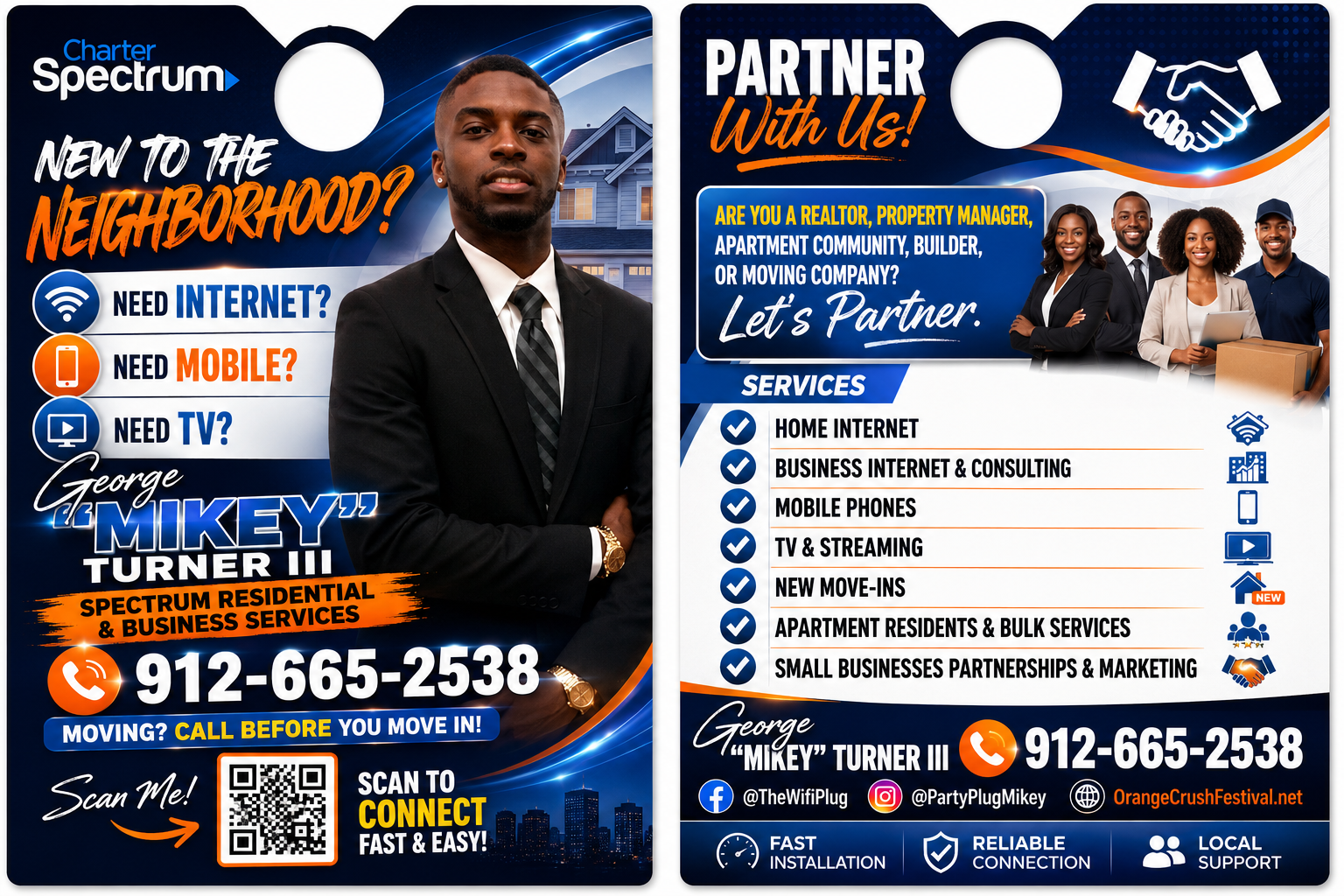

George “Mikey” Ransom Turner III is a Georgia-based entrepreneur, sales executive, event producer, military veteran, and strategic partnership builder whose career has centered around connecting
George “Mikey” Ransom Turner III
George “Mikey” Ransom Turner III is a Georgia-based entrepreneur, sales executive, event producer, military veteran, and strategic partnership builder whose career has centered around connecting people, brands, businesses, and communities through media, events, technology, and relationship-driven business development.
Born and raised in Savannah, Georgia, George developed an early reputation as a leader, athlete, and connector. During his years at Calvary Day School, he earned recognition as one of the state’s top three-point shooters, helped lead multiple playoff teams, earned regional honors, and was selected as a Wendy’s High School Heisman nominee. His experiences in athletics helped shape the competitive mindset, discipline, and leadership philosophy that would later define his entrepreneurial and professional career.
Following high school and college studies, George served in the United States Army, where he trained and worked in Chemical, Biological, Radiological, and Nuclear (CBRN) operations. His military service included deployment to the Middle East in support of national security operations. The Army strengthened his abilities in logistics, operations management, crisis response, team leadership, and mission execution under pressure.
After military service, George built a career in sales, marketing, telecommunications, and business development. Over the years he gained experience in both residential and business-to-business sales environments, helping customers navigate technology, communications, advertising, and connectivity solutions. His background includes telecommunications and media sales, local business marketing, digital advertising, and relationship management across diverse industries.
Today, George serves as a Spectrum Residential & Business Services professional, helping individuals, families, property managers, apartment communities, real estate professionals, builders, and business owners access internet, mobile, television, and business connectivity solutions. His approach extends beyond traditional sales. Rather than simply selling products, he focuses on building referral ecosystems and strategic partnerships that create long-term value for customers and partners alike.
In addition to his corporate career, George is widely recognized as the Founder and Owner of the Orange Crush brand platform. What began as a cultural event concept evolved into a broader ecosystem that includes entertainment, media, tourism, community engagement, sponsorship opportunities, and event production initiatives. Through Orange Crush, George has worked to build a recognizable regional brand that attracts students, young professionals, creators, businesses, sponsors, and community stakeholders from across the Southeast.
His vision for Orange Crush extends beyond festivals and events. He views the platform as a long-term media, lifestyle, and economic-development vehicle capable of generating opportunities for entrepreneurs, creators, local businesses, nonprofit organizations, and corporate partners. His long-range strategy includes event production, media distribution, digital content, tourism activation, educational programming, business networking, sponsorship sales, and community investment initiatives.
One of George’s strongest professional skills is sponsorship development. He specializes in identifying mutually beneficial relationships between brands and audiences, creating partnership opportunities that align business objectives with measurable community engagement. His work involves connecting businesses with consumers through experiential marketing, live events, digital media, grassroots outreach, and strategic visibility campaigns.
Throughout his career, George has developed relationships with:
• Apartment Communities
• Property Management Companies
• Realtors and Real Estate Brokerages
• Home Builders and Developers
• Mortgage Professionals
• Insurance Agencies
• Small Businesses
• Chambers of Commerce
• Community Organizations
• Corporate Sponsors
• Media Partners
• Entertainment Professionals
• Local Government Stakeholders
His philosophy is that every successful business is built on relationships, trust, and consistency. Whether working with a residential internet customer, a local business owner, a major sponsor, or a community partner, George focuses on creating genuine connections that lead to long-term growth and collaboration.
As a service-disabled veteran, entrepreneur, father, sales professional, and community advocate, George’s mission is to build sustainable businesses and partnerships that create opportunities for others while generating measurable economic impact. He believes technology, connectivity, media, and entrepreneurship can serve as powerful tools for community development and upward mobility.
Looking ahead, George’s vision includes becoming one of the Southeast’s leading partnership and sponsorship professionals while continuing to expand Orange Crush into a nationally recognized media and events platform. By combining telecommunications, media, sponsorships, business development, and community engagement, he aims to build a legacy centered on innovation, opportunity, and meaningful connections between people and organizations.
At the center of everything he does is a simple philosophy:
“Relationships create opportunities. Opportunities create growth. Growth creates impact.”

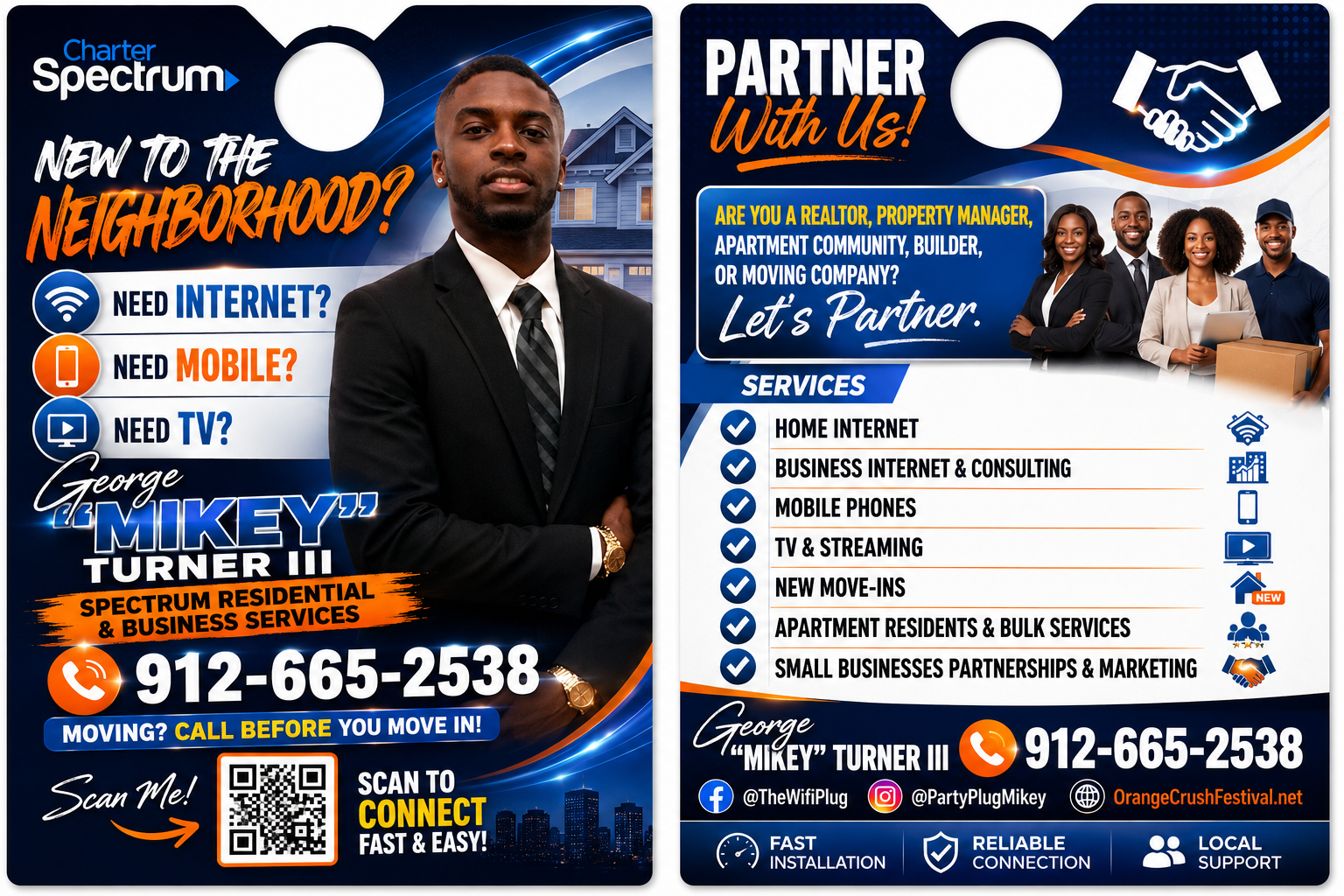

George “Mikey” Ransom Turner III
George “Mikey” Ransom Turner III
George “Mikey” Ransom Turner III is an entrepreneur, sales executive, event producer, and community connector based in Georgia.
He is indeed the Founder and Owner of Orange Crush Festival, one of the most recognized spring break and entertainment brands associated with the Southeast. Through Orange Crush, he works across event production, media, sponsorship development, experiential marketing, tourism, and community engagement.
Professionally, George serves as a Spectrum Residential & Business Services Representative, helping residents, apartment communities, property managers, real estate professionals, moving companies, and small businesses secure internet, mobile, TV, and connectivity solutions.
His core expertise includes:
• Sponsorship Sales & Brand Partnerships
• Business Development
• Community Relations
• Event Marketing & Promotions
• Referral Partner Network Building
• Residential & Business Telecommunications Sales
• Strategic Partnerships & Local Market Expansion
George’s current mission is to build one of Georgia’s largest referral-partner networks by connecting realtors, apartment communities, HOAs, builders, moving companies, chambers of commerce, and local businesses with Spectrum services while simultaneously expanding Orange Crush as a regional media and events platform.
Known for relationship-driven sales, networking, and grassroots marketing, George focuses on creating long-term partnerships that generate value for businesses, residents, sponsors, and community stakeholders alike.


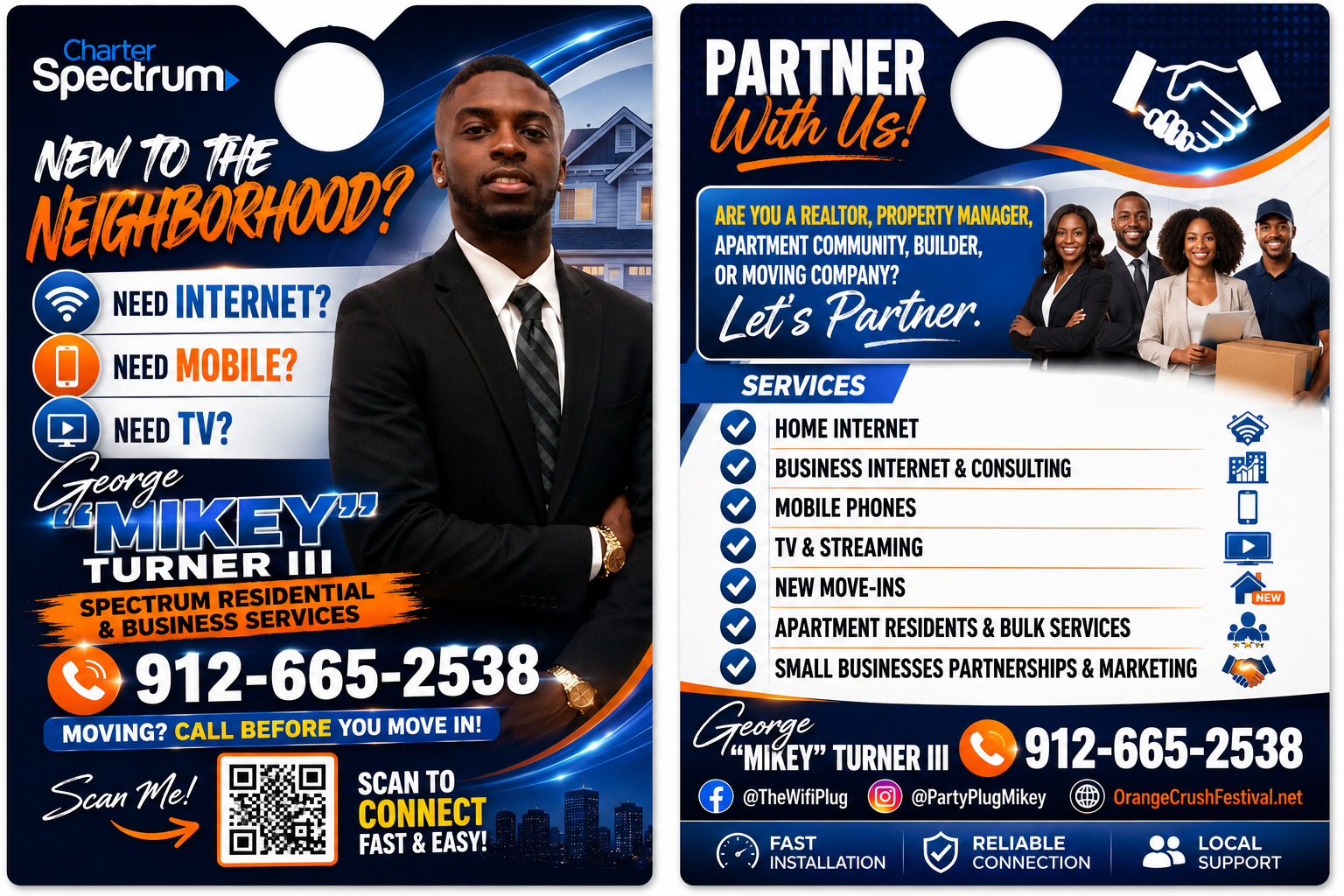
The Trust Infrastructure Why the Most Valuable Asset a Brand Can Build Is Not a Network of Towers, Stores, or Servers—But a Network of Relationships
The Trust Infrastructure
Why the Most Valuable Asset a Brand Can Build Is Not a Network of Towers, Stores, or Servers—But a Network of Relationships
Every major company invests in infrastructure.
Telecommunications companies build networks.
Banks build financial systems.
Airlines build transportation routes.
Technology companies build platforms.
Retailers build distribution systems.
These investments are essential.
Yet there is another form of infrastructure that often determines long-term success.
Trust infrastructure.
Unlike physical infrastructure, trust cannot be purchased outright.
It must be earned.
Built.
Maintained.
Strengthened.
Over time.
The Hidden Foundation of Growth
Every transaction depends on trust.
Every partnership depends on trust.
Every customer relationship depends on trust.
People trust organizations that consistently create value.
People trust organizations that demonstrate reliability.
People trust organizations that contribute positively to communities.
Trust influences decisions long before contracts are signed or purchases are made.
The Cost of Distrust
Organizations often measure customer acquisition costs.
Far fewer measure the cost of distrust.
Distrust creates:
Higher marketing expenses
Lower conversion rates
Reduced retention
Weaker referrals
Slower growth
Trust often produces the opposite.
Stronger loyalty.
Greater advocacy.
Improved customer retention.
More efficient growth.
The economic value of trust is substantial.
Communities as Trust Accelerators
Trust develops through repeated positive interactions.
Communities create environments where those interactions occur naturally.
People share experiences.
Exchange recommendations.
Build relationships.
Support one another.
Organizations that contribute meaningfully to communities often strengthen their reputation and credibility.
Trust becomes scalable.
Why Visibility Is No Longer Enough
For decades, many brands focused primarily on awareness.
The assumption was simple:
If enough people see the message, growth will follow.
Today’s marketplace is more complex.
Consumers have access to nearly unlimited information.
They can research products instantly.
Compare alternatives.
Read reviews.
Watch demonstrations.
Visibility creates awareness.
Trust influences decisions.
Organizations increasingly need both.
The Connectivity Example
Telecommunications providers illustrate this principle clearly.
Consumers depend on connectivity every day.
For education.
For work.
For healthcare.
For communication.
For entertainment.
For business.
Network performance matters.
Customer experience matters.
Reliability matters.
Every interaction either strengthens trust or weakens it.
Over time, these experiences shape brand perception.
The Community Investment Advantage
Organizations that invest in communities often create multiple forms of value simultaneously.
They strengthen:
Relationships
Reputation
Visibility
Goodwill
Engagement
These outcomes contribute to long-term organizational resilience.
Communities benefit.
Organizations benefit.
The relationship becomes mutually reinforcing.
Building Multi-Generational Value
The strongest brands often think beyond immediate results.
They focus on long-term relevance.
Today’s student may become tomorrow’s executive.
Today’s entrepreneur may become tomorrow’s industry leader.
Today’s customer may become tomorrow’s advocate.
Organizations that consistently invest in relationships often create value across generations.
Measuring Trust
Trust may be intangible, but its effects are measurable.
Indicators often include:
Customer retention
Brand preference
Referral activity
Community engagement
Partnership development
Reputation strength
These metrics frequently influence long-term performance more than short-term visibility alone.
The Infrastructure of the Future
The future economy will continue relying on physical infrastructure.
Roads.
Airports.
Networks.
Data centers.
Power systems.
But increasingly, success will also depend on trust infrastructure.
The relationships connecting organizations, communities, customers, creators, entrepreneurs, educators, and institutions.
Those connections create resilience.
They create opportunity.
They create growth.
The Competitive Advantage That Compounds
Technology evolves.
Markets change.
Consumer preferences shift.
Trust remains remarkably durable.
Organizations that consistently earn trust often create advantages that competitors struggle to replicate.
Because trust compounds.
Relationships compound.
Reputation compounds.
Community goodwill compounds.
And organizations that successfully build all four may possess one of the most valuable assets in modern business.
A network of relationships capable of creating value for decades.
That is trust infrastructure.
And it may become one of the defining competitive advantages of the twenty-first century.
The Trust Infrastructure Why the Most Valuable Asset a Brand Can Build Is Not a Network of Towers, Stores, or Servers—But a Network of Relationships
The Trust Infrastructure
Why the Most Valuable Asset a Brand Can Build Is Not a Network of Towers, Stores, or Servers—But a Network of Relationships
Every major company invests in infrastructure.
Telecommunications companies build networks.
Banks build financial systems.
Airlines build transportation routes.
Technology companies build platforms.
Retailers build distribution systems.
These investments are essential.
Yet there is another form of infrastructure that often determines long-term success.
Trust infrastructure.
Unlike physical infrastructure, trust cannot be purchased outright.
It must be earned.
Built.
Maintained.
Strengthened.
Over time.
The Hidden Foundation of Growth
Every transaction depends on trust.
Every partnership depends on trust.
Every customer relationship depends on trust.
People trust organizations that consistently create value.
People trust organizations that demonstrate reliability.
People trust organizations that contribute positively to communities.
Trust influences decisions long before contracts are signed or purchases are made.
The Cost of Distrust
Organizations often measure customer acquisition costs.
Far fewer measure the cost of distrust.
Distrust creates:
Higher marketing expenses
Lower conversion rates
Reduced retention
Weaker referrals
Slower growth
Trust often produces the opposite.
Stronger loyalty.
Greater advocacy.
Improved customer retention.
More efficient growth.
The economic value of trust is substantial.
Communities as Trust Accelerators
Trust develops through repeated positive interactions.
Communities create environments where those interactions occur naturally.
People share experiences.
Exchange recommendations.
Build relationships.
Support one another.
Organizations that contribute meaningfully to communities often strengthen their reputation and credibility.
Trust becomes scalable.
Why Visibility Is No Longer Enough
For decades, many brands focused primarily on awareness.
The assumption was simple:
If enough people see the message, growth will follow.
Today’s marketplace is more complex.
Consumers have access to nearly unlimited information.
They can research products instantly.
Compare alternatives.
Read reviews.
Watch demonstrations.
Visibility creates awareness.
Trust influences decisions.
Organizations increasingly need both.
The Connectivity Example
Telecommunications providers illustrate this principle clearly.
Consumers depend on connectivity every day.
For education.
For work.
For healthcare.
For communication.
For entertainment.
For business.
Network performance matters.
Customer experience matters.
Reliability matters.
Every interaction either strengthens trust or weakens it.
Over time, these experiences shape brand perception.
The Community Investment Advantage
Organizations that invest in communities often create multiple forms of value simultaneously.
They strengthen:
Relationships
Reputation
Visibility
Goodwill
Engagement
These outcomes contribute to long-term organizational resilience.
Communities benefit.
Organizations benefit.
The relationship becomes mutually reinforcing.
Building Multi-Generational Value
The strongest brands often think beyond immediate results.
They focus on long-term relevance.
Today’s student may become tomorrow’s executive.
Today’s entrepreneur may become tomorrow’s industry leader.
Today’s customer may become tomorrow’s advocate.
Organizations that consistently invest in relationships often create value across generations.
Measuring Trust
Trust may be intangible, but its effects are measurable.
Indicators often include:
Customer retention
Brand preference
Referral activity
Community engagement
Partnership development
Reputation strength
These metrics frequently influence long-term performance more than short-term visibility alone.
The Infrastructure of the Future
The future economy will continue relying on physical infrastructure.
Roads.
Airports.
Networks.
Data centers.
Power systems.
But increasingly, success will also depend on trust infrastructure.
The relationships connecting organizations, communities, customers, creators, entrepreneurs, educators, and institutions.
Those connections create resilience.
They create opportunity.
They create growth.
The Competitive Advantage That Compounds
Technology evolves.
Markets change.
Consumer preferences shift.
Trust remains remarkably durable.
Organizations that consistently earn trust often create advantages that competitors struggle to replicate.
Because trust compounds.
Relationships compound.
Reputation compounds.
Community goodwill compounds.
And organizations that successfully build all four may possess one of the most valuable assets in modern business.
A network of relationships capable of creating value for decades.
That is trust infrastructure.
And it may become one of the defining competitive advantages of the twenty-first century.
Why Forward-Thinking Brands Are Investing in Communities Instead of Campaigns
The Audience Asset
Why Forward-Thinking Brands Are Investing in Communities Instead of Campaigns
The most valuable asset in modern business is not inventory.
It is not real estate.
It is not technology.
It is not advertising.
It is audience.
More specifically:
An engaged audience.
A trusted audience.
A connected audience.
A growing audience.
Organizations spend billions of dollars annually attempting to capture attention.
Yet attention alone is becoming less valuable.
Relationships are becoming more valuable.
The future belongs to organizations capable of transforming audiences into communities and communities into ecosystems.
The New Economics of Attention
Consumers have never had more choices.
More platforms.
More content.
More brands.
More messages.
The challenge is no longer visibility.
The challenge is meaningful engagement.
People increasingly ignore interruptions.
They seek relevance.
They seek value.
They seek authenticity.
Organizations that consistently deliver those qualities often create stronger long-term outcomes than organizations focused solely on exposure.
Why Audience Ownership Matters
For years, brands relied heavily on rented audiences.
Social media platforms.
Advertising networks.
Search engines.
Streaming services.
These channels remain important.
However, organizations increasingly recognize the value of direct relationships.
Direct relationships create:
Better engagement
Stronger trust
Improved customer insights
Greater retention
Lower acquisition costs
The ability to communicate directly with an audience has become a significant strategic advantage.
The Rise of First-Party Relationships
As privacy regulations evolve and digital advertising continues changing, first-party relationships become increasingly important.
Brands seek opportunities to:
Build direct engagement
Encourage voluntary participation
Deliver meaningful experiences
Strengthen customer trust
The future increasingly belongs to organizations capable of creating authentic connections rather than simply purchasing impressions.
Community as a Growth Engine
Communities create momentum.
People introduce people.
Experiences create conversations.
Conversations create awareness.
Awareness creates interest.
Interest creates opportunity.
The strongest ecosystems often grow because participants become advocates.
Advocates become ambassadors.
Ambassadors help expand reach organically.
This cycle creates durable value.
The Student and Young Professional Market
Young adults represent one of the most influential future consumer segments in America.
Many will become:
Homeowners
Parents
Entrepreneurs
Executives
Community leaders
The organizations that engage authentically during these life stages often create long-term relationships that extend far beyond a single purchase.
The objective is not merely customer acquisition.
The objective is customer development.
The Creator Economy Opportunity
Today’s consumers are also publishers.
Every smartphone can create:
Videos
Livestreams
Reviews
Recommendations
Social content
The result is a constantly expanding media ecosystem.
Organizations that help empower creators often benefit from increased visibility, engagement, and community participation.
Why Major Sponsors Think Long-Term
Leading organizations increasingly evaluate partnerships through multiple lenses.
Brand visibility.
Customer engagement.
Community impact.
Workforce development.
Market access.
Relationship building.
The strongest opportunities often create value across several of these categories simultaneously.
This is where partnerships become more than marketing.
They become strategic assets.
The Ecosystem Effect
When audiences, communities, creators, businesses, institutions, and brands interact together, value expands.
Students connect with opportunities.
Entrepreneurs connect with resources.
Brands connect with consumers.
Communities connect with investment.
The ecosystem becomes larger than any individual participant.
That is where long-term value is created.
The Future of Brand Growth
The next decade will reward organizations that understand a simple principle:
People are not merely consumers.
They are participants.
They are creators.
They are community members.
They are future leaders.
The organizations that successfully invest in relationships today may create opportunities that compound for years to come.
Because the most valuable audiences are not those that simply watch.
They are the audiences that engage.
The audiences that participate.
The audiences that trust.
And trust remains one of the most powerful growth assets in the modern economy.
Why Forward-Thinking Brands Are Investing in Communities Instead of Campaigns
The Audience Asset
Why Forward-Thinking Brands Are Investing in Communities Instead of Campaigns
The most valuable asset in modern business is not inventory.
It is not real estate.
It is not technology.
It is not advertising.
It is audience.
More specifically:
An engaged audience.
A trusted audience.
A connected audience.
A growing audience.
Organizations spend billions of dollars annually attempting to capture attention.
Yet attention alone is becoming less valuable.
Relationships are becoming more valuable.
The future belongs to organizations capable of transforming audiences into communities and communities into ecosystems.
The New Economics of Attention
Consumers have never had more choices.
More platforms.
More content.
More brands.
More messages.
The challenge is no longer visibility.
The challenge is meaningful engagement.
People increasingly ignore interruptions.
They seek relevance.
They seek value.
They seek authenticity.
Organizations that consistently deliver those qualities often create stronger long-term outcomes than organizations focused solely on exposure.
Why Audience Ownership Matters
For years, brands relied heavily on rented audiences.
Social media platforms.
Advertising networks.
Search engines.
Streaming services.
These channels remain important.
However, organizations increasingly recognize the value of direct relationships.
Direct relationships create:
Better engagement
Stronger trust
Improved customer insights
Greater retention
Lower acquisition costs
The ability to communicate directly with an audience has become a significant strategic advantage.
The Rise of First-Party Relationships
As privacy regulations evolve and digital advertising continues changing, first-party relationships become increasingly important.
Brands seek opportunities to:
Build direct engagement
Encourage voluntary participation
Deliver meaningful experiences
Strengthen customer trust
The future increasingly belongs to organizations capable of creating authentic connections rather than simply purchasing impressions.
Community as a Growth Engine
Communities create momentum.
People introduce people.
Experiences create conversations.
Conversations create awareness.
Awareness creates interest.
Interest creates opportunity.
The strongest ecosystems often grow because participants become advocates.
Advocates become ambassadors.
Ambassadors help expand reach organically.
This cycle creates durable value.
The Student and Young Professional Market
Young adults represent one of the most influential future consumer segments in America.
Many will become:
Homeowners
Parents
Entrepreneurs
Executives
Community leaders
The organizations that engage authentically during these life stages often create long-term relationships that extend far beyond a single purchase.
The objective is not merely customer acquisition.
The objective is customer development.
The Creator Economy Opportunity
Today’s consumers are also publishers.
Every smartphone can create:
Videos
Livestreams
Reviews
Recommendations
Social content
The result is a constantly expanding media ecosystem.
Organizations that help empower creators often benefit from increased visibility, engagement, and community participation.
Why Major Sponsors Think Long-Term
Leading organizations increasingly evaluate partnerships through multiple lenses.
Brand visibility.
Customer engagement.
Community impact.
Workforce development.
Market access.
Relationship building.
The strongest opportunities often create value across several of these categories simultaneously.
This is where partnerships become more than marketing.
They become strategic assets.
The Ecosystem Effect
When audiences, communities, creators, businesses, institutions, and brands interact together, value expands.
Students connect with opportunities.
Entrepreneurs connect with resources.
Brands connect with consumers.
Communities connect with investment.
The ecosystem becomes larger than any individual participant.
That is where long-term value is created.
The Future of Brand Growth
The next decade will reward organizations that understand a simple principle:
People are not merely consumers.
They are participants.
They are creators.
They are community members.
They are future leaders.
The organizations that successfully invest in relationships today may create opportunities that compound for years to come.
Because the most valuable audiences are not those that simply watch.
They are the audiences that engage.
The audiences that participate.
The audiences that trust.
And trust remains one of the most powerful growth assets in the modern economy.
Why Leading Brands Are Investing in Ecosystems
The Community Investment Thesis
Why Leading Brands Are Investing in Ecosystems
The most sophisticated organizations no longer evaluate opportunities through the lens of sponsorship alone.
They evaluate opportunities through the lens of investment.
An advertisement is an expense.
A strategic partnership is an investment.
The distinction matters.
Expenses disappear after they are spent.
Investments create future value.
This shift is changing how corporations, municipalities, universities, and institutions approach community engagement, economic development, and brand growth.
The Evolution of Corporate Investment
Historically, many sponsorship decisions focused on visibility.
Questions included:
How many attendees?
How many impressions?
How many advertisements?
How many media placements?
These metrics remain important.
However, executive leadership teams increasingly ask additional questions.
Will this strengthen customer relationships?
Will this improve brand trust?
Will this support future workforce development?
Will this increase community goodwill?
Will this expand market opportunities?
Will this generate long-term value?
These questions move beyond marketing.
They move into strategic investment.
The Ecosystem Advantage
An event is temporary.
An ecosystem is continuous.
Events happen on specific dates.
Ecosystems operate year-round.
The most valuable partnership opportunities increasingly function as ecosystems connecting:
Businesses
Students
Entrepreneurs
Families
Communities
Institutions
Investors
These connections continue generating value long after a single activation concludes.
The Four Pillars of Community Investment
Education
Education remains one of the strongest long-term economic drivers.
Organizations that support learning often help strengthen future workforce development, innovation, and economic competitiveness.
Entrepreneurship
Entrepreneurs create businesses.
Businesses create jobs.
Jobs create economic activity.
Supporting entrepreneurship often produces benefits throughout an entire community.
Connectivity
Digital infrastructure enables participation in the modern economy.
Connectivity supports education, employment, healthcare, communication, and commerce.
Access increasingly influences opportunity.
Community Engagement
Strong communities create stronger markets.
Organizations that contribute meaningfully to community growth often strengthen both reputation and long-term business performance.
Why Trust Matters
Trust is one of the most valuable business assets.
Consumers increasingly have unlimited choices.
Products can be compared instantly.
Prices can be matched quickly.
Technology evolves rapidly.
Trust remains difficult to replicate.
Organizations that consistently demonstrate commitment to communities often strengthen trust over time.
That trust influences future decisions.
The Workforce Development Opportunity
Many industries face ongoing workforce challenges.
Organizations increasingly recognize the value of engaging future professionals earlier.
Students today represent tomorrow’s:
Engineers
Entrepreneurs
Teachers
Healthcare professionals
Technologists
Business leaders
Partnerships that support education and career development may help create stronger future talent pipelines.
The Customer Development Opportunity
Customers evolve.
Students become professionals.
Professionals become homeowners.
Homeowners become parents.
Parents become community leaders.
Each stage introduces new needs and purchasing decisions.
Organizations that establish trust early often benefit from long-term customer relationships.
Measuring Investment Success
The strongest partnerships often evaluate success across multiple dimensions.
Financial outcomes matter.
Community outcomes matter.
Relationship outcomes matter.
Examples include:
Customer engagement
Brand trust
Workforce development
Community impact
Economic activity
Educational access
Entrepreneurial growth
Together, these indicators provide a broader understanding of value creation.
Thinking Beyond the Quarter
Public companies often operate within quarterly reporting cycles.
Successful organizations also think beyond the next quarter.
They think about:
Five-year opportunities
Ten-year opportunities
Generational opportunities
The strongest investments often require patience.
Trust compounds.
Relationships compound.
Reputation compounds.
Community goodwill compounds.
The Future of Partnership Strategy
The organizations that create the most value in the coming decades may not be those that spend the most money.
They may be those that build the strongest ecosystems.
Ecosystems that connect people.
Ecosystems that create opportunity.
Ecosystems that strengthen communities.
Ecosystems that support growth.
Because when organizations invest in ecosystems rather than isolated moments, they often create something much larger than a sponsorship.
They create a platform for shared success.
And shared success remains one of the most powerful investment strategies ever developed.
Why the Smartest Brands Focus on Relationships Before Transactions
Access Before Acquisition
Why the Smartest Brands Focus on Relationships Before Transactions
Every year, corporations spend billions of dollars trying to acquire customers.
Advertising.
Marketing.
Sales campaigns.
Promotions.
Discounts.
Lead generation.
Yet many organizations overlook a fundamental reality.
Customer acquisition becomes significantly easier when customer access already exists.
The companies that consistently win are often the companies that build relationships before they attempt to make sales.
The Difference Between Access and Acquisition
Acquisition happens when a transaction occurs.
Access happens when a relationship begins.
Many organizations focus exclusively on acquisition metrics.
How many customers purchased?
How many leads converted?
How many subscriptions were sold?
These measurements matter.
But they represent outcomes.
The larger opportunity often exists earlier in the process.
How many people trust the brand?
How many people recognize the brand?
How many people engage with the brand?
How many people view the organization positively?
Access frequently determines acquisition.
The Trust Economy
Modern consumers possess unprecedented access to information.
They can compare products.
Read reviews.
Watch demonstrations.
Evaluate competitors.
Research pricing.
Because of this transparency, trust has become increasingly valuable.
Organizations no longer compete solely on products.
They compete on credibility.
The question consumers often ask is not:
“What is the best option?”
The question becomes:
“Who do I trust?”
Community Creates Access
Communities create environments where trust develops naturally.
People interact.
Ideas are exchanged.
Relationships form.
Experiences are shared.
Organizations that participate authentically in communities often create stronger relationships than those relying solely on advertising.
Trust grows through participation.
Credibility grows through contribution.
Why Experiences Matter
Experiences create emotional connections.
People remember:
Conversations
Opportunities
Educational experiences
Community initiatives
Meaningful interactions
Experiences help transform organizations from brands into relationships.
That distinction creates long-term value.
The Student Opportunity
College students represent one of the most influential future consumer groups in America.
Many will become:
Homeowners
Parents
Entrepreneurs
Community leaders
Business executives
Organizations that establish trust early may benefit from years of future engagement.
The opportunity is not simply reaching students.
The opportunity is building future relationships.
The Family Opportunity
Households remain central to consumer decision-making.
Families make decisions regarding:
Internet services
Mobile providers
Banking relationships
Insurance products
Healthcare services
Travel choices
A trusted household relationship can generate value across multiple product categories and life stages.
The Entrepreneurial Opportunity
Entrepreneurs frequently influence broader communities.
Business owners recommend vendors.
Share experiences.
Build networks.
Create employment.
Support local economies.
Organizations that assist entrepreneurs often strengthen their position within growing economic ecosystems.
Why Corporate Partners Are Shifting Strategy
Many executives now recognize that long-term growth requires more than advertising exposure.
They seek opportunities to:
Build trust
Strengthen communities
Support education
Encourage entrepreneurship
Improve brand perception
Create authentic engagement
These objectives often generate benefits that extend well beyond a single campaign.
Access Creates Opportunity
Organizations that establish meaningful access gain several advantages.
They improve familiarity.
They strengthen credibility.
They increase engagement.
They enhance trust.
Over time, these advantages often contribute to stronger acquisition outcomes.
Relationships create opportunities that advertising alone cannot always achieve.
The Future of Growth
The next generation of growth strategies will increasingly focus on access before acquisition.
Relationships before transactions.
Value before promotion.
Trust before conversion.
Organizations that understand this sequence often position themselves for sustainable success.
Because customers rarely appear at the moment of purchase.
They begin forming opinions long before that decision occurs.
The organizations that successfully earn trust during that journey often earn something much more valuable than a sale.
They earn a relationship.
And in the modern economy, relationships remain one of the most powerful assets a business can possess.
Why the Most Valuable Partnerships Reach Consumers Long Before and Long After the Event
The Customer Journey Ecosystem
Why the Most Valuable Partnerships Reach Consumers Long Before and Long After the Event
Every company wants customers.
The most successful companies understand something deeper.
Customers do not appear overnight.
They evolve.
A college student becomes a graduate.
A graduate becomes a professional.
A professional becomes a homeowner.
A homeowner becomes a parent.
A parent becomes a business owner.
A business owner becomes an investor.
Every stage creates new needs.
New purchasing decisions.
New opportunities for brands to provide value.
The organizations that understand this journey often build stronger relationships and greater lifetime value.
The Traditional Marketing Problem
Most advertising reaches consumers for a moment.
A commercial.
A social media post.
A billboard.
A digital advertisement.
The interaction is brief.
The connection is temporary.
The challenge becomes maintaining relevance after the campaign ends.
This is why many organizations are increasingly focused on ecosystems rather than isolated campaigns.
Ecosystems create ongoing engagement.
The Power of Multi-Stage Engagement
Modern consumers interact with brands across multiple environments.
Education.
Entertainment.
Employment.
Entrepreneurship.
Community involvement.
Technology.
Travel.
Financial planning.
Family life.
Every stage presents opportunities for meaningful engagement.
Organizations that support consumers throughout these transitions often create stronger long-term relationships.
Students: The Future Workforce
Today’s students are tomorrow’s professionals.
They represent:
Future homeowners
Future entrepreneurs
Future parents
Future investors
Future executives
Organizations that engage young adults responsibly and authentically often create familiarity that lasts for years.
The objective is not immediate conversion.
The objective is long-term trust.
Young Professionals: Building Stability
As consumers enter the workforce, priorities evolve.
They begin considering:
Internet services
Mobile plans
Banking relationships
Insurance coverage
Transportation options
Housing opportunities
Brands that remain visible and relevant during these transitions often strengthen customer retention.
Entrepreneurs: Creating Economic Growth
Small businesses continue driving innovation throughout America.
Entrepreneurs need:
Connectivity
Financial services
Marketing resources
Technology solutions
Professional networks
Organizations that help entrepreneurs succeed contribute to broader economic development while creating valuable business relationships.
Families: The Household Economy
The household remains one of the most important economic centers in society.
Families make decisions regarding:
Communications
Education
Entertainment
Healthcare
Transportation
Financial planning
A trusted relationship at the household level can influence purchasing decisions for years.
The Community Connection
Communities influence behavior.
Consumers trust recommendations from:
Friends
Family
Co-workers
Community leaders
Organizations that support communities often strengthen their reputation and credibility.
Trust becomes a growth asset.
Why Sponsors Are Thinking Beyond Events
Forward-thinking organizations increasingly evaluate opportunities through a broader lens.
Questions include:
Can this partnership create customer relationships?
Can it strengthen community engagement?
Can it support workforce development?
Can it improve brand trust?
Can it generate long-term value?
These questions move beyond event sponsorship and toward ecosystem participation.
The Opportunity Platform
A modern partnership platform can support:
Consumer engagement
Educational initiatives
Entrepreneurship programs
Workforce development
Community outreach
Media storytelling
Technology access
Together, these elements create year-round opportunities for meaningful interaction.
The Future of Partnership Strategy
The strongest partnerships will increasingly focus on people rather than impressions.
Relationships rather than transactions.
Trust rather than visibility alone.
Long-term value rather than short-term attention.
Organizations that successfully connect with consumers throughout multiple stages of life often create something far more valuable than awareness.
They create loyalty.
Because customers are not static.
They are constantly evolving.
And the brands that evolve alongside them are often the brands that remain relevant for generations.
Why the Most Valuable Partnerships Reach Consumers Long Before and Long After the Event
The Customer Journey Ecosystem
Why the Most Valuable Partnerships Reach Consumers Long Before and Long After the Event
Every company wants customers.
The most successful companies understand something deeper.
Customers do not appear overnight.
They evolve.
A college student becomes a graduate.
A graduate becomes a professional.
A professional becomes a homeowner.
A homeowner becomes a parent.
A parent becomes a business owner.
A business owner becomes an investor.
Every stage creates new needs.
New purchasing decisions.
New opportunities for brands to provide value.
The organizations that understand this journey often build stronger relationships and greater lifetime value.
The Traditional Marketing Problem
Most advertising reaches consumers for a moment.
A commercial.
A social media post.
A billboard.
A digital advertisement.
The interaction is brief.
The connection is temporary.
The challenge becomes maintaining relevance after the campaign ends.
This is why many organizations are increasingly focused on ecosystems rather than isolated campaigns.
Ecosystems create ongoing engagement.
The Power of Multi-Stage Engagement
Modern consumers interact with brands across multiple environments.
Education.
Entertainment.
Employment.
Entrepreneurship.
Community involvement.
Technology.
Travel.
Financial planning.
Family life.
Every stage presents opportunities for meaningful engagement.
Organizations that support consumers throughout these transitions often create stronger long-term relationships.
Students: The Future Workforce
Today’s students are tomorrow’s professionals.
They represent:
Future homeowners
Future entrepreneurs
Future parents
Future investors
Future executives
Organizations that engage young adults responsibly and authentically often create familiarity that lasts for years.
The objective is not immediate conversion.
The objective is long-term trust.
Young Professionals: Building Stability
As consumers enter the workforce, priorities evolve.
They begin considering:
Internet services
Mobile plans
Banking relationships
Insurance coverage
Transportation options
Housing opportunities
Brands that remain visible and relevant during these transitions often strengthen customer retention.
Entrepreneurs: Creating Economic Growth
Small businesses continue driving innovation throughout America.
Entrepreneurs need:
Connectivity
Financial services
Marketing resources
Technology solutions
Professional networks
Organizations that help entrepreneurs succeed contribute to broader economic development while creating valuable business relationships.
Families: The Household Economy
The household remains one of the most important economic centers in society.
Families make decisions regarding:
Communications
Education
Entertainment
Healthcare
Transportation
Financial planning
A trusted relationship at the household level can influence purchasing decisions for years.
The Community Connection
Communities influence behavior.
Consumers trust recommendations from:
Friends
Family
Co-workers
Community leaders
Organizations that support communities often strengthen their reputation and credibility.
Trust becomes a growth asset.
Why Sponsors Are Thinking Beyond Events
Forward-thinking organizations increasingly evaluate opportunities through a broader lens.
Questions include:
Can this partnership create customer relationships?
Can it strengthen community engagement?
Can it support workforce development?
Can it improve brand trust?
Can it generate long-term value?
These questions move beyond event sponsorship and toward ecosystem participation.
The Opportunity Platform
A modern partnership platform can support:
Consumer engagement
Educational initiatives
Entrepreneurship programs
Workforce development
Community outreach
Media storytelling
Technology access
Together, these elements create year-round opportunities for meaningful interaction.
The Future of Partnership Strategy
The strongest partnerships will increasingly focus on people rather than impressions.
Relationships rather than transactions.
Trust rather than visibility alone.
Long-term value rather than short-term attention.
Organizations that successfully connect with consumers throughout multiple stages of life often create something far more valuable than awareness.
They create loyalty.
Because customers are not static.
They are constantly evolving.
And the brands that evolve alongside them are often the brands that remain relevant for generations.
Why the Most Valuable Corporate Partnerships Are Built Around Shared Growth
Beyond Sponsorship
Why the Most Valuable Corporate Partnerships Are Built Around Shared Growth
For many years, sponsorship was viewed as a marketing expense.
A logo on a banner.
A commercial during an event.
A sign near a stage.
A digital advertisement.
While those tactics still have value, the most successful organizations increasingly view partnerships through a different lens.
Not as sponsorships.
As growth platforms.
The question is no longer:
“How many impressions did we buy?”
The question is:
“What value did we create together?”
Organizations that answer this question effectively often generate stronger returns than those focused solely on visibility.
The Evolution of Partnership Strategy
Modern executives are accountable for measurable outcomes.
Marketing leaders seek customer acquisition.
Sales leaders seek revenue growth.
Community affairs leaders seek meaningful impact.
Human resource leaders seek talent development.
Public affairs teams seek trust and credibility.
Economic development leaders seek investment and opportunity.
The strongest partnerships create value across multiple objectives simultaneously.
This is where strategic platforms become powerful.
The New Partnership Model
A modern partnership ecosystem creates benefits for multiple stakeholders at the same time.
For Brands
Opportunities include:
Customer acquisition
Lead generation
Brand visibility
Community engagement
Market research
Consumer insights
Content creation
Relationship development
For Communities
Benefits may include:
Economic activity
Tourism
Technology access
Educational resources
Workforce development
Entrepreneurial opportunities
For Consumers
Value may include:
Experiences
Resources
Information
Access
Entertainment
Professional development
When all three groups benefit, partnership value becomes significantly more durable.
The Multi-Touchpoint Advantage
Consumers rarely make decisions based on a single interaction.
Trust develops through repetition.
A modern partnership platform can create engagement through:
Live experiences
Digital media
Educational initiatives
Community programming
Content marketing
Social engagement
Business networking
Workforce development
Every interaction reinforces the relationship.
Every interaction increases familiarity.
Every interaction strengthens trust.
Industry Opportunities
Telecommunications
Connectivity powers modern life.
Partnership opportunities may include:
Digital inclusion initiatives
Connectivity activations
Creator economy support
Workforce development
Educational technology
Financial Services
Financial institutions increasingly seek opportunities to support:
Financial literacy
Entrepreneurship
Homeownership education
Wealth-building initiatives
Small business growth
Automotive
Automotive brands benefit from:
Product visibility
Experiential marketing
Lifestyle alignment
Regional market engagement
Healthcare
Healthcare organizations often focus on:
Wellness initiatives
Community education
Preventive care awareness
Public health engagement
Technology
Technology companies can showcase:
Innovation
Emerging solutions
Workforce readiness
Digital transformation
Every industry possesses unique strengths that can contribute to a larger ecosystem.
Why Communities Matter
Communities remain one of the most influential forces in commerce.
People trust people.
People trust relationships.
People trust experiences.
Organizations that genuinely contribute to community growth often create stronger emotional connections than those relying solely on traditional advertising.
These relationships frequently translate into long-term business value.
Measuring Partnership Success
Successful partnerships increasingly evaluate outcomes beyond impressions.
Key measurements may include:
Brand engagement
Customer acquisition
Lead generation
Community impact
Digital engagement
Economic activity
Content reach
Relationship growth
These metrics provide a more complete understanding of partnership performance.
Building Long-Term Value
The strongest partnerships are not built around a weekend.
They are built around a vision.
A vision for:
Economic growth
Educational opportunity
Entrepreneurship
Connectivity
Innovation
Community development
Organizations that align around these objectives often create value that extends far beyond a single campaign.
The Future of Sponsorship
The future belongs to partnerships that create measurable value for everyone involved.
Brands want growth.
Communities want opportunity.
Consumers want meaningful experiences.
When these goals align, sponsorship evolves into something much larger.
A platform.
An ecosystem.
A long-term growth strategy.
Because the most valuable partnerships are not defined by what one organization receives.
They are defined by what multiple organizations build together.
And the organizations that understand this principle will be best positioned to create lasting impact in the years ahead.
Why the Most Valuable Corporate Partnerships Are Built Around Shared Growth
Beyond Sponsorship
Why the Most Valuable Corporate Partnerships Are Built Around Shared Growth
For many years, sponsorship was viewed as a marketing expense.
A logo on a banner.
A commercial during an event.
A sign near a stage.
A digital advertisement.
While those tactics still have value, the most successful organizations increasingly view partnerships through a different lens.
Not as sponsorships.
As growth platforms.
The question is no longer:
“How many impressions did we buy?”
The question is:
“What value did we create together?”
Organizations that answer this question effectively often generate stronger returns than those focused solely on visibility.
The Evolution of Partnership Strategy
Modern executives are accountable for measurable outcomes.
Marketing leaders seek customer acquisition.
Sales leaders seek revenue growth.
Community affairs leaders seek meaningful impact.
Human resource leaders seek talent development.
Public affairs teams seek trust and credibility.
Economic development leaders seek investment and opportunity.
The strongest partnerships create value across multiple objectives simultaneously.
This is where strategic platforms become powerful.
The New Partnership Model
A modern partnership ecosystem creates benefits for multiple stakeholders at the same time.
For Brands
Opportunities include:
Customer acquisition
Lead generation
Brand visibility
Community engagement
Market research
Consumer insights
Content creation
Relationship development
For Communities
Benefits may include:
Economic activity
Tourism
Technology access
Educational resources
Workforce development
Entrepreneurial opportunities
For Consumers
Value may include:
Experiences
Resources
Information
Access
Entertainment
Professional development
When all three groups benefit, partnership value becomes significantly more durable.
The Multi-Touchpoint Advantage
Consumers rarely make decisions based on a single interaction.
Trust develops through repetition.
A modern partnership platform can create engagement through:
Live experiences
Digital media
Educational initiatives
Community programming
Content marketing
Social engagement
Business networking
Workforce development
Every interaction reinforces the relationship.
Every interaction increases familiarity.
Every interaction strengthens trust.
Industry Opportunities
Telecommunications
Connectivity powers modern life.
Partnership opportunities may include:
Digital inclusion initiatives
Connectivity activations
Creator economy support
Workforce development
Educational technology
Financial Services
Financial institutions increasingly seek opportunities to support:
Financial literacy
Entrepreneurship
Homeownership education
Wealth-building initiatives
Small business growth
Automotive
Automotive brands benefit from:
Product visibility
Experiential marketing
Lifestyle alignment
Regional market engagement
Healthcare
Healthcare organizations often focus on:
Wellness initiatives
Community education
Preventive care awareness
Public health engagement
Technology
Technology companies can showcase:
Innovation
Emerging solutions
Workforce readiness
Digital transformation
Every industry possesses unique strengths that can contribute to a larger ecosystem.
Why Communities Matter
Communities remain one of the most influential forces in commerce.
People trust people.
People trust relationships.
People trust experiences.
Organizations that genuinely contribute to community growth often create stronger emotional connections than those relying solely on traditional advertising.
These relationships frequently translate into long-term business value.
Measuring Partnership Success
Successful partnerships increasingly evaluate outcomes beyond impressions.
Key measurements may include:
Brand engagement
Customer acquisition
Lead generation
Community impact
Digital engagement
Economic activity
Content reach
Relationship growth
These metrics provide a more complete understanding of partnership performance.
Building Long-Term Value
The strongest partnerships are not built around a weekend.
They are built around a vision.
A vision for:
Economic growth
Educational opportunity
Entrepreneurship
Connectivity
Innovation
Community development
Organizations that align around these objectives often create value that extends far beyond a single campaign.
The Future of Sponsorship
The future belongs to partnerships that create measurable value for everyone involved.
Brands want growth.
Communities want opportunity.
Consumers want meaningful experiences.
When these goals align, sponsorship evolves into something much larger.
A platform.
An ecosystem.
A long-term growth strategy.
Because the most valuable partnerships are not defined by what one organization receives.
They are defined by what multiple organizations build together.
And the organizations that understand this principle will be best positioned to create lasting impact in the years ahead.
How America’s Leading Connectivity Companies Are Helping Shape the Future of Communities, Education, Business, and Culture
Different Networks. Shared Opportunity.
How America’s Leading Connectivity Companies Are Helping Shape the Future of Communities, Education, Business, and Culture
The future of America will be built through connections.
Connections between people.
Connections between communities.
Connections between businesses.
Connections between ideas.
And increasingly, those connections are powered by telecommunications infrastructure.
Across the country, leading connectivity providers continue investing billions of dollars into networks that support education, entrepreneurship, commerce, entertainment, healthcare, and economic development.
While each organization approaches the market differently, they all contribute to a shared objective:
Connecting people to opportunity.
The Infrastructure Economy
Modern life depends on connectivity.
Students rely on digital learning.
Families rely on streaming and communication.
Businesses rely on cloud services and digital commerce.
Communities rely on broadband access and mobile connectivity.
As demand continues growing, telecommunications providers remain among the most significant infrastructure investors in the United States.
Their networks help power the daily activities that drive economic growth.
AT&T: Building Long-Term Connectivity
For generations, AT&T has played a significant role in America’s communications landscape.
The company’s investments in wireless, fiber, enterprise technology, and community initiatives continue supporting millions of households and businesses.
Areas of impact include:
Fiber expansion
Wireless innovation
Business connectivity
Educational initiatives
Community engagement
Workforce development
AT&T’s long-standing presence across the Southeast and throughout the nation positions the company as an important contributor to economic and digital development.
T-Mobile: Driving the Mobile Future
T-Mobile has established a reputation for innovation, speed, and customer-focused growth.
Its nationwide 5G investments continue expanding access to advanced wireless services for consumers, creators, entrepreneurs, and businesses.
Key strengths include:
Advanced wireless networks
Mobile-first innovation
Creator economy alignment
Consumer engagement
Technology accessibility
Digital lifestyle integration
As mobile technology continues evolving, organizations like T-Mobile help accelerate new forms of communication and participation.
Comcast and Xfinity: Connecting Homes and Businesses
Broadband access remains a critical component of modern life.
Through internet, mobile, entertainment, and business solutions, Comcast and Xfinity help connect millions of households and organizations.
Their contributions support:
Residential broadband
Small business operations
Streaming ecosystems
Digital learning
Community investment
Technology accessibility
Strong broadband infrastructure helps create opportunities for both families and entrepreneurs.
Spectrum: Supporting Everyday Connectivity
Spectrum serves millions of residential and business customers through broadband, mobile, entertainment, and communications services.
The company’s focus on connectivity helps support households, small businesses, educational access, and community participation.
Areas of impact include:
Broadband access
Mobile connectivity
Small business support
Community investment
Workforce participation
Digital inclusion
As communities continue becoming more connected, providers like Spectrum help support the infrastructure behind daily life.
Verizon: Powering Innovation
Verizon continues investing heavily in wireless infrastructure, business solutions, and emerging technologies.
Its network investments help support industries ranging from healthcare and education to logistics and entertainment.
Core strengths include:
Network reliability
Enterprise solutions
Wireless innovation
Public sector support
Emerging technologies
Large-scale infrastructure investment
Technology leadership remains an important component of America’s digital future.
A Shared Mission
While each company brings unique capabilities, they collectively contribute to a larger national objective.
Expanding opportunity.
Strengthening communities.
Supporting innovation.
Connecting businesses.
Empowering students.
Enabling entrepreneurship.
Advancing economic growth.
The future of connectivity is not simply about technology.
It is about people.
The Opportunity Ahead
As communities continue evolving, partnerships between telecommunications providers, educational institutions, municipalities, entrepreneurs, media organizations, and cultural platforms will become increasingly important.
Together, these stakeholders can help expand access, strengthen economic opportunity, support workforce development, and create pathways for future growth.
The companies building networks today are helping build the opportunities of tomorrow.
Because every innovation begins with a connection.
Every opportunity begins with access.
And every connected future begins with infrastructure.
How America’s Leading Connectivity Companies Are Helping Shape the Future of Communities, Education, Business, and Culture
Different Networks. Shared Opportunity.
How America’s Leading Connectivity Companies Are Helping Shape the Future of Communities, Education, Business, and Culture
The future of America will be built through connections.
Connections between people.
Connections between communities.
Connections between businesses.
Connections between ideas.
And increasingly, those connections are powered by telecommunications infrastructure.
Across the country, leading connectivity providers continue investing billions of dollars into networks that support education, entrepreneurship, commerce, entertainment, healthcare, and economic development.
While each organization approaches the market differently, they all contribute to a shared objective:
Connecting people to opportunity.
The Infrastructure Economy
Modern life depends on connectivity.
Students rely on digital learning.
Families rely on streaming and communication.
Businesses rely on cloud services and digital commerce.
Communities rely on broadband access and mobile connectivity.
As demand continues growing, telecommunications providers remain among the most significant infrastructure investors in the United States.
Their networks help power the daily activities that drive economic growth.
AT&T: Building Long-Term Connectivity
For generations, AT&T has played a significant role in America’s communications landscape.
The company’s investments in wireless, fiber, enterprise technology, and community initiatives continue supporting millions of households and businesses.
Areas of impact include:
Fiber expansion
Wireless innovation
Business connectivity
Educational initiatives
Community engagement
Workforce development
AT&T’s long-standing presence across the Southeast and throughout the nation positions the company as an important contributor to economic and digital development.
T-Mobile: Driving the Mobile Future
T-Mobile has established a reputation for innovation, speed, and customer-focused growth.
Its nationwide 5G investments continue expanding access to advanced wireless services for consumers, creators, entrepreneurs, and businesses.
Key strengths include:
Advanced wireless networks
Mobile-first innovation
Creator economy alignment
Consumer engagement
Technology accessibility
Digital lifestyle integration
As mobile technology continues evolving, organizations like T-Mobile help accelerate new forms of communication and participation.
Comcast and Xfinity: Connecting Homes and Businesses
Broadband access remains a critical component of modern life.
Through internet, mobile, entertainment, and business solutions, Comcast and Xfinity help connect millions of households and organizations.
Their contributions support:
Residential broadband
Small business operations
Streaming ecosystems
Digital learning
Community investment
Technology accessibility
Strong broadband infrastructure helps create opportunities for both families and entrepreneurs.
Spectrum: Supporting Everyday Connectivity
Spectrum serves millions of residential and business customers through broadband, mobile, entertainment, and communications services.
The company’s focus on connectivity helps support households, small businesses, educational access, and community participation.
Areas of impact include:
Broadband access
Mobile connectivity
Small business support
Community investment
Workforce participation
Digital inclusion
As communities continue becoming more connected, providers like Spectrum help support the infrastructure behind daily life.
Verizon: Powering Innovation
Verizon continues investing heavily in wireless infrastructure, business solutions, and emerging technologies.
Its network investments help support industries ranging from healthcare and education to logistics and entertainment.
Core strengths include:
Network reliability
Enterprise solutions
Wireless innovation
Public sector support
Emerging technologies
Large-scale infrastructure investment
Technology leadership remains an important component of America’s digital future.
A Shared Mission
While each company brings unique capabilities, they collectively contribute to a larger national objective.
Expanding opportunity.
Strengthening communities.
Supporting innovation.
Connecting businesses.
Empowering students.
Enabling entrepreneurship.
Advancing economic growth.
The future of connectivity is not simply about technology.
It is about people.
The Opportunity Ahead
As communities continue evolving, partnerships between telecommunications providers, educational institutions, municipalities, entrepreneurs, media organizations, and cultural platforms will become increasingly important.
Together, these stakeholders can help expand access, strengthen economic opportunity, support workforce development, and create pathways for future growth.
The companies building networks today are helping build the opportunities of tomorrow.
Because every innovation begins with a connection.
Every opportunity begins with access.
And every connected future begins with infrastructure.
The Platform Economy Why the Most Valuable Organizations No Longer Operate as Single Businesses
The Platform Economy
Why the Most Valuable Organizations No Longer Operate as Single Businesses
The most powerful companies in the modern economy rarely win because they sell a product.
They win because they build a platform.
A platform connects people.
A platform creates opportunity.
A platform enables transactions.
A platform attracts partnerships.
A platform generates value for multiple stakeholders simultaneously.
This distinction is important.
Products can be copied.
Platforms are much harder to replicate.
The Evolution of Value Creation
Historically, businesses operated through relatively simple models.
A manufacturer produced goods.
A retailer sold products.
A service provider delivered expertise.
Value moved in a straight line.
Today’s economy increasingly operates through networks.
Organizations create value by connecting:
Customers
Businesses
Creators
Communities
Institutions
Investors
The more connections a platform creates, the more valuable the platform can become.
The Network Effect
Platforms benefit from a powerful economic principle.
The network effect.
As participation increases, value often increases.
More users create more opportunities.
More partners create more resources.
More engagement creates more visibility.
More visibility attracts additional participants.
Growth begins reinforcing itself.
The platform becomes stronger because people continue joining it.
Why Community Matters
Every successful platform ultimately depends on people.
Communities create:
Engagement
Trust
Participation
Content
Advocacy
Innovation
Technology may enable a platform.
People give it life.
Organizations that successfully cultivate community often create stronger ecosystems than those focused solely on transactions.
The Rise of Multi-Stakeholder Platforms
The next generation of growth increasingly involves multiple stakeholders operating together.
Examples include:
Businesses
Universities
Municipalities
Nonprofits
Entrepreneurs
Media organizations
Technology providers
Each participant contributes unique value.
Together, they create opportunities that would be difficult to achieve independently.
This collaborative model is becoming increasingly common across industries.
Connectivity as a Platform Enabler
Modern platforms depend on connectivity.
Communication.
Commerce.
Content creation.
Collaboration.
Education.
Innovation.
All require reliable digital infrastructure.
Connectivity providers therefore play a unique role.
They help enable the interactions that make platforms possible.
Without strong networks, platform growth becomes more difficult.
With strong networks, participation expands.
The Economic Development Opportunity
Communities increasingly compete for talent, investment, entrepreneurship, and innovation.
Platforms can support these goals by creating environments where connections occur more frequently.
Students meet employers.
Entrepreneurs meet investors.
Businesses meet customers.
Organizations meet partners.
The platform becomes an engine for opportunity creation.
Why Sponsors Are Thinking Differently
Traditional sponsorship models often focus on visibility.
Modern partnership strategies increasingly focus on participation.
Organizations want to contribute.
Collaborate.
Engage.
Create value.
The most effective partnerships move beyond logos and advertisements.
They become integrated relationships that support broader objectives.
Building Durable Ecosystems
The strongest platforms often share common characteristics.
They create value repeatedly.
They support multiple stakeholders.
They encourage participation.
They facilitate meaningful interactions.
They remain relevant over time.
These qualities create resilience.
The ecosystem becomes larger than any individual participant.
Looking Ahead
The future economy will likely continue rewarding organizations that connect people, ideas, resources, and opportunities.
The most valuable companies may not be those with the largest inventories.
Or the largest buildings.
Or even the largest audiences.
They may be the organizations that create the most valuable connections.
Because connections create relationships.
Relationships create trust.
Trust creates opportunity.
And opportunity creates growth.
In the platform economy, growth is no longer driven solely by what an organization owns.
It is increasingly driven by what an organization connects.
The organizations that understand this shift may help shape the next generation of economic, technological, and community development.
Because platforms do more than generate transactions.
They create ecosystems where opportunity can flourish.
The Platform Economy Why the Most Valuable Organizations No Longer Operate as Single Businesses
The Platform Economy
Why the Most Valuable Organizations No Longer Operate as Single Businesses
The most powerful companies in the modern economy rarely win because they sell a product.
They win because they build a platform.
A platform connects people.
A platform creates opportunity.
A platform enables transactions.
A platform attracts partnerships.
A platform generates value for multiple stakeholders simultaneously.
This distinction is important.
Products can be copied.
Platforms are much harder to replicate.
The Evolution of Value Creation
Historically, businesses operated through relatively simple models.
A manufacturer produced goods.
A retailer sold products.
A service provider delivered expertise.
Value moved in a straight line.
Today’s economy increasingly operates through networks.
Organizations create value by connecting:
Customers
Businesses
Creators
Communities
Institutions
Investors
The more connections a platform creates, the more valuable the platform can become.
The Network Effect
Platforms benefit from a powerful economic principle.
The network effect.
As participation increases, value often increases.
More users create more opportunities.
More partners create more resources.
More engagement creates more visibility.
More visibility attracts additional participants.
Growth begins reinforcing itself.
The platform becomes stronger because people continue joining it.
Why Community Matters
Every successful platform ultimately depends on people.
Communities create:
Engagement
Trust
Participation
Content
Advocacy
Innovation
Technology may enable a platform.
People give it life.
Organizations that successfully cultivate community often create stronger ecosystems than those focused solely on transactions.
The Rise of Multi-Stakeholder Platforms
The next generation of growth increasingly involves multiple stakeholders operating together.
Examples include:
Businesses
Universities
Municipalities
Nonprofits
Entrepreneurs
Media organizations
Technology providers
Each participant contributes unique value.
Together, they create opportunities that would be difficult to achieve independently.
This collaborative model is becoming increasingly common across industries.
Connectivity as a Platform Enabler
Modern platforms depend on connectivity.
Communication.
Commerce.
Content creation.
Collaboration.
Education.
Innovation.
All require reliable digital infrastructure.
Connectivity providers therefore play a unique role.
They help enable the interactions that make platforms possible.
Without strong networks, platform growth becomes more difficult.
With strong networks, participation expands.
The Economic Development Opportunity
Communities increasingly compete for talent, investment, entrepreneurship, and innovation.
Platforms can support these goals by creating environments where connections occur more frequently.
Students meet employers.
Entrepreneurs meet investors.
Businesses meet customers.
Organizations meet partners.
The platform becomes an engine for opportunity creation.
Why Sponsors Are Thinking Differently
Traditional sponsorship models often focus on visibility.
Modern partnership strategies increasingly focus on participation.
Organizations want to contribute.
Collaborate.
Engage.
Create value.
The most effective partnerships move beyond logos and advertisements.
They become integrated relationships that support broader objectives.
Building Durable Ecosystems
The strongest platforms often share common characteristics.
They create value repeatedly.
They support multiple stakeholders.
They encourage participation.
They facilitate meaningful interactions.
They remain relevant over time.
These qualities create resilience.
The ecosystem becomes larger than any individual participant.
Looking Ahead
The future economy will likely continue rewarding organizations that connect people, ideas, resources, and opportunities.
The most valuable companies may not be those with the largest inventories.
Or the largest buildings.
Or even the largest audiences.
They may be the organizations that create the most valuable connections.
Because connections create relationships.
Relationships create trust.
Trust creates opportunity.
And opportunity creates growth.
In the platform economy, growth is no longer driven solely by what an organization owns.
It is increasingly driven by what an organization connects.
The organizations that understand this shift may help shape the next generation of economic, technological, and community development.
Because platforms do more than generate transactions.
They create ecosystems where opportunity can flourish.
Why the Most Successful Organizations Focus on Relationships That Last for Decades
The Lifetime Value Economy
Why the Most Successful Organizations Focus on Relationships That Last for Decades
Every company tracks revenue.
Most companies track customers.
The most successful companies track something much more important.
Lifetime value.
Because the true value of a customer is rarely measured by a single transaction.
It is measured by the relationship that follows.
A monthly subscriber.
A repeat customer.
A long-term client.
A loyal advocate.
A family that stays with a brand for years.
These relationships create the foundation of sustainable growth.
Beyond the First Sale
Many organizations devote enormous resources toward customer acquisition.
Advertising campaigns.
Marketing budgets.
Promotional offers.
Lead generation systems.
Sales teams.
These investments are important.
But acquisition is only the beginning.
The greater opportunity often emerges after the first sale.
Will the customer stay?
Will they upgrade?
Will they recommend the brand?
Will they purchase additional services?
Will they remain loyal through changing life stages?
The answers determine lifetime value.
The Compounding Effect
A customer relationship behaves much like compound interest.
The longer the relationship lasts, the greater the potential value.
One satisfied customer may eventually become:
A multi-product customer
A referral source
A community advocate
A repeat buyer
A long-term subscriber
The economic impact can extend far beyond the original transaction.
This is why retention often receives increasing executive attention.
Keeping trust is frequently more efficient than rebuilding it.
The Student-to-Professional Journey
Consider a typical customer journey.
A student selects a service provider while attending college.
A few years later they enter the workforce.
Eventually they rent an apartment.
Purchase a home.
Start a family.
Launch a business.
At each stage, new needs emerge.
Internet.
Mobile service.
Financial products.
Insurance.
Travel.
Home services.
Technology solutions.
The relationship evolves.
The opportunity expands.
Organizations that remain relevant throughout these transitions often create extraordinary lifetime value.
Why Connectivity Matters
Few services remain as consistently present throughout life as connectivity.
People rely on networks for:
Education
Employment
Entertainment
Commerce
Communication
Entrepreneurship
Connectivity follows consumers through nearly every stage of modern life.
This creates opportunities for service providers to become long-term partners rather than short-term vendors.
Trust becomes the differentiator.
The Household Multiplier
Customers rarely make decisions in isolation.
A single household can influence:
Family members
Friends
Co-workers
Neighbors
Business partners
Positive experiences often spread.
Negative experiences often spread.
The impact of a customer relationship extends well beyond the individual account holder.
Every satisfied customer can become a growth asset.
Community as a Retention Strategy
Organizations increasingly recognize that retention is not solely a customer service function.
It is also a relationship function.
People are more likely to remain connected to organizations they trust.
Trust is often strengthened through:
Community engagement
Educational initiatives
Local partnerships
Meaningful experiences
Consistent value creation
Strong relationships create stronger retention.
The New Economics of Growth
Historically, growth was often associated with expansion alone.
More locations.
More advertising.
More customers.
Today’s marketplace requires a more balanced approach.
Growth now depends on:
Acquisition
Retention
Trust
Reputation
Customer experience
Organizations that excel across all five areas frequently create stronger and more sustainable outcomes.
Thinking in Decades
Quarterly results matter.
Annual results matter.
But the strongest organizations also think in decades.
They ask:
How do we remain valuable?
How do we remain trusted?
How do we remain relevant?
How do we continue serving customers as their lives evolve?
These questions often determine long-term success.
The Future of Customer Relationships
Technology will continue changing.
Markets will continue evolving.
Consumer expectations will continue rising.
Yet one principle is likely to remain constant.
Organizations that consistently create value, earn trust, and strengthen relationships will remain well positioned for future growth.
Because the greatest business asset is not a transaction.
It is a relationship that continues generating value year after year.
And in the lifetime value economy, those relationships may become the most valuable assets of all.