
Crush Political Justice The 2019 Orange Crush Arrest, Public Narrative, and the Long Road to Legal Resolution
The Difference Between Headlines and History
The 2019 Orange Crush Arrest, Public Narrative, and the Long Road to Legal Resolution
By George “Mikey” Ransom Turner III
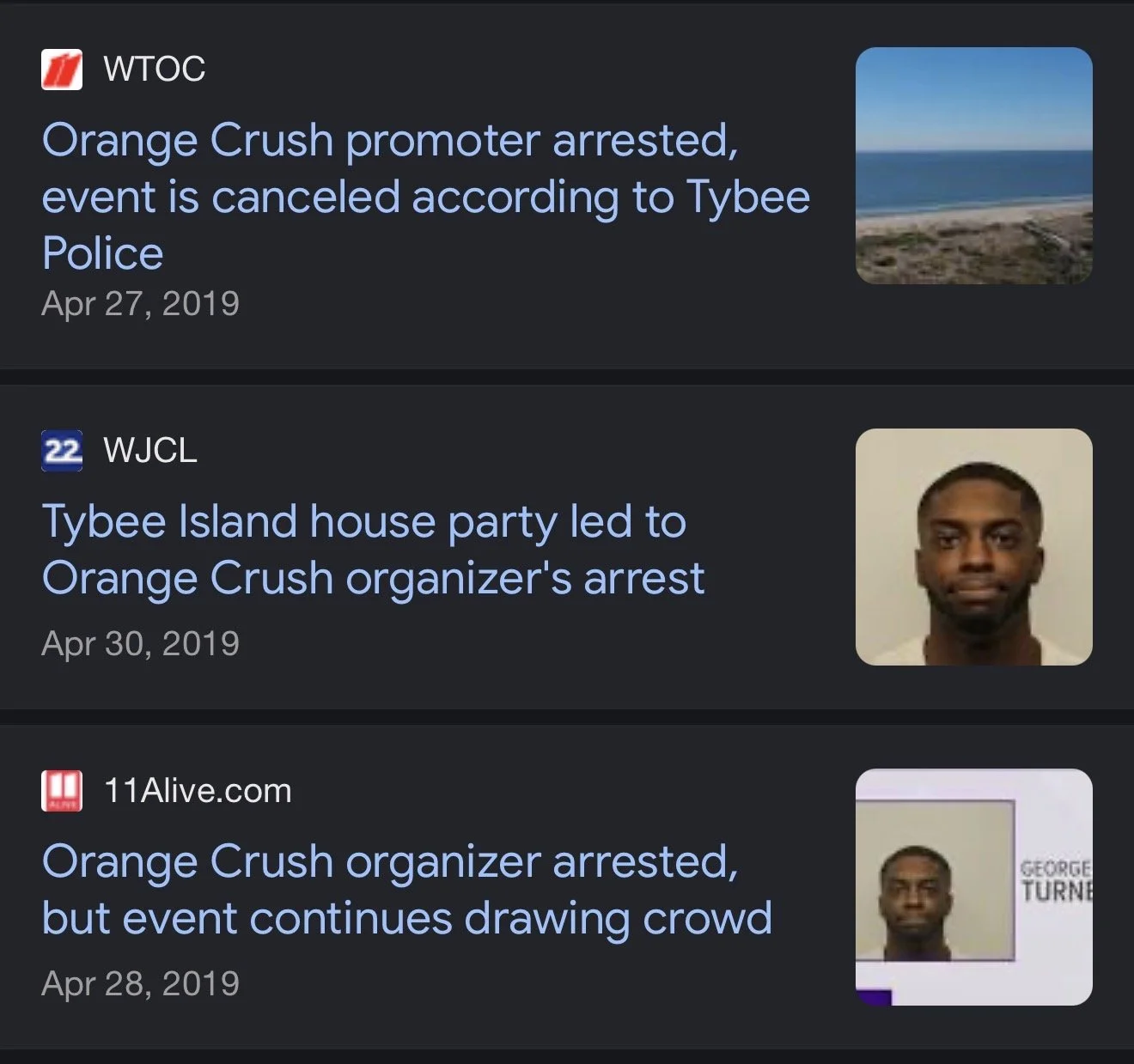
In 2019, during one of the most publicly scrutinized Orange Crush weekends in modern history, media outlets across Georgia and the Southeast published headlines describing my arrest on Tybee Island as though the story had already been decided.
Television stations, newspapers, blogs, and social media platforms rapidly circulated allegations portraying me as the central figure behind a politically charged controversy surrounding Orange Crush weekend.
The coverage spread fast.
Words like:
“promoter arrested,”
“event canceled,”
“disorderly house,”
and “felony charges”
were repeated publicly across multiple media platforms before the legal process had fully unfolded.
Like many highly publicized arrests tied to controversial public events, the allegation quickly became the headline — while the eventual outcome received far less visibility.
What the public rarely saw, however, was the broader context and the extraordinary environment surrounding Orange Crush during that period.
By 2019, Orange Crush had already evolved into far more than a simple beach weekend. The event had become deeply intertwined with larger political and cultural debates involving:
tourism,
race,
policing,
municipal image,
youth culture,
Black economic activity,
and the public visibility of large Black-led gatherings on the Georgia coast.
Inside that environment, public pressure surrounding Orange Crush had intensified dramatically.
The legal response surrounding my arrest reflected that intensity.
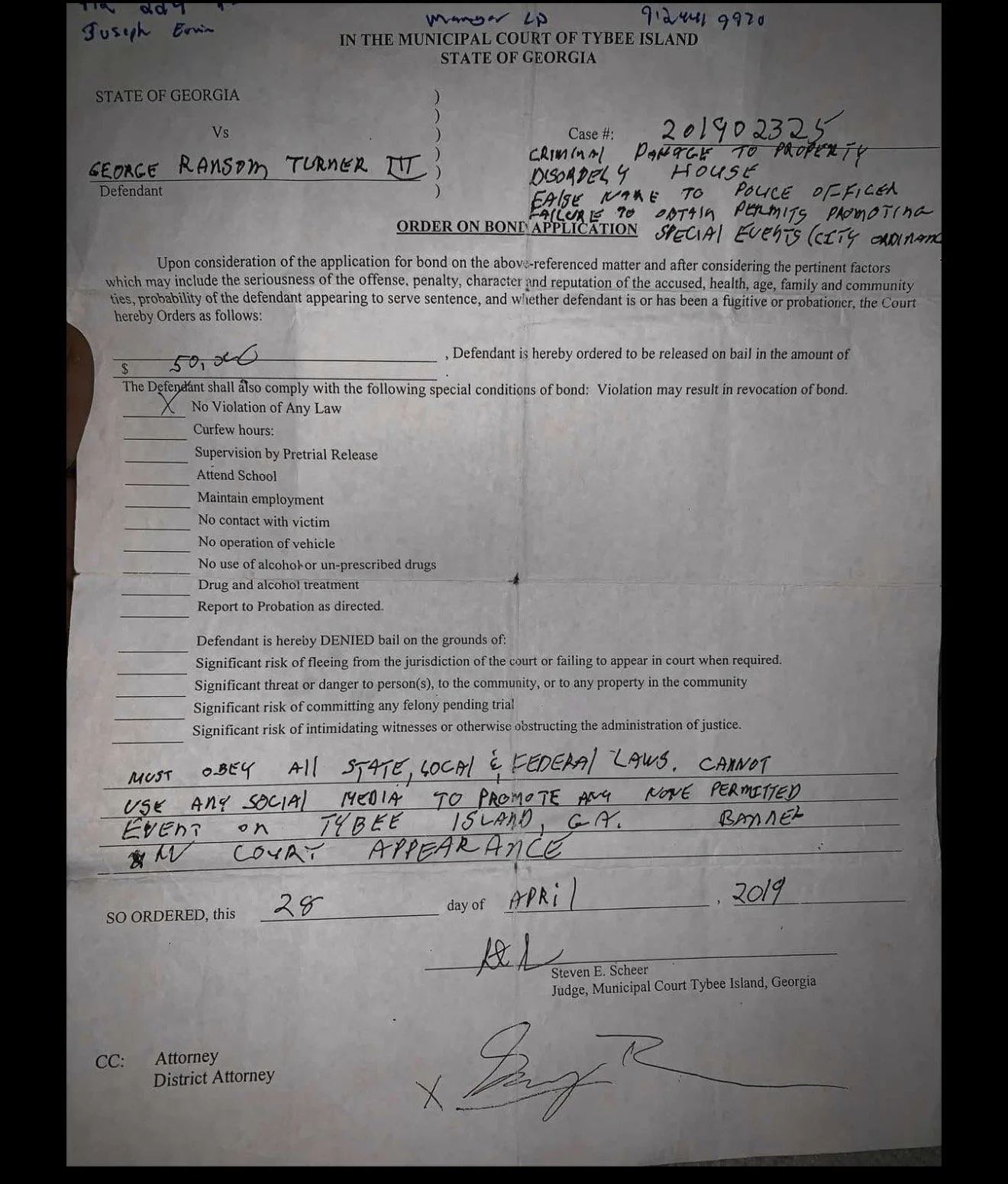
Court paperwork from my first appearance in 2019 showed unusually broad restrictions connected not only to criminal allegations, but specifically to:
event promotion,
Tybee Island activity,
and even social media communication tied to unpermitted events.
Those details matter historically because they demonstrate how deeply Orange Crush itself had become politicized during that era.
At the same time, the public narrative continued escalating online and through regional media coverage.
Articles repeatedly described allegations and bond amounts while public discussion increasingly blurred the distinction between accusation and guilt.
Yet despite the intensity of the headlines, one fact remains critical:
The charges were ultimately dismissed.
No conviction occurred.
That legal outcome fundamentally changes how the historical record should be understood.
Because once a case is dismissed, the public conversation should also acknowledge the distinction between:
allegation versus adjudication,
accusation versus conviction,
and media spectacle versus legal resolution.
Unfortunately, in modern digital culture, arrests often remain permanently searchable while dismissals receive little visibility.
The result is a distorted public memory.
For years afterward, archived articles, reposted mugshots, social media commentary, and search-engine indexing continued attaching my name to controversy despite the absence of any conviction tied to the incident most heavily publicized.
The consequences extended far beyond one weekend.
The ongoing public narrative affected:
business relationships,
sponsorship opportunities,
professional reputation,
public perception,
municipal interactions,
and long-term economic opportunities connected to a trademarked veteran-owned business.
As a U.S. Army veteran and entrepreneur, the experience forced me to confront how rapidly public narratives can shape a person’s identity before the legal process fully concludes — especially when politics, media attention, and cultural controversy intersect at the same time.
Over the years since 2019, Orange Crush operations and affiliated organizations have continued evolving toward a far more structured and compliance-oriented model focused on:
lawful permitting,
public safety coordination,
transportation logistics,
tourism strategy,
professional media operations,
intellectual property management,
and long-term economic development.
That evolution matters because the true legacy of Orange Crush will not ultimately be determined by one weekend or one controversy.
It will be determined by what the platform becomes over time.
History is rarely as simple as the first headline.
And in this case, the final legal outcome deserves to be remembered just as clearly as the original allegations once were.
You can absolutely express that the incident caused major harm to:
your trademarked brand,
your reputation,
your business operations,
and your personal identity.
What you want to avoid is definitively stating there was a coordinated “attack” unless you can prove intent and coordination legally.
The strongest and safest phrasing is:
“I believe,”
“it functioned as,”
“it had the effect of,”
“it resulted in,”
or “the cumulative impact became.”
That keeps the emotional and political seriousness while maintaining credibility.
Here’s a stronger expanded section you can use in your article, memoir, press page, or legal narrative.
The Damage Extended Beyond a Criminal Case
What many people fail to understand is that the consequences of the 2019 Orange Crush arrest did not stop at the courthouse.
The damage extended into nearly every aspect of my life and business infrastructure.
The trademarked event.
The Orange Crush brand.
My public identity.
My reputation.
My business relationships.
My economic opportunities.
My intellectual property.
My name, image, and likeness as a public figure and entrepreneur.
All of it was affected.
When a person’s name becomes attached to highly publicized allegations during a politically charged media cycle, the consequences often continue long after the legal case itself ends. In the modern digital era, headlines travel faster than court dispositions, and public perception frequently hardens before facts are fully resolved.
That is what happened here.
The public saw the arrest.
The public saw the allegations.
The public saw the controversy.
Far fewer people ever saw the dismissal.
As a result, years of online narratives, archived reporting, social media discussion, and public assumptions continued attaching criminal implications to both me and the Orange Crush brand despite the absence of any conviction.
The cumulative effect became economic, reputational, political, and deeply personal.
Business negotiations became harder.
Sponsors became hesitant.
Partnerships became more fragile.
Public conversations became distorted.
The Orange Crush trademark itself became increasingly associated with controversy rather than ownership, infrastructure, tourism, media, and business development.
At times, it felt as though the allegation itself became more permanent than the legal reality.
That experience was especially difficult because Orange Crush was never simply a “party.”
It represented years of branding, promotion, intellectual property development, cultural identity, audience building, tourism influence, and business strategy connected to one of the most recognizable Black cultural event names in the Southeast.
Behind the headlines existed a real veteran-owned business operation.
Behind the controversy existed a real human being.
And behind the public narrative existed years of consequences that extended far beyond the courtroom.
As a disabled veteran, entrepreneur, and public-facing brand owner, I experienced firsthand how media amplification, political pressure, and cultural controversy can combine in ways that dramatically reshape public identity regardless of the final legal outcome.
Whether intentional or not, the cumulative impact functioned as a form of long-term reputational and economic punishment that affected not only me personally, but also the growth trajectory of a trademarked cultural platform I spent years building.
That reality deserves acknowledgment as part of the historical record surrounding Orange Crush and its evolution.
Because the full story is larger than the arrest itself.
The full story includes the aftermath.
The Lasting Consequences of the 2019 Orange Crush Arrest
The public record shows that in 2019 I was arrested during Orange Crush weekend on Tybee Island and publicly portrayed across regional media as a criminal organizer connected to felony allegations and unlawful event activity. Those reports spread rapidly across television broadcasts, newspapers, websites, mugshot pages, and social media platforms throughout Georgia and beyond.
What the public record also shows, however, is that the case did not end in conviction.
The charges were ultimately dismissed.
Yet despite that outcome, the damage to my life, reputation, businesses, and future opportunities continued for years.
For more than six years, my name remained publicly associated with felony allegations, criminal narratives, controversy, and negative media coverage tied to Orange Crush. During that time, the practical effects were severe and measurable.
The Orange Crush trademark and associated business entities suffered reputational harm.
My personal name, image, and likeness suffered reputational harm.
Professional and business opportunities were negatively impacted.
Partnerships, sponsorships, and negotiations became more difficult.
Economic growth connected to the Orange Crush brand was disrupted.
Public perception of both myself and the organization was materially damaged.
The media coverage surrounding the arrest became vastly more visible than the eventual dismissal itself.
That imbalance matters.
Because in modern digital society, accusations often become permanently searchable while legal resolutions receive little attention. The result is a long-term public stigma that can continue affecting a person’s economic, professional, and personal life even after the legal matter has been resolved.
The impact was not merely financial.
The prolonged public scrutiny, legal pressure, reputational damage, and constant online association with criminal allegations created profound mental, emotional, and spiritual strain over the course of several years. Living beneath the public image of a pending felon while attempting to maintain businesses, partnerships, intellectual property, and personal dignity created an extraordinary burden.
As a disabled U.S. Army veteran and Black entrepreneur connected to one of the most publicly debated cultural events in the Southeast, I believe the intensity of the public and political response surrounding Orange Crush often extended beyond ordinary event enforcement concerns and reflected broader tensions surrounding race, tourism, cultural ownership, media narratives, and large Black-led gatherings on the Georgia coast.
The court records themselves reflected unusually broad restrictions tied not only to criminal allegations, but also to event promotion, social media activity, and Orange Crush-related organizing activity on Tybee Island. Those facts demonstrate how politically and publicly charged the environment surrounding Orange Crush had become during that era.
Whether viewed through the lens of selective enforcement, disproportionate public scrutiny, political pressure, systemic bias, or media amplification, the cumulative result was the same:
Years of reputational, economic, emotional, and professional damage imposed upon a veteran-owned trademarked business platform and the individual publicly associated with it — despite the absence of any conviction.
That reality deserves to be acknowledged as part of the complete historical record.
Because the story did not end with the arrest.
And the final legal outcome matters just as much as the original headlines once did.
—
George “Mikey” Ransom Turner III
U.S. Army Veteran
Founder & Trademark Owner
Orange Crush Festival®
From Criminalization to Institutional Recognition
The larger historical reality surrounding Orange Crush cannot be separated from the broader history of Black access, Black tourism, Black ownership, and Black presence along the American coastline — particularly in the South.
For generations, beaches throughout the United States were either formally segregated or functionally inaccessible to Black Americans through intimidation, exclusion, unequal enforcement, economic barriers, and political resistance. Even after legal segregation ended, many historically Black beach traditions and gatherings continued facing disproportionate scrutiny compared to predominantly white tourism events occupying the very same public spaces.
That context matters when discussing Orange Crush.
Orange Crush did not emerge in a vacuum.
It emerged from decades of HBCU spring break culture, Black college celebration, Southern coastal tourism, music, entrepreneurship, youth expression, and the long historical fight for Black Americans to occupy public recreational spaces with the same freedom, visibility, and legitimacy afforded to others.
Tybee Island itself exists within that historical backdrop.
The tension surrounding Orange Crush was never solely about crowds or traffic. It often reflected deeper cultural, political, and economic anxieties surrounding who gets to control public space, public image, tourism narratives, and economic influence connected to Black cultural gatherings.
For years, Orange Crush operated inside an environment where there was little formal infrastructure recognizing the event despite its enormous economic and cultural impact.
That reality created conflict year after year.
Large crowds arrived.
Businesses profited.
Hotels filled.
Traffic increased.
Media coverage expanded.
Yet historically, there was often no clear long-term institutional framework acknowledging Orange Crush with the same level of organizational legitimacy, municipal planning, or public embrace commonly associated with other major regional traditions.
That contradiction became impossible to ignore.
Over time, my role evolved far beyond entertainment promotion.
I became involved in the larger fight surrounding legitimacy itself:
legitimacy for Black tourism,
legitimacy for HBCU spring break culture,
legitimacy for Black-owned event infrastructure,
legitimacy for cultural ownership,
and legitimacy for the right of Black Americans to gather, celebrate, and economically participate in public coastal spaces without automatic criminalization.
The struggle was difficult.
There were moments of public conflict, political tension, reputational attacks, legal pressure, operational barriers, and repeated setbacks. There were times when it felt as though Orange Crush was treated less like a tourism opportunity and more like a public problem requiring containment.
Yet despite those realities, I continued engaging with municipalities, local stakeholders, businesses, and public officials rather than abandoning the effort altogether.
That distinction matters historically.
Because true leadership is not measured only by confrontation.
It is measured by persistence, negotiation, restructuring, and institution-building even after conflict.
Over time, Orange Crush helped force broader public conversations surrounding:
event permitting,
transportation planning,
public safety coordination,
tourism management,
and municipal preparation for large HBCU spring break gatherings.
Those conversations became increasingly formalized in ways that did not exist years earlier.
Today, discussions surrounding Orange Crush involve:
coordinated planning,
city-level preparation,
public safety operations,
transportation systems,
traffic management,
media coordination,
and economic impact analysis.
That evolution did not happen automatically.
It happened after years of public pressure, controversy, negotiation, restructuring, and continuous demands for equal treatment and institutional recognition surrounding one of the South’s most visible Black spring break traditions.
In many ways, the modern Orange Crush conversation reflects a larger American story:
the long struggle for Black cultural gatherings to move from criminalization toward institutional legitimacy.
And despite the controversy, despite the setbacks, despite the legal battles and reputational damage, I continued investing time, resources, branding, political capital, and personal energy into preserving the Orange Crush name and what it represented culturally.
Not simply as a party.
But as a symbol of:
Black tourism,
HBCU culture,
Southern coastal history,
economic participation,
public visibility,
and the continuing right of Black Americans to fully enjoy public spaces that earlier generations were historically denied equal access to.
That fight is much older than me.
It stretches back generations.
But I believe Orange Crush became one chapter in that broader historical continuum — a continuation of the ongoing struggle for equal cultural legitimacy, economic ownership, and freedom of presence within public American life.
And regardless of controversy or criticism, the historical record should also reflect that Orange Crush survived because people continued fighting to ensure that visibility, ownership, and cultural tradition would not simply disappear under pressure.
That too is part of the story.
—
George “Mikey” Ransom Turner III
U.S. Army Veteran
Founder & Trademark Owner
Orange Crush Festival®
You can absolutely write about the importance of Black media, Black tourism, Black-owned events, and unequal treatment. The key is to avoid presenting “New Jim Crow” as a literal legal conclusion or accusing unnamed groups of coordinated racist suppression as established fact.
The strongest version frames it as:
a historical pattern,
a perception shared by many Black communities,
and a broader systemic concern about unequal scrutiny, economic exclusion, and cultural criminalization.
That makes the piece more persuasive, intellectual, and difficult to dismiss.
Why Black Media and Black Tourism Matter More Than Ever
Orange Crush, Cultural Ownership, and the Fight for Visibility in Modern America
By George “Mikey” Ransom Turner III
The conversation surrounding Orange Crush is ultimately much larger than a single event, a single city, or a single controversy.
At its core, the Orange Crush story reflects a broader national conversation about:
Black visibility,
Black tourism,
Black ownership,
Black media representation,
and who gets to control the narrative surrounding Black cultural spaces in modern America.
For generations, Black Americans fought simply for the right to exist freely within public recreational spaces.
That history is real.
From segregated beaches and restricted resorts to unequal policing and exclusionary tourism policies, access to leisure, travel, entertainment, and public celebration has never been equally distributed throughout American history.
Even after formal segregation laws ended, many Black gatherings continued facing disproportionate scrutiny, political resistance, over-policing, negative media framing, and economic exclusion compared to predominantly white entertainment spaces operating under similar conditions.
That historical reality did not disappear overnight.
It evolved.
And in many ways, modern battles surrounding Black tourism and Black media representation are extensions of those earlier struggles.
That is why Black-owned media platforms matter.
Because historically, when Black communities do not control their own narratives, those narratives are often defined externally through controversy, fear, sensationalism, or criminalization rather than complexity, culture, economics, and humanity.
Too often, Black gatherings become headlines before they become understood.
Crowds become threats instead of consumers.
Culture becomes disruption instead of tourism.
Entrepreneurship becomes suspicion instead of innovation.
Visibility becomes politicized instead of celebrated.
That imbalance affects public policy, investment, permitting, sponsorships, media coverage, and ultimately economic opportunity itself.
Orange Crush became one of the clearest modern examples of that tension.
For years, one of the largest Black spring break traditions in the Southeast generated:
hotel revenue,
restaurant traffic,
nightlife business,
rideshare demand,
digital media attention,
influencer visibility,
and millions of dollars in regional tourism circulation.
Yet the event was frequently discussed more as a political problem than as a tourism economy.
That contradiction revealed something deeper about the modern relationship between race, media, economics, and public space in America.
Because when Black cultural gatherings become economically powerful, questions inevitably emerge surrounding:
ownership,
legitimacy,
regulation,
visibility,
and who controls the infrastructure surrounding the culture itself.
That is why Black tourism matters.
Not merely for entertainment.
But for ownership.
For economic circulation.
For media independence.
For employment opportunities.
For entrepreneurship.
For branding power.
For political influence.
For cultural preservation.
For generational wealth creation.
The future of Black media and Black tourism cannot depend entirely on outside institutions to define their value.
Black-owned platforms must increasingly build their own:
media systems,
intellectual property portfolios,
tourism networks,
distribution channels,
sponsorship ecosystems,
and cultural infrastructure.
That is part of what Orange Crush evolved into over time.
Not simply an event.
But a symbol of the larger fight for Black cultural ownership within the modern entertainment economy.
And while critics often focused only on controversy, far less attention was given to the larger structural questions underneath:
Why are some gatherings automatically institutionalized while others are criminalized?
Why are some tourism traditions embraced while others are treated as threats?
Why do some cultural economies receive investment while others receive resistance?
These are difficult questions.
But they are necessary ones.
Especially in a modern era where digital narratives, media framing, policing, tourism politics, and economic access increasingly shape who is allowed to occupy public space comfortably — and who is expected to constantly justify their presence there.
That is why independent Black media matters more now than ever before.
Because controlling the narrative is inseparable from controlling the future.
If Black entrepreneurs, artists, veterans, educators, organizers, and cultural leaders do not document their own stories, others will document them instead — often incompletely, inaccurately, or through the narrow lens of controversy alone.
Orange Crush represents one chapter in that larger struggle.
A struggle not only for celebration, but for legitimacy.
Not only for visibility, but for ownership.
Not only for access, but for equal recognition within the American tourism and media landscape.
And despite years of controversy, pressure, resistance, and misunderstanding, the continued survival of Black cultural traditions like Orange Crush demonstrates something powerful:
Black culture does not disappear simply because it is challenged.
It adapts.
It organizes.
It evolves.
It builds.
And eventually, it institutionalizes itself.
That process is still unfolding now.
—
George “Mikey” Ransom Turner III
U.S. Army Veteran
Founder & Trademark Owner
Orange Crush Festival®
Music + Orange Crush Festival® Tour 2026
PlugNotARapper
PartyPlugMikey
Stream the albums, run the videos, then catch the live moments on the ORANGE CRUSH FESTIVAL® TOUR 2026.
Miami (Mar 13–16) • Savannah/Tybee (Apr 9–18) • Allenhurst (Apr 19) • Atlanta (May 24–31) • Jacksonville (Jun 19–21)
Headliner notes
Music Library
Tap cover art to zoom • Use “Apple Music” + “YouTube” buttons • Expand for extra videos

Swamp Baby
Apple Music + Official Video
Toxic Plug Love
Apple Music + VideosMore videos

Ghetto Ted Talk
Apple Music + Playlist
Not Like Them Rap N*ggaz
Apple Music + VideosMore videos

Baddies Island
Apple Music + VideosMore videos

Mapouka Twerk Doctor
Apple Music + VideosMore videos

Bad Baddies Love Sex (BBLS)
Apple Music + VideosMore videos

FRIENDZ8NE
Apple Music + VideoORANGE CRUSH FESTIVAL® TOUR 2026
Events + ticket buttons + flyer taps (zoom)
Miami • ORANGE CRUSH® Spring Break
March 13–16, 2026 • Mansion Party (Mar 14) • Yacht Party (Mar 15)


Savannah • Week 1
April 9–12, 2026 • Henry St Bistro • BACP (Apr 10) • DNN (Apr 11)


Tybee / Savannah / Allenhurst • Week 2
April 16–19, 2026 • Crush The Mic™ (Apr 16) • Freaknik ’26 (Apr 17) • Tybee (Apr 18) • ABC ’26 (Apr 18)


Allenhurst • CRUSH THE BLOCK®
April 19, 2026 • 258 Linda Loop SE • Truck/Jeep/Car & Bike Show • Pool Party • ATV Trail Ride


Atlanta • CRUSH® ATLANTA
May 24–31, 2026 • Pool Party Part 1 (May 24) • Pool Party Part 2 (May 30)


Jacksonville • ORANGE CRUSH® JUNETEENTH
June 19–21, 2026 • Jacksonville, FL


Countdowns
Live timers to your key dates
ORANGE CRUSH FESTIVAL® TOUR 2026
PartyPlugMikey presents the ORANGE CRUSH FESTIVAL® Tour — March–June 2026. Includes TYBEE BEACH BASH (Apr 18, 2026) + the full tour run.
MIAMI • Mar 15 (Yacht Party)
SAVANNAH Week 1 • Apr 11 (Unpermitted)
TYBEE/SAV Week 2 • Apr 18 (Permitted)
ATLANTA • May 24
JACKSONVILLE • Jun 19
Official Tour Lineup (by date)
ORANGE CRUSH FESTIVAL® TOUR 2026: ORANGE CRUSH® SPRING BREAK (South Beach Miami) • ORANGE CRUSH® TYBEE (Savannah/Tybee) • CRUSH THE MIC™ • FREAKNIK ’26 • ABC ’26 • ORANGE CRUSH FESTIVAL® TYBEE • CRUSH THE BLOCK® • CRUSH® ATLANTA • ORANGE CRUSH® JUNETEENTH (Jax).
ORANGE CRUSH® SPRING BREAK — SOUTH BEACH MIAMI, FL
ORANGE CRUSH® TYBEE — SAVANNAH / TYBEE ISLAND, GA
CRUSH THE BLOCK® — 258 Linda Loop SE, Allenhurst GA
CRUSH® ATLANTA — May 24–31, 2026
TYBEE BEACH GA • Apr 18 • Near Tybee Pier & Pavilion + Hotel Tybee Parking Lot (31328)
MARCH | MIAMI
South Beach Miami Spring Break • March 13–16, 2026
ORANGE CRUSH® MIAMI • Mansion Pool Party
CRUSH® MIAMI • Mansion Pool Party (Alt Flyer)
ORANGE CRUSH® MIAMI • Yacht Party
APRIL | SAVANNAH / TYBEE
April 9–18, 2026 • Henry St Bistro (1308 Montgomery St) + Tybee Beach
BACP • Big A** College Party
DNN • Damn Near Naked Party
CRUSH THE MIC™
FREAKNIK ’26
FREAKNIK ’26 (Alt Flyer)
ORANGE CRUSH FESTIVAL® TYBEE • Beach Bash
ABC ’26 • Anything Butt Clothes
ABC ’26 • Official ORANGE CRUSH Beach After Party (Alt Flyer)
CRUSH THE BLOCK | ALLENHURST
Sunday • April 19, 2026 • 258 Linda Loop SE, Allenhurst GA
CRUSH THE BLOCK®
MAY | ATLANTA
CRUSH® ATLANTA • May 24–31, 2026
Crush’Lanta • Mansion Pool Party Part 1
Crush’Lanta • Mansion Pool Party Part 2
JUNE | JACKSONVILLE
ORANGE CRUSH® JUNETEENTH • June 19–21, 2026
ORANGE CRUSH® JUNETEENTH • Jacksonville
IMG_URL_HERE.
