
CRUSH® THE MAP: HOW ORANGE CRUSH® MOBILIZES BLACK AMERICA—CITY BY CITY, CAMPUS BY CAMPUS
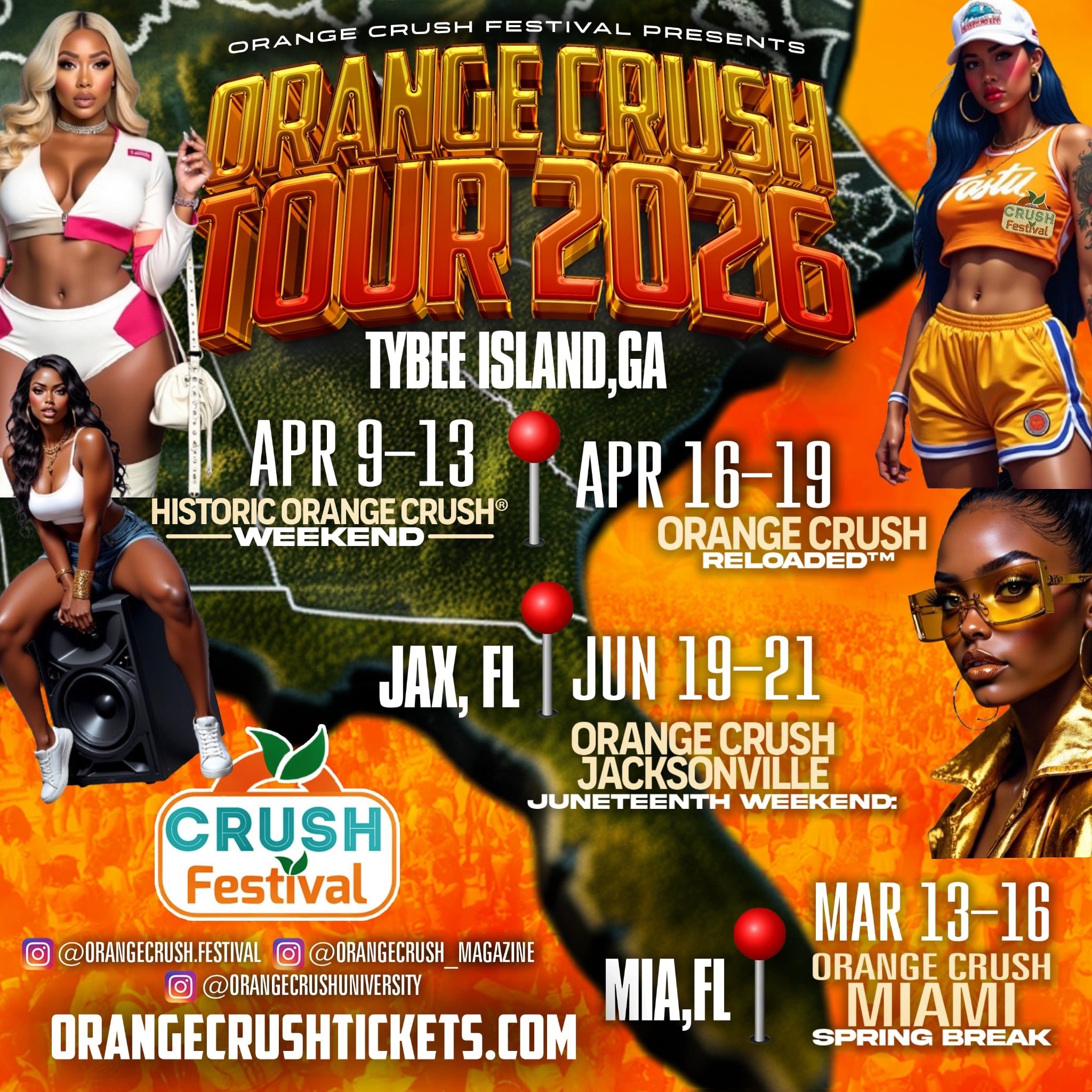
CRUSH® THE MAP: HOW ORANGE CRUSH® MOBILIZES BLACK AMERICA—CITY BY CITY, CAMPUS BY CAMPUS
By Crush Magazine
Orange Crush® is not accidental.
It is not viral luck.
It is not random turnout.
It is precision movement of Black crowds, organized by population density, campus calendars, highway access, and cultural gravity. Every Orange Crush® weekend is engineered to pull people from surrounding cities and colleges—sometimes hundreds of miles away—into a single, unified cultural moment.
For Spring–Summer 2026, Orange Crush® is activating one of the largest coordinated Black travel networks in the country.
Here is how it happens—city by city.
🔶 GEORGIA: THE CULTURAL ENGINE ROOM
Atlanta, Georgia
Atlanta is the largest Black metropolitan hub in the Southeast and one of the most influential cultural cities in the world. With Clark Atlanta University, Spelman College, Morehouse College, Morris Brown College, Georgia State University, and Georgia Tech all within close proximity, Atlanta produces tens of thousands of students, alumni, creatives, and promoters annually. Atlanta serves both as a destination city for CRUSH® Atlanta (May 30–31) and as a primary feeder into Savannah, Tybee Island, and Miami weekends. College Park, directly connected to Atlanta and home to students commuting to HBCUs and Georgia State, plays a critical role in street-level and alumni-based mobilization.
Savannah, Georgia
Savannah is not just a stop—it is a headquarters. Savannah State University, one of Georgia’s original HBCUs, anchors a city that blends students, military families, creatives from SCAD (Savannah College of Art and Design), and regional travelers from South Carolina and Florida. Events like Orange Crush® Savannah, Freaknik ’26, ABC ’26, and Crush® The Mic™ turn Savannah into a multi-day convergence zone, pulling crowds from across the Southeast.
Tybee Island, Georgia
Tybee Island is the beach destination that completes the Savannah experience. While not a college city itself, Tybee draws students from Savannah State, Georgia Southern University, SCAD, and regional HBCUs who want a beach-centric capstone to their weekend. Orange Crush® Tybee is marketed as the “final stop” that turns attendance into tradition.
Albany, Georgia
Albany is anchored by Albany State University, a major HBCU serving Southwest Georgia. Students and alumni from Albany routinely travel to Savannah and Atlanta for major cultural weekends, making Albany a key feeder city for Orange Crush® Savannah and Tybee Island.
Hinesville, Georgia
Hinesville is home to Fort Stewart, one of the largest military installations in the United States. The city’s Black military population, combined with nearby Savannah State University and Georgia Southern University, creates a consistent pipeline of young adults who travel in groups to Savannah, Tybee Island, and Jacksonville Beach events.
Jesup, Georgia
Jesup functions as a satellite city between Savannah and Brunswick. While smaller, it contributes working-class and military-connected attendees who travel regionally for Orange Crush® weekends, particularly Tybee and Savannah dates.
Statesboro, Georgia
Statesboro is dominated by Georgia Southern University, one of the largest universities in the state. Its student population feeds directly into Savannah and Tybee Island weekends, especially during spring semester peak party periods.
Macon, Georgia
Macon draws from Middle Georgia State University, Mercer University, and nearby Fort Valley State University (an HBCU). Macon travelers are a major contributor to both Savannah and Atlanta Orange Crush® events due to easy highway access and strong Greek-life networks.
Brunswick, Georgia
Brunswick sits along the coast and pulls students from College of Coastal Georgia while also serving as a coastal feeder into Savannah, Tybee Island, and Jacksonville Beach events.
Augusta, Georgia
Augusta is home to Augusta University and Paine College (HBCU). The city’s student and military populations travel frequently to Atlanta and Savannah for major cultural weekends, making Augusta a reliable feeder market.
Columbus, Georgia
Columbus benefits from Fort Moore (formerly Fort Benning) and Columbus State University. Its large Black military population makes Columbus a strong contributor to Atlanta and Savannah Orange Crush® dates.
Douglasville, Georgia
Douglasville, part of Metro Atlanta, feeds directly into Atlanta-based CRUSH® events and supplies alumni and young professionals who also travel to Savannah and Miami weekends.
Rincon, Georgia
Rincon functions as a Savannah suburb, feeding students, young families, and military-connected attendees into Savannah-based Orange Crush® programming.
College Park, Georgia
College Park’s proximity to Atlanta’s HBCU cluster and airport makes it a strategic mobilization zone for both ground travel and flights to Miami, Los Angeles, and New York for destination Orange Crush® weekends.
🌴 FLORIDA: SPRING BREAK POWER GRID
Miami, Florida
Miami is the official season opener. With Florida International University (FIU), Miami Dade College, and nearby Florida Memorial University (HBCU), Miami provides both a local crowd and a national destination appeal. Orange Crush® Miami is marketed nationwide as a Spring Break cornerstone event.
Jacksonville, Florida
Jacksonville anchors the Juneteenth finale. Edward Waters University (HBCU), the University of North Florida, and Jacksonville University feed a massive local Black population into Orange Crush® Jax Beach.
Tallahassee, Florida
Tallahassee is one of the strongest feeder cities due to Florida A&M University (HBCU) and Florida State University. Students regularly travel in buses and caravans to Miami and Savannah Orange Crush® weekends.
Fort Lauderdale, Florida
Fort Lauderdale pulls from Broward College and nearby Florida Atlantic University (FAU), contributing South Florida students and professionals to Miami events.
Orlando, Florida
Orlando draws from the University of Central Florida (one of the largest universities in the country) and serves as a major feeder into Miami and Jacksonville weekends.
Tampa, Florida
The University of South Florida and surrounding colleges supply Tampa’s contribution to Miami and Jacksonville Orange Crush® events.
Daytona Beach, Florida
Daytona Beach is anchored by Bethune-Cookman University (HBCU), making it a historically consistent Spring Break contributor to Miami and Jacksonville crowds.
🎤 TENNESSEE, THE CAROLINAS & THE MID-ATLANTIC
Memphis, Tennessee
Memphis pulls from the University of Memphis, LeMoyne-Owen College (HBCU), and regional Black culture networks that travel to Atlanta and Savannah Orange Crush® dates.
Chattanooga, Tennessee
Chattanooga feeds into Atlanta events due to proximity and student populations from UTC and nearby HBCUs.
Knoxville, Tennessee
Knoxville students from the University of Tennessee often travel to Atlanta for CRUSH® weekends.
Nashville, Tennessee
Nashville, home to Tennessee State University (HBCU), Fisk University (HBCU), and Belmont University, serves as a cultural feeder into Atlanta Orange Crush® events.
Charleston, South Carolina
Charleston draws from the College of Charleston and nearby HBCUs like South Carolina State University (Orangeburg) that travel to Savannah and Tybee Island.
Columbia, South Carolina
Columbia anchors Benedict College and Allen University (both HBCUs) along with the University of South Carolina, making it a major Savannah feeder.
Greenville, Clemson & Spartanburg, South Carolina
These cities pull students from Clemson University, USC Upstate, and regional colleges that funnel crowds toward Savannah and Atlanta Orange Crush® weekends.
🏙️ NATIONAL DESTINATION MARKETS
Cities like Los Angeles, Detroit, Chicago, St. Louis, New York City, Philadelphia, Baltimore, Cleveland, Houston, Dallas, and New Orleans contribute through alumni travel, influencer culture, birthday trips, Greek reunions, and destination party planning tied to Orange Crush® weekends.
🍊 THE STRATEGY THAT MAKES IT WORK
Orange Crush® doesn’t ask, “Who’s local?”
It asks, “Who’s willing to move?”
By aligning Black population centers, college ecosystems, military communities, and cultural calendars, Orange Crush® transforms cities into starting points and weekends into destinations.
This is why the crowds are massive.
This is why they return every year.
This is why Orange Crush® isn’t just an event.
It’s a migration.
🟠 Orange Crush® — Where Black Culture Travels Together
Music + Orange Crush Festival® Tour 2026
PlugNotARapper
PartyPlugMikey
Stream the albums, run the videos, then catch the live moments on the ORANGE CRUSH FESTIVAL® TOUR 2026.
Miami (Mar 13–16) • Savannah/Tybee (Apr 9–18) • Allenhurst (Apr 19) • Atlanta (May 24–31) • Jacksonville (Jun 19–21)
Headliner notes
Music Library
Tap cover art to zoom • Use “Apple Music” + “YouTube” buttons • Expand for extra videos

Swamp Baby
Apple Music + Official Video
Toxic Plug Love
Apple Music + VideosMore videos

Ghetto Ted Talk
Apple Music + Playlist
Not Like Them Rap N*ggaz
Apple Music + VideosMore videos

Baddies Island
Apple Music + VideosMore videos

Mapouka Twerk Doctor
Apple Music + VideosMore videos

Bad Baddies Love Sex (BBLS)
Apple Music + VideosMore videos

FRIENDZ8NE
Apple Music + VideoORANGE CRUSH FESTIVAL® TOUR 2026
Events + ticket buttons + flyer taps (zoom)
Miami • ORANGE CRUSH® Spring Break
March 13–16, 2026 • Mansion Party (Mar 14) • Yacht Party (Mar 15)


Savannah • Week 1
April 9–12, 2026 • Henry St Bistro • BACP (Apr 10) • DNN (Apr 11)


Tybee / Savannah / Allenhurst • Week 2
April 16–19, 2026 • Crush The Mic™ (Apr 16) • Freaknik ’26 (Apr 17) • Tybee (Apr 18) • ABC ’26 (Apr 18)


Allenhurst • CRUSH THE BLOCK®
April 19, 2026 • 258 Linda Loop SE • Truck/Jeep/Car & Bike Show • Pool Party • ATV Trail Ride


Atlanta • CRUSH® ATLANTA
May 24–31, 2026 • Pool Party Part 1 (May 24) • Pool Party Part 2 (May 30)


Jacksonville • ORANGE CRUSH® JUNETEENTH
June 19–21, 2026 • Jacksonville, FL


Countdowns
Live timers to your key dates
ORANGE CRUSH FESTIVAL® TOUR 2026
PartyPlugMikey presents the ORANGE CRUSH FESTIVAL® Tour — March–June 2026. Includes TYBEE BEACH BASH (Apr 18, 2026) + the full tour run.
MIAMI • Mar 15 (Yacht Party)
SAVANNAH Week 1 • Apr 11 (Unpermitted)
TYBEE/SAV Week 2 • Apr 18 (Permitted)
ATLANTA • May 24
JACKSONVILLE • Jun 19
Official Tour Lineup (by date)
ORANGE CRUSH FESTIVAL® TOUR 2026: ORANGE CRUSH® SPRING BREAK (South Beach Miami) • ORANGE CRUSH® TYBEE (Savannah/Tybee) • CRUSH THE MIC™ • FREAKNIK ’26 • ABC ’26 • ORANGE CRUSH FESTIVAL® TYBEE • CRUSH THE BLOCK® • CRUSH® ATLANTA • ORANGE CRUSH® JUNETEENTH (Jax).
ORANGE CRUSH® SPRING BREAK — SOUTH BEACH MIAMI, FL
ORANGE CRUSH® TYBEE — SAVANNAH / TYBEE ISLAND, GA
CRUSH THE BLOCK® — 258 Linda Loop SE, Allenhurst GA
CRUSH® ATLANTA — May 24–31, 2026
TYBEE BEACH GA • Apr 18 • Near Tybee Pier & Pavilion + Hotel Tybee Parking Lot (31328)
MARCH | MIAMI
South Beach Miami Spring Break • March 13–16, 2026
ORANGE CRUSH® MIAMI • Mansion Pool Party
CRUSH® MIAMI • Mansion Pool Party (Alt Flyer)
ORANGE CRUSH® MIAMI • Yacht Party
APRIL | SAVANNAH / TYBEE
April 9–18, 2026 • Henry St Bistro (1308 Montgomery St) + Tybee Beach
BACP • Big A** College Party
DNN • Damn Near Naked Party
CRUSH THE MIC™
FREAKNIK ’26
FREAKNIK ’26 (Alt Flyer)
ORANGE CRUSH FESTIVAL® TYBEE • Beach Bash
ABC ’26 • Anything Butt Clothes
ABC ’26 • Official ORANGE CRUSH Beach After Party (Alt Flyer)
CRUSH THE BLOCK | ALLENHURST
Sunday • April 19, 2026 • 258 Linda Loop SE, Allenhurst GA
CRUSH THE BLOCK®
MAY | ATLANTA
CRUSH® ATLANTA • May 24–31, 2026
Crush’Lanta • Mansion Pool Party Part 1
Crush’Lanta • Mansion Pool Party Part 2
JUNE | JACKSONVILLE
ORANGE CRUSH® JUNETEENTH • June 19–21, 2026
ORANGE CRUSH® JUNETEENTH • Jacksonville
IMG_URL_HERE.
