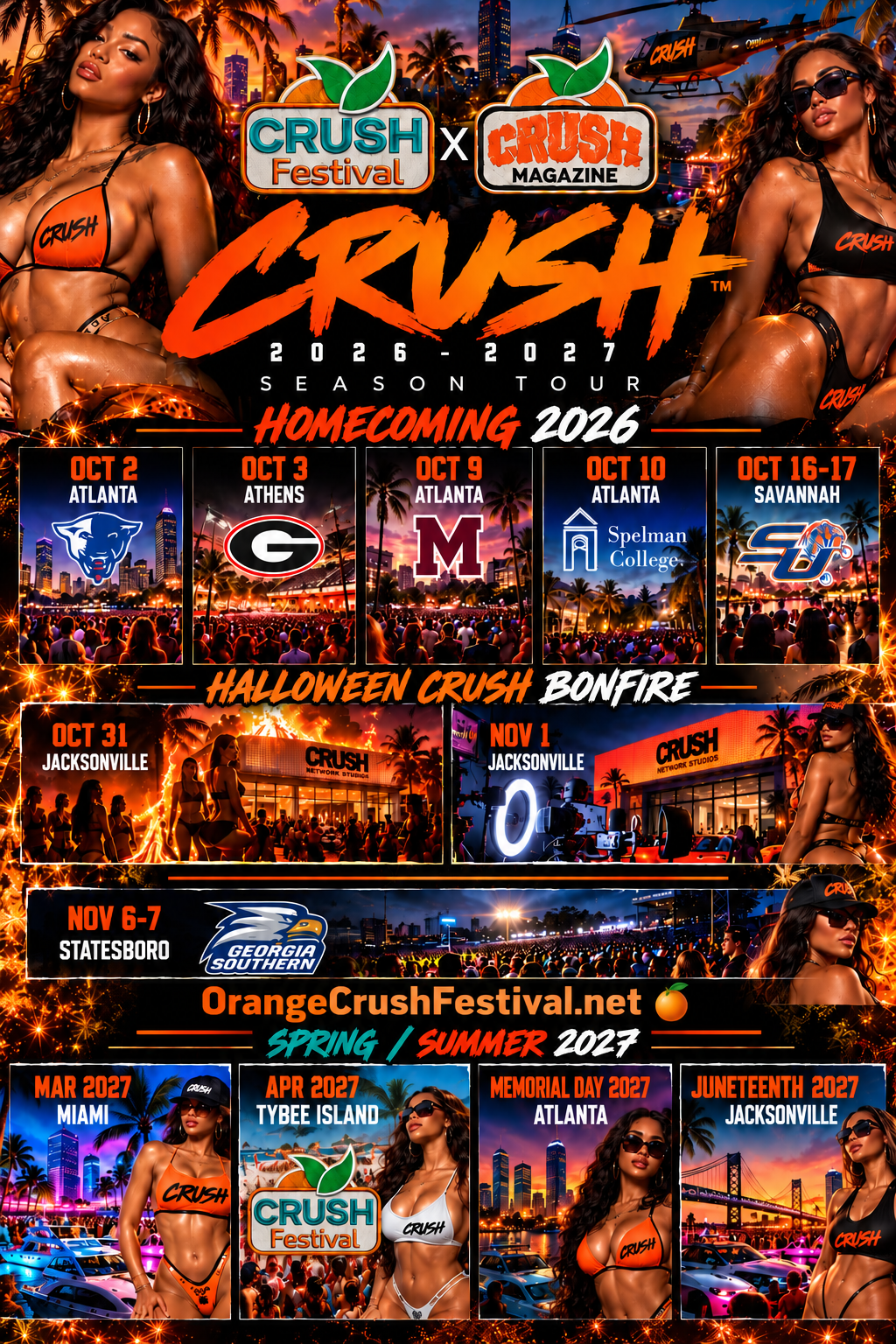
CRUSH MAGAZINE THE PEOPLE ARE THE HEADLINERS CRUSH Is Building a Tour Where the Audience Doesn’t Just Attend the Culture — They Become Part of It
CRUSH MAGAZINE
THE PEOPLE ARE THE HEADLINERS
CRUSH Is Building a Tour Where the Audience Doesn’t Just Attend the Culture — They Become Part of It
Most event flyers tell you who to come see.
The artist.
The DJ.
The celebrity host.
The headliner.
CRUSH is interested in another question:
What if the most important person at the event isn’t on the flyer yet?
Maybe she’s standing in the crowd.
Maybe he’s selling clothes outside.
Maybe they’re shooting video on a phone.
Maybe she’s a student who spent three weeks building her Homecoming outfit.
Maybe he’s an artist nobody in another city has heard yet.
Maybe she’s a model who has never modeled professionally.
Maybe he’s the basketball player everybody on campus already knows.
Maybe they’re running a business between classes.
Maybe they’re simply funny enough that a 30-second interview becomes the clip everybody remembers.
The 2026–2027 CRUSH season is being built around a simple belief:
The audience isn’t background.
The audience is part of the story.
WE DON’T WANT EMPTY CROWD SHOTS
Every event needs crowd photography.
But CRUSH Magazine should never look at 500 people and see one crowd.
That’s 500 individual lives.
Different hometowns.
Different ambitions.
Different relationships.
Different clothes.
Different reasons for being there.
Different stories.
The camera’s job is to get closer.
Find the face.
Learn the name.
Ask the question.
That’s when documentation becomes journalism.
HOMECOMING IS PERFECT FOR THIS
Homecoming is one of the rare cultural environments where multiple generations intentionally occupy the same space.
Current students.
Recent graduates.
Older alumni.
Families.
Faculty.
Entrepreneurs.
Athletes.
Artists.
Greek organizations.
Local residents.
Visitors.
People returning after years away.
People experiencing their first Homecoming.
Everybody is physically sharing a weekend, but they’re not necessarily experiencing the same Homecoming.
That’s fascinating.
CRUSH Magazine should capture those differences.
ASK THE FRESHMAN
What did you expect?
What surprised you?
What’s the outfit?
What’s the move tonight?
What have upperclassmen told you about Homecoming?
Now photograph them.
Save the date.
Imagine finding that interview four years later.
Now they’re graduating.
Interview them again.
That’s a story CRUSH cannot manufacture afterward.
It has to start now.
ASK THE SENIOR
What does the last Homecoming as a student feel like?
What’s changed since freshman year?
What are you going to miss?
Where are you going after graduation?
Who helped you make it?
What did college actually teach you?
Now suddenly a party weekend has emotional weight.
ASK THE ALUM
Why did you come back?
How far did you travel?
What’s completely different?
What’s exactly the same?
What place did you have to visit first?
What Homecoming will you never forget?
Who were you hoping to see?
That’s oral history hiding inside a sidewalk interview.
ASK THE ENTREPRENEUR
How much did you bring to sell?
When did you start?
What’s your best product?
Did you attend this school?
What’s your biggest month?
What’s the next move?
Where can people find you?
Now CRUSH isn’t simply covering consumption.
It’s documenting commerce.
ASK THE MODEL
Not:
“Can we take your picture?”
Go further.
“Who are you?”
What’s your name?
Where are you from?
Did you style yourself?
What makes you feel beautiful?
Do you model?
What do you want to do?
What’s something people assume about you that’s completely wrong?
Now the photograph has a person attached to it.
ASK THE ARTIST
Don’t start with streams.
Ask:
“What’s the record we should hear first?”
That’s a better question.
Let the artist choose the introduction.
Then listen.
If it’s good, the story continues.
ASK THE PERSON EVERYBODY KEEPS GREETING
Every environment has one.
CRUSH needs to notice them.
You don’t know who they are.
But every 15 feet:
Handshake.
Hug.
Handshake.
Photo.
Nickname yelled from across the street.
Stop them.
“Everybody out here knows you. Who are you?”
That could become an entire recurring CRUSH Magazine format.
THIS IS HOW A TOUR BECOMES HUMAN
Dates don’t create emotional attachment.
People do.
Georgia State matters more when readers remember somebody we met there.
Athens matters more when it has a face.
The AUC matters more when we hear actual voices.
Savannah becomes more than scenery.
Jacksonville becomes more than a building.
Miami becomes more than palm trees.
Tybee becomes more than sand.
People give locations memory.
THEN LET THE PEOPLE CROSS OVER
This is where the larger CRUSH ecosystem becomes powerful.
Imagine someone first appearing during an October street interview.
Nothing elaborate.
Twenty seconds.
She makes everybody laugh.
The comments love her.
CRUSH finds her again.
Next appearance:
A longer interview.
Then:
A CRUSH Magazine shoot.
Then:
Halloween BonfireCRUSH.
Then:
A Crush Network Studios conversation.
Months later:
Miami.
Then:
Tybee.
Now go back and repost the first clip.
“This is where we first met her.”
The original 20 seconds suddenly means more than it did when it was recorded.
That’s storytelling through time.
THE COMMENTS SHOULD HELP SHAPE THE WORLD
CRUSH Magazine doesn’t have to pretend editors know everything.
Let audiences discover people with us.
“We need another interview with her.”
Listen.
“Who is dude in the background?”
Find out.
“Bring him to Jacksonville.”
Maybe we should.
“She needs a CRUSH shoot.”
Maybe she does.
“Put these two against each other in basketball.”
Interesting.
The audience begins participating in the development of the universe.
Not controlling it.
Participating.
That distinction matters.
SOMEONE SHOULD BE ABLE TO ENTER CRUSH FROM ALMOST ANY DIRECTION
Music isn’t your thing?
Maybe fashion is.
Don’t care about fashion?
Basketball.
Don’t play basketball?
Business.
Don’t own a business?
Photography.
Don’t shoot?
Model.
Don’t model?
Podcast.
Don’t podcast?
Come to the party.
Don’t party?
Read the magazine.
Don’t live nearby?
Watch the content.
Want to sell?
Become a vendor.
Want exposure?
Explore media opportunities.
Want to partner?
Sponsorship.
Want to create?
Crush Network Studios.
Different doors.
Same world.
THAT MAKES CRUSH BIGGER THAN A DEMOGRAPHIC
The goal isn’t to make everybody identical.
Quite the opposite.
A functioning ecosystem needs different people.
Artists need listeners.
Models need photographers.
Photographers need subjects.
Businesses need customers.
Events need audiences.
Media needs stories.
Sponsors need communities.
Communities need places to gather.
Creators need distribution.
One person’s output becomes another person’s opportunity.
That’s why the diversity of the CRUSH ecosystem matters commercially as much as culturally.
MODELS SHOULD HAVE NAMES
This deserves its own statement.
CRUSH can create glamorous imagery without reducing women to scenery.
A model can be beautiful and interesting.
Sexy and intelligent.
Editorial and entrepreneurial.
Visual and verbal.
She can wear the merchandise and tell you about her company.
She can appear on the flyer and sit for an interview.
She can create a viral photograph and have an opinion worth publishing.
She can be part of the visual identity while still being treated as a complete person.
CRUSH Magazine should make that standard obvious.
ARTISTS SHOULD HAVE STORIES
The same applies to performers.
A performance slot shouldn’t automatically reduce somebody to:
“Next up.”
Who are you?
Where are you from?
Why this song?
Who produced it?
What happened while making it?
What’s the line everybody needs to hear?
What are you trying to become?
What do you do outside music?
What would make tonight successful for you?
Now the performance has context.
VENDORS SHOULD HAVE STORIES TOO
A vendor isn’t simply a table CRUSH charged money to occupy.
That’s a business.
Somebody invested money.
Bought inventory.
Designed something.
Cooked something.
Built something.
Took a risk.
Drove somewhere.
Set up.
Tried to make customers care.
That’s entrepreneurship happening inside the event.
Document it.
EVEN THE WINNER SHOULDN’T BE THE ONLY STORY
Basketball creates an easy narrative:
Winner and loser.
But CRUSH Magazine can look wider.
Who talked the most before the game?
Who had the best entrance?
Who brought a crowd?
Who hit the wildest shot?
Who underestimated somebody?
Who wants the rematch?
Who had the funniest excuse afterward?
Who played in jeans?
Who became an unexpected crowd favorite?
Competition creates characters.
Characters create future content.
MIKEY VS. TROJAN SHOULD WORK THE SAME WAY
Battle #1 has a result.
But the result isn’t the only media asset.
There is:
Before.
Preparation.
Predictions.
Trash talk.
Arrival.
Backstage.
Performance.
Crowd reaction.
Result.
Immediate reaction.
Sunday interview.
Individual interviews.
Photographs.
Unreleased footage.
Retrospective.
Potential future consequences.
One battle can become an entire editorial package if CRUSH treats it as a story rather than one clip.
CRUSH MAGAZINE SHOULD DOCUMENT THE PEOPLE WORKING TOO
Turn the camera around sometimes.
The photographer changing lenses.
The videographer running backward.
The engineer checking audio.
The model getting makeup fixed.
The DJ preparing.
The vendor unloading.
The security meeting.
The intern holding three things at once.
The person sweeping afterward.
The exhausted team sitting inside an empty studio at 3 a.m.
That’s part of the story.
Brands often erase the labor required to make themselves look effortless.
CRUSH doesn’t have to.
The work makes the finished product more impressive.
SHOW THE EMPTY ROOM
Before the people arrive.
Take the photograph.
Then photograph the same room full.
Then photograph it empty again.
Those three images tell an entire story.
Before.
During.
After.
That’s documentary thinking.
SHOW THE DRIVE
Not every piece of CRUSH content needs fireworks.
Sometimes the most important clip is the highway sign.
ATHENS — 42 MILES.
The gas station.
The luggage.
The camera batteries.
The weather.
The group chat.
The person asleep in the passenger seat.
The wrong turn.
The first sight of campus.
The first orange shirt in the crowd.
Movement itself is part of a tour.
Document it.
SHOW THE FIRSTS
First Homecoming pop-up.
First person interviewed.
First person recognized from an earlier episode.
First Jacksonville Halloween weekend.
First Mikey vs. Trojan battle.
First person brought from Homecoming into the studio.
First Miami activation of this season.
First 2027 CRUSH beach sunrise.
First returning participant.
First sponsor that renews.
First time somebody says:
“I found y’all from that video.”
Firsts eventually become history.
But only if somebody records them.
AND SHOW THE RETURNS
Returns may eventually become even more important.
The second interview.
The rematch.
The model’s second editorial.
The artist’s second performance.
The second year.
The annual Tybee trip.
Another Halloween.
Another Homecoming.
Another Miami spring.
Another Juneteenth.
Repetition transforms activities into traditions.
THAT’S HOW THE AUDIENCE BECOMES COMMUNITY
A crowd exists because people occupy the same place.
A community exists because relationships survive after everyone leaves.
That’s the higher standard for CRUSH.
Did people connect?
Did they return?
Did they collaborate?
Did they follow one another?
Did they work together?
Did they travel to another CRUSH stop?
Did somebody we met become somebody we know?
Did somebody we know become somebody the audience knows?
Those are signs that something deeper than attendance is developing.
THE HEADLINER IS THE WORLD ITSELF
Of course CRUSH will have artists.
Performances.
Featured personalities.
Battles.
Models.
Special attractions.
There will be names on flyers.
But underneath all of it is a larger idea.
The most powerful CRUSH season would be one where the audience begins arriving partly because they want to see who else will be there.
Not one celebrity.
The environment.
The people.
The possibility.
The feeling that you might meet somebody.
Get photographed.
Discover an artist.
Find a business.
See something ridiculous.
End up in an interview.
Reconnect with somebody.
Become part of a story.
That’s culture.
OCTOBER 2026 STARTS THE SEARCH
Atlanta.
Athens.
Atlanta again.
Savannah.
Jacksonville.
Statesboro.
Then the story moves through winter and into:
Miami.
Tybee.
Atlanta.
Jacksonville.
We know the cities.
We know the calendar.
We know the CRUSH name.
What we don’t know yet are all the people who will eventually define this chapter.
That’s the exciting part.
Because somewhere between the first camera turning on at Homecoming and the final Juneteenth footage being saved, strangers will become familiar faces.
Attendees will become participants.
Participants will become personalities.
Connections will become collaborations.
Moments will become memories.
And memories will become an archive.
So yes, CRUSH has headliners.
But across the 2026–2027 CRUSH season, the biggest headliner we’re searching for is everybody we haven’t met yet.
CRUSH MAGAZINE BEFORE THE WORLD KNOWS THEIR NAMES CRUSH Is Building a Discovery Platform for the People Creating the Next Wave of Southern Culture Somebody CRUSH !
CRUSH MAGAZINE
BEFORE THE WORLD KNOWS THEIR NAMES
CRUSH Is Building a Discovery Platform for the People Creating the Next Wave of Southern Culture
Somebody CRUSH meets during the next nine months is going to surprise us.
Maybe at Georgia State.
Maybe walking through Athens.
Maybe during Morehouse and Spelman Homecoming.
Maybe in Savannah.
Maybe outside Crush Network Studios.
Maybe in Miami.
Maybe on Tybee.
We don’t know their name yet.
That’s the point.
The most interesting version of CRUSH Magazine isn’t a publication that waits until culture decides somebody matters and then asks for an interview.
It gets there earlier.
Before the blue check.
Before the million views.
Before the major booking.
Before everybody suddenly claims they knew.
CRUSH should be paying attention while people are becoming.
FAME ISN’T THE REQUIREMENT
There will always be room for established names in CRUSH.
But celebrity alone isn’t an editorial strategy.
Interesting people are everywhere.
The college student running a profitable company between classes.
The photographer everybody on campus calls.
The woman whose Homecoming look stops the sidewalk.
The artist performing for 70 people like it’s 70,000.
The DJ quietly controlling an entire city’s nightlife.
The athlete with another talent nobody knows about.
The model who has never had a professional editorial.
The barber with celebrity-level clientele but no media profile.
The stylist responsible for everybody else’s photographs.
The chef selling out every weekend.
The promoter everybody knows by nickname.
The designer producing clothes from a bedroom.
The creator whose phone is becoming a production company.
The alumnus who returned and built something meaningful.
The personality who can make a 30-second interview impossible to scroll past.
These are magazine subjects.
THE SOUTH DOESN’T HAVE A TALENT PROBLEM
It has a discovery problem.
Atlanta receives enormous attention because its entertainment infrastructure is impossible to ignore.
But drive outward.
Athens.
Savannah.
Jacksonville.
Statesboro.
Smaller communities between them.
Then farther south toward Miami.
There are people creating everywhere.
The difference is often infrastructure.
Who photographs them professionally?
Who interviews them?
Who writes the story?
Who puts their name in a headline?
Who introduces them to another city?
Who archives the moment before their breakthrough?
CRUSH Magazine can become part of that infrastructure.
THAT CHANGES THE PURPOSE OF THE HOMECOMING CAMERA
The obvious Homecoming photograph is the crowd.
Take it.
We need it.
But then turn around.
Who is standing behind the crowd?
Who designed the shirt?
Who organized the tailgate?
Who brought the sound system?
Who styled the models?
Who owns the food truck?
Who shot everybody’s photographs?
Who flew home because their business is finally successful enough to sponsor something?
Who is performing later?
Who is everybody greeting?
Who has a story nobody has asked about?
That’s where CRUSH Magazine separates itself.
The crowd tells us something happened.
The people tell us why it mattered.
GEORGIA STATE: FIND THE BUILDERS
October 2 begins the search.
Atlanta gives CRUSH access to one of the deepest creative pools in the South.
But we’re not only looking for entertainers.
We’re looking for builders.
Students with LLCs.
Creators.
Fashion brands.
Musicians.
Models.
Campus personalities.
Young professionals.
Photographers.
Event organizers.
People developing technology.
People working two jobs while building something at night.
People who don’t fit neatly into one category.
The question isn’t:
“Are you famous?”
It’s:
“What are you working on?”
That single question could become one of the defining questions of the entire CRUSH Homecoming run.
ATHENS: FIND WHAT ATLANTA DOESN’T HAVE
Then CRUSH leaves Atlanta.
That matters editorially.
A publication becomes boring when it only knows one type of person.
Athens gives us another population.
Another economy.
Another culture.
Another campus.
Another style.
Another relationship with sports.
Another nightlife environment.
The objective isn’t to find an Atlanta personality standing in Athens.
It’s to find somebody who makes sense because we’re in Athens.
Every city should add something new to the cast.
MOREHOUSE + SPELMAN: FIND THE FUTURE NETWORK
There is another dimension to discovery at the AUC.
Long-term trajectory.
Some of the people walking through Homecoming will become executives.
Doctors.
Attorneys.
Artists.
Founders.
Educators.
Politicians.
Producers.
Scientists.
Investors.
Media personalities.
Community leaders.
Parents.
Philanthropists.
And people working in industries that don’t even exist yet.
CRUSH Magazine doesn’t need to predict who becomes what.
That’s not the job.
Document them now.
Let time tell us what happens next.
Imagine returning to a 2026 interview in 2036.
That’s an archive.
SAVANNAH: FIND THE PEOPLE WHO CONNECT THE CITY TO THE COAST
Savannah presents another opportunity because CRUSH returns to the broader market in April.
A relationship beginning at Savannah State Homecoming doesn’t have to end there.
Who belongs in the future Tybee world?
Artists.
Models.
Hospitality businesses.
Food brands.
Photographers.
Creators.
DJs.
Swimwear designers.
Beach businesses.
Transportation companies.
Local personalities.
Savannah State can become the introduction.
Tybee can become the reunion.
Now the audience gets continuity.
JACKSONVILLE: GIVE DISCOVERY A PLACE TO GO
This is where the CRUSH model becomes more useful than a normal street interview page.
Finding somebody is step one.
Developing the relationship is step two.
Crush Network Studios provides somewhere for that to happen.
Meet an artist?
Invite them to create.
Meet a model?
Build an editorial.
Meet a photographer?
Collaborate.
Meet a podcaster?
Record.
Meet an entrepreneur?
Interview them.
Meet a clothing brand?
Shoot the collection.
Meet a personality?
Give them a microphone.
A discovery platform becomes significantly more powerful when it also has production infrastructure.
HALLOWEEN BONFIRECRUSH CAN BECOME THE FIRST CONVERGENCE
October 31 and November 1 can show the audience the discovery process in reverse.
People CRUSH met outside begin appearing inside the CRUSH environment.
Imagine the content:
“We met her at Homecoming three weeks ago. Today she’s shooting her first CRUSH Magazine editorial.”
That’s a story.
“We found him performing in Atlanta. Tonight he’s competing at BonfireCRUSH.”
Story.
“This brand caught our attention in Savannah. Now they’re vending in Jacksonville.”
Story.
“He talked trash during our Homecoming interview. Now he’s entering the basketball 1v1.”
Story.
Suddenly promotion doesn’t feel like advertising.
It has characters and consequences.
THE PUBLIC SHOULD BE ABLE TO FOLLOW PEOPLE ACROSS THE CRUSH WORLD
This is where things become addictive.
A person first appears in a 15-second clip.
Then a photograph.
Then an interview.
Then Jacksonville.
Then an individual profile.
Then Miami.
Then Tybee.
By the fifth appearance, audiences know them.
Comments change.
Instead of:
“Who is this?”
People begin saying:
“She’s back.”
That is an enormous difference.
Recognition means world building is working.
CRUSH SHOULD CREATE ITS OWN CLASS OF EMERGING PERSONALITIES
Not employees pretending to be celebrities.
Not fake fame.
Real people audiences naturally become interested in.
There could eventually be recognizable:
CRUSH models.
CRUSH photographers.
CRUSH artists.
CRUSH hosts.
CRUSH athletes.
CRUSH entrepreneurs.
CRUSH creators.
CRUSH couples.
CRUSH alumni personalities.
CRUSH vendors.
CRUSH city correspondents.
Some people may appear once.
Others may become recurring.
The audience helps determine who resonates.
AND NOT EVERYBODY NEEDS TO BE BEAUTIFUL
This matters.
Visual culture can become shallow quickly.
CRUSH absolutely has a glamorous side.
Models matter.
Fashion matters.
Sex appeal exists.
But a real magazine needs texture.
The 65-year-old alumnus with the incredible Homecoming story belongs.
The hilarious parking attendant belongs.
The chef belongs.
The band director belongs.
The entrepreneur belongs.
The mother who attended the same school as her daughter belongs.
The professor everybody remembers belongs.
The student photographer belongs.
The security guard who has worked 20 Homecomings might have a better story than half the people on stage.
Interesting beats perfect.
Every time.
THAT’S HOW CRUSH AVOIDS BECOMING JUST ANOTHER PARTY PAGE
Party pages are easy.
Pretty people.
Bottles.
Crowds.
Flash.
Repeat.
CRUSH can have all of that.
But then go deeper.
Who owns the club?
Who promoted the night?
Who designed the flyer?
Who made the dress?
Who produced the record?
Who drove three hours?
Who almost didn’t perform?
Who just graduated?
Who started the company?
Who is returning home?
Who fell in love?
Who reunited?
Who is celebrating something nobody else knows about?
The nightlife image gets attention.
The human story creates meaning.
Use both.
THE MAGAZINE CAN BECOME A RECEIPT
Imagine somebody becomes nationally known in 2030.
CRUSH interviewed them in 2026.
Don’t rewrite history.
Don’t claim CRUSH created them.
Simply open the archive.
“Before millions knew the name, we met them here.”
Date.
Photograph.
Original interview.
Original words.
That’s editorial credibility money cannot retroactively manufacture.
You either documented the moment or you didn’t.
THIS IS WHY NAMES MATTER
Get everyone’s name.
Spell it correctly.
Get their social handle.
Get their city.
Get what they do.
Get permission where needed.
Organize the files.
Tag the photographs.
Save the original footage.
Write the date.
Write the location.
This sounds boring compared with going viral.
It isn’t.
It’s how an archive becomes usable.
Ten thousand unlabeled photographs become a mess.
Ten thousand organized photographs become a media library.
CRUSH needs the second one.
THE DATABASE BEHIND THE MAGAZINE MAY BECOME AS IMPORTANT AS THE MAGAZINE
Every legitimate relationship should be organized.
Not private information collected carelessly.
Professional contacts people willingly provide.
Artist.
Model.
Photographer.
Business.
Vendor.
Creator.
City.
School where relevant.
What CRUSH worked with them on.
When we met.
Where we met.
What content exists.
Whether they want future opportunities.
Now CRUSH doesn’t begin every event searching from zero.
Need Savannah models?
We know people.
Need Jacksonville artists?
We know people.
Need Atlanta photographers?
We know people.
Need Miami creators?
The list begins growing.
That’s institutional memory.
THEN OPPORTUNITY CAN MOVE THROUGH THE NETWORK
A sponsor needs models.
CRUSH knows models.
An artist needs photographs.
CRUSH knows photographers.
A vendor wants Tybee exposure.
CRUSH has Tybee.
A model wants portfolio material.
CRUSH has the studio.
A creator needs personalities.
CRUSH knows personalities.
An artist wants another market.
CRUSH operates in multiple markets.
CRUSH doesn’t need to own everybody’s career.
It can become valuable simply by being a trusted connector.
THAT VALUE CAN OUTLAST ANY SINGLE EVENT
This is the deeper purpose.
October 31 ends.
Tybee weekend ends.
Memorial Day Weekend ends.
Juneteenth ends.
Relationships don’t have to.
The person CRUSH meets at 21 could still matter at 31.
The photographer could become a director.
The model could become an entrepreneur.
The artist could become a producer.
The student founder could employ 100 people.
The vendor could become a sponsor.
The attendee could eventually bring their children.
We don’t know.
That’s why we document.
THE FIRST SEASON SHOULD FEEL LIKE CASTING A REAL-LIFE UNIVERSE
Not casting in the fake sense.
Discovery.
CRUSH is traveling through environments filled with potential recurring characters.
Somebody from Atlanta.
Somebody from Athens.
Somebody from Savannah.
Somebody from Jacksonville.
Somebody from Statesboro.
Somebody from Miami.
People whose lives have nothing to do with each other today.
Then CRUSH connects them.
A year later they’re standing in the same photograph.
That’s the magic.
Not manufacturing people.
Connecting people who were already becoming something.
BY JUNETEENTH, WE SHOULD KNOW MORE NAMES
That may be one of the simplest ways to measure whether this season worked.
Not only:
How many followers did CRUSH gain?
Ask:
How many people does CRUSH genuinely know now that we didn’t know October 1?
How many artists?
How many models?
How many businesses?
How many creators?
How many photographers?
How many students?
How many alumni?
How many vendors?
How many supporters?
How many people know each other because CRUSH introduced them?
That is impact.
AND SOMEWHERE OUT THERE IS SOMEBODY WE HAVEN’T MET YET
Maybe October 2.
Maybe October 3.
Maybe October 9.
Maybe Savannah.
Maybe Jacksonville.
Maybe Statesboro.
Maybe Miami.
Maybe Tybee.
Maybe Memorial Day Weekend.
Maybe Juneteenth.
They aren’t in this article because we don’t know their name.
Yet.
They don’t know they’re going to meet CRUSH.
We don’t know what they’ll become.
That’s what makes the next nine months worth documenting.
Because while everybody else is waiting to see who’s next,
CRUSH Magazine is going outside to meet them.
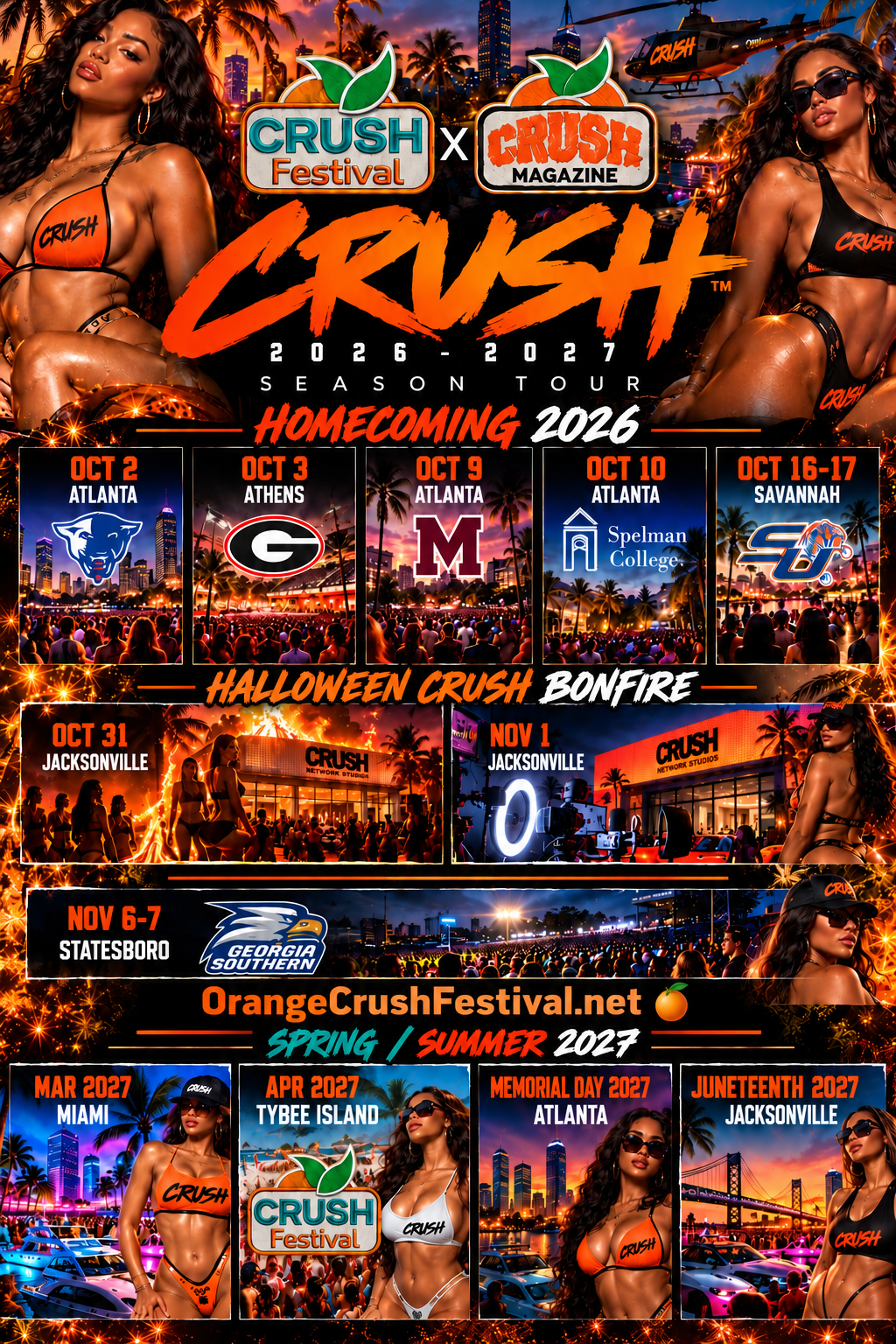
CRUSH MAGAZINE ONE SEASON. FOUR MARKETS. A THOUSAND STORIES. Why CRUSH Is Building Atlanta, Savannah/Tybee, Jacksonville and Miami as Connected Cultural Homes — Not Random Tour Stops
CRUSH MAGAZINE
ONE SEASON. FOUR MARKETS. A THOUSAND STORIES.
Why CRUSH Is Building Atlanta, Savannah/Tybee, Jacksonville and Miami as Connected Cultural Homes — Not Random Tour Stops
A map can tell you where CRUSH is going.
It cannot tell you why.
From October 2026 through Juneteenth 2027, CRUSH will appear across college Homecomings, Halloween weekend, Spring Break season, the beach, Memorial Day Weekend and Juneteenth.
There will be photographs.
Music.
Models.
Artists.
Students.
Athletes.
Entrepreneurs.
Parties.
Interviews.
Travel.
Performances.
Businesses.
Crowds.
And a lot of orange.
But underneath the calendar is a more deliberate idea.
CRUSH isn’t trying to visit every city in America.
It’s trying to become deeply recognizable in a small group of markets that naturally connect to the identity of the brand.
Atlanta.
Savannah and Tybee Island.
Jacksonville.
Miami.
Four markets.
Four completely different environments.
Four different reasons to matter.
And one CRUSH ecosystem connecting them.
THE MAP IS SMALL ON PURPOSE
There is a temptation when building an entertainment brand to announce everywhere.
New York.
Los Angeles.
Houston.
Las Vegas.
Chicago.
Charlotte.
New Orleans.
Washington.
Dallas.
Every major market becomes another logo on a flyer.
It looks enormous.
But geography isn’t community.
Being somewhere once doesn’t mean you belong there.
CRUSH is taking another approach.
Go deeper before going wider.
Return to cities.
Build relationships.
Learn the neighborhoods.
Know the photographers.
Know the artists.
Know the models.
Know the venues.
Know the businesses.
Know the promoters.
Know the audience.
Let people see CRUSH more than once.
That repetition creates familiarity.
And familiarity is the beginning of culture.
ATLANTA: THE CONNECTOR
Atlanta doesn’t need CRUSH to make it culturally important.
That’s precisely why Atlanta matters.
The city already contains an enormous concentration of music, media, college culture, fashion, nightlife, entrepreneurship and Black professional life.
CRUSH enters that ecosystem first through college culture.
Georgia State.
Then Morehouse and Spelman.
Months later, CRUSH returns for Memorial Day Weekend.
Those aren’t the same Atlanta.
That’s important.
Georgia State gives us downtown college energy.
The AUC gives us a completely different historical and cultural environment.
Memorial Day Weekend gives us Atlanta without the Homecoming framework.
Three encounters.
One market.
Multiple perspectives.
That’s how CRUSH Magazine should cover cities.
Not as backdrops.
As characters.
ATHENS: THE CONTRAST
Athens isn’t one of the four permanent CRUSH core markets.
That’s exactly what makes it useful.
It introduces contrast.
Twenty-four hours after Atlanta, CRUSH enters a major college town built around a very different campus culture.
UGA.
SEC football.
Downtown Athens.
Students.
Alumni.
Tradition.
Red and black.
The comparison is editorially valuable.
What changes when CRUSH leaves Atlanta?
What stays the same?
How does fashion change?
How does the crowd change?
How does Homecoming change?
How does nightlife change?
What does college culture look like outside the metropolitan environment?
CRUSH Magazine gets stronger when it documents differences rather than forcing everything into the same aesthetic.
SAVANNAH: THE ROOTED CITY
Savannah offers something none of the other markets can replicate.
History.
The city already has an unmistakable visual identity.
Squares.
Spanish moss.
Architecture.
River Street.
Historic neighborhoods.
Tourism.
Nightlife.
Coastal Georgia.
Savannah State adds another cultural layer.
And just beyond Savannah sits the location that gives this market its special position inside the CRUSH world:
Tybee Island.
October introduces the market through Homecoming.
April transforms the relationship.
TYBEE: WHERE CRUSH OWNS ITS FESTIVAL IDENTITY
CRUSH can pop up anywhere.
Tybee is different.
Tybee is where the annual beach music festival identity lives.
That means CRUSH shouldn’t treat Tybee like another date.
It should build memory around it.
People should eventually know:
April means Tybee.
The same way certain destinations become inseparable from certain annual cultural weekends, CRUSH has the opportunity to build consistency around its own beach tradition.
Ocean.
Music.
Travel.
Swimwear.
Models.
Performances.
Vendors.
Food.
Photography.
Sun.
Nightlife.
Savannah.
Tybee.
Orange.
CRUSH.
Repeated annually, those associations become stronger.
Eventually, the destination itself becomes part of the brand language.
JACKSONVILLE: THE HOME
Jacksonville has a completely different responsibility.
This is where CRUSH has something it doesn’t have in Miami, Atlanta or Tybee:
a permanent physical location.
Crush Network Studios.
That changes Jacksonville from a destination into infrastructure.
The studio can exist when there isn’t a festival.
It can produce when there isn’t a Homecoming.
It can photograph when there isn’t a giant crowd.
It can interview somebody on a random Tuesday.
It can host.
Record.
Shoot.
Develop.
Rehearse.
Meet.
Create.
That makes Jacksonville the operational center of the network.
OCTOBER 31: OPEN THE DOORS
Halloween BonfireCRUSH is important because it gives the public a concentrated demonstration of what the Jacksonville ecosystem can become.
Outside:
Bonfire.
Basketball.
Music.
Games.
Models.
Vendors.
Food.
People.
Inside:
Performances.
Halloween.
Versus battles.
Photography.
Content.
And eventually:
Mikey vs. Trojan — Battle #1.
But the most important word might not be “battle.”
It might be:
#1.
Because CRUSH is interested in formats that can develop histories.
First battles.
Rematches.
Champions.
Returning performers.
Recurring models.
Annual events.
Familiar personalities.
The goal is to give audiences reasons to remember what happened before.
NOVEMBER 1: TURN THE BUILDING INTO A MEDIA COMPANY
Sunday reveals the other side.
CRUSH Network Studios isn’t valuable merely because people can gather there.
The building becomes significantly more valuable if what happens there can travel beyond Jacksonville.
An interview recorded in Jacksonville can reach Atlanta.
A photograph shot in Jacksonville can reach Miami.
A performance clip can reach Savannah.
A podcast can reach somebody who has never visited Florida.
The studio gives CRUSH a physical address.
Media removes the geographic ceiling.
That’s why CRUSH Magazine and Crush Network Studios belong beside one another.
One creates the material.
The other gives the material context and distribution.
MIAMI: THE EXPANSION MARKET
Miami introduces another dimension entirely.
The environment is immediately different.
International tourism.
Caribbean influence.
Latin influence.
Music.
Fashion.
Water.
Luxury.
Street culture.
Nightlife.
Hotels.
Restaurants.
Beaches.
Boats.
Spring Break.
Miami gives CRUSH the opportunity to look beyond the Georgia–North Florida corridor without abandoning the Southern/coastal identity that makes the circuit coherent.
But Miami should never become a generic vacation photoshoot.
CRUSH needs to meet Miami.
Local artists.
Local models.
Local creators.
Local businesses.
Local photographers.
Local personalities.
The city needs to add people to the CRUSH world.
Otherwise CRUSH merely visited.
THIS IS THE DIFFERENCE BETWEEN TOURISM AND EXPANSION
Tourism says:
“We went to Miami.”
Expansion says:
“Miami is now connected to CRUSH.”
Tourism creates pictures.
Expansion creates relationships.
Tourism ends when the flight leaves.
Expansion leaves something behind and brings something home.
That’s the standard every market should eventually meet.
FOUR MARKETS. FOUR JOBS.
Strip everything down and the strategy becomes remarkably simple.
ATLANTA
CONNECT.
Media.
Music.
College culture.
Creators.
Business.
Fashion.
Relationships.
SAVANNAH/TYBEE
CELEBRATE.
Beach.
Festival.
Culture.
Travel.
Annual tradition.
JACKSONVILLE
BUILD.
Studio.
Production.
Events.
Media.
Infrastructure.
Community.
MIAMI
EXPAND.
Travel.
New audiences.
New culture.
New relationships.
Destination energy.
Those four verbs can guide the entire circuit.
CONNECT. CELEBRATE. BUILD. EXPAND.
Then repeat.
THE ROUTE CREATES A CONTENT ADVANTAGE
One of the biggest advantages of this geography is visual diversity.
CRUSH can produce content in an Atlanta skyline.
Then on a college campus.
Then underneath Savannah’s Spanish moss.
Then beside the Atlantic.
Then inside Crush Network Studios.
Then around a Jacksonville bonfire.
Then beneath Miami palms.
Then on Tybee Beach.
Then back inside Atlanta nightlife.
A brand with access to that many environments shouldn’t have a boring social feed.
The challenge isn’t finding backgrounds.
The challenge is developing enough recognizable CRUSH identity that all those backgrounds still belong to the same world.
THAT’S WHERE ORANGE BECOMES MORE THAN A COLOR
Brand recognition happens through repetition.
Orange should become a visual signal.
Not necessarily covering every inch of everything.
Sometimes subtle.
Sometimes dominant.
A microphone flag.
A swimsuit.
A shirt.
A light.
A logo.
A backdrop.
A wristband.
A vehicle detail.
A magazine graphic.
A piece of merchandise.
A festival installation.
An accent inside the studio.
Over time, audiences begin connecting the color to the experience.
That’s powerful because eventually the brand can communicate before the audience reads anything.
THE PEOPLE BECOME VISUAL SIGNALS TOO
Eventually CRUSH should have faces audiences recognize.
Not because everybody needs to become famous.
Because continuity makes a world believable.
Imagine the same model appearing:
At Savannah State.
Then Halloween.
Then Miami.
Then Tybee.
Now she has a story.
Imagine an artist:
Interviewed at Morehouse/Spelman.
Performs at BonfireCRUSH.
Returns for a studio interview.
Appears at Tybee.
Now he has a CRUSH history.
Imagine a photographer:
Starts shooting one Homecoming.
Becomes part of the content team.
Travels to Miami.
Shoots the festival.
Now audiences are watching careers develop around the platform.
That is much richer than constantly replacing everybody.
CRUSH MAGAZINE SHOULD MAKE THE AUDIENCE CARE WHO THESE PEOPLE ARE
This is where editorial depth matters.
A photograph can create attraction.
A story creates attachment.
Who is she?
Where is she from?
What does she want?
Why does she model?
What does she do when she isn’t in front of a camera?
Who designed that outfit?
What’s his music about?
Why did he start the business?
What happened before the performance?
What did winning mean?
What went wrong?
What happens next?
The more audiences know, the more returning appearances matter.
AND THE EVENTS BECOME MEETING POINTS
Once the audience knows the personalities, physical events become more valuable.
People aren’t simply attending because a flyer said something is happening.
They’re entering a world they’ve already been watching.
They recognize somebody.
They’ve heard the song.
They saw the interview.
They remember the model.
They know about the battle.
They’ve been following the road trip.
They want to experience something they’ve previously only seen through a screen.
That relationship between media and physical experience is one of CRUSH’s biggest opportunities.
THE PHYSICAL EXPERIENCE THEN FEEDS THE MEDIA AGAIN
This is the loop.
CONTENT
creates curiosity.
↓
CURIOSITY
creates attendance.
↓
ATTENDANCE
creates experiences.
↓
EXPERIENCES
create new content.
↓
NEW CONTENT
reaches more people.
↓
MORE PEOPLE
enter the ecosystem.
Then repeat.
That’s the machine.
COMMERCE CAN LIVE INSIDE THE SAME LOOP
The same audience can support:
Tickets.
VIP.
Merchandise.
Vendors.
Artist opportunities.
Model opportunities.
Media packages.
Advertising.
Sponsorships.
Food.
Travel partnerships.
Brand collaborations.
Future CRUSH products.
But commerce works better when audiences care about the world around the products.
Nobody needs another random T-shirt.
A shirt connected to a weekend someone remembers means something different.
Nobody needs another random photo backdrop.
A photograph from a place where someone experienced something meaningful has more value.
Culture increases the emotional value of commerce.
THE TOUR CAN ALSO CREATE A SOUTHERN CREATIVE PIPELINE
This is where the concept gets particularly interesting.
The Southeast contains enormous creative talent spread across cities that are close enough to interact but often operate in separate circles.
CRUSH can become one of the bridges.
Atlanta.
Savannah.
Jacksonville.
Miami.
And the college environments between them.
An artist shouldn’t necessarily have to relocate to participate.
A model shouldn’t have to live in Atlanta.
A photographer shouldn’t have to be famous.
A Jacksonville creator could work in Tybee.
A Savannah model could shoot in Miami.
An Atlanta artist could perform in Jacksonville.
A Miami photographer could cover a future CRUSH activation.
The network becomes useful because it moves opportunity.
AND THAT’S THE REAL SCALE
Scale isn’t merely:
“How many people were there?”
Scale can also mean:
How many cities are connected?
How many people collaborate?
How many repeat participants exist?
How much original content is produced?
How many businesses participate?
How many careers receive visibility?
How many customers return?
How many people travel?
How many relationships survive?
How much history accumulates?
A 500-person event connected to a functioning ecosystem can potentially have more long-term strategic value than a larger disconnected party that disappears the next morning.
BY JUNETEENTH, THE MAP SHOULD FEEL DIFFERENT
At the beginning:
Atlanta.
Savannah.
Jacksonville.
Miami.
They are names.
By the end of the season, they should contain memories.
Atlanta becomes where the Homecoming journey started and where CRUSH later returned.
Savannah becomes Homecoming, people and the gateway to Tybee.
Tybee becomes the annual beach festival home.
Jacksonville becomes Crush Network Studios, Halloween, content and Juneteenth.
Miami becomes the spring expansion chapter.
That’s what brand world building actually does.
It gives locations meaning inside the story.
AND THEN 2027–2028 DOESN’T START FROM ZERO
This may be the greatest payoff.
Next Homecoming season, CRUSH doesn’t introduce the idea.
It says:
We’re back.
Next Halloween:
There is a previous Halloween to reference.
Next Miami:
There are photographs from Miami.
Next Tybee:
There is another chapter in an annual tradition.
Next Memorial Weekend:
Atlanta remembers the last one.
Next Juneteenth:
Jacksonville has another year of history.
That’s when momentum starts compounding.
THIS FIRST FULL SEASON IS ABOUT BUILDING THE REASON TO RETURN
The 2026–2027 CRUSH calendar gives us dates.
Our job is to give those dates meaning.
Through people.
Through photography.
Through music.
Through journalism.
Through fashion.
Through entertainment.
Through entrepreneurship.
Through community.
Through travel.
Through repetition.
Through memory.
And through a willingness to return to the same places long enough for relationships to become real.
Because the goal isn’t for CRUSH to be able to say:
“We’ve been everywhere.”
The stronger goal is for people in the places that matter to be able to say:
“CRUSH comes here.”
And eventually:
“CRUSH belongs here.”
CRUSH MAGAZINE FROM POP-UP TO POWERHOUSE How CRUSH Plans to Turn Nine Months of Movement Into Years of Brand Equity
CRUSH MAGAZINE
FROM POP-UP TO POWERHOUSE
How CRUSH Plans to Turn Nine Months of Movement Into Years of Brand Equity
On October 1, 2026, CRUSH enters a new chapter with something deceptively simple:
A calendar.
Not a finished empire.
Not an endless archive of viral videos.
Not years of footage from every city.
A calendar, a brand, a physical studio, an expanding media platform and a plan to put all of them into motion.
By Juneteenth 2027, the objective is for that calendar to have become something tangible.
People.
Pictures.
Stories.
Relationships.
Events.
Artists.
Models.
Businesses.
Memories.
Original media.
And, most importantly, proof that the different pieces of CRUSH can operate as one connected world.
This is the season where CRUSH goes outside and builds that proof in public.
FIRST, UNDERSTAND WHAT CRUSH IS — AND WHAT IT ISN’T
CRUSH isn’t one event.
That distinction becomes more important with every new date added to the calendar.
The CRUSH world contains several properties with different responsibilities.
CRUSH Magazine tells stories.
CRUSH Festival creates destination experiences.
Crush Network Studios provides a permanent physical home.
CRUSH Homecoming Pop-Ups put the media brand directly into existing college culture.
Halloween BonfireCRUSH brings multiple parts of the ecosystem together at the Jacksonville studio.
And the annual CRUSH circuit gives the brand recurring reasons to move between markets.
Those properties shouldn’t be flattened into one thing.
They should strengthen one another.
Think of CRUSH as a neighborhood.
Every building has a different address.
They still belong to the same place.
PHASE ONE: GO WHERE THE PEOPLE ALREADY ARE
The season begins with one of the simplest ideas in media:
Don’t wait for culture to come to you.
Go to it.
College Homecoming provides the perfect starting environment.
Thousands of people are already moving.
Already dressing.
Already celebrating.
Already spending.
Already traveling.
Already creating.
Already filming.
Already reconnecting.
Already telling stories.
CRUSH doesn’t need to manufacture that energy.
It needs to recognize it.
That is why the October Homecoming run consists of pop-ups, not CRUSH-produced festivals.
The assignment is cultural documentation and discovery.
OCTOBER 2: ATLANTA
Georgia State is first.
That matters.
Because the first stop establishes habits that will either help or hurt everything afterward.
How does CRUSH approach people?
What does the microphone look like?
What questions generate good answers?
Which camera angles become recognizable?
How quickly can footage be edited?
What gets posted immediately?
What gets saved for the magazine?
How are people’s names recorded?
How are social handles collected?
What makes someone actually want to share their CRUSH feature?
What doesn’t work?
Georgia State isn’t simply Stop One.
It’s the first real-world laboratory for the new CRUSH media system.
OCTOBER 3: ATHENS
Twenty-four hours later, the experiment moves.
That speed matters.
CRUSH doesn’t have a week to analyze everything Atlanta taught us.
The camera goes directly into another environment.
Different city.
Different school.
Different traditions.
Different audience.
Different visual identity.
The challenge is maintaining recognizable CRUSH DNA without making Athens look like Atlanta.
That’s the beginning of editorial discipline.
OCTOBER 9–10: THE AUC
Then CRUSH returns to Atlanta under completely different circumstances.
Morehouse and Spelman bring another dimension.
History.
Black collegiate culture.
Tradition.
Alumni.
Fashion.
Greek life.
Entrepreneurship.
Atlanta culture.
National networks.
Generational relationships.
CRUSH should arrive looking for depth, not simply crowd shots.
Who came back?
Why?
What does Homecoming mean after graduation?
What changed?
What stayed exactly the same?
Who is building something?
Who should CRUSH know?
Homecoming becomes more powerful editorially when the camera stops treating everybody as background scenery.
OCTOBER 16–17: SAVANNAH
Then the season enters a market with a much larger relationship to the future CRUSH calendar.
Savannah isn’t only a Homecoming destination.
It sits beside Tybee Island.
Months later, the annual CRUSH Beach Music Festival will bring the brand back into this broader coastal market under entirely different circumstances.
That gives Savannah State Homecoming additional strategic value.
October can begin relationships that April may deepen.
The person CRUSH meets at Homecoming doesn’t have to remain a Homecoming contact.
They could become part of the beach festival world.
That’s what makes a circuit different from random travel.
You return.
THEN THE POP-UP BECOMES A PLACE
After weeks of movement, CRUSH goes home.
Not metaphorically.
Physically.
Jacksonville.
Crush Network Studios.
October 31 and November 1 represent the moment when audiences get to see what happens when the traveling CRUSH world enters a permanent CRUSH environment.
And the format intentionally contains two very different days.
OCTOBER 31: MAKE SOMETHING WORTH REMEMBERING
Halloween BonfireCRUSH Saturday is built around spectacle.
Not spectacle in the sense of unnecessary excess.
Spectacle in the literal sense:
something worth watching.
Costumes worth photographing.
Performances worth filming.
Basketball worth reacting to.
Models worth featuring.
Personalities worth interviewing.
A bonfire worth gathering around.
Competitions worth discussing.
And a headline battle with a simple beginning:
Mikey vs. Trojan — Battle #1.
The “#1” matters.
It doesn’t claim there will definitely be twenty battles.
It establishes that this is the beginning of a possible story.
The audience gets to decide whether it wants Chapter Two.
NOVEMBER 1: DON’T WASTE SATURDAY
This may become one of the most important principles in the entire CRUSH business model.
Never create attention without thinking about what happens next.
Saturday produces people.
Sunday produces assets.
An artist who performed Saturday can sit down Sunday.
A model who stood out Saturday can be photographed Sunday.
A basketball winner can be interviewed.
A vendor can tell the story behind the business.
The battle can be discussed.
Creators can collaborate.
Merchandise can be photographed.
CRUSH Magazine can build profiles.
Crush Network Studios can demonstrate its actual purpose.
The audience experiences the event.
The cameras preserve it.
The studio extends it.
The magazine contextualizes it.
Now one weekend has multiple lives.
NOVEMBER 6–7: PROVE THE MACHINE KEEPS MOVING
Then comes Georgia Southern.
This stop has an unusual job.
It proves Halloween wasn’t the end.
A weak content cycle looks like:
Promote.
Promote.
Promote.
Event.
Recap.
Silence.
CRUSH needs the opposite.
By the following weekend, the brand is already back outside.
And now the camera carries fresh history.
People in Statesboro can see what happened in Jacksonville days earlier.
That gives CRUSH something it didn’t possess at Georgia State:
recent evidence.
The content machine begins feeding itself.
THEN THE PHYSICAL TOUR STOPS — BUT THE STORY DOESN’T
Winter is where CRUSH either becomes a media company or reveals that it was simply documenting events.
There should be too much content to disappear.
October and November should generate months of material.
Not leftovers.
Stories.
Individual portraits.
Extended interviews.
Previously unseen performances.
Model profiles.
Artist profiles.
Business profiles.
Homecoming photo essays.
Jacksonville retrospectives.
Behind-the-scenes material.
Mikey vs. Trojan conversations.
Studio sessions.
City stories.
CRUSH Magazine should spend winter making audiences feel like they’re discovering material they somehow missed while simultaneously watching the next season take shape.
THEN SOMETHING IMPORTANT HAPPENS:
PEOPLE BEGIN TO RECOGNIZE PEOPLE
This is one of the milestones CRUSH should pursue aggressively.
At first, every face is new.
Eventually, somebody returns.
A model from October appears again in January.
An artist from Jacksonville appears in Miami.
A photographer from Atlanta works Tybee.
A vendor returns.
A host returns.
A creator becomes familiar.
Now the audience doesn’t have to relearn the entire cast every weekend.
Continuity appears.
That’s when world building becomes visible.
Marvel didn’t create a universe merely by putting different characters on posters.
The characters crossed paths.
Stories carried forward.
Actions had consequences.
Locations became familiar.
CRUSH doesn’t need fictional superheroes.
Real people can create continuity.
MARCH: MIAMI CHANGES THE FRAME
By March 2027, the audience should visually feel the season change.
Miami introduces a completely different environment.
CRUSH should lean into it.
Water.
Palm trees.
Swimwear.
Hotels.
Boats.
Restaurants.
Nightlife.
Travel.
Luxury.
Street culture.
Latin and Caribbean influence.
Tourists.
Locals.
Creators.
Artists.
Models.
The camera needs to capture Miami rather than merely using Miami as a background.
And CRUSH Magazine needs to meet people who belong to Miami—not simply import everybody from somewhere else.
Expansion means adding to the world.
Not relocating the exact same cast.
APRIL: TYBEE BECOMES THE FLAGSHIP BEACH MOMENT
Then the calendar reaches one of its clearest identities:
The annual CRUSH Beach Music Festival.
This is where all the previous media development can become extremely valuable.
Months of audiences.
Months of models.
Months of artists.
Months of photography.
Months of relationships.
Months of sponsor conversations.
Months of website traffic.
Months of learning what people respond to.
Now all of that knowledge can be directed toward an annual destination.
Tybee should feel bigger because October happened.
Bigger because Jacksonville happened.
Bigger because Miami happened.
Not simply because more money was spent.
Because more world exists around it.
MEMORIAL DAY: ATLANTA SEES WHAT CHANGED
Returning to Atlanta creates accountability.
The audience that encountered CRUSH during Homecoming can see the difference.
Is the photography better?
Is the content better?
Are there recognizable personalities now?
Did the network grow?
Did the brand identity sharpen?
Are people traveling with CRUSH?
Did the studio create anything meaningful?
Did Miami matter?
Did Tybee matter?
The return creates a natural comparison.
That’s useful.
A brand should want evidence of its own growth.
JUNETEENTH: BRING THE ENTIRE WORLD HOME
Then Jacksonville.
Again.
But now the possibilities are completely different from Halloween.
October’s Jacksonville event happens near the beginning of the season.
Juneteenth happens after months of movement.
Think about the potential guest list.
Someone from Georgia State.
Someone from UGA.
Someone from Morehouse.
Someone from Spelman.
Someone from Savannah.
Someone from Statesboro.
Someone from Miami.
Someone from Tybee.
Someone from Atlanta Memorial Weekend.
Jacksonville originals.
Crush Network Studios regulars.
Artists.
Models.
Creators.
Businesses.
Now the network can physically occupy the same city.
That’s the payoff.
THIS IS HOW BRAND EQUITY ACTUALLY ACCUMULATES
Not through one logo.
Not through one viral video.
Not through one successful night.
Through repeated positive associations.
Someone sees CRUSH at Homecoming.
Then again in Jacksonville.
Then Miami.
Then Tybee.
They see a model they recognize.
They hear an artist they remember.
They recognize the orange.
They recognize the microphone.
They recognize the photography.
They recognize the name.
Eventually CRUSH stops being something that requires explanation.
It becomes something they have context for.
That context has value.
EVERY PIECE OF CONTENT SHOULD INCREASE THE VALUE OF THE NEXT PIECE
This is the standard.
A Georgia State video shouldn’t die at Georgia State.
It introduces the series.
An Athens photograph shouldn’t die in Athens.
It establishes visual language.
An AUC interview shouldn’t disappear after Homecoming.
It introduces a personality.
A Savannah relationship shouldn’t end in Savannah.
It can lead toward Tybee.
A Halloween performance shouldn’t end at midnight.
Sunday extends it.
A Sunday interview shouldn’t disappear Monday.
The magazine extends it.
A Miami shoot shouldn’t simply say CRUSH went to Miami.
It should make Tybee more desirable.
Tybee should make Atlanta more anticipated.
Atlanta should make Jacksonville feel inevitable.
Everything points forward.
AND EVERYTHING SHOULD ALSO POINT BACKWARD
This is equally important.
When someone discovers CRUSH in Miami, they should be able to go backward.
Who is Mikey?
What’s Crush Network Studios?
What happened at Halloween?
What’s CRUSH Magazine?
Who are these models?
Where did this artist first appear?
What happened during Homecoming?
Why Tybee?
Now old content becomes valuable again.
The archive doesn’t decay.
It becomes lore.
BY JUNETEENTH, CRUSH SHOULD BE ABLE TO SHOW — NOT TELL
This may be the most important objective of the entire season.
Right now, many parts of the CRUSH vision have to be explained in words.
By summer, the goal is to need fewer words.
Don’t tell someone CRUSH covers college culture.
Show the Homecoming archive.
Don’t tell them CRUSH works with models.
Show the editorials.
Don’t tell them artists participate.
Show the performances and interviews.
Don’t tell them Crush Network Studios creates content.
Show the studio catalog.
Don’t tell them CRUSH travels.
Show Miami.
Don’t tell them CRUSH owns a beach identity.
Show Tybee.
Don’t tell them Atlanta matters.
Show the city.
Don’t tell them Jacksonville is home.
Show people repeatedly returning there.
Proof replaces promises.
THAT IS THE REAL 2026–2027 CAMPAIGN
October isn’t merely Homecoming season.
Halloween isn’t merely a party.
Winter isn’t downtime.
Miami isn’t merely a trip.
Tybee isn’t merely a festival date.
Memorial Weekend isn’t merely Atlanta nightlife.
Juneteenth isn’t merely another celebration.
They’re chapters.
And if CRUSH documents them correctly, each chapter makes the previous one more meaningful and the next one more valuable.
By the end, CRUSH should possess something money alone cannot instantly purchase:
history.
A first Homecoming run.
A first season of Crush Network Studios content.
A Halloween archive.
A Battle #1.
A Miami chapter.
Another Tybee chapter.
An Atlanta chapter.
A Jacksonville chapter.
People who can say:
“I was there.”
People who can say:
“That’s where CRUSH first interviewed me.”
People who can say:
“That’s when I started modeling with them.”
People who can say:
“That’s the first CRUSH event I attended.”
People who can say:
“I remember before all of this.”
That’s how a brand stops feeling manufactured.
It acquires memory.
And once enough people share those memories,
CRUSH isn’t merely building events anymore.
CRUSH is building history people can personally belong to.
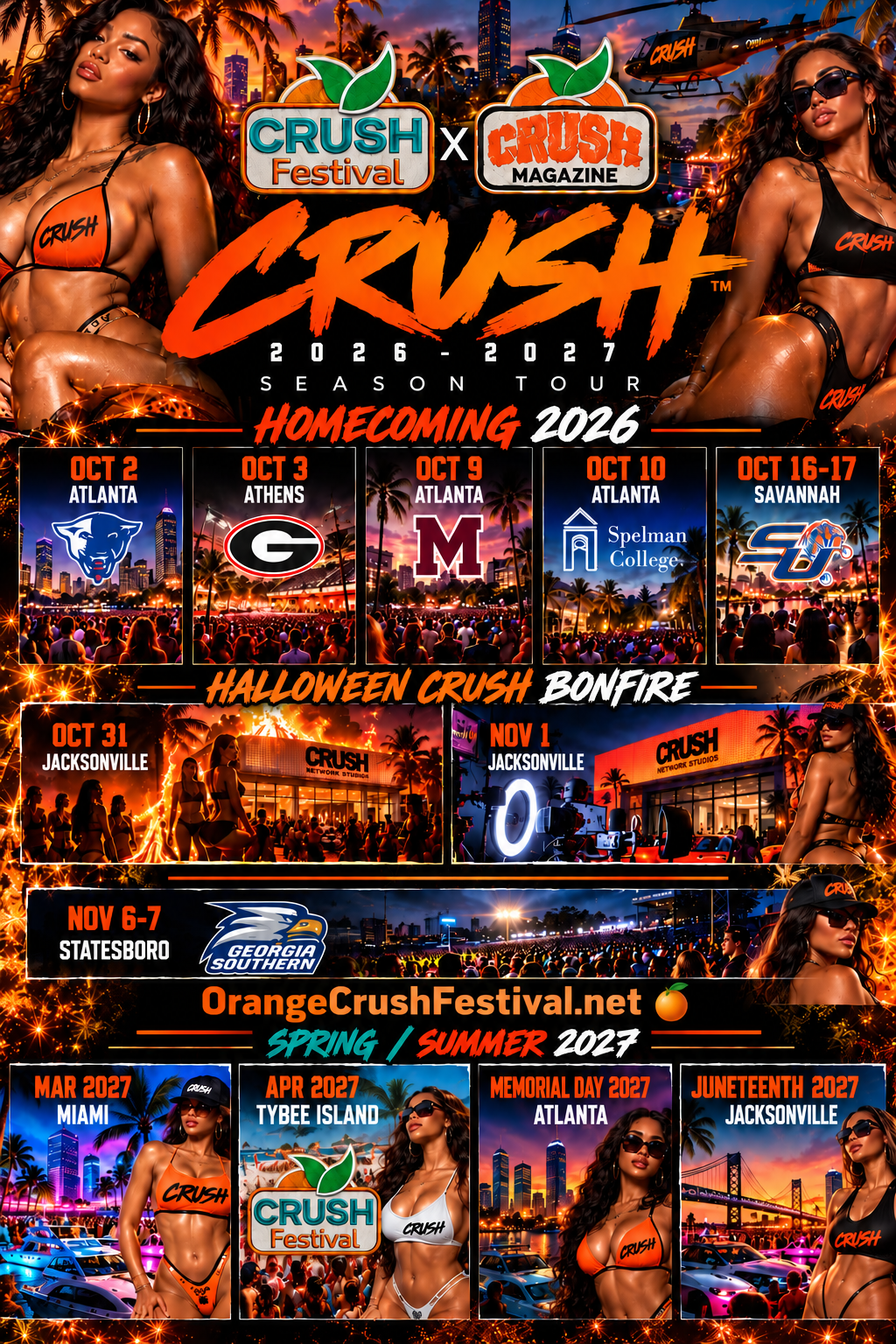
CRUSH MAGAZINE THE CRUSH EFFECT What Happens When Music, Media, Models, College Culture, Business and Cities Stop Operating Separately? Most entertainment brands sell
CRUSH MAGAZINE
THE CRUSH EFFECT
What Happens When Music, Media, Models, College Culture, Business and Cities Stop Operating Separately?
Most entertainment brands sell you a moment.
A ticket.
A party.
A concert.
A festival.
A photoshoot.
A magazine feature.
Then everybody goes home.
CRUSH is trying to build something more connected.
The 2026–2027 CRUSH season isn’t important simply because the calendar contains Atlanta, Athens, Savannah, Jacksonville, Statesboro, Miami and Tybee Island.
The bigger idea is what can happen between those places.
A student meets CRUSH at Homecoming.
A model gets photographed.
An artist gets interviewed.
A business owner sees the interview.
A photographer joins the next activation.
The model comes to Jacksonville.
The artist performs.
The business becomes a vendor.
The photographer creates the campaign.
Those images reach Miami.
Miami introduces another audience.
That audience discovers Tybee.
Tybee creates thousands of new pieces of media.
That media comes back through Atlanta.
And eventually the entire network returns to Jacksonville.
One interaction creates another.
That’s the CRUSH Effect.
WE AREN’T STARTING WITH CELEBRITIES. WE’RE STARTING WITH PEOPLE.
There is an old entertainment-industry formula:
Find somebody famous.
Put their face on the flyer.
Rent the venue.
Sell tickets.
Repeat.
CRUSH has another opportunity.
Build the people before they become obvious.
College Homecoming is an extraordinary environment for that.
Thousands of ambitious young adults and alumni are concentrated in the same places.
Future executives are walking beside future artists.
Future attorneys are standing beside photographers.
Models are sitting beside entrepreneurs.
Athletes are meeting creators.
People are launching brands from apartments, dorm rooms and phones.
Somebody CRUSH photographs in October 2026 could be considerably more important five years later.
That’s why the archive matters.
CRUSH Magazine isn’t only asking:
“Who is famous?”
We’re asking:
“Who should we know?”
Those are very different questions.
THE HOMECOMING POP-UP IS A DISCOVERY ENGINE
Georgia State.
UGA.
Morehouse.
Spelman.
Savannah State.
Georgia Southern.
CRUSH doesn’t need to build six giant events around those names.
The culture is already happening.
Our job is to arrive prepared enough to recognize opportunity.
That means the most important CRUSH equipment during Homecoming might not be a stage.
It might be:
A camera.
A microphone.
A QR code.
A photographer.
A videographer.
A personality capable of approaching strangers.
And somebody keeping track of everybody we meet.
Because content without relationships leaves enormous value behind.
If CRUSH photographs someone incredible and never learns her name, we captured an image.
If we photograph her, interview her, connect with her and eventually bring her into another CRUSH project?
We potentially created a relationship.
The second outcome is more valuable.
CRUSH MAGAZINE IS THE FRONT DOOR
This is where the magazine becomes much more important than promotional articles.
CRUSH Magazine gives the brand a legitimate reason to be curious.
Instead of:
“Come to our event.”
The conversation becomes:
“Tell us about you.”
What are you building?
Where are you from?
What are you wearing?
What are you studying?
What’s your business?
What’s your music?
Why did you come back for Homecoming?
What does this school mean to you?
What does this city get wrong?
What’s next for you?
Now CRUSH isn’t simply extracting attention.
We’re giving people an opportunity to tell their story.
That changes the relationship.
A MODEL SHOULDN’T DISAPPEAR AFTER ONE FLYER
Imagine CRUSH meets a model during Savannah State Homecoming.
The traditional promotional model cycle might look like this:
Take photograph.
Post photograph.
Move on.
The CRUSH ecosystem can potentially create a longer path.
Homecoming discovery.
↓
CRUSH Magazine portrait.
↓
Short interview.
↓
Jacksonville invitation.
↓
Crush Network Studios shoot.
↓
CRUSH merchandise content.
↓
Miami campaign.
↓
Tybee Festival appearance.
↓
Individual magazine profile.
↓
Atlanta activation.
↓
Future campaign.
Now audiences have watched somebody develop inside the world.
She isn’t “a girl on a flyer.”
She has a name.
A personality.
A history with CRUSH.
That is how brands develop recognizable casts.
AN ARTIST SHOULDN’T DISAPPEAR AFTER ONE PERFORMANCE EITHER
The same principle applies to music.
Suppose CRUSH discovers an artist at Georgia State.
First interaction:
60-second interview.
Second:
Song clip.
Third:
Jacksonville performance.
Fourth:
Sunday studio interview.
Fifth:
CRUSH Magazine profile.
Sixth:
Performance content released weeks later.
Seventh:
Potential future CRUSH booking.
One artist can create an entire chain of content.
And CRUSH can help introduce that artist to audiences in cities they haven’t reached independently.
That creates mutual value.
THE ENTREPRENEUR MATTERS TOO
College culture is full of commerce.
Clothing.
Food.
Hair.
Beauty.
Photography.
Graphic design.
Jewelry.
Transportation.
Events.
Technology.
Fitness.
Creative services.
Students and alumni aren’t simply consumers.
Many are business owners.
CRUSH Magazine should document that side of Homecoming aggressively.
Because today’s person selling clothing from a small table could eventually operate a major company.
And CRUSH shouldn’t wait until everybody else notices to tell the story.
JACKSONVILLE TURNS DISCOVERY INTO PRODUCTION
Then comes the permanent infrastructure.
Crush Network Studios gives CRUSH somewhere to continue relationships that begin elsewhere.
This is one of the biggest differences between a media brand with a physical location and one operating entirely through social media.
The conversation can move offline.
Come shoot.
Come interview.
Come perform.
Come podcast.
Come model.
Come network.
Come collaborate.
Come create.
The studio can become the place where “we met at Homecoming” turns into “we made something together.”
That’s powerful.
OCTOBER 31 IS THE COLLISION
Halloween BonfireCRUSH brings multiple CRUSH lanes into the same environment.
Artists.
Models.
Basketball.
Halloween.
Music.
Vendors.
Creators.
Businesses.
Photographers.
Attendees.
Media.
Mikey vs. Trojan.
The important part isn’t merely having many attractions.
It’s creating collisions between communities that normally operate separately.
The basketball player sees the artist perform.
The artist meets the photographer.
The photographer meets the model.
The model discovers the clothing vendor.
The clothing vendor meets the creator.
The creator films the battle.
The battle clip reaches somebody in another city.
Connections happen naturally when the room contains enough different types of people.
CRUSH’s job is to design environments where those collisions are more likely.
NOVEMBER 1 CAPTURES THE COLLISION
Sunday is where the CRUSH model becomes especially clear.
Saturday generates energy.
Sunday organizes it.
People who met Saturday can come back with less noise around them.
Sit down.
Talk.
Shoot.
Record.
Exchange information.
Create.
A performance becomes an interview.
A costume becomes an editorial.
A competitor becomes a personality.
A vendor becomes a business feature.
A random Saturday interaction becomes Sunday’s collaboration.
The content isn’t an afterthought.
The content is part of the event architecture.
THEN SOCIAL MEDIA BECOMES DISTRIBUTION — NOT THE PRODUCT
This distinction matters.
CRUSH should absolutely pursue viral content.
We want millions of views.
We want reposts.
We want conversations.
We want people sending CRUSH clips into group chats.
But virality can’t be the foundation.
Platforms change.
Algorithms change.
Accounts rise and fall.
Trends disappear.
The underlying assets remain:
Relationships.
Original photography.
Original video.
Interviews.
Email contacts.
Customer information gathered appropriately.
Business relationships.
Talent relationships.
The studio.
The festival.
The website.
The magazine archive.
Brand recognition.
Community.
Social media distributes the world.
It shouldn’t be the entire world.
EVERY CITY ADDS A DIFFERENT RESOURCE
The cities aren’t interchangeable.
ATLANTA
Talent.
Media.
Music.
Fashion.
College culture.
Business.
Creators.
Connectivity.
ATHENS
College-town energy.
SEC culture.
Students.
Alumni.
Football.
Downtown activity.
SAVANNAH
History.
Culture.
Savannah State.
Tourism.
Nightlife.
Coastal identity.
Proximity to Tybee.
JACKSONVILLE
Permanent infrastructure.
Crush Network Studios.
Florida audience.
Artists.
Models.
Local businesses.
Year-round production.
STATESBORO
Georgia Southern.
College culture.
Regional audience.
Homecoming.
MIAMI
Travel.
Spring Break.
International visibility.
Water.
Nightlife.
Fashion.
Luxury.
Tourism.
TYBEE ISLAND
Beach.
Music.
Annual tradition.
Savannah connection.
Destination festival identity.
The network gets more interesting because those environments aren’t the same.
CRUSH CAN CREATE MOVEMENT BETWEEN CITIES
This may become one of the strongest long-term pieces of the model.
Don’t only move CRUSH between markets.
Move people through CRUSH.
Atlanta artist → Jacksonville studio.
Jacksonville model → Miami.
Miami creator → Tybee.
Savannah vendor → Atlanta.
Atlanta photographer → Jacksonville.
Jacksonville artist → Tybee.
Tybee attendee → next year’s Miami activation.
Now the brand isn’t merely operating in multiple cities.
It’s connecting them.
That creates a completely different sense of scale.
THE AUDIENCE CAN BECOME PARTICIPANTS
Traditional media creates a hard division:
People on screen.
People watching screen.
CRUSH can blur that.
Someone watching Georgia State coverage could appear in the Morehouse/Spelman coverage the following week.
Someone watching Savannah content could register for Halloween.
Someone attending Halloween could become Sunday’s interview.
Someone watching that interview could meet CRUSH in Miami.
Someone photographed in Miami could appear at Tybee.
The audience begins understanding:
I don’t only have to watch CRUSH. I can enter CRUSH.
That is extremely important for community building.
THE WEBSITE BECOMES THE MAP
Social media gives audiences fragments.
CRUSH Magazine should give them the world.
Someone sees a 12-second video.
They visit the site.
Now they find:
The person from the video.
The full interview.
The photographer.
The event.
The next city.
Another model.
Another artist.
Another story.
The studio.
The festival.
The calendar.
The archive.
One viral clip can then create exploration instead of one disposable view.
That’s why the editorial infrastructure has to exist before something goes viral.
Attention needs somewhere to go.
THE IMPACT IS CULTURAL — BUT IT IS ALSO ECONOMIC
A functioning CRUSH circuit creates opportunities for money to move through independent creative communities.
Photographers get booked.
Videographers work.
Artists perform.
Models shoot.
Vendors sell.
Food businesses serve customers.
DJs get booked.
Hosts work.
Security works.
Designers create merchandise.
Studios produce content.
Local businesses advertise.
Sponsors access audiences.
Hotels receive travelers.
Transportation gets used.
People eat.
People shop.
People create.
CRUSH doesn’t capture all of that revenue.
Nor should it.
Part of the ecosystem’s value is that economic activity occurs around it.
A successful cultural property can create opportunities beyond its own balance sheet.
THERE CAN BE COMMUNITY IMPACT TOO
CRUSH doesn’t have to choose between entertainment and meaningful contribution.
The larger the platform becomes, the more opportunities exist to connect visibility with service.
Student entrepreneurs can receive coverage.
Independent businesses can receive exposure.
Emerging artists can receive platforms.
Models can receive professional media.
Creators can build portfolios.
Communities can tell their own stories.
Future philanthropic initiatives can use the same media infrastructure and audience.
The party can generate attention.
The platform can decide what else that attention supports.
SUCCESS ISN’T ONE NUMBER
Attendance matters.
Revenue matters.
Views matter.
Followers matter.
But none of those individually tells the complete story.
By Juneteenth 2027, CRUSH should also ask:
How many original stories did we publish?
How many people did we interview?
How many models did we discover?
How many artists did we document?
How many businesses entered the network?
How many paid creative opportunities were generated?
How many people returned for another CRUSH experience?
How many cities did our audience travel between?
How much original media do we own?
How many relationships survived beyond one weekend?
How many people recognize CRUSH without needing an explanation?
Those measurements reveal whether an ecosystem is actually forming.
AND THEN THERE’S THE IMPACT WE CAN’T PREDICT
This may be the most exciting part.
Some of the most important moments of the season probably aren’t on the calendar yet.
We don’t know who we’re going to meet October 2.
We don’t know which interview will unexpectedly explode.
We don’t know which model audiences will love.
We don’t know which artist will have the record everybody keeps asking about.
We don’t know which photograph will define the season.
We don’t know which business owner becomes a long-term partner.
We don’t know which stranger becomes part of CRUSH for years.
That’s why we go outside.
If everything could be predicted from a planning document, there would be no reason to document the journey.
OCTOBER 2026 → JUNETEENTH 2027
The calendar provides the structure.
People will provide the story.
Atlanta → Athens → Atlanta → Savannah → Jacksonville → Statesboro → Miami → Tybee → Atlanta → Jacksonville.
Homecoming gives CRUSH discovery.
Crush Network Studios gives it a home.
Halloween gives it spectacle.
CRUSH Magazine gives it memory.
Miami gives it expansion.
Tybee gives it an annual destination.
Atlanta gives it another major-market stage.
Jacksonville brings the network home.
And every person encountered along the way has the potential to change what comes next.
That’s the larger impact we’re pursuing.
Not simply more events.
Not simply more followers.
Not simply more content.
More connections.
Between people.
Between businesses.
Between cities.
Between entertainment and media.
Between an audience and the world they’re watching develop.
Because the most valuable thing CRUSH can build isn’t a crowded room.
It’s a network strong enough that when the room empties,
the relationships remain.
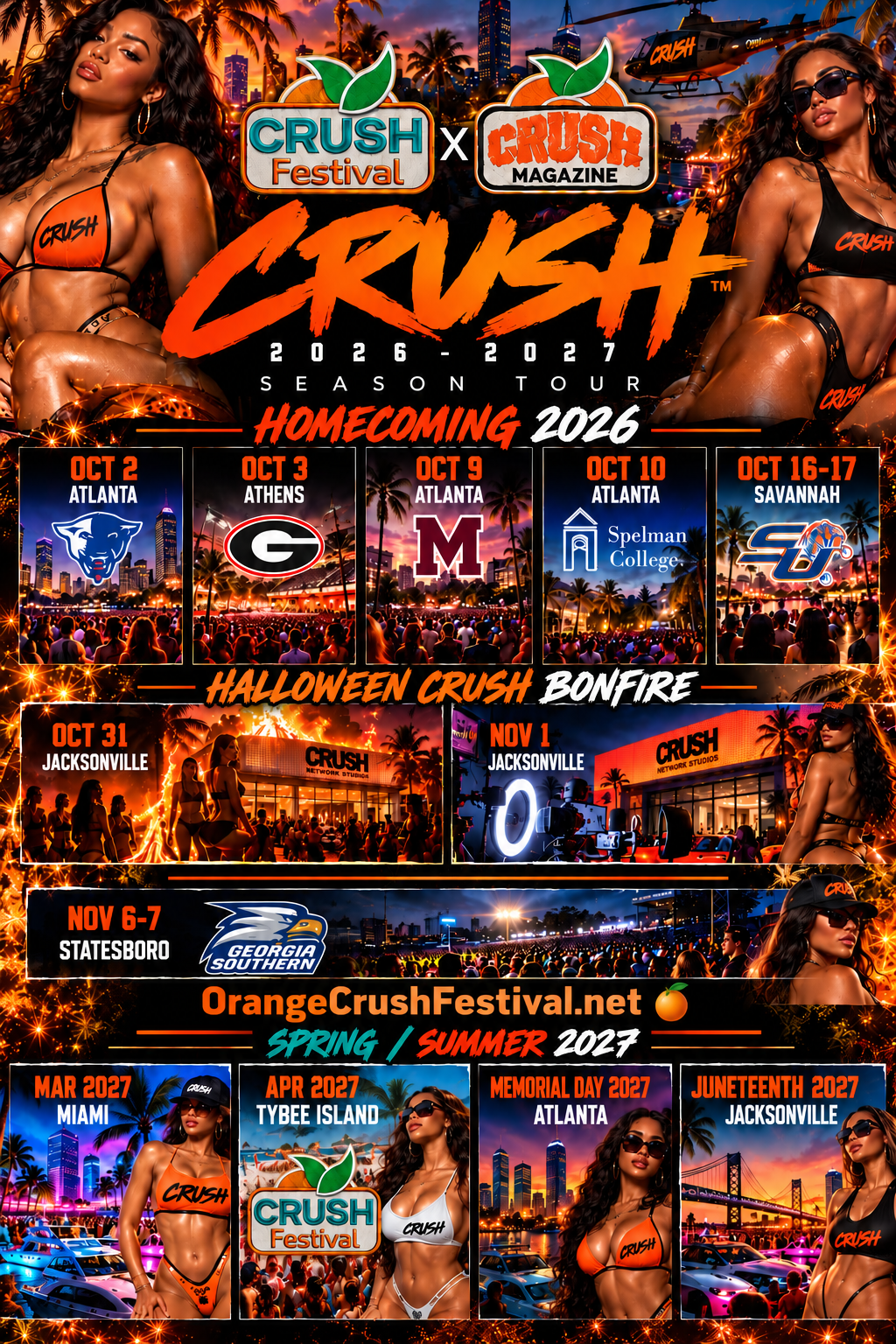
CRUSH MAGAZINE THE CRUSH 2026–2027 SEASON This Isn’t a Tour of Events. It’s a Tour Designed to Build an Ecosystem.
CRUSH MAGAZINE
THE CRUSH 2026–2027 SEASON
This Isn’t a Tour of Events. It’s a Tour Designed to Build an Ecosystem.
There is a difference between having dates on a calendar and having a reason those dates belong together.
CRUSH now has both.
From October 2026 through Juneteenth 2027, the CRUSH world will move through college campuses, major Southern cities, a permanent Jacksonville studio, Homecoming weekends, Halloween, Spring Break, a beach music festival, Memorial Day Weekend and Juneteenth.
Atlanta.
Athens.
Savannah.
Jacksonville.
Statesboro.
Miami.
Tybee Island.
Then Atlanta and Jacksonville again.
Look at those dates individually and they are events, trips and pop-ups.
Look at them together and something much more important becomes visible:
CRUSH is building a circuit.
Not a tour where the same stage gets packed into a truck and reconstructed in another city.
A cultural circuit where every stop has a different purpose—and everything created at one stop becomes fuel for the next.
That is the real story of the CRUSH 2026–2027 Season.
IT STARTS WITH HOMECOMING
October is discovery.
CRUSH begins inside environments that already have history, traditions and communities of their own.
October 2 — Georgia State, Atlanta.
October 3 — UGA, Athens.
October 9–10 — Morehouse + Spelman, Atlanta.
October 16–17 — Savannah State, Savannah.
And later:
November 6–7 — Georgia Southern, Statesboro.
CRUSH isn’t attempting to own those Homecomings.
The universities already own their traditions.
Students and alumni already create the culture.
CRUSH is there to document, participate, discover and connect.
That’s why these are pop-ups.
A microphone.
A camera.
CRUSH Magazine.
CRUSH personalities.
Real conversations.
Real people.
Real environments.
At one school, the story might be fashion.
At another, tradition.
At another, music.
At another, Greek life.
At another, entrepreneurship.
At another, somebody CRUSH didn’t know existed 15 minutes before the camera found them.
That unpredictability is part of the product.
EVERY STOP SHOULD CHANGE CRUSH
This is where the tour becomes different from a normal promotional campaign.
The objective isn’t simply to leave flyers behind.
CRUSH should leave every city with something it didn’t have when it arrived.
A new model.
A new artist.
A photographer.
A business relationship.
A vendor.
A sponsor prospect.
A great interview.
A hilarious video.
A photograph people can’t stop reposting.
A student entrepreneur worth profiling.
A future host.
A basketball player.
A DJ.
A story.
An audience.
A relationship.
Maybe all of them.
If 100 people encounter CRUSH during a Homecoming weekend, the objective isn’t merely getting 100 people to follow an Instagram page.
The question is:
Who among those 100 people belongs somewhere else in the CRUSH world?
That’s ecosystem thinking.
ATLANTA ISN’T JUST A STOP
Atlanta appears repeatedly in this season for a reason.
Georgia State introduces CRUSH to one version of Atlanta.
Morehouse and Spelman introduce another.
Then Memorial Day Weekend 2027 brings CRUSH back after months of development.
That creates something valuable:
before-and-after.
The CRUSH that arrives in Atlanta in October 2026 should not be identical to the CRUSH that returns Memorial Day Weekend 2027.
By then there should be more content.
More relationships.
More recognizable faces.
More editorial history.
More proof.
More stories.
More infrastructure.
More people who understand what CRUSH actually is.
The city becomes a measuring stick.
SAVANNAH ISN’T JUST A STOP EITHER
Savannah State Homecoming brings CRUSH into Savannah in October.
Then spring changes everything.
In April, the ecosystem returns to the Savannah/Tybee market for something fundamentally different:
THE ANNUAL CRUSH BEACH MUSIC FESTIVAL.
Homecoming is a pop-up.
Tybee is the festival.
That distinction is central to the architecture.
October allows CRUSH Magazine to move through Savannah culture and build relationships.
April allows CRUSH Festival to create its own destination.
Same broader market.
Different product.
Different atmosphere.
Different purpose.
And six months of storytelling connecting them.
THEN EVERYTHING RUNS THROUGH JACKSONVILLE
October’s Homecoming movement eventually reaches a physical address.
That’s where the strategy changes.
CRUSH doesn’t merely visit Jacksonville.
CRUSH Network Studios lives there.
That makes Jacksonville different from every other market on the circuit.
On October 31 and November 1, the studio becomes the proving ground for the entire fall concept.
HALLOWEEN BONFIRECRUSH.
Saturday is spectacle.
Sunday is content.
The distinction is deceptively important.
Saturday asks:
Can CRUSH create a moment people want to experience?
Sunday asks:
Can CRUSH turn that moment into something valuable after it happens?
Music.
Basketball.
Models.
Halloween.
Bonfire.
Performances.
Competition.
Mikey vs. Trojan.
Then:
Photography.
Interviews.
Podcasts.
CRUSH Magazine.
Artist media.
Model editorials.
Networking.
Recaps.
The weekend is essentially the CRUSH business model compressed into 48 hours.
Experience creates attention.
Media extends attention.
Infrastructure makes it repeatable.
THE STUDIO CHANGES THE ECONOMICS
A touring brand constantly has to rent somebody else’s world.
A permanent location creates another possibility.
CRUSH can build its own.
Crush Network Studios can potentially generate activity between major calendar dates rather than waiting months for another festival.
An artist discovered during Homecoming could eventually record an interview there.
A model discovered in Savannah could eventually shoot there.
A Jacksonville entrepreneur could become a sponsor.
A photographer could become a collaborator.
A performer from BonfireCRUSH could return for another production.
A podcast recorded there could promote Miami.
A Miami conversation could promote Tybee.
A Tybee interview could promote Atlanta.
The building becomes more valuable as the network around it becomes more valuable.
And the network becomes more valuable as the building gives people somewhere to return.
THEN CRUSH CHANGES SEASONS
After fall comes winter.
And winter shouldn’t be dead space.
It should be editing season.
Publishing season.
Development season.
CRUSH Magazine has October and November material to release.
Crush Network Studios has people to bring back.
The audience has characters to become familiar with.
And gradually the imagery changes.
College colors disappear.
Halloween disappears.
Bonfires disappear.
Palm trees start appearing.
Water.
Boats.
Swimwear.
Sunshine.
Miami.
MARCH 2027: THE WORLD GETS BIGGER
Miami changes the perceived scale of CRUSH.
Not because Miami automatically makes a brand important.
It doesn’t.
But because geography changes perception when the movement is authentic.
A CRUSH audience that has watched Atlanta, Athens, Savannah, Jacksonville and Statesboro now watches the cameras arrive in South Florida.
The visual language changes.
The people change.
The nightlife changes.
The fashion changes.
The environment changes.
The brand remains recognizable.
That’s the challenge.
CRUSH has to become portable without becoming generic.
You should be able to remove the location tag from a photograph and still know it came from CRUSH.
But you should also be able to look at the photograph and know:
That’s Miami.
That’s world building.
APRIL 2027: THE BEACH BECOMES THE DESTINATION
Then comes Tybee.
And this is where everything CRUSH learned from documenting other people’s cultural moments can be applied to its own annual festival environment.
The CRUSH Beach Music Festival has a different responsibility.
Here, CRUSH isn’t simply covering the environment.
CRUSH is responsible for helping create it.
The artists matter.
The audience matters.
The models matter.
The vendors matter.
The beach matters.
The music matters.
The photographs matter.
The experience matters.
And because it is annual, the archive matters enormously.
Every April should add another chapter.
Eventually people shouldn’t simply ask when CRUSH Festival is happening.
They should compare years.
Remember moments.
Remember outfits.
Remember performances.
Remember who they met.
Remember where they stayed.
Remember the first year they attended.
That’s how an annual event develops cultural memory.
MEMORIAL DAY: TAKE THE PROGRESS BACK TO ATLANTA
Then CRUSH returns to Atlanta.
But now imagine what exists that didn’t exist in October.
Months of CRUSH Magazine stories.
Homecoming footage.
Halloween BonfireCRUSH.
Mikey vs. Trojan Battle #1.
Studio interviews.
Models.
Miami footage.
Tybee footage.
Festival photographs.
New artists.
New personalities.
New relationships.
Possibly new sponsors.
Possibly recurring attendees.
Possibly people who first encountered CRUSH at Georgia State seven months earlier.
Now the audience gets to see whether the brand actually grew.
That’s why returning to cities matters.
Growth becomes visible.
JUNETEENTH: BACK TO JACKSONVILLE
Then the circuit comes home.
Jacksonville.
Juneteenth 2027.
The city containing the permanent CRUSH infrastructure becomes the final major destination of this season.
But it shouldn’t feel like the same Jacksonville we left in November.
The entire journey should come back with us.
Imagine the visual possibility alone.
A model discovered during Homecoming.
An artist met in Miami.
A business relationship developed at Tybee.
A creator from Atlanta.
Jacksonville personalities who have been present since BonfireCRUSH.
CRUSH Magazine documenting all of them together.
That’s when a calendar becomes a network.
THE REAL PRODUCT IS THE NETWORK
Events are visible.
The network underneath them is more important.
CRUSH is potentially connecting:
Artists.
Models.
Students.
Alumni.
Photographers.
Videographers.
Creators.
Athletes.
Promoters.
DJs.
Entrepreneurs.
Vendors.
Businesses.
Sponsors.
Media personalities.
Fans.
Travelers.
Cities.
Venues.
And audiences.
Every successful interaction creates another possible connection.
That’s where the long-term value lives.
A model isn’t useful only because she creates one photograph.
She can become a recurring personality.
An artist isn’t useful only because he performs one song.
He can become an interview, collaborator, performer and future draw.
A sponsor isn’t useful only because it buys one placement.
It can become a long-term business relationship.
An attendee isn’t simply a ticket.
That person can become a follower, customer, ambassador, traveler and repeat attendee.
The CRUSH network gets stronger when people have reasons to remain inside it.
THE SECOND PRODUCT IS THE ARCHIVE
By Juneteenth 2027, CRUSH should possess something it does not possess today:
a massive original media library.
Thousands of photographs.
Hundreds or thousands of video clips.
Interviews.
Performances.
Model editorials.
Crowd reactions.
City footage.
Behind-the-scenes material.
Studio sessions.
Festival imagery.
Travel content.
Personality profiles.
Articles.
Short-form video.
Long-form video.
Sponsor material.
Historical documentation.
That library becomes intellectual and marketing infrastructure.
Future flyers don’t need generic imagery.
Use CRUSH.
Future advertisements don’t need random models.
Use CRUSH personalities.
Future recap videos don’t need filler.
Open the archive.
Future sponsors don’t need to imagine what CRUSH looks like.
Show them.
Future documentaries have source material.
Future anniversary content has history.
Future magazines have photography.
The brand gradually becomes capable of illustrating itself.
That is a major threshold for a media brand.
THE THIRD PRODUCT IS RECOGNITION
At the beginning, somebody may need the logo explained.
Eventually, they shouldn’t.
The orange.
The photography.
The models.
The microphone.
The magazine.
The studio.
The festival.
The cities.
The recurring faces.
The visual language.
The attitude.
All of it should begin producing recognition before someone even reads the word CRUSH.
That’s what this season can accomplish if it is documented properly.
Not instant fame.
Repetition with identity.
That is much more durable.
THE TOUR IS ALSO A STORY ABOUT SCALE
October begins small by design.
A camera can start it.
A microphone can start it.
A conversation can start it.
That’s important.
Because audiences rarely get to watch a brand become what it says it wants to become.
Usually they’re introduced after everything is polished.
CRUSH has another opportunity:
show the construction.
Show Georgia State.
Show the drive to Athens.
Show the AUC.
Show Savannah.
Show the Jacksonville studio.
Show Halloween.
Show Statesboro.
Show the winter work.
Show the flight or drive to Miami.
Show Tybee being built.
Show Atlanta.
Show Jacksonville.
Show the mistakes too.
Show the improvements.
Let the audience watch CRUSH accumulate.
People don’t only become invested in destinations.
They become invested in journeys.
FROM ZERO CONTENT TO A LIVING WORLD
At the beginning of this season, CRUSH faces an unusual advantage disguised as a weakness:
There isn’t enough content yet.
Good.
That means we know where the story starts.
There is a before.
Now we create the after.
Every photograph matters more because the archive is young.
Every great interview introduces someone new.
Every city expands the visual vocabulary.
Every successful event adds proof.
Every mistake creates information.
Every returning personality creates continuity.
Every new market makes the map larger.
By Juneteenth, the goal shouldn’t simply be to say:
“CRUSH threw some successful events.”
The goal should be for someone looking backward at the previous nine months to see something unmistakable:
A media platform became more active.
A studio became more populated.
A festival became more visible.
A network became more connected.
A cast of personalities began emerging.
An archive began accumulating.
Cities started connecting.
And an audience started understanding that CRUSH isn’t one party.
It’s a world.
THE 2026–2027 CRUSH SEASON
OCT 2 — ATLANTA
Georgia State Homecoming Pop-Up
OCT 3 — ATHENS
UGA Homecoming Pop-Up
OCT 9–10 — ATLANTA
Morehouse + Spelman Homecoming Pop-Ups
OCT 16–17 — SAVANNAH
Savannah State Homecoming Pop-Up
OCT 31 — JACKSONVILLE
Halloween BonfireCRUSH — Saturday: Spectacle
NOV 1 — JACKSONVILLE
Halloween BonfireCRUSH — Sunday: Content
NOV 6–7 — STATESBORO
Georgia Southern Homecoming Pop-Up
MARCH 2027 — MIAMI
APRIL 2027 — TYBEE ISLAND
Annual CRUSH Beach Music Festival
MEMORIAL DAY WEEKEND 2027 — ATLANTA
JUNETEENTH 2027 — JACKSONVILLE
Nine months.
Multiple cities.
One permanent home.
One annual beach festival.
A traveling media platform.
And thousands of opportunities to turn strangers into stories, stories into content, content into attention, attention into relationships, and relationships into something capable of lasting beyond any single weekend.
The season isn’t the product.
What CRUSH becomes during the season is.
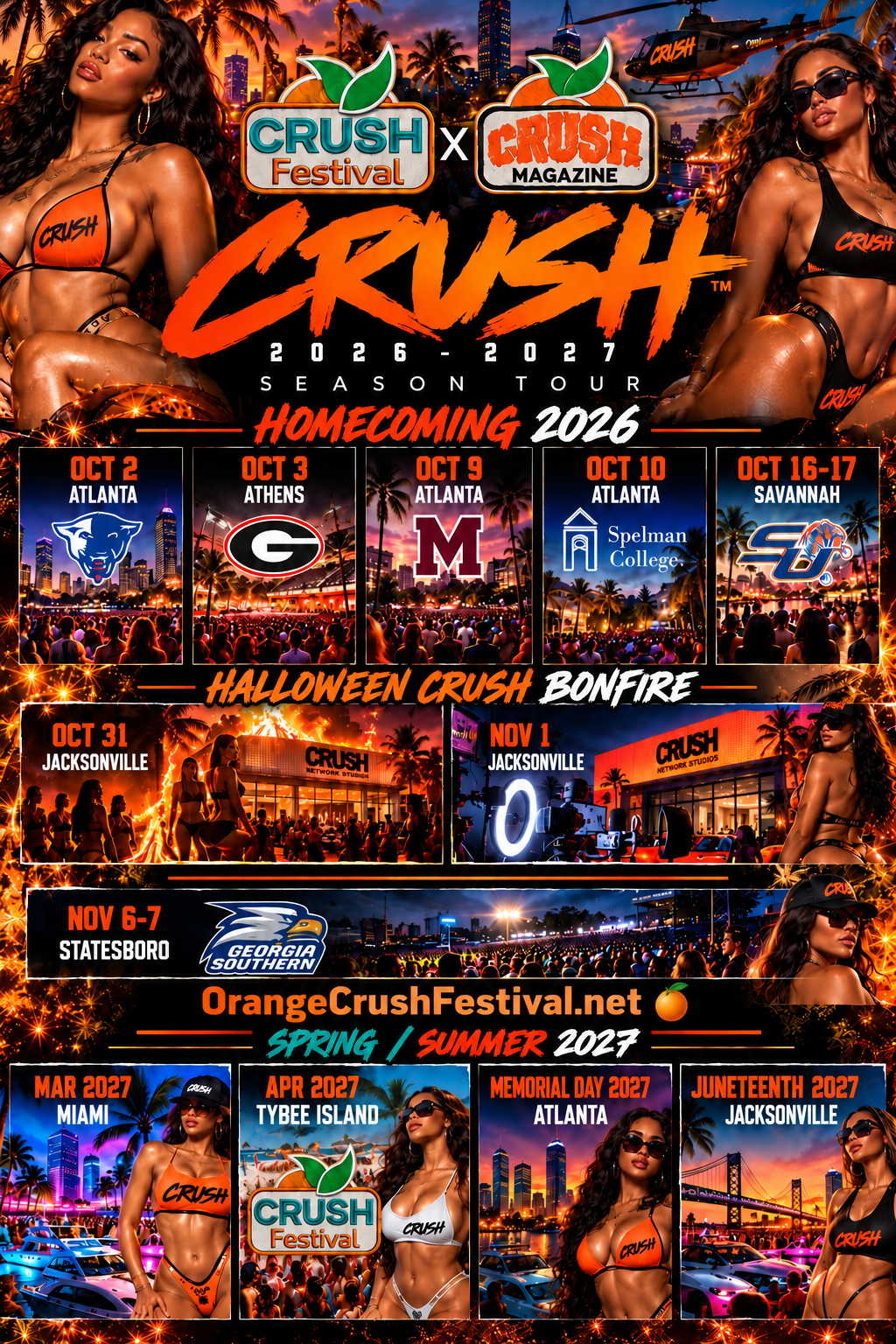
CRUSH 2026–2027 🍊 HOMECOMING → HALLOWEEN → SPRING BREAK → FESTIVAL SEASON → JUNETEENTH CRUSH Festival × CRUSH Magazine is taking the CRUSH experience from October 2026 thru June 2027
CRUSH 2026–2027 🍊
HOMECOMING → HALLOWEEN → SPRING BREAK → FESTIVAL SEASON → JUNETEENTH
CRUSH Festival × CRUSH Magazine is taking the CRUSH experience across multiple cities from October 2026 through Juneteenth 2027.
We’re bringing together music, models, media, fashion, basketball, photography, artist performances, content creation, merchandise, businesses and live experiences.
🍊 2026–2027 CRUSH SCHEDULE
OCT 2 — ATLANTA
Georgia State area
OCT 3 — ATHENS
UGA area
OCT 9–10 — ATLANTA
Morehouse + Spelman / AUC
OCT 16–17 — SAVANNAH
Savannah State Homecoming weekend
OCT 31–NOV 1 — JACKSONVILLE
🎃🔥 HALLOWEEN CRUSH BONFIRE
Crush Network Studios
INSIDE:
VERSUZ Performances • Halloween Party • Costume Power Shoot
OUTSIDE:
Bonfire • 1v1 Basketball • Halloween Games
NOV 6–7 — STATESBORO
Georgia Southern area
MARCH 2027 — MIAMI
🌴 Spring Break
APRIL 2027 — SAVANNAH / TYBEE
🍊 Spring CRUSH
MEMORIAL DAY WEEKEND 2027 — ATLANTA
JUNETEENTH 2027 — JACKSONVILLE
CRUSH MAGAZINE 📸
CRUSH Magazine will support the season with artist interviews, model features, event coverage, photography, business spotlights, fashion, music coverage and original CRUSH content.
ARTISTS 🎤
CRUSH is creating opportunities for artists through performances, VERSUZ battles, interviews, magazine features, photography and performance content.
MODELS 📸
CRUSH models will participate in magazine modeling, costume modeling, fashion shoots, product campaigns, event visuals and destination content.
CREATORS 🎥
We’re working with photographers, videographers, hosts, DJs, producers, designers, stylists and other creators throughout the season.
BUSINESSES 💼
CRUSH will feature opportunities for vendors, sponsors, advertisers, merchandise partners and participating businesses across our events and media.
CRUSH NETWORK STUDIOS — JACKSONVILLE
Crush Network Studios supports music, photography, interviews, podcasts, model shoots, artist content and CRUSH media production.
THE CRUSH NETWORK 🍊
CRUSH Festival — Live experiences
CRUSH Magazine — Media + editorial coverage
CRUSH Music — Original music + performances
CRUSH Models — Modeling + campaigns
Crush Network Studios — Creative production
CRUSH Merchandise — Branded products
CRUSH Business — Vendors + partnerships + sponsorships
CRUSH Community — Community and philanthropic initiatives
ATLANTA • SAVANNAH • TYBEE • JACKSONVILLE • MIAMI + TOUR STOPS
2026–2027 CRUSH SEASON 🍊
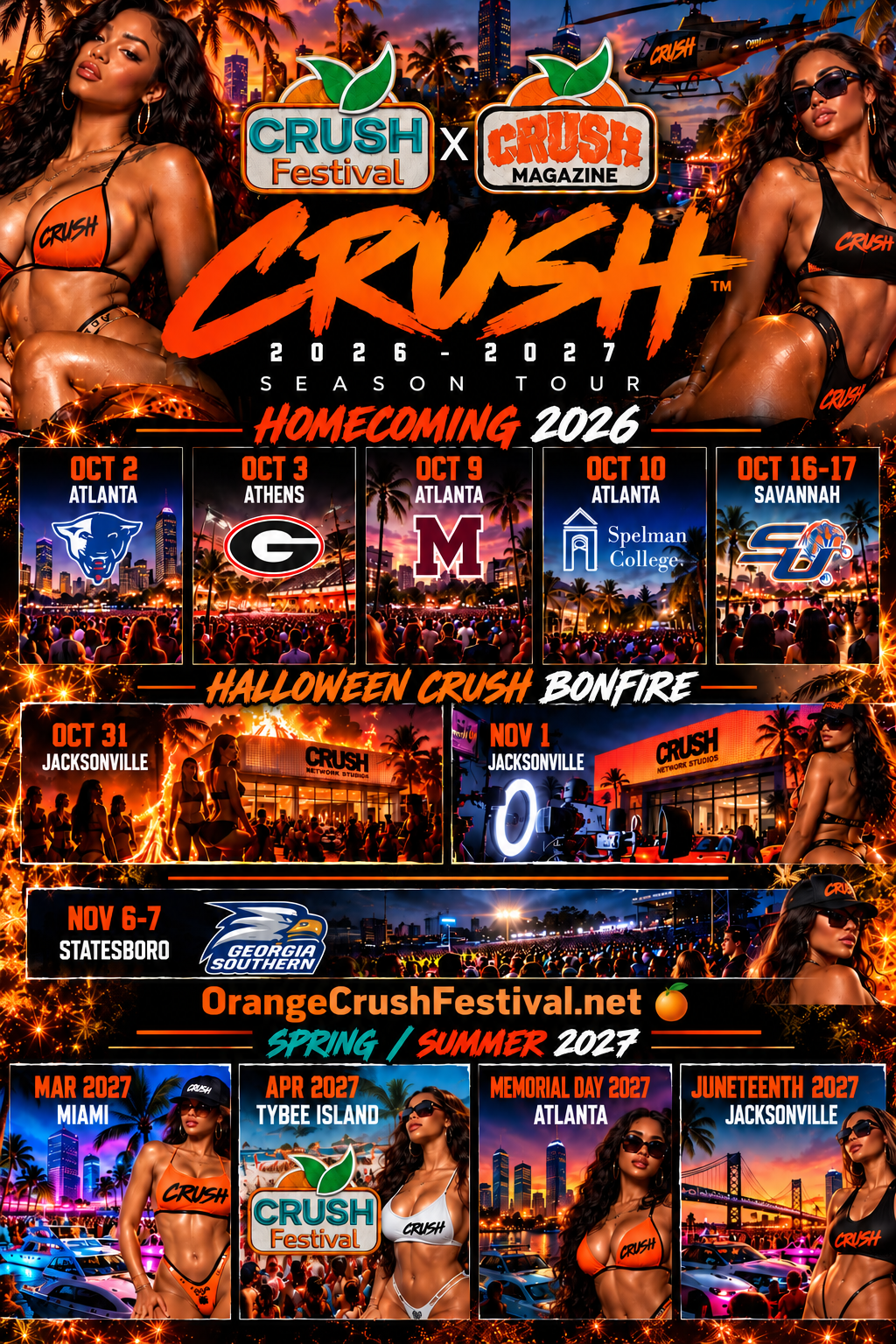
CRUSH 2026–2027 🍊 HOMECOMING → HALLOWEEN → SPRING BREAK → FESTIVAL SEASON → JUNETEENTH CRUSH Festival × CRUSH Magazine is taking the CRUSH experience from October 2026 thru June 2027
CRUSH 2026–2027 🍊
HOMECOMING → HALLOWEEN → SPRING BREAK → FESTIVAL SEASON → JUNETEENTH
CRUSH Festival × CRUSH Magazine is taking the CRUSH experience across multiple cities from October 2026 through Juneteenth 2027.
We’re bringing together music, models, media, fashion, basketball, photography, artist performances, content creation, merchandise, businesses and live experiences.
🍊 2026–2027 CRUSH SCHEDULE
OCT 2 — ATLANTA
Georgia State area
OCT 3 — ATHENS
UGA area
OCT 9–10 — ATLANTA
Morehouse + Spelman / AUC
OCT 16–17 — SAVANNAH
Savannah State Homecoming weekend
OCT 31–NOV 1 — JACKSONVILLE
🎃🔥 HALLOWEEN CRUSH BONFIRE
Crush Network Studios
INSIDE:
VERSUZ Performances • Halloween Party • Costume Power Shoot
OUTSIDE:
Bonfire • 1v1 Basketball • Halloween Games
NOV 6–7 — STATESBORO
Georgia Southern area
MARCH 2027 — MIAMI
🌴 Spring Break
APRIL 2027 — SAVANNAH / TYBEE
🍊 Spring CRUSH
MEMORIAL DAY WEEKEND 2027 — ATLANTA
JUNETEENTH 2027 — JACKSONVILLE
CRUSH MAGAZINE 📸
CRUSH Magazine will support the season with artist interviews, model features, event coverage, photography, business spotlights, fashion, music coverage and original CRUSH content.
ARTISTS 🎤
CRUSH is creating opportunities for artists through performances, VERSUZ battles, interviews, magazine features, photography and performance content.
MODELS 📸
CRUSH models will participate in magazine modeling, costume modeling, fashion shoots, product campaigns, event visuals and destination content.
CREATORS 🎥
We’re working with photographers, videographers, hosts, DJs, producers, designers, stylists and other creators throughout the season.
BUSINESSES 💼
CRUSH will feature opportunities for vendors, sponsors, advertisers, merchandise partners and participating businesses across our events and media.
CRUSH NETWORK STUDIOS — JACKSONVILLE
Crush Network Studios supports music, photography, interviews, podcasts, model shoots, artist content and CRUSH media production.
THE CRUSH NETWORK 🍊
CRUSH Festival — Live experiences
CRUSH Magazine — Media + editorial coverage
CRUSH Music — Original music + performances
CRUSH Models — Modeling + campaigns
Crush Network Studios — Creative production
CRUSH Merchandise — Branded products
CRUSH Business — Vendors + partnerships + sponsorships
CRUSH Community — Community and philanthropic initiatives
ATLANTA • SAVANNAH • TYBEE • JACKSONVILLE • MIAMI + TOUR STOPS
2026–2027 CRUSH SEASON 🍊
SATURDAY MAKES THE MEMORY. SUNDAY MAKES THE MEDIA. October 31 should be loud. November 1 should be useful. That’s the philosophy behind Halloween BonfireCRUSH. Saturday brings the collision: Bonf
SATURDAY MAKES THE MEMORY. SUNDAY MAKES THE MEDIA.
October 31 should be loud.
November 1 should be useful.
That’s the philosophy behind Halloween BonfireCRUSH.
Saturday brings the collision:
Bonfire.
Halloween.
Basketball.
Music.
Costumes.
Models.
Performances.
Competition.
Crowds.
And Mikey vs. Trojan.
Then Sunday asks a different question:
What do we do with everybody we just brought together?
Interview them.
Photograph them.
Record them.
Let them network.
Give artists a camera.
Give models a set.
Give personalities a microphone.
Talk about what happened the night before.
Create the next story.
Saturday creates attention.
Sunday turns attention into assets.
That’s the business.
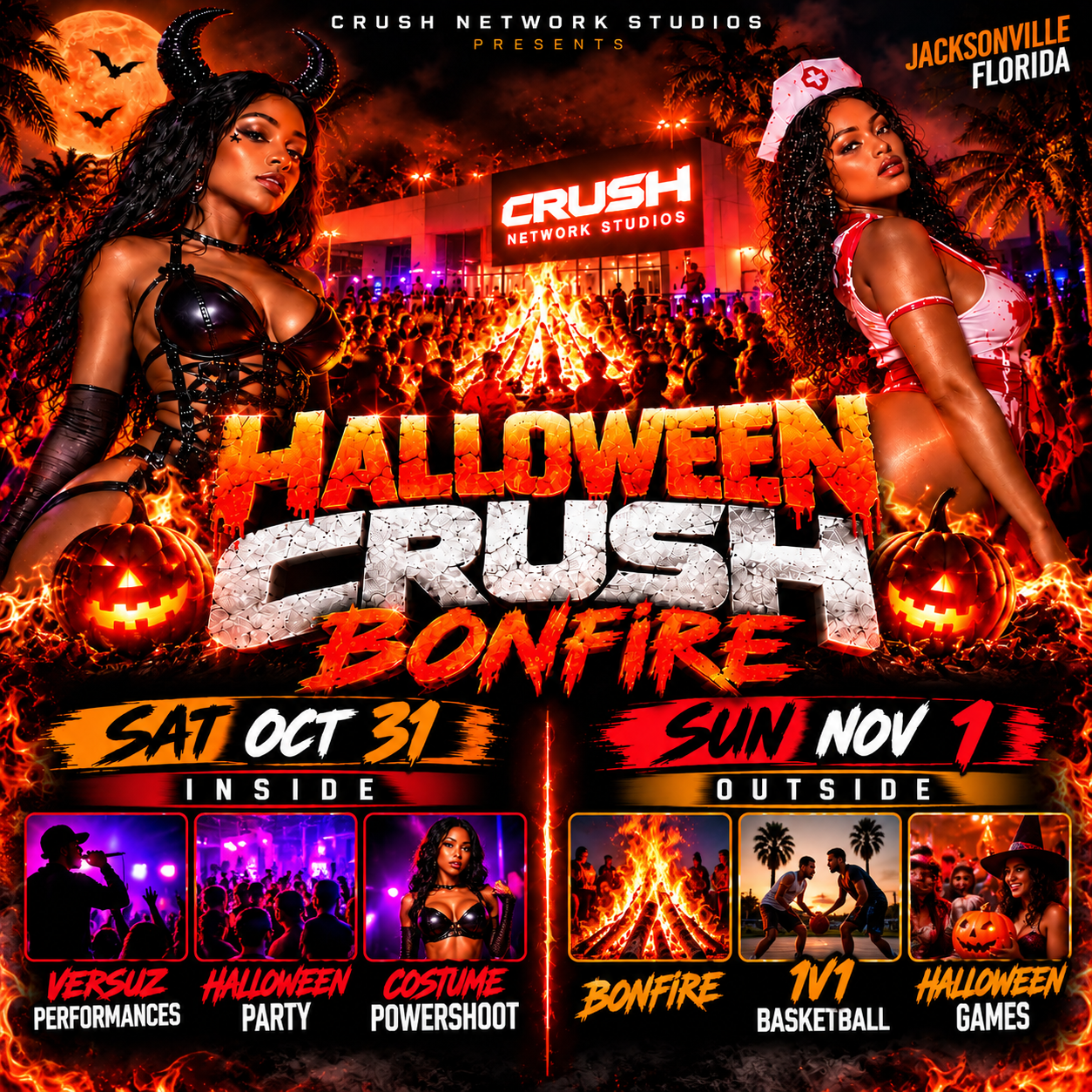
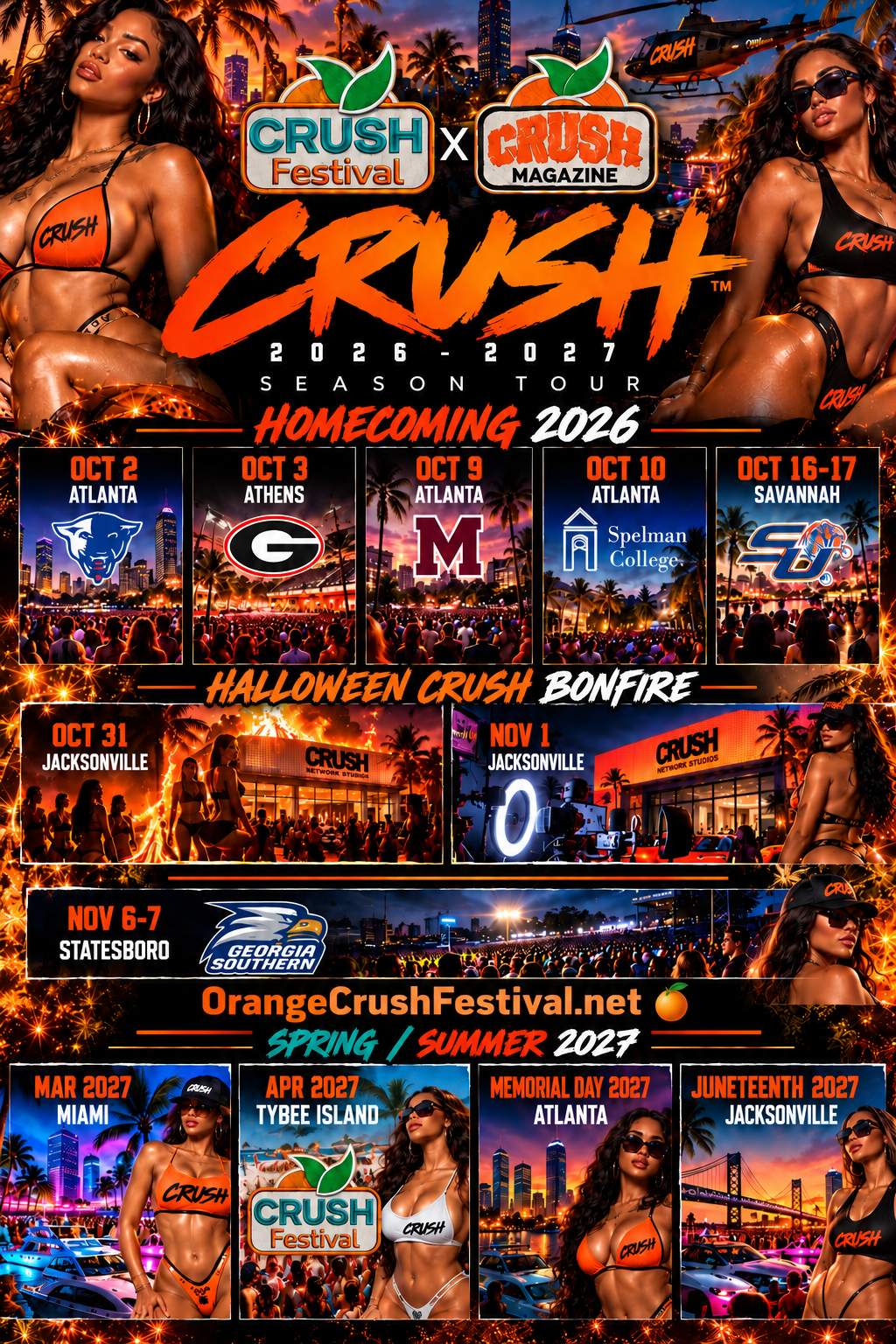
THERE’S A BUILDING IN JACKSONVILLE The road eventually reaches something permanent. Crush Network Studios. That’s important because CRUSH can’t become what we’re building if everything disappears w
THERE’S A BUILDING IN JACKSONVILLE
The road eventually reaches something permanent.
Crush Network Studios.
That’s important because CRUSH can’t become what we’re building if everything disappears when an event ends.
Festivals end.
Homecomings end.
Parties end.
A studio gives the ideas somewhere to live afterward.
October 31 and November 1 will demonstrate that concept publicly.
Outside: people.
Inside: production.
Saturday: spectacle.
Sunday: content.
And Monday?
The building is still there.
That’s the point.
THERE’S A BUILDING IN JACKSONVILLE The road eventually reaches something permanent. Crush Network Studios. That’s important because CRUSH can’t become what we’re building if everything disappears w
THERE’S A BUILDING IN JACKSONVILLE
The road eventually reaches something permanent.
Crush Network Studios.
That’s important because CRUSH can’t become what we’re building if everything disappears when an event ends.
Festivals end.
Homecomings end.
Parties end.
A studio gives the ideas somewhere to live afterward.
October 31 and November 1 will demonstrate that concept publicly.
Outside: people.
Inside: production.
Saturday: spectacle.
Sunday: content.
And Monday?
The building is still there.
That’s the point.
THE ROAD TO JACKSONVILLE IS MADE OF PEOPLE Here’s where the story changes. Every CRUSH Homecoming Pop-Up before Halloween has a destination. Jacksonville.
THE ROAD TO JACKSONVILLE IS MADE OF PEOPLE
Here’s where the story changes.
Every CRUSH Homecoming Pop-Up before Halloween has a destination.
Jacksonville.
But this isn’t simply a promotional road trip where we repeatedly tell strangers to buy tickets.
We’re looking for people who can change what Jacksonville becomes.
Imagine meeting an artist in Atlanta on October 2.
A model in Athens on October 3.
A photographer at Morehouse/Spelman.
A clothing company the following day.
Another model in Savannah.
A basketball player.
A DJ.
A creator.
A food business.
Then Halloween weekend arrives.
And suddenly those people aren’t disconnected contacts anymore.
They’re standing inside the same CRUSH environment.
That’s more interesting than an advertisement.
That’s world building.
YOU DON’T NEED 100,000 FOLLOWERS CRUSH Magazine isn’t searching for algorithms. We’re searching for characters.
YOU DON’T NEED 100,000 FOLLOWERS
CRUSH Magazine isn’t searching for algorithms. We’re searching for characters.
Somewhere during this Homecoming run, we’re going to meet somebody we’ve never heard of.
That’s intentional.
Maybe she’s a model.
Maybe he makes music.
Maybe she’s graduating this year.
Maybe he’s building a company from his dorm.
Maybe they’re hilarious.
Maybe their clothes stop the camera.
Maybe their story does.
Internet culture has trained people to mistake audience size for interestingness.
They aren’t the same thing.
CRUSH Magazine wants people worth remembering.
Followers can come later.
WHO ARE YOU WEARING? Not the designer. You. CRUSH Magazine is introducing a different kind of Homecoming fashion coverage this season.
WHO ARE YOU WEARING?
Not the designer.
You.
CRUSH Magazine is introducing a different kind of Homecoming fashion coverage this season.
We care about the clothes.
Of course.
But we’re more interested in the person who put them together.
Did you spend $1,500?
Did you spend $75 and somehow look better than everybody?
Did you make it yourself?
Did your friend style you?
Are those vintage?
Did you change three times?
Did you coordinate with your friends?
Did you fly in with the outfit already packed?
Did you almost stay home?
That’s the interview.
Because style without personality becomes a catalog.
CRUSH isn’t making a catalog.
We’re documenting people.
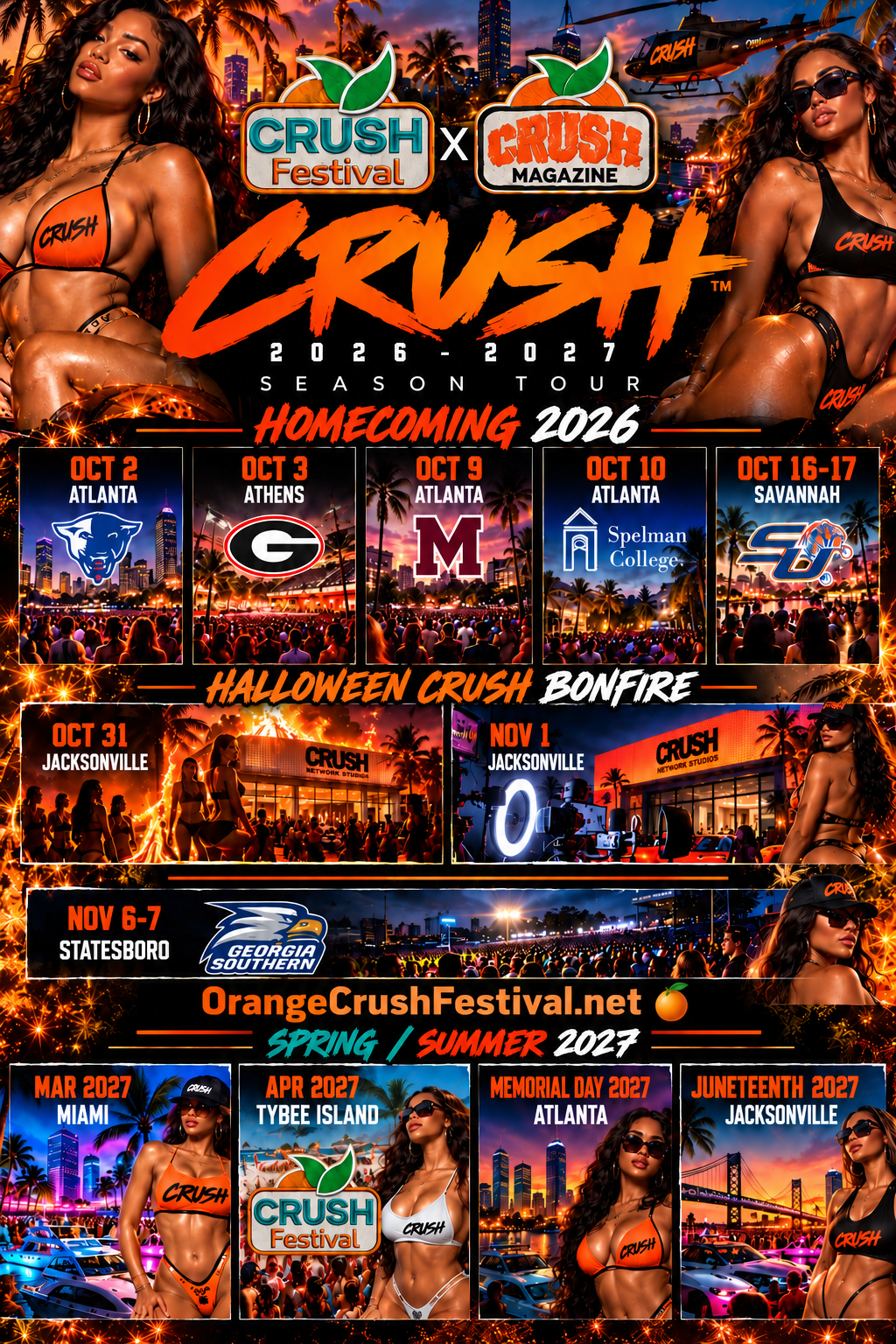
WHO ARE YOU WEARING? Not the designer. You. CRUSH Magazine is introducing a different kind of Homecoming fashion coverage this season.
WHO ARE YOU WEARING?
Not the designer.
You.
CRUSH Magazine is introducing a different kind of Homecoming fashion coverage this season.
We care about the clothes.
Of course.
But we’re more interested in the person who put them together.
Did you spend $1,500?
Did you spend $75 and somehow look better than everybody?
Did you make it yourself?
Did your friend style you?
Are those vintage?
Did you change three times?
Did you coordinate with your friends?
Did you fly in with the outfit already packed?
Did you almost stay home?
That’s the interview.
Because style without personality becomes a catalog.
CRUSH isn’t making a catalog.
We’re documenting people.
THE AUC DOESN’T NEED AN INTRODUCTION
THE AUC DOESN’T NEED AN INTRODUCTION
Morehouse. Spelman. Atlanta. Homecoming.
There are college weekends.
Then there are cultural institutions that happen to have a weekend attached.
The Atlanta University Center belongs in the second category.
Morehouse and Spelman bring history into the same frame as youth culture.
Generations overlap.
Tradition meets whatever is happening right now.
Tailoring meets streetwear.
Alumni meet freshmen.
Atlanta meets people who traveled across the country to return.
And on October 9 and 10, CRUSH Magazine will be there to document—not redefine—that environment.
We aren’t arriving to explain Morehouse to Morehouse.
We aren’t arriving to explain Spelman to Spelman.
We’re arriving with a question:
What does Homecoming feel like from inside it?
That’s where the good stories begin.
24 HOURS LATER, THE COLORS CHANGE
24 HOURS LATER, THE COLORS CHANGE
Atlanta on Friday. Athens on Saturday. Same cameras. Completely different world.
The easiest mistake CRUSH could make would be covering every school exactly the same way.
We won’t.
Athens isn’t Atlanta.
UGA isn’t Georgia State.
Savannah isn’t the AUC.
Statesboro isn’t Jacksonville.
That’s the point.
If every city looks identical through our camera, we failed.
October 3 belongs to Athens.
Georgia football culture.
Downtown packed with people.
Red and black everywhere.
Generations of alumni.
Students.
Tailgates.
Visitors.
Fashion adapting itself to school colors.
And thousands of little stories occurring simultaneously.
Our job isn’t to manufacture the atmosphere.
It’s to notice it.
The question CRUSH Magazine will keep asking throughout this entire tour is:
What can only happen here?
Find that.
Photograph that.
Interview that.
Remember that.
Then move.
24 HOURS LATER, THE COLORS CHANGE
24 HOURS LATER, THE COLORS CHANGE
Atlanta on Friday. Athens on Saturday. Same cameras. Completely different world.
The easiest mistake CRUSH could make would be covering every school exactly the same way.
We won’t.
Athens isn’t Atlanta.
UGA isn’t Georgia State.
Savannah isn’t the AUC.
Statesboro isn’t Jacksonville.
That’s the point.
If every city looks identical through our camera, we failed.
October 3 belongs to Athens.
Georgia football culture.
Downtown packed with people.
Red and black everywhere.
Generations of alumni.
Students.
Tailgates.
Visitors.
Fashion adapting itself to school colors.
And thousands of little stories occurring simultaneously.
Our job isn’t to manufacture the atmosphere.
It’s to notice it.
The question CRUSH Magazine will keep asking throughout this entire tour is:
What can only happen here?
Find that.
Photograph that.
Interview that.
Remember that.
Then move.
THE CAMERA IS COMING OUTSIDE CRUSH Magazine is spending Homecoming season where Homecoming actually happens
THE CAMERA IS COMING OUTSIDE
CRUSH Magazine is spending Homecoming season where Homecoming actually happens.
There are easier ways to cover college Homecoming.
You could wait for the photographs.
Repost the outfits.
Write about the football score.
Compile a gallery on Monday morning and call it culture.
We’re not doing that.
CRUSH Magazine is going outside.
On Friday, October 2, the cameras arrive in Atlanta. A day later, they’re in Athens. The following weekend, they’re back in Atlanta for Morehouse and Spelman. Then Savannah. Then Jacksonville. Then Statesboro.
No giant traveling stage.
No attempt to turn somebody else’s Homecoming into our festival.
Just CRUSH entering the environment with cameras, microphones and curiosity.
We call them CRUSH Homecoming Pop-Ups.
The assignment is simple:
Find the people.
HOMECOMING DOESN’T BELONG TO THE FOOTBALL FIELD
The game matters.
But anybody who has actually experienced Homecoming knows that the scoreboard doesn’t explain the weekend.
Homecoming happens in parking lots.
On sidewalks.
At restaurants.
In hotel lobbies.
At tailgates.
At step shows.
Inside barbershops and beauty salons before anybody gets dressed.
In group chats asking where everybody is going.
At gas stations packed with cars from three states.
In somebody’s mirror while they’re deciding whether the first outfit is good enough.
Homecoming is the graduate who hasn’t seen his line brothers together in years.
It’s the freshman experiencing the spectacle for the first time.
It’s the woman who started planning Saturday’s outfit before September.
It’s somebody selling plates.
Somebody promoting an afterparty.
Somebody trying to get discovered.
Somebody who swore they weren’t coming this year and somehow ends up outside anyway.
Those are stories.
CRUSH Magazine wants those stories.
ATLANTA IS FIRST
Georgia State opens the run October 2.
Atlanta presents an unusual beginning because campus life and city life constantly overlap.
There isn’t a wall where Atlanta ends and the college experience begins.
Students are living inside one of America’s most recognizable Black cultural and entertainment centers.
That makes the first assignment bigger than photographing people wearing school colors.
What does Atlanta Homecoming culture actually look like in 2026?
Who has style?
Who’s creating?
What are students listening to?
Who owns a business already?
Who is making music nobody outside campus has heard yet?
Who’s funny?
Who’s interesting?
Who’s going somewhere?
CRUSH wants to know.
And then we’re driving to Athens.
THE BUSINESS OF CRUSH: HOW ONE CULTURE CAN CREATE AN ENTIRE CREATIVE ECONOMY 🍊💼 CRUSH Magazine | Business + Entrepreneurship + Culture | 2026–2027
THE BUSINESS OF CRUSH: HOW ONE CULTURE CAN CREATE AN ENTIRE CREATIVE ECONOMY 🍊💼
CRUSH Magazine | Business + Entrepreneurship + Culture | 2026–2027
The crowd sees the party.
The camera sees the models.
The audience hears the music.
But behind every successful cultural experience is something less visible:
an economy.
Someone owns the venue.
Someone shoots the photographs.
Someone makes the food.
Someone designs the clothes.
Someone performs.
Someone engineers the music.
Someone sells the merchandise.
Someone provides security.
Someone creates the graphics.
Someone styles the models.
Someone sponsors the activation.
Someone edits the videos.
Someone markets everything.
Money moves through culture every day.
The bigger vision for CRUSH is to make sure more of that economic activity happens inside the ecosystem we’re building.
CULTURE IS ALSO COMMERCE
There is nothing wrong with creating an incredible experience simply because people deserve to enjoy themselves.
But sustainability matters.
If CRUSH wants to exist for years—not weekends—the culture has to support a real business structure.
Tickets.
Vendors.
Sponsorships.
Advertising.
Merchandise.
Artist opportunities.
Photography.
Media packages.
Modeling.
Content production.
Studio services.
Brand collaborations.
Partnerships.
These aren’t distractions from the culture.
Handled correctly, they’re what allow the culture to keep growing.
ONE PERSON’S EXPENSE CAN BECOME ANOTHER PERSON’S OPPORTUNITY
An event needs photography.
That’s work for a photographer.
It needs video.
That’s work for a filmmaker.
Models need styling.
That’s work for stylists and beauty professionals.
Artists need engineering.
That’s work for engineers.
People need food.
That’s opportunity for vendors.
Brands need exposure.
That’s opportunity for CRUSH Magazine.
Merchandise needs production.
That’s work for designers and manufacturers.
The objective is to create an ecosystem where CRUSH spending doesn’t simply disappear.
It creates opportunities around CRUSH.
THE FESTIVAL IS A MARKETPLACE
A CRUSH event can be entertainment and commerce simultaneously.
People aren’t only attending.
They’re discovering.
A food company can gain customers.
A designer can introduce a collection.
An artist can gain listeners.
A model can gain bookings.
A photographer can gain clients.
A sponsor can reach an audience.
A vendor can make sales.
A content creator can build a portfolio.
CRUSH Magazine can then extend that exposure beyond the physical event.
That’s where an activation becomes more than admission at the door.
THE MAGAZINE CREATES ANOTHER ECONOMY
Media itself has value.
Businesses need visibility.
Artists need storytelling.
Models need professional presentation.
Events need coverage.
Products need photography.
Entrepreneurs need credibility.
CRUSH Magazine can sit at the intersection of those needs.
Editorial stories remain editorial.
Advertising remains advertising.
But both can exist inside a strong publication.
The important thing is clarity.
Readers should know when CRUSH is telling a story and when a company is paying for placement.
Trust makes media more valuable, not less profitable.
SPONSORSHIP SHOULD FEEL NATURAL
The strongest sponsorship doesn’t feel like a random logo dropped onto a flyer.
It solves something.
A beverage company supports refreshments.
A fashion brand dresses talent.
An automotive partner provides transportation or a vehicle display.
A beauty company supports model preparation.
A restaurant supports hospitality.
A technology company supports content production.
A local business sponsors a competition.
A company supports a magazine feature or community initiative.
Now the partnership makes sense inside the experience.
The sponsor gets visibility.
CRUSH gets resources.
The audience gets something better.
MODELS CAN BECOME BRAND PARTNERS
A model’s value doesn’t stop when the photoshoot ends.
Models can demonstrate products.
Create social content.
Appear in campaigns.
Host activations.
Represent merchandise.
Participate in magazine editorials.
Become recurring personalities.
Eventually, some may develop their own businesses.
Then CRUSH can support those businesses too.
That’s the difference between simply hiring talent and developing relationships with talent.
ARTISTS NEED MORE THAN STREAMS
Music creates multiple economic opportunities.
Performances.
Features.
Content.
Merchandise.
Appearances.
Brand partnerships.
Licensing.
Media.
Events.
Creative services.
An independent artist shouldn’t think of a song as the entire business.
The record is one asset.
The personality is another.
The performance is another.
The audience is another.
The story is another.
CRUSH can create environments where those assets interact.
VENDORS SHOULD GROW WITH THE TOUR
Imagine a small business joining CRUSH in Savannah.
The activation goes well.
Then that vendor appears in Jacksonville.
Later Atlanta.
Eventually Miami.
Now CRUSH hasn’t merely rented somebody a table.
It helped introduce a business into multiple markets.
The same can happen with photographers, DJs, designers, models and artists.
The tour can move opportunities, not just people.
CRUSH NETWORK STUDIOS CAN KEEP THE ECONOMY MOVING BETWEEN EVENTS
Events happen on dates.
Creative work happens every day.
That’s why a studio environment matters.
Between major activations, the ecosystem can continue producing.
Photography.
Interviews.
Podcasts.
Music.
Content.
Auditions.
Product campaigns.
Model development.
Artist development.
Meetings.
Planning.
Editing.
Media production.
The festival creates spikes of attention.
The studio can help maintain activity between those spikes.
MERCHANDISE TURNS ATTENTION INTO OWNERSHIP
People want something physical from cultures they identify with.
A shirt.
A hat.
An accessory.
A collectible.
A magazine.
A festival item.
A CRUSH cooling product.
Something orange.
Something that says:
I was there.
Or:
I’m part of this.
The best merchandise isn’t merely another revenue stream.
It allows the audience to physically carry the culture into places CRUSH hasn’t reached yet.
CONTENT ITSELF BECOMES AN ASSET
One well-produced weekend can create:
Photography.
Short-form video.
Interviews.
Performance clips.
Model portfolios.
Advertisements.
Magazine articles.
Music visuals.
Sponsor content.
Documentary footage.
Product photography.
Those assets can continue creating attention long after the event ends.
That’s why content shouldn’t be treated as an afterthought.
The event happens once.
The media can work hundreds of times.
THE WEBSITE CAN BECOME THE MARKETPLACE FOR THE WORLD
OrangeCrushFestival.net doesn’t have to function only as a place to read event information.
Over time, it can connect the entire ecosystem.
Artists.
Business partners.
Sponsorship opportunities.
Products.
Now traffic generated by one side of CRUSH can discover another side.
The website becomes the intersection.
PHILANTHROPY BELONGS INSIDE THE ECONOMIC MODEL
Building wealth and creating community impact don’t have to oppose each other.
As CRUSH grows, philanthropy can become part of the structure.
Creative opportunities for young people.
Educational initiatives.
Entrepreneurship exposure.
Artist development.
Youth sports.
Mentorship.
Local giving.
The objective isn’t simply to generate revenue around communities.
It’s to create ways for value to circulate back into those communities.
There is a major difference between participating in culture and owning infrastructure within it.
A company owns trademarks and intellectual property.
A studio controls production space.
An event company builds recurring experiences.
A merchandise operation creates physical products.
A digital platform controls an archive and direct audience relationship.
The more pieces CRUSH develops responsibly, the less dependent the ecosystem becomes on one single source of income.
ONE CUSTOMER CAN ENTER THROUGH TEN DIFFERENT DOORS
Someone might never attend a CRUSH festival.
Someone may never read a long article.
But they stream the music.
Another buys merchandise.
Another watches basketball content.
Another becomes a vendor.
Another sponsors an event.
Another books creative services.
Another attends Halloween CRUSH.
Another travels for the spring experience.
Different doors.
The long-term opportunity isn’t simply:
Sell more tickets.
Build a cultural ecosystem where every successful piece increases the value of the other pieces.
More music creates more content.
More content creates more attention.
More attention helps events.
Events introduce talent.
Talent creates stories.
Stories grow the magazine.
The magazine attracts partners.
Partners provide resources.
Resources improve experiences.
Better experiences create more content.
And the cycle begins again.
CULTURE CREATES VALUE. CRUSH BUILDS THE SYSTEM. 🍊
That’s what makes the business side exciting.
CRUSH doesn’t have to choose between being culturally meaningful and commercially sustainable.
The objective is to build both carefully.
A festival people genuinely enjoy.
A magazine people genuinely read.
Music people genuinely play.
Models people recognize.
Products people genuinely want.
Businesses that gain real customers.
Creators who gain real opportunities.
Communities that receive real value.
And an organization capable of continuing to build all of it.
Because the biggest CRUSH opportunity isn’t simply throwing bigger events.
It’s building an economy around a culture people already want to participate in.
THE BUSINESS OF CRUSH 🍊
FESTIVAL • MAGAZINE • MUSIC • MODELS • MEDIA • MERCHANDISE • STUDIOS • COMMUNITY
CRUSH Festival × CRUSH Magazine
SEO title: The Business of CRUSH: Building a Creative Economy Around Culture
Meta description: Inside the CRUSH business model connecting festivals, media, music, models, merchandise, vendors, sponsors, studios, entrepreneurship and community into one growing creative economy.
Suggested tags: CRUSH Business, CRUSH Ecosystem, CRUSH Festival, CRUSH Magazine, Creative Economy, Black Entrepreneurship, Entertainment Business, Event Business, Music Business, Model Industry, Brand Partnerships, Festival Vendors, Crush Network Studios, CRUSH Merchandise, Orange Crush Festival.
CRUSH ANNOUNCES 2026–2027 SEASON TOUR: FROM HOMECOMING TO JUNETEENTH
CRUSH isn’t waiting for summer.
The next CRUSH season begins this fall and keeps moving.
CRUSH Festival and CRUSH Magazine are launching a 2026–2027 run connecting college homecomings, Halloween, spring break, festival culture and some of the South’s most important celebration weekends across one season.
The journey begins in Georgia with stops surrounding Homecoming season in Atlanta, Athens, Savannah and Statesboro before CRUSH Network Studios brings the movement to Jacksonville for Halloween CRUSH Bonfire.
Then the temperature changes.
Spring 2027 takes CRUSH south to Miami before returning to Tybee Island in April, Atlanta for Memorial Day weekend and Jacksonville for Juneteenth.
Different cities. Different weekends. One CRUSH season.
FALL 2026
OCT 2 — Atlanta
OCT 3 — Athens
OCT 9–10 — Atlanta / Morehouse + Spelman
OCT 16–17 — Savannah
OCT 31–NOV 1 — Jacksonville / Halloween CRUSH Bonfire
NOV 6–7 — Statesboro
SPRING / SUMMER 2027
MARCH — Miami
APRIL — Tybee Island
MEMORIAL DAY — Atlanta
JUNETEENTH — Jacksonville
CRUSH Festival x CRUSH Magazine is building the season around the things that have always powered the culture: music, beautiful visuals, college energy, fashion, models, nightlife, basketball, media and unforgettable experiences.
This isn’t one weekend.
This is CRUSH Season.
2026 → 2027.