
ONLYFANZ: MR CRUSH OPENS AM-ORIGINAL WITH LOVE, LUST AND THE DIGITAL AGE Chapter 01 | AM-ORIGINAL I Animated Motion Picture Series CRUSH MAGAZINE | OCTOBER 2026 MUSIC • ROMANCE • DIGITAL CULTURE
ONLYFANZ: MR CRUSH OPENS AM-ORIGINAL WITH LOVE, LUST AND THE DIGITAL AGE
Chapter 01 | AM-ORIGINAL I Animated Motion Picture Series
CRUSH MAGAZINE | OCTOBER 2026
MUSIC • ROMANCE • DIGITAL CULTURE • ANIMATION
WHEN EVERYBODY IS WATCHING, WHO REALLY HAS YOUR ATTENTION?
The opening chapter of AM-ORIGINAL I enters a world where attraction, celebrity, internet attention, romantic loyalty, and personal desire compete for the spotlight.
OnlyFanz establishes the tone for Mr CRUSH’s animated music-video universe by turning complicated modern relationships into an expressive visual experience.
The title immediately introduces the relationship between fandom and affection. But beneath the surface is a more complicated question: what happens when a person wants genuine love while remaining attracted to the attention of everyone else?
That contradiction becomes the heart of the song’s storytelling.
ROMANCE MEETS INTERNET CULTURE
OnlyFanz explores the tension between unconditional affection and the temptations created by social media, online personalities, and an environment where attention is constantly available.
The animated concept draws on glamour, nightlife, digital interactions, CRUSH entertainment culture, and emotionally charged relationships.
The visual world is designed to be colorful, dramatic, sometimes humorous, and unmistakably larger than everyday life.
Rather than reducing the song to a straightforward romance story, Mr CRUSH allows competing desires to exist within the same narrative.
THE FIRST CHAPTER OF TEN
As the opening chapter, OnlyFanz introduces audiences to AM-ORIGINAL’s larger artistic approach: music videos built as animated experiences with their own characters, settings, and evolving situations.
From here, the series moves into Climate Controlla, Been Jammin, What Time, and CRUSH World Cup before entering the second act.
OnlyFanz is not simply the first video. It opens the door to the entire motion-picture concept.
WATCH ONLYFANZ — OFFICIAL ANIMATED MUSIC VIDEO
FOLLOW MR CRUSH
YouTube: https://youtube.com/@plugnotarapperpartyplugmikey
VEVO: https://youtube.com/@plugnotrappervevo
Apple Music: https://music.apple.com/us/artist/plug-not-a-rapper/1573969143
Explore more music videos: https://www.orangecrushfestival.net/musicvideos

AM-ORIGINAL I: MR CRUSH TURNS TEN SONGS INTO ONE ANIMATED MOTION PICTURE Ten Records. Ten Visual Worlds. One Complete Cinematic Experience. CRUSH MAGAZINE | OCTOBER 2026 MUSIC • ANIMATION
AM-ORIGINAL I: MR CRUSH TURNS TEN SONGS INTO ONE ANIMATED MOTION PICTURE
Ten Records. Ten Visual Worlds. One Complete Cinematic Experience.
CRUSH MAGAZINE | OCTOBER 2026
MUSIC • ANIMATION • CINEMA • CULTURE • MR CRUSH
THE ALBUM IS ONLY THE BEGINNING
There are albums designed to be heard. There are music videos designed to be watched. Then there are creative projects that attempt to make the music and moving images inseparable.
AM-ORIGINAL I is Mr CRUSH’s entry into that third category.
Known through his connected artistic identities as Plug Not A Rapper and PartyPlugMikey, Mr CRUSH is developing a ten-song animated motion-picture experience in which every record becomes its own cinematic chapter.
The concept is expansive: hip-hop meets animated storytelling, with luxury automobiles, digital romance, emotional relationships, international dance competitions, extravagant wealth, flamboyant characters, and original CRUSH-branded environments.
Instead of relying entirely on conventional performance footage, the visual series uses animated characters, expressive environments, and changing storylines to communicate the personality of each record.
THE TEN-CHAPTER EXPERIENCE
ACT I — THE WORLD OF AM-ORIGINAL
OnlyFanz
Climate Controlla
Been Jammin
What Time
CRUSH World Cup
ACT II — THE PERSONALITIES, POWER AND EMOTIONS
Rich Chief
Mood Swingerz
Medieval Mayor Mikey Hendrixxx
Mr Unanimous
Sumn Rare
Each chapter has its own identity. Together, the ten songs form the foundation of one connected motion-picture album.
SIX ANIMATED VIDEOS AVAILABLE NOW
The published music-video chapters are:
OnlyFanz: https://youtu.be/hrNrHfx0Lgo
Climate Controlla: https://youtu.be/uv4KlX6zAVU
Been Jammin: https://youtu.be/D8r2bt–aZc
What Time: https://youtu.be/nvVqnyrdces
CRUSH World Cup: https://youtu.be/T3aiTaOnXis
Mood Swingerz: https://youtu.be/-Q1wybGiQUU
Four additional chapters are planned to complete the ten-video collection.
THE CRUSH MAGAZINE INTRODUCTION
The eventual full motion picture is designed to open with a 30-second animated CRUSH Magazine introduction, followed by all ten song videos in their official album sequence.
The introduction appears only once, creating a unified opening to the cinematic experience.
AN ARTIST BUILDING HIS OWN VISUAL LANGUAGE
AM-ORIGINAL I also reflects a larger creative ambition: building a recognizable entertainment world where the music, artist identity, animation, CRUSH Magazine, and Orange Crush entertainment properties connect.
For Mr CRUSH, the music creates the foundation. The animated stories create another way to experience it.
And the complete motion picture is intended to bring those worlds together.
THE MUSIC IS ORIGINAL. THE WORLDS ARE ANIMATED. THE MOTION PICTURE IS AM-ORIGINAL.
WATCH • LISTEN • EXPLORE
Official YouTube: https://youtube.com/@plugnotarapperpartyplugmikey
Official VEVO: https://youtube.com/@plugnotrappervevo
Apple Music Artist: https://music.apple.com/us/artist/plug-not-a-rapper/1573969143
Official Website: https://www.orangecrushfestival.net/
Music Videos: https://www.orangecrushfestival.net/musicvideos
CRUSH ZINE: https://www.orangecrushfestival.net/thezine
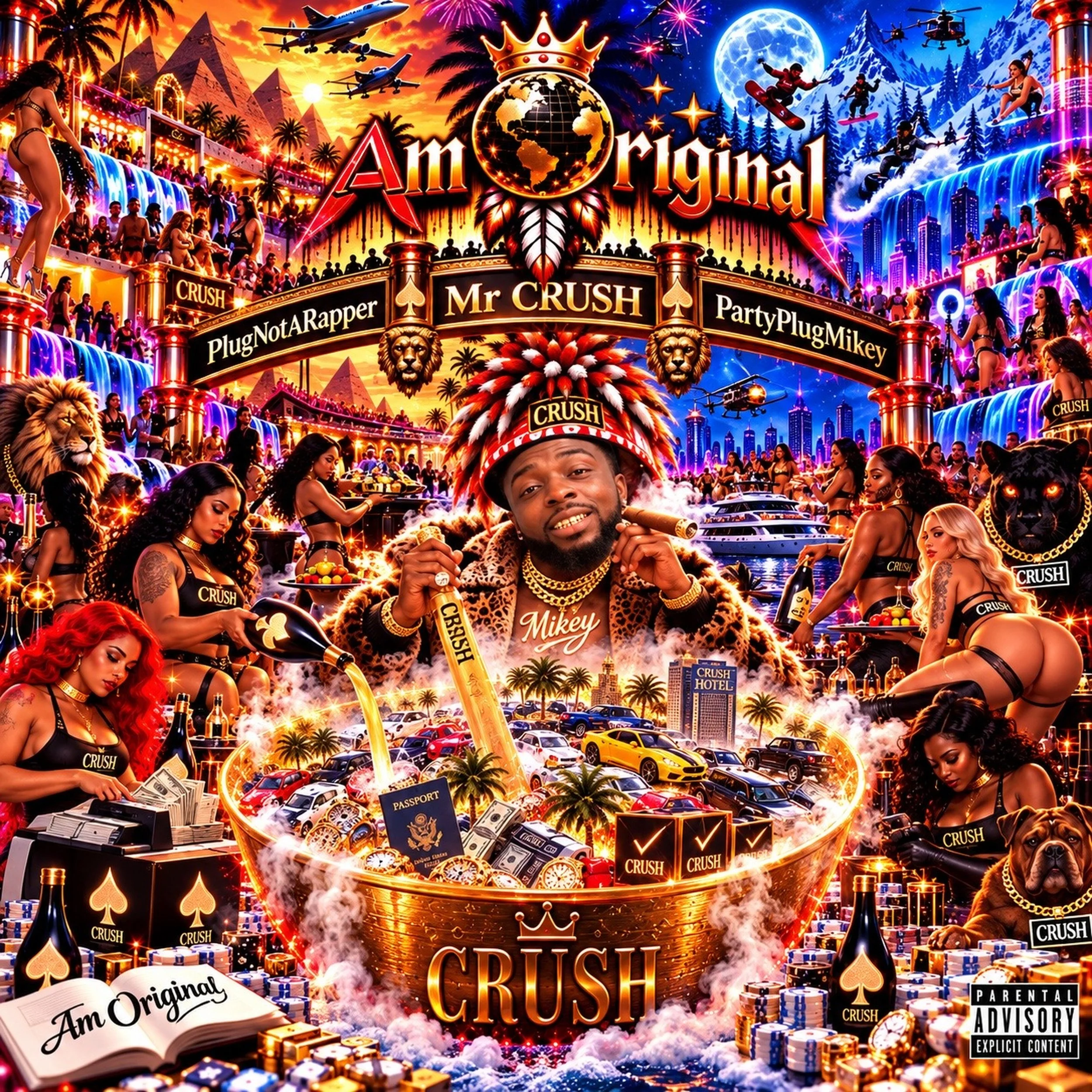

MR CRUSH RELEASES SIX ANIMATED MUSIC VIDEOS FROM AM-ORIGINAL I CRUSH MAGAZINE | MUSIC & ENTERTAINMENT The AM-ORIGINAL I motion-picture experience continues to expand as Mr CRUSH, also known as Plug
MR CRUSH RELEASES SIX ANIMATED MUSIC VIDEOS FROM AM-ORIGINAL I
CRUSH MAGAZINE | MUSIC & ENTERTAINMENT
The AM-ORIGINAL I motion-picture experience continues to expand as Mr CRUSH, also known as Plug Not A Rapper and PartyPlugMikey, brings six original records to life through cinematic animated music videos.
The released chapters include OnlyFanz, Climate Controlla, Been Jammin, What Time, CRUSH World Cup, and Mood Swingerz.
Each video explores a different world of music, culture, luxury, romance, ambition, and entertainment, building toward the complete ten-chapter AM-ORIGINAL motion picture.
Four additional chapters remain before the full film is assembled, featuring a special 30-second CRUSH Magazine introduction and all ten videos in album sequence.
Watch the series and follow the release at OrangeCrushFestival.net.
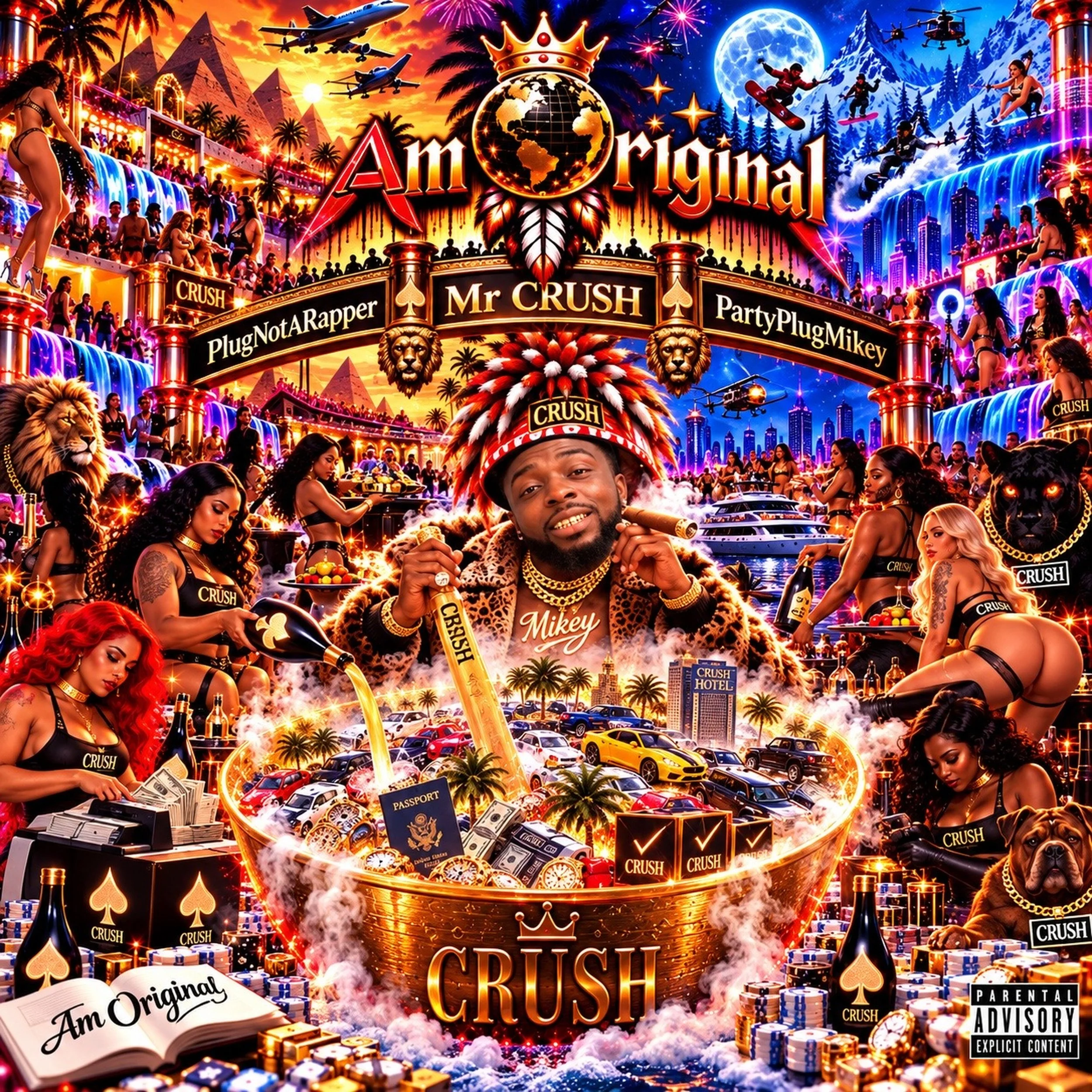
AM-ORIGINAL I: MR CRUSH EXPANDS HIP-HOP INTO A 10-CHAPTER ANIMATED MOTION PICTURE CRUSH MAGAZINE | MUSIC • ANIMATION • HIP-HOP • CINEMA • CULTURE Artist: Mr CRUSH / Plug Not A Rapper / PartyPlugMike
AM-ORIGINAL I: MR CRUSH EXPANDS HIP-HOP INTO A 10-CHAPTER ANIMATED MOTION PICTURE
CRUSH MAGAZINE | MUSIC • ANIMATION • HIP-HOP • CINEMA • CULTURE
Artist: Mr CRUSH / Plug Not A Rapper / PartyPlugMikey
Project: AM-ORIGINAL I
Format: 10 original songs • 10 animated music videos • One complete motion picture
THE ALBUM BECOMES THE MOVIE
Mr CRUSH is transforming his AM-ORIGINAL I album into a connected animated motion-picture experience, combining original hip-hop records with cinematic digital storytelling.
The project moves beyond traditional performance videos. Each song introduces its own characters, environments, emotions, and visual identity while remaining part of the larger CRUSH entertainment universe.
The result is an animated series exploring luxury, romance, ambition, nightlife, wealth, relationships, and global entertainment.
FIVE RELEASED CHAPTERS
ONLYFANZ — THE OPENING CHAPTER
The motion-picture series begins with a world of fandom, relationships, celebrity attention, attraction, and digital culture.
WATCH: https://youtu.be/hrNrHfx0Lgo
CLIMATE CONTROLLA — THE POWER TO CHANGE THE ATMOSPHERE
Social influence, charisma, nightlife, and changing environments collide in a visually expressive animated world.
BEEN JAMMIN — THE SOUND OF LUXURY
Luxury automobiles, powerful sound systems, music-driven movement, and cinematic automotive scenes bring the record’s energy to life.
WHAT TIME — THE RICH TIME EXPERIENCE
A visually inventive chapter exploring time, urgency, personal ambition, nightlife, and the philosophy of making every moment count.
CRUSH WORLD CUP — THE GLOBAL CHAMPIONSHIP
An international celebration of dance, competition, music, and culture, featuring animated performers representing different countries in a CRUSH-branded championship atmosphere.
FIVE MORE CHAPTERS COMPLETE THE ALBUM
The remaining album chapters are Rich Chief, Mood Swingerz, Medieval Mayor Mikey Hendrixxx, Mr Unanimous, and Sumn Rare.
Each expands the animated universe through distinct themes, from wealth and emotional relationships to eccentric characters and cinematic romance.
ONE COMPLETE MOTION PICTURE
The final AM-ORIGINAL motion picture is designed to begin with a 30-second animated CRUSH Magazine introduction before transitioning through all ten music videos in album order.
The introduction appears once at the beginning, creating a continuous film experience rather than ten disconnected video presentations.
ENTER THE CRUSH UNIVERSE
Official Website: https://www.orangecrushfestival.net/
Music Videos: https://www.orangecrushfestival.net/musicvideos
CRUSH ZINE: https://www.orangecrushfestival.net/thezine
Featured Artist: https://www.orangecrushfestival.net/partyplugmikeyfeatured
AM-ORIGINAL I represents the intersection of independent music, animated cinema, digital artistry, and the expanding creative identity of Mr CRUSH.
CRUSH MAGAZINE CRUSHTOBER UNIVERSITY 21+ ISN’T AN ALBUM ABOUT COLLEGE. IT’S WHAT HAPPENS WHEN EVERYBODY COMES BACK. Across 21 records, Plug Not A Rapper Party Plug Mikey
CRUSH MAGAZINE
CRUSHTOBER UNIVERSITY 21+ ISN’T AN ALBUM ABOUT COLLEGE. IT’S WHAT HAPPENS WHEN EVERYBODY COMES BACK.
Across 21 records, Plug Not A Rapper turns homecoming, Atlanta nightlife, women, money, anime, fashion, alumni culture and pure outside energy into one sprawling adult-campus universe.
By CRUSH Magazine | Atlanta, GA | October 2026
There is college.
Then there is homecoming.
Those are not the same thing.
College has classes. Deadlines. Parking passes. Professors. Eight o’clock mornings.
Homecoming has somebody who graduated six years ago standing in the student section like they never left.
Homecoming has hotel rooms booked across the city. Fresh clothes still hanging in garment bags. Alumni pulling up in cars they absolutely want old classmates to notice. Women who haven’t spoken since sophomore year suddenly taking pictures together. Day parties turning into tailgates, tailgates turning into games, games turning into functions and functions turning into somebody asking the most important question of the entire weekend:
Where we going next?
That’s the world Plug Not A Rapper builds across the 21 tracks of CRUSHTOBER UNIVERSITY 21+.
Not school.
The return.
21 SONGS. ONE VERY LONG WEEKEND.
The scale matters.
CRUSHTOBER UNIVERSITY 21+ isn’t structured like a short collection of interchangeable singles.
Twenty-one records give Plug room to move.
The album can be funny without becoming a comedy album. Sexual without every record being about sex. Expensive without spending 21 tracks counting money. Nostalgic without turning sentimental. Southern without reducing itself to one Atlanta sound.
The connective tissue is culture.
Specifically, the strange collision that happens when college life, adult life and nightlife temporarily occupy the same space.
That’s why the “21+” matters beyond being a title decoration.
This isn’t freshman orientation.
It’s the people who went to college.
The people still in college.
The people who graduated.
The people who never attended but somehow know exactly where every homecoming party is.
The alumni.
The locals.
The artists.
The women.
The athletes.
The promoters.
The hustlers.
The people who said they were staying home.
And the people calling them at 12:47 a.m. asking why.
CRUSHTOBER is for everybody outside.
IT STARTS WITH A QUESTION: “GOIN”
The current album begins with “Goin.”
That’s almost ridiculously appropriate.
Instead of opening CRUSHTOBER with a cinematic speech explaining the concept, Plug starts by taking attendance:
Who goin’?
Who not?
That’s the album in miniature.
The record operates like a group chat slowly becoming real life. Who has money? Who has motion? Who has cars? Who has friends? Who’s driving? Where’s the party?
The answers barely matter.
The momentum does.
“Goin” establishes one of the album’s most important musical ideas immediately: conversation can become rhythm.
Questions become hooks.
Responses become ad-libs.
Plans become lyrics.
The song doesn’t describe people preparing to go outside.
It sounds like the exact conversation happening while they’re going outside.
And that’s how the doors to CRUSHTOBER open.
Not:
“Welcome to our university.”
More like:
“Who the fuck goin’?”
Much better.
THEN THE CAMPUS STARTS GETTING CROWDED
From there, the album moves through records like “F* 2 Good,” “Hi,” “Sip Sumn University Ave,” “MEAC Homecoming”** and “Crush Da Yard.”
Even the titles start building geography.
There’s an avenue.
There’s a yard.
There’s homecoming.
There’s an introduction.
There’s attraction.
There’s drinking.
Suddenly this isn’t simply a tracklist.
It’s a campus map after dark.
“MEAC Homecoming” gives the project a specific cultural vocabulary. “Crush Da Yard” pushes further into Black college iconography. “Sip Sumn University Ave” sounds like the location somebody texts you instead of an abstract song title.
That specificity is important.
The album doesn’t need every song to literally say “college” because the environment is already surrounding the records.
You begin understanding where you are.
Then track seven arrives.
“ARCH MADNESS” TURNS THE CAMPUS INTO AN ARENA
Plug Not A Rapper featuring Tyniee.
“Arch Madness” is where CRUSHTOBER’s sports imagery gets huge.
Basketball.
Football.
Stadium lights.
Women.
Homecoming.
Nightlife.
The single’s Orange Crush University artwork presents all of those things simultaneously, but the record underneath is considerably darker than the colorful spectacle surrounding it.
Its slow-rolling Southern pocket leaves room for low end, percussion and personality rather than chasing pep-rally brightness.
That’s what makes it work.
The artwork looks like the game.
The song sounds like after the game.
And Tyniee brings another Atlanta voice into the album at precisely the moment when the CRUSHTOBER campus needs to feel bigger than Plug alone.
Her current Apple Music catalog includes 2026 releases such as “Wop Wop” featuring Mohogany, “Slappp” featuring Mohogany and “Nasty Dancerz” featuring Jo & Coco, alongside appearances on other artists’ records. Tyniee on Apple Music
Inside CRUSHTOBER, she’s not treated like somebody visiting the school.
She sounds enrolled.
BY “MY TURN,” THE ALBUM DOESN’T NEED DIRECTIONS ANYMORE
After “Arch Madness,” records including “My Turn,” “College & Alumni Gurlz” and “BigBootiezAnthem” push the album further away from the stadium and deeper into the social ecosystem surrounding it.
“College & Alumni Gurlz” may contain the clearest explanation of the entire concept in its title.
College AND alumni.
That’s CRUSHTOBER.
The age groups overlap.
The eras overlap.
Somebody is experiencing homecoming for the first time while somebody standing ten feet away is remembering what the same campus looked like a decade earlier.
That’s why alumni culture matters to the album.
Homecoming is one of the rare social rituals where getting older doesn’t necessarily remove you from the culture.
Sometimes it gives you more reason to come back.
Better clothes.
Better car.
More money.
Old stories.
Old relationships.
New relationships.
And absolutely no intention of behaving like it’s a normal weekend.
THE MIDDLE OF CRUSHTOBER GETS WEIRDER
Then come titles like “Shalom Blakk,” “Midnight,” “Bonnet,” “Not Me” and “Mr Put That Shit On.”
This is where a 21-track album earns its length.
A shorter project might have been forced to stay tightly attached to one obvious homecoming aesthetic.
CRUSHTOBER has enough space to wander.
“Midnight” immediately changes the clock.
“Bonnet” changes the imagery.
“Mr Put That Shit On” moves toward fashion and personal presentation.
“Not Me” introduces another attitude entirely.
That’s how actual weekends work.
Nobody experiences homecoming in one continuous emotional tone.
At 4 p.m., you’re at the game.
At 8 p.m., you’re changing clothes.
At midnight, you’re somewhere you didn’t plan to be.
At 3 a.m., somebody is wearing something they absolutely were not wearing in the first picture of the day.
The album’s sprawl starts becoming part of its realism.
THEN CRUSHTOBER DISCOVERS ANIME
And somehow, it fits.
“Anime.”
“Hunter x Hunter Episode 304.”
Those titles shouldn’t necessarily belong beside homecoming records.
That’s exactly why they’re interesting.
Because CRUSHTOBER isn’t trying to recreate some imaginary version of college culture frozen in 2004.
Modern Black youth culture doesn’t exist in neat categories.
The same person can watch college football Saturday afternoon, argue about anime that evening, listen to trap in the car, know every word to an old R&B record, dress like they’re attending Fashion Week and end up at a homecoming function before midnight.
Nobody considers those interests contradictory in real life.
So the album doesn’t either.
The campus gets to contain all of it.
That makes the project feel less like somebody researching what college kids enjoy and more like an actual collection of interests colliding inside one personality-driven world.
THE LAST STRETCH DOESN’T SUDDENLY BECOME RESPONSIBLE
Good.
Records including “Johnni Deepp,” “Lilo & Stitch,” “Demure DeRozan” and “Trick or Treat” keep the album’s naming language unpredictable through the closing stretch.
Celebrity references.
Cartoons.
Basketball.
Halloween.
Pop culture gets tossed into the same blender as money, women, college and nightlife.
And because this is CRUSHTOBER, “Trick or Treat” carries a particularly natural final-season association.
October already contains multiple identities.
College football.
Homecoming.
Fall.
Halloween.
Parties.
Costumes.
Nightlife.
The album takes advantage of that overlap rather than choosing one.
CRUSHTOBER isn’t one holiday.
It’s a season.
SONICALLY, THE PROJECT’S BIGGEST INSTRUMENT IS PERSONALITY
That’s what separates a 21-track project like this from simply collecting 21 beats.
Plug Not A Rapper’s catalog has increasingly relied on character as connective tissue.
His current Apple Music page shows a multi-project catalog extending through releases including Not Like Them Rap Nz, Baddies Island, Mapouka Twerk Doctor, F.R.1.E.N.D. Z.8.N.E., Mr CRUSH, Home Screen** and September 2026’s Crush Culture Society. Plug Not A Rapper on Apple Music
CRUSHTOBER UNIVERSITY 21+ pushes that personality-first approach toward something broader.
The beats can change.
The tempos can change.
One song can lean melodic while another relies on conversational rap.
One record can be women-heavy.
Another can live in sports imagery.
Another can get strange.
What holds them together is the same person walking from room to room.
Party Plug Mikey becomes the tour guide.
Not a traditional narrator.
More like the person who somehow knows everybody at every function.
THE ALBUM DOESN’T WANT TO SOUND “ACADEMIC”
Despite the University branding, CRUSHTOBER has very little interest in behaving like an academic concept album.
That’s part of the joke.
Orange Crush University isn’t really about lectures.
Its curriculum is:
motion.
women.
fashion.
money.
sports.
music.
homecoming.
nightlife.
culture.
And apparently anime.
The records don’t need skits explaining the fictional institution every five minutes because the titles, visuals and recurring language already perform that job.
The world exists around the music instead of suffocating it.
That’s important.
Because ultimately, these songs still have to work outside the album.
“Arch Madness” has to survive without somebody reading the CRUSHTOBER manifesto first.
“Goin” has to make sense when somebody hears it at a party.
“BigBootiezAnthem” isn’t asking for a syllabus.
The concept enhances the songs.
It doesn’t hold them hostage.
21 TRACKS MAKES SENSE BECAUSE HOMECOMING ISN’T ONE EVENT
That’s the key.
If CRUSHTOBER UNIVERSITY 21+ were telling one simple story, 21 songs could feel excessive.
But that’s not the architecture.
The album is documenting an ecosystem.
The hotel.
The game.
The tailgate.
The campus.
The women.
The alumni.
The cars.
The outfits.
The drinking.
The parties.
The inside jokes.
The pop-culture references.
The late-night decisions.
The next morning.
And then somehow going back outside again.
You need room for that.
The album’s length becomes part of the proposition:
You’re not stopping by CRUSHTOBER.
You’re spending the weekend.
AND THAT MAY BE THE ALBUM’S CLEAREST IDEA
Most artists release albums and then build marketing around them.
CRUSHTOBER feels like it’s attempting the opposite:
Build a place big enough that the music has somewhere to live.
Orange Crush University.
CRUSH Magazine.
CRUSH Festival.
Homecoming.
Sports.
Fashion.
Women.
Visuals.
Parties.
And twenty-one records moving through all of it.
That’s bigger than asking whether every song sounds exactly alike.
Actual universities don’t have one building.
Actual homecomings don’t have one function.
Actual weekends don’t have one mood.
So CRUSHTOBER doesn’t either.
By the time the last record ends, the listener shouldn’t feel like they finished a lecture.
They should feel like somebody finally turned the lights on.
Phone almost dead.
Voice halfway gone.
Pictures you haven’t looked at yet.
Somebody missing a hoodie.
Somebody still asking where everybody went.
And one question left from the beginning:
Who goin’?
Apparently everybody.
CRUSHTOBER UNIVERSITY 21+
PLUG NOT A RAPPER
21 TRACKS.
ONE CAMPUS.
ONE VERY LONG HOMECOMING.
WELCOME TO ORANGE CRUSH UNIVERSITY.
CRUSH MAGAZINE® | ATLANTA
You don’t graduate from CRUSHTOBER. You just eventually go home.
CRUSH MAGAZINE | MUSIC WELCOME TO CRUSHTOBER UNIVERSITY: PARTY PLUG MIKEY’S 21+ CAMPUS HAS NO CURFEW On CRUSHTOBER UNIVERSITY 21+, Plug Not A Rapper turns homecoming season into a CRUSH
CRUSH MAGAZINE | MUSIC
WELCOME TO CRUSHTOBER UNIVERSITY: PARTY PLUG MIKEY’S 21+ CAMPUS HAS NO CURFEW
On CRUSHTOBER UNIVERSITY 21+, Plug Not A Rapper turns homecoming season into a loud, lustful, funny and unmistakably Southern universe where football, women, fashion, HBCU culture, anime, nightlife and CRUSH all live on the same campus.
By CRUSH Magazine
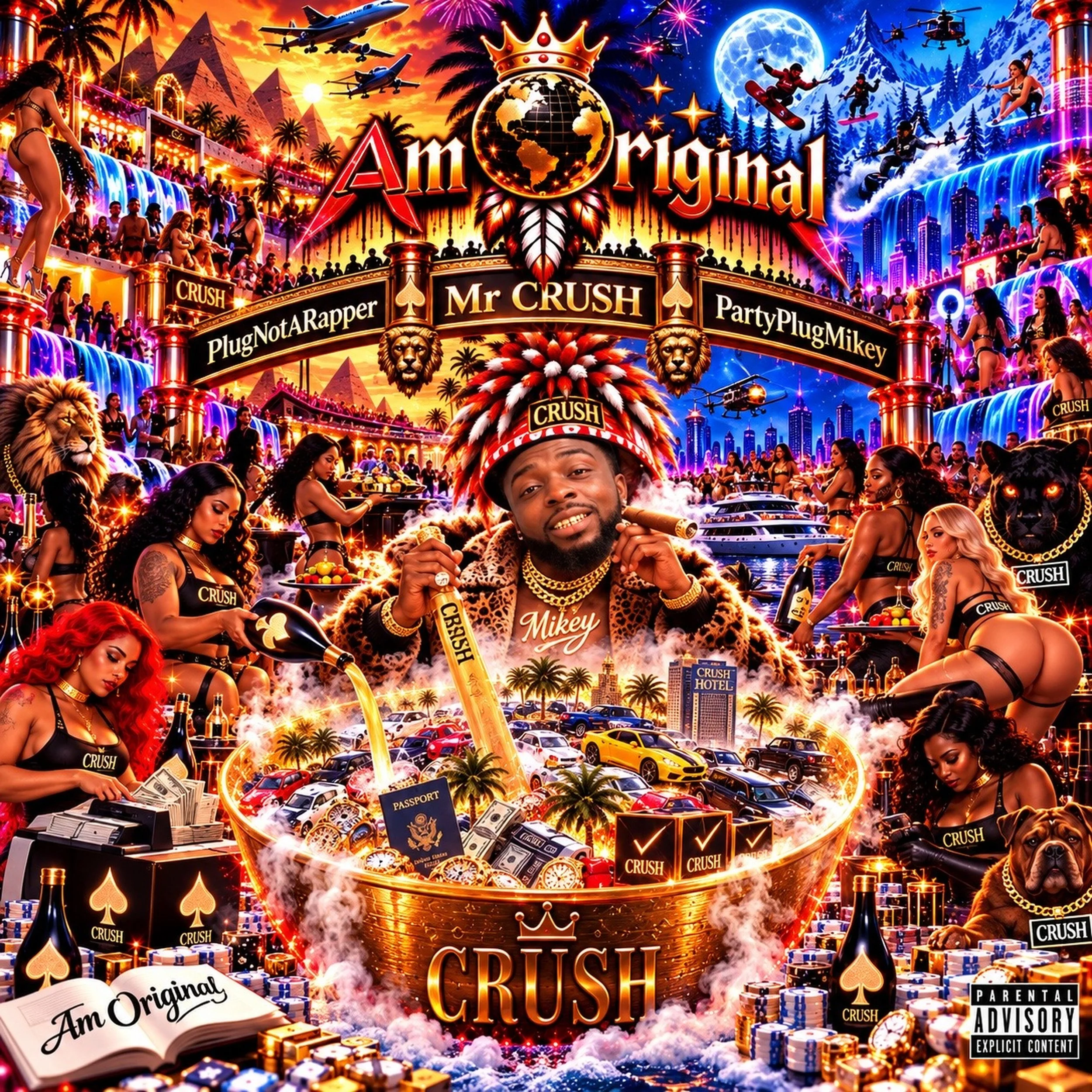
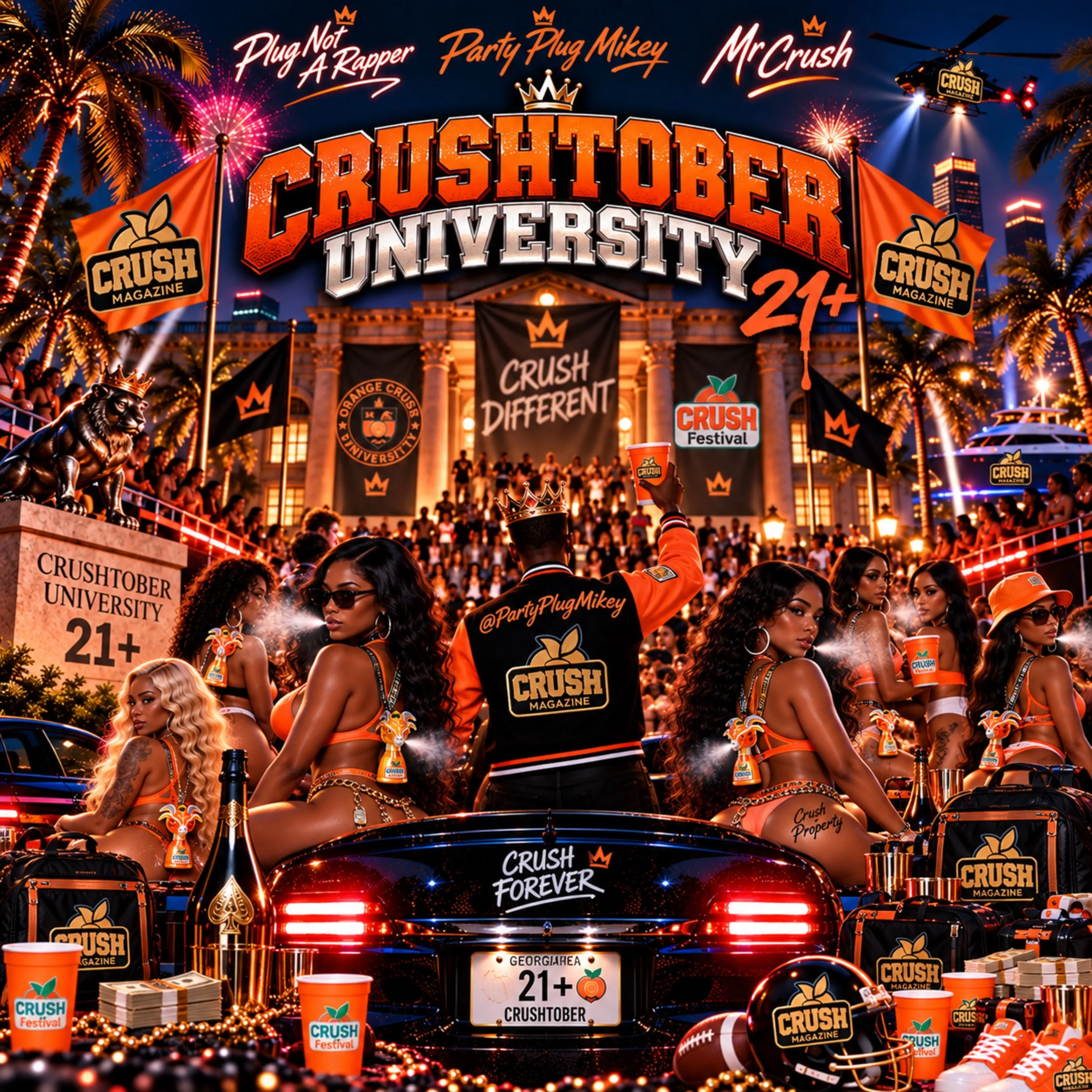
Before CRUSHTOBER UNIVERSITY 21+ even plays, the cover tells you exactly what kind of institution this is.
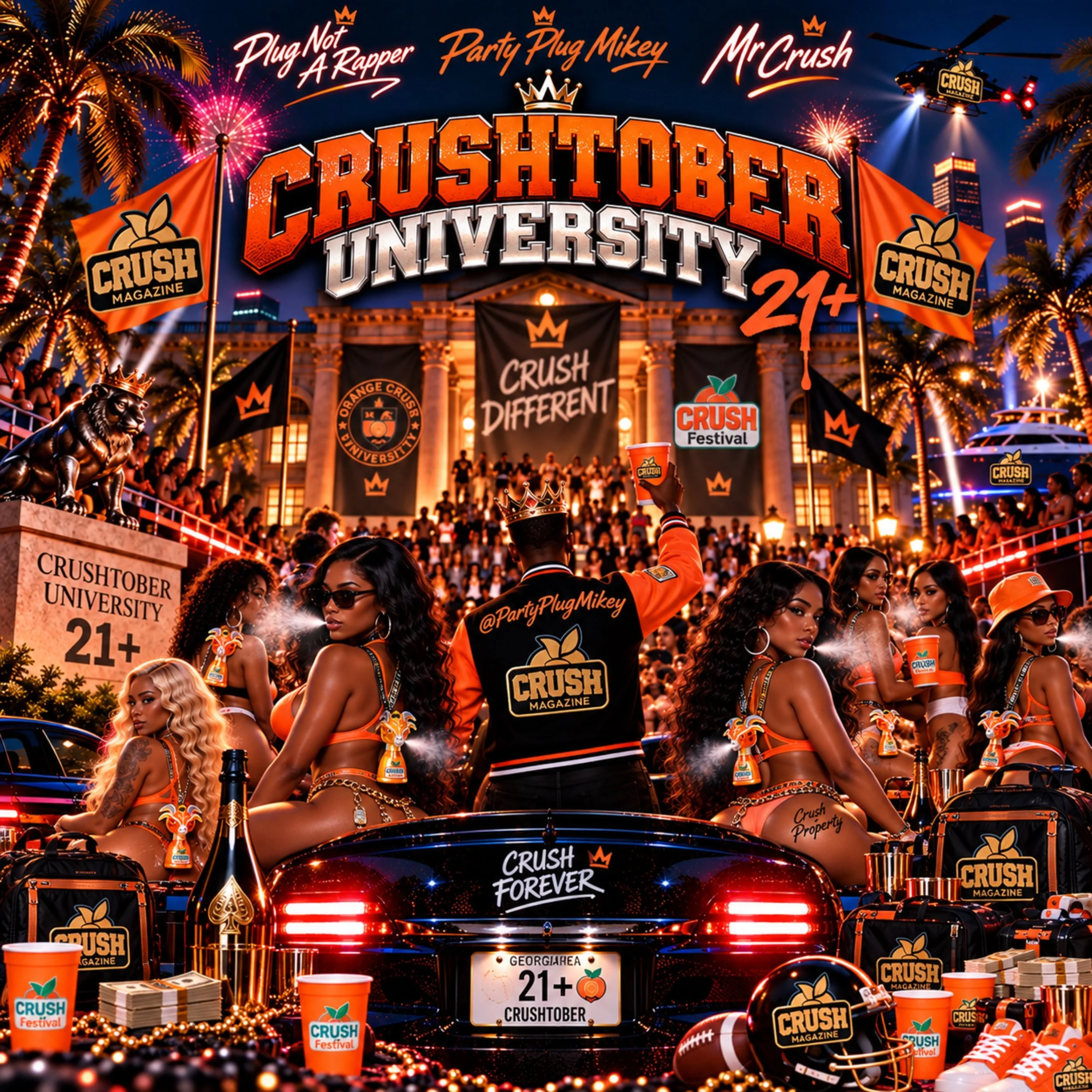
Orange flags fly over a packed campus at night. Fireworks explode behind palm trees. Pretty women occupy the foreground. Footballs, cups, champagne, money and CRUSH branding spill across the scene. A helicopter circles overhead. In the center of everything stands Party Plug Mikey, back turned to us, crown on his head and cup raised toward the crowd.
Above him are three names:
Plug Not A Rapper.
Party Plug Mikey.
Mr Crush.
They aren’t three different artists.
They’re three sides of the same personality.
And CRUSHTOBER UNIVERSITY 21+ might be the clearest musical meeting point between all three yet.
This isn’t an artist pretending to be a college student.
It’s a grown man returning to the yard with money in his pocket, history behind him, women around him and enough personality to turn homecoming into his own fictional university.
CRUSHTOBER isn’t where Mikey goes to school.
CRUSHTOBER is his school.
THE ALBUM STARTS BEFORE YOU GET THERE
Every homecoming weekend begins with the same question.
Who going?
That’s why “Goin” is such a natural entrance into this world.
The language is almost aggressively simple:
Who goin’?
Who not?
Who got pape’?
Like WE GOT!
Who got motion?
Like WE GOT!
That’s not traditional songwriting exposition.
That’s the group chat.
That’s somebody yelling across the room while getting dressed.
That’s three cars trying to figure out who’s riding with who.
Then comes the most important declaration:
She askin’ when we stoppin’?
WE NOT!
And there it is.
The thesis of the album in two words.
WE NOT.
Because CRUSHTOBER isn’t built around arriving at one destination. It’s about continuous motion.
Pregame becomes tailgate.
Tailgate becomes game.
Game becomes function.
Function becomes afterparty.
Afterparty becomes somebody’s house.
Saturday becomes Sunday.
And somehow you’re still wearing the wristband Monday morning.
That perpetual motion is the actual sound of CRUSHTOBER UNIVERSITY 21+.
AN ALBUM THAT SMELLS LIKE HOMECOMING
Some albums create worlds through complicated mythology.
CRUSHTOBER does it through details.
You can practically smell this album.
Liquor in plastic cups.
Perfume.
Smoke floating through a parking lot.
Fresh sneakers.
Car interiors.
Food from somebody’s tailgate.
Grass around the stadium.
Whatever she sprayed on herself before walking out the house.
That sensory quality comes from how deeply the record commits to social environments.
“Sip Sumn University Ave” doesn’t need a cinematic monologue explaining nightlife. The title itself drops you onto the strip.
“MEAC Homecoming” expands the landscape into the particular cultural electricity surrounding HBCU homecoming.
“Crush Da Yard” takes the most recognizable gathering place on a college campus and runs CRUSH directly through it.
Then “Arch Madness” featuring TYNIEE brings football into the party without treating sports like a separate universe.
That’s important.
At CRUSHTOBER UNIVERSITY, the game and the function aren’t two events.
They’re one day.
The jersey somebody wears at noon becomes part of the outfit at 7.
The person you saw at the tailgate appears again at midnight.
The football conversation becomes flirting.
The flirting becomes the next record.
That’s homecoming.
PLUG NOT A RAPPER IS THE CHEAT CODE
The smartest thing about the name Plug Not A Rapper is the freedom it gives Mikey.
He doesn’t have to enter every beat trying to prove he’s the most technically impressive rapper alive.
Sometimes the best thing he can do is say less.
A phrase.
A melody.
A question.
A command.
A joke.
A ridiculous reference that somehow becomes the line everybody remembers.
That philosophy fits this album particularly well because parties don’t reward lyrical density the same way headphones do.
In a packed room, clarity is power.
People need to catch it.
Women need to repeat it.
Friends need to yell it at each other.
The DJ needs to know exactly where the moment is.
And Mikey’s increasingly conversational writing style understands something deceptively difficult:
regular speech becomes musical when the right personality says it the right way.
That’s why something as basic as “Who goin’?” can become a record.
The writing isn’t trying to sound smarter than the room.
It’s trying to control the room.
THE WOMEN AREN’T BACKGROUND SCENERY
Look at the artwork again.
Women don’t simply appear somewhere behind the artist.
They dominate the frame with him.
That same feminine presence runs through the music.
“College & Alumni Gurlz.”
“BigBootiezAnthem.”
“Bonnet.”
Even outside those explicitly titled records, women remain central to CRUSHTOBER’s social ecosystem.
And “College & Alumni Gurlz” contains one of the more interesting ideas hiding underneath the album’s party surface.
Homecoming isn’t exclusively for students.
That’s exactly why it hits differently.
The 21-year-old undergraduate is outside.
So is the 25-year-old graduate.
So is the 30-something alum who hasn’t been back in years.
People return with different clothes, different money, different cars and different lives—but the music reconnects them to the same place.
The 21+ in the album title therefore becomes more than a parental-advisory-style warning.
It establishes perspective.
This is college culture viewed through adulthood.
Not dorm-room fantasy.
Alumni homecoming energy.
THEN THE ALBUM GETS WEIRD
And thank God it does.
Because eventually we arrive at a run containing titles like:
Anime.
Hunter x Hunter Episode 304.
Johnni Deepp.
Lilo & Stitch.
Demure DeRozan.
Read those five titles again.
There is no respectable corporate meeting where somebody would invent that sequence.
That’s exactly why it feels personal.
The references bounce between animation, celebrity, basketball, internet language and whatever was occupying Mikey’s brain when a phrase suddenly became a song.
Instead of cleaning those impulses up to appear more traditionally “artistic,” CRUSHTOBER leans into them.
The album becomes funnier.
Stranger.
More specific.
More quotable.
And, ultimately, more identifiable.
Because personality is often found in the choices another artist wouldn’t make.
Plenty of rappers can make a song about homecoming.
How many are putting “Hunter x Hunter Episode 304” in the same universe?
Exactly.
CRUSHTOBER DOESN’T SOUND LIKE A CLASSROOM. IT SOUNDS LIKE THE YARD.
The word “University” could have pushed this project toward obvious college clichés.
Instead, Mikey’s version of school is almost entirely social.
The curriculum is motion.
The electives are fashion, women, football, nightlife and anime.
The student union sells drinks.
Nobody knows where the dean is.
And apparently Halloween counts as finals.
That last part matters because “Trick or Treat” gives the project another natural cultural anchor.
CRUSHTOBER isn’t just homecoming music.
It’s October music.
Football season.
Homecoming season.
Halloween season.
Cooling temperatures.
Longer nights.
Costumes.
Parties.
Bonfires.
College campuses at their most active.
The name CRUSHTOBER suddenly feels less like branding and more like a calendar designation.
October belongs to CRUSH.
FROM ALBUM TO INSTITUTION
This is where the project becomes more ambitious than its party-first surface suggests.
Mikey has spent years building different pieces underneath the CRUSH identity: music, events, Orange Crush, CRUSH Festival, CRUSH Magazine, merchandise and other entertainment ventures.
The cover doesn’t hide that ecosystem.
It celebrates it.
CRUSH Magazine isn’t merely promoting the album; it physically exists inside the album artwork.
CRUSH Festival cups sit inside the world.
CRUSH flags fly from the campus.
CRUSH merchandise appears on bodies and objects.
Even the university itself carries the brand.
That’s a meaningful evolution.
A weaker approach would place a logo everywhere and call it branding.
Here, the stronger idea is that every CRUSH property appears to belong to the same fictional place.
CRUSH Magazine is the campus publication.
CRUSH Festival is the big event.
Party Plug Mikey is the host.
Plug Not A Rapper makes the soundtrack.
Mr Crush owns the mythology.
And CRUSHTOBER UNIVERSITY houses all of it.
That is the difference between promoting products and constructing a universe.
THE CROWN MAKES MORE SENSE FROM BEHIND
There’s another subtle choice on the cover worth noticing.
Mikey isn’t facing us.
For an artist-driven album, that’s unusual.
Instead, we’re positioned behind him while he looks toward everything he’s supposedly built.
The crowd.
The campus.
The women.
The flags.
The CRUSH ecosystem.
His jacket carries the identity while his face becomes almost unnecessary.
It changes the visual from “look at me” to “look at this.”
That’s an appropriate image for where the CRUSH concept is heading.
Party Plug Mikey remains the central character.
But the ambition is increasingly bigger than the character.
The objective is to build something recognizable enough that eventually people don’t need Mikey standing in front of it to know they’re inside the CRUSH universe.
Orange should tell them.
The fruit should tell them.
The crown should tell them.
The energy should tell them.
A VERY SERIOUS COMMITMENT TO NOT BEING TOO SERIOUS
That might ultimately be CRUSHTOBER UNIVERSITY 21+’s defining characteristic.
It is ambitious without constantly announcing its ambition.
The world-building is serious.
The branding is serious.
The catalog development is serious.
The intention behind connecting music, touring, media and events is serious.
But the actual experience?
Fun.
Sometimes horny.
Sometimes ridiculous.
Sometimes fashionable.
Sometimes melodic.
Sometimes drunk.
Sometimes clever.
Sometimes intentionally simple.
Sometimes the entire idea is apparently that somebody thought Demure DeRozan sounded hard enough to become a song title.
Good.
A party album shouldn’t feel like homework.
And that’s where Plug Not A Rapper becomes less of a nickname and more of a creative philosophy.
Mikey isn’t asking listeners to admire how difficult the music was to make.
He’s asking whether they’re coming.
WELCOME TO THE UNIVERSITY
By the time CRUSHTOBER reaches its final stretch, the fictional school doesn’t feel completely fictional anymore.
You understand its people.
You understand its language.
You understand what everybody does on weekends.
You understand what they wear.
You know where they drink.
You know football matters.
You know the women matter.
You know homecoming is damn near a religious holiday.
You know somebody watches anime.
You know nobody wants to go home.
And you definitely know the school color.
Orange.
That’s the accomplishment hiding beneath all the chaos.
CRUSHTOBER UNIVERSITY 21+ doesn’t simply give Party Plug Mikey another album title.
It gives CRUSH another place to exist.
And places can become traditions.
Traditions become culture.
Culture lasts longer than campaigns.
So when the opening record asks—
“Who goin’?”
—the answer isn’t supposed to be complicated.
Grab your cup.
Find your people.
Wear something worth remembering.
Homecoming already started.
CRUSHTOBER UNIVERSITY 21+
Plug Not A Rapper × Party Plug Mikey × Mr Crush
21+ ONLY.
NO CURFEW.
NO BORING SHIT.
CRUSH DIFFERENT. 🍊👑
— CRUSH MAGAZINE
CRUSH MAGAZINE — COVER STORY CRUSHTOBER UNIVERSITY 21+: PARTY PLUG MIKEY BUILT AN ALBUM THAT FEELS LIKE HOMECOMING AFTER DARK By CRUSH Magazine | Music & Culture
CRUSH MAGAZINE — COVER STORY
CRUSHTOBER UNIVERSITY 21+: PARTY PLUG MIKEY BUILT AN ALBUM THAT FEELS LIKE HOMECOMING AFTER DARK
By CRUSH Magazine | Music & Culture
There are albums made about college.
Then there are albums that sound like somebody actually pulled up.
CRUSHTOBER UNIVERSITY 21+ belongs to the second category.
Party Plug Mikey — also operating under his Plug Not A Rapper and Mr Crush identities — takes the world surrounding CRUSH and turns it into a full-length adult homecoming experience: parking lots overflowing, alumni outside, Greek energy, pretty women dressed for the function, cups in the air, football in the background, somebody asking where everybody is going next, and an entire weekend that refuses to end when the stadium lights shut off.
The title explains the concept before the music even starts.
This isn’t freshman orientation.
This is CRUSHTOBER UNIVERSITY — 21+.
And Mikey isn’t approaching the project like a rapper trying to recreate college culture from a studio. His entire Party Plug identity comes from events, nightlife, promotion, travel, women, sports, homecomings and gathering people together. CRUSHTOBER takes that lived social language and converts it into records.
That difference matters.
THE CAMPUS IS THE ALBUM
CRUSHTOBER doesn’t need a fictional storyline because the environment itself becomes the story.
One record feels like the pregame.
Another feels like walking across the yard.
Another belongs in the car headed toward the function.
Another sounds built for the women already inside it.
Then midnight hits.
The clothes change. The conversations change. The energy gets more adult.
By the end, CRUSHTOBER has moved far beyond a collection of “college songs.” It starts functioning like a soundtrack to an entire homecoming weekend.
That range is visible just from the record titles.
Goin. F* 2 Good. Hi. Sip Sumn University Ave. MEAC Homecoming. Crush Da Yard. Arch Madness featuring TYNIEE. My Turn. College & Alumni Gurlz. BigBootiezAnthem. Shalom Blakk. Midnight. Bonnet. Not Me. Mr Put That Shit On. Anime. Hunter x Hunter Episode 304. Johnni Deepp. Lilo & Stitch. Demure DeRozan. Trick or Treat.**
The naming is part of Mikey’s writing language.
Instead of making every title overly serious, he lets references collide: college culture, sports, cartoons, fashion, nightlife, women, celebrities, internet language and random phrases that become memorable because of how they’re placed.
That unpredictability gives CRUSHTOBER personality.
It sounds like Mikey’s campus, not an industry template.
“WHO GOIN’? WHO NOT?”
And that is why “Goin” makes so much sense at the front door.
Who goin’?
Who not?
Who got pape’?
Like WE GOT!
Who got motion?
Like WE GOT!
There isn’t supposed to be some complicated philosophical entrance.
It’s the group-chat question before everybody leaves.
Who going?
That phrase immediately creates participation. By the time the record starts bouncing between “Who Goin?”, “Who not?”, “She goin?” and “Who already comin?”, the listener isn’t being introduced to CRUSHTOBER through exposition.
They’re being invited somewhere.
That’s a very Party Plug Mikey way to begin an album.
THE HOMECOMING RUN IS THE CENTER OF GRAVITY
The project becomes especially literal through “Sip Sumn University Ave,” “MEAC Homecoming,” “Crush Da Yard” and “Arch Madness.”
Those records establish the campus DNA from different directions.
“University Ave” sounds like an address without needing to be one specific address. Almost every college town has that road — the strip where traffic slows down, alumni reconnect, music leaks from cars and everybody seems to be headed toward something.
“MEAC Homecoming” pushes directly into HBCU celebration.
“Crush Da Yard” takes CRUSH branding and plants it inside the physical and cultural idea of the Yard.
And then comes “Arch Madness” featuring TYNIEE, pulling football imagery, attraction, swagger and homecoming energy into the same record.
That’s where CRUSHTOBER’s world-building becomes clearer.
Football isn’t separate from the party.
Fashion isn’t separate from music.
Women aren’t separate from the atmosphere.
The alumni aren’t separate from the students.
The tailgate isn’t separate from the club.
It’s one weekend.
So Mikey treats it like one world.
THIS IS PARTY MUSIC WITH CHARACTER
One of CRUSHTOBER’s defining qualities is that Mikey doesn’t seem interested in proving he can rap the hardest for 22 consecutive records.
That’s precisely what “Plug Not A Rapper” allows him to do.
He can chant.
Talk.
Sing.
Repeat something ridiculous.
Turn a conversation into a hook.
Let a phrase breathe.
Make something for women.
Make something for a tailgate.
Make something funny.
Make something slick.
Then make something that sounds like it shouldn’t work until everybody in the room starts repeating it.
That looseness is essential to the project.
CRUSHTOBER is less concerned with lyrical gymnastics than social effectiveness.
Can people remember it?
Can women say it?
Can a DJ bring it back?
Can somebody caption a picture with it?
Can ten people yell the hook together?
Does it make sense coming out of a car?
Does it still work at 1:17 in the morning?
Those questions define this particular musical universe more than traditional rap rules do.
THE TITLES GET WEIRDER — AND THE WORLD GETS BIGGER
Then CRUSHTOBER starts wandering into Mikey’s more eccentric territory.
Anime. Hunter x Hunter Episode 304. Johnni Deepp. Lilo & Stitch. Demure DeRozan.
On paper, those titles look like five completely different internet searches.
Inside the CRUSHTOBER universe, that’s almost the point.
Mikey’s catalog has increasingly operated through association rather than conventional subject labels. A sports reference can become a personality. A cartoon can become relationship language. A celebrity name can become imagery. A joke can become a record.
It gives the back half of the album a different texture from the obvious homecoming material.
The listener has already entered the university.
Now they’re learning the personality of the person who built it.
“21+” IS MORE THAN AN AGE STAMP
The 21+ attached to CRUSHTOBER UNIVERSITY is important.
It immediately separates this from some clean, nostalgic college scrapbook.
This is the grown homecoming.
The version where graduates come back.
The version where people have money now.
Cars now.
Careers now.
Relationships, exes, businesses and responsibilities now.
But for one weekend, everybody puts the school colors back on.
That makes “College & Alumni Gurlz” an especially fitting title within the concept. CRUSHTOBER isn’t only fascinated with who’s currently enrolled. It recognizes what makes homecoming unusual in the first place:
generations occupy the same party.
Twenty-one.
Twenty-eight.
Thirty-four.
Forty.
Different graduating classes, same records playing.
That gives the “University” concept room to extend beyond literal students.
CRUSH IS BECOMING THE INSTITUTION
The cover artwork says the quiet part loudly.
There is no ordinary campus.
There is CRUSH University.
CRUSH Magazine flags hang beside the crowd. CRUSH Festival branding appears throughout the environment. Orange dominates the landscape. The artist stands in the center with his back toward the viewer, cup raised toward what looks less like an audience than an entire student body.
Even the luxury, nightlife, football and women surrounding him function as pieces of one larger ecosystem.
That’s the bigger idea behind CRUSHTOBER.
Party Plug Mikey isn’t merely placing the CRUSH name on an album.
He’s using music to make CRUSH feel like a place.
A festival can happen there.
A magazine can report from there.
Merchandise can come from there.
Artists can perform there.
Models can appear there.
Homecoming can happen there.
And Mikey can make the soundtrack.
That’s brand world-building through music rather than an advertisement interrupting music.
WELCOME TO CRUSHTOBER
There is an appropriately oversized quality to all of this.
A 21+ imaginary university.
A homecoming album.
Football.
Halloween.
Anime.
Women.
Alumni.
Fashion.
Nightlife.
CRUSH everywhere.
And an artist simultaneously calling himself Party Plug Mikey, Plug Not A Rapper and Mr Crush.
Trying to make that world smaller would probably defeat the purpose.
CRUSHTOBER UNIVERSITY 21+ works from the opposite philosophy:
What if the party was the campus?
What if the album was the homecoming?
What if CRUSH was the school everybody wished existed?
Class is in session.
But judging by the music, nobody came here to study.
Welcome to CRUSHTOBER UNIVERSITY 21+.
School colors: Orange & Black.
Major: Motion.
Minor: Bad Decisions.
Homecoming: Mandatory.
Age Requirement: 21+.
— CRUSH MAGAZINE
CRUSH MAGAZINE “ARCH MADNESS” DOESN’T SOUND LIKE THE GAME — IT SOUNDS LIKE WHAT ATLANTA DOES AFTER IT Plug Not A Rapper and Tyniee find the sweet spot between dark Southern rap
CRUSH MAGAZINE
“ARCH MADNESS” DOESN’T SOUND LIKE THE GAME — IT SOUNDS LIKE WHAT ATLANTA DOES AFTER IT
Plug Not A Rapper and Tyniee find the sweet spot between dark Southern rap, flirtatious chaos and homecoming excess on a record whose real instrument might be personality.
By CRUSH Magazine | Atlanta, GA | October 2026
The first thing “Arch Madness” gets right is something deceptively simple:
It has room.
Room for the bass to hit. Room for a line to hang in the air. Room for a voice to change the temperature. Room for somebody to say something slick without immediately burying it underneath another sixteen syllables.
That’s increasingly rare in an era when records can sound like everybody involved is afraid of silence.
Plug Not A Rapper and Tyniee aren’t.
Their new Atlanta collaboration breathes.
And because it breathes, it moves differently.
“Arch Madness” sits in a slow-rolling Southern pocket—roughly 85 BPM—but the number doesn’t adequately describe how the record feels. The drums can be counted. The atmosphere can’t.
There’s something nocturnal about it.
The instrumental carries the kind of low-end pressure that feels designed to be experienced somewhere larger than headphones. The bass doesn’t simply accompany the record; it gives the song physical dimensions. Above it, the percussion is sharper and leaner, leaving open pockets between impacts instead of filling the production with unnecessary movement.
Then there is the melodic atmosphere hovering behind everything: dark, repetitive, slightly sinister, more interested in creating tension than resolving it.
The result is music that feels expensive without sounding polished to death.
Atlanta expensive.
Tinted-window expensive.
Hotel-lobby-after-midnight expensive.
Two cars outside because nobody could decide who was driving expensive.
And once the voices enter, “Arch Madness” stops sounding like a beat and starts sounding like a situation.
THE PRODUCTION HAS THE CONFIDENCE TO STAY OUT OF THE WAY
Some beats introduce themselves every four bars.
This one establishes its rules and lets the artists live inside them.
That’s important because “Arch Madness” isn’t built around some giant instrumental trick. Its power comes from pocket.
The low frequencies carry the weight.
The drums provide the punctuation.
The darker melodic layer creates the environment.
Everything else is space.
That means a vocal pause becomes musical.
An ad-lib becomes musical.
The difference between somebody whispering something and somebody barking something becomes musical.
Even the moment before the next line arrives starts carrying tension.
It’s the kind of production where an artist who doesn’t understand pocket could easily sound exposed.
Plug sounds comfortable being exposed.
PLUG RAPS LIKE THE PARTY ALREADY KNOWS HIM
There’s a particular kind of confidence that sounds different from aggression.
Plug Not A Rapper doesn’t need to spend the entire record convincing you that he’s important.
He performs more like the room has already made that decision.
That’s an important distinction in his delivery.
Rather than approaching “Arch Madness” like an athletic exercise—look how fast I can rap, look how many internal rhymes I can fit into eight bars—the performance leans into timing, personality and the spaces between statements.
It gives the record swagger without forcing it.
That approach makes sense when placed beside the catalog currently visible on Plug Not A Rapper’s Apple Music profile. Apple Music shows a multi-year run of projects including Not Like Them Rap Nz, Baddies Island, Mapouka Twerk Doctor, F.R.1.E.N.D. Z.8.N.E., Mr CRUSH, Home Screen** and September 2026’s Crush Culture Society. (music.apple.com)
That most recent project is particularly revealing. Crush Culture Society contains eight tracks—“Founder,” “Open2Real,” “Motion Witness Wireless,” “Sum Fine S***s,” “The Temptations,” “Type Action Word,” “Gold Bottles” and “New Era Eve”—with Party Plug Mikey featured across the project. Several currently appear among Plug Not A Rapper’s Top Songs on Apple Music. (music.apple.com)
The through-line isn’t simply musical.
It’s character.
Plug’s records increasingly function like rooms where the Party Plug Mikey personality gets to behave differently.
“Arch Madness” gives that personality a particularly appropriate room:
homecoming after dark.
THERE’S A LITTLE COMEDY HIDING INSIDE THE SWAGGER
That’s another important piece of the sound.
“Arch Madness” doesn’t feel humorless.
The production might be dark, but the vocal attitude isn’t trapped inside that darkness. There’s enough playfulness in the delivery to keep the song from becoming another interchangeable “serious rapper over sinister beat” record.
That matters.
Atlanta’s rap tradition has always left room for personality to coexist with technical ability—voices that bend words strangely, unexpected pauses, ridiculous boasts delivered completely straight, ad-libs becoming hooks, lines becoming memorable because of how somebody said them.
“Arch Madness” understands that performance can be writing.
A phrase doesn’t necessarily need twelve meanings when the right vocal inflection can give three ordinary words an entire personality.
That’s where Plug’s approach works particularly well.
There are moments where the cadence feels almost conversational, as if you’re overhearing something that happened to land perfectly on beat.
Sounding effortless is its own technique.
AND THEN TYNIEE MAKES THE SAME BEAT FEEL DIFFERENT
A feature should change something.
Not just the name underneath the song title.
Not just the streaming metadata.
The actual temperature of the record.
When a female voice enters a production already carrying male swagger, sexual tension and nightlife energy, the listener’s relationship with the record changes immediately.
Suddenly the world isn’t being described exclusively from one side.
And because the instrumental is relatively spacious, Tyniee doesn’t have to fight through layers of production to establish herself.
Her voice becomes the new texture.
That’s crucial.
Her current Apple Music catalog shows a developing 2026 run built heavily around collaboration. Apple currently lists “Wop Wop” featuring Mohogany as her latest release, alongside “Slappp” featuring Mohogany and “Nasty Dancerz” featuring Jo & Coco. Her profile also connects her to collaborations including Mohogany’s “No Competition” and 10k.Caash’s “Show Us Ya Hoe.” (music.apple.com)
That history matters because she doesn’t approach “Arch Madness” like someone cautiously stepping onto somebody else’s record.
There’s already collaborative muscle there.
And against Plug’s personality, the contrast becomes useful.
Male voice. Female voice.
Dark production. Playful personalities.
Same Atlanta. Different energy.
That’s where the chemistry lives.
THE BEAT HAS THREE DIFFERENT LIVES
Play “Arch Madness” quietly and you hear the atmosphere.
Play it through headphones and you start noticing the vocal pockets.
Play it through speakers capable of actually reproducing the low end and the record becomes something else.
That’s the third life.
Physical music.
The kind where you understand the production differently once the bass starts interacting with the room.
That’s important for a record attached to CRUSHTOBER UNIVERSITY 21+.
Because CRUSHTOBER isn’t being constructed as a headphone-only concept.
It’s inherently social.
Cars.
Hotels.
Tailgates.
Campus.
Sections.
Clubs.
Homecomings.
People standing around pretending they’re not listening before the hook comes back.
For that environment, the bottom of the record has to matter.
“Arch Madness” has bottom.
IT SOUNDS LIKE ORANGE AND BLACK
Certain songs create colors in your head.
“Arch Madness” feels dark orange.
Not bright citrus.
Not daytime.
Burnt orange under stadium lights.
There’s black around the edges.
Chrome somewhere nearby.
White headlights moving through it.
That’s the sonic equivalent of the artwork.
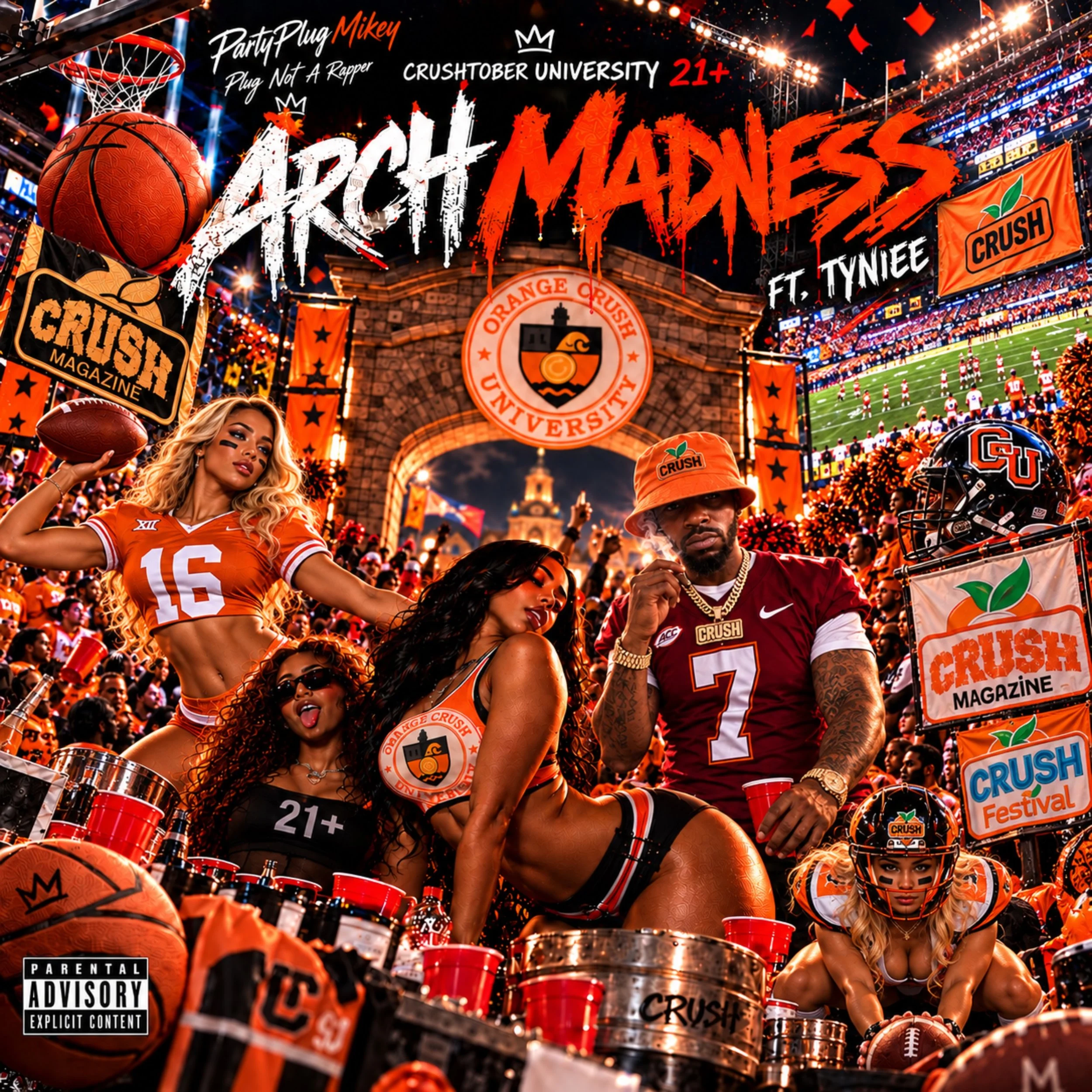
The cover is deliberately maximalist—sports, women, football, basketball, stadium architecture, CRUSH branding, college imagery and nightlife all fighting for the same frame.
The production takes the opposite approach.
Minimal information. Maximum atmosphere.
That’s why the two work together.
If the beat were as busy as the artwork, the entire package could become exhausting.
The cover gives you the crowd.
The beat gives you the parking lot after the crowd moves.
THE 85 BPM POCKET IS IMPORTANT
There is a reason the record doesn’t need to be faster.
At roughly 85 BPM, there is enough time between major rhythmic events for the performers to develop attitude.
A faster beat can force movement.
This one permits swagger.
That’s different.
Swagger requires enough empty time for the listener to anticipate what comes next.
It lets consonants hit.
It lets the tail of an ad-lib remain audible.
It lets somebody intentionally come in a fraction late and make the pocket feel heavier.
It lets the rapper talk.
That’s where a lot of the record’s Atlanta character lives—not necessarily in a specific drum sound or one melodic choice, but in the relationship between voice and time.
The beat doesn’t drag the artists forward.
The artists can lean backward against it.
And once that happens, 85 BPM starts feeling huge.
THIS IS A WOMEN-HEAVY WORLD WITHOUT MAKING THE WOMAN A PROP
That’s another reason Tyniee matters to the concept beyond simply being a feature.
Look at the CRUSHTOBER universe.
Women are everywhere.
The artwork itself puts female characters directly in the foreground. They’re wearing jerseys. They’re part of the sports imagery. They’re part of the nightlife imagery. They’re part of the attraction and spectacle surrounding Orange Crush University.
Putting an actual female Atlanta artist inside the music gives that visual world another dimension.
Tyniee isn’t merely somebody being talked about.
She gets a microphone.
That’s a meaningful difference.
And because her existing Apple Music catalog already includes collaborations with women—including Mohogany and Jo & Coco—the pairing doesn’t feel like a branding exercise invented specifically for this cover. (music.apple.com)
It feels like two existing trajectories crossing.
“ARCH MADNESS” ISN’T TRYING TO WIN THE LYRICAL OLYMPICS
Good.
Because that’s not what this record needs.
The value here isn’t in stopping the song every eight seconds so somebody can explain a triple entendre.
It’s immediacy.
Can you feel the record before you completely understand it?
Can somebody walk into the room during the second verse and understand the energy without receiving background information?
Can a DJ move from another Atlanta record into this one without the room suddenly feeling like somebody changed genres?
Can somebody hear ten seconds on a Reel and recognize the attitude?
Those are different measurements of songwriting.
And for “Arch Madness,” they’re arguably the more relevant ones.
This record is selling behavior.
Not scholarship.
THE TITLE GETS BETTER ONCE YOU HEAR THE MUSIC
“Arch Madness” initially sounds like a visual concept.
March Madness flipped into CRUSH language.
Basketball.
College.
Brackets.
Arena.
Then you hear the record.
And “madness” starts describing something else.
Not basketball chaos.
Social chaos.
Who’s coming?
Where are we going?
Who’s with who?
What hotel?
Which party?
Who has the address?
Who’s driving?
Why is everybody still outside?
How did the person who said they weren’t coming end up standing beside you?
That’s homecoming madness.
The sports imagery gets you through the gate.
The record takes you somewhere else.
THAT’S WHY TRACK 7 MAKES SENSE
Inside the current CRUSHTOBER UNIVERSITY 21+ sequence, “Arch Madness” occupies track seven.
That placement gives it a different job than an opener.
By track seven, the listener should already understand that they’re inside a world.
“Arch Madness” doesn’t need to introduce the university.
It can simply throw an event there.
And as a standalone single, the equation reverses.
Now Arch Madness itself becomes the entrance.
Somebody who has never heard the surrounding album doesn’t need to know anything about CRUSHTOBER to understand:
Two Atlanta artists.
Dark beat.
Heavy bass.
Female/male chemistry.
College-sports imagery.
Homecoming energy.
That’s enough to enter.
Then the larger album can explain what building they just walked into.
THE MOST IMPORTANT SOUND ON THE RECORD ISN’T THE 808
It’s confidence.
Not loudness.
Not aggression.
Confidence.
The instrumental is confident enough not to overcrowd itself.
Plug is confident enough not to rap every available second.
Tyniee is confident enough to bring a different energy instead of becoming a female version of the lead artist.
The concept is confident enough to use basketball and football imagery without turning the production into novelty sports music.
And the CRUSHTOBER branding is confident enough to be absurdly large visually while allowing the record underneath it to remain relatively stripped down.
That’s why “Arch Madness” feels bigger than its individual components.
Everybody isn’t fighting to be the loudest thing.
They’re occupying different parts of the same world.
WHEN THE STADIUM EMPTIES, TURN THIS ONE UP
The easiest mistake would be calling “Arch Madness” a sports anthem.
That’s too small.
It’s not really about basketball.
It’s not really about football.
Those things provide imagery.
The actual subject is the electricity surrounding the weekend.
The moment when thousands of people who have jobs, children, classes, businesses, relationships and real adult responsibilities collectively decide that—for approximately 48 hours—none of that is going to prevent them from being outside.
That’s homecoming.
That’s the joke.
That’s the danger.
That’s the fun.
And that’s where Plug Not A Rapper and Tyniee sound most comfortable.
The beat rolls instead of races.
The bass carries weight instead of clutter.
The melody keeps the lights low.
The percussion keeps the body moving.
Plug supplies personality.
Tyniee changes the temperature.
And the fictional Orange Crush University gives all of it somewhere to happen.
The game might be on the flyer.
But “Arch Madness” sounds like nobody came just for the game.
PLUG NOT A RAPPER FT. TYNIEE
“ARCH MADNESS”
From CRUSHTOBER UNIVERSITY 21+
Plug Not A Rapper on Apple Music
Tyniee on Apple Music
CRUSH MAGAZINE® | ATLANTA
The scoreboard says the game is over. Atlanta says otherwise.
CRUSH MAGAZINE “ARCH MADNESS” SOUNDS LIKE ATLANTA AFTER THE SCOREBOARD GOES OFF Plug Not A Rapper and Tyniee turn booming low end, dark keys, sharp percussion and contrasting personalities into🍊
CRUSH MAGAZINE
“ARCH MADNESS” SOUNDS LIKE ATLANTA AFTER THE SCOREBOARD GOES OFF
Plug Not A Rapper and Tyniee turn booming low end, dark keys, sharp percussion and contrasting personalities into a CRUSHTOBER record that feels somewhere between the arena tunnel, the homecoming tailgate and the function after.
By CRUSH Magazine | Atlanta, GA | October 2026
There’s a difference between making a song about homecoming and making a record that sounds like it could actually survive homecoming.
“Arch Madness” sounds built for the latter.
The new collaboration between Atlanta-based Plug Not A Rapper and Tyniee doesn’t arrive dressed like a sentimental college anthem. There are no soft-focus memories of campus life here. The record is darker, harder and considerably more mischievous than its university packaging might initially suggest.
At roughly 85 BPM, “Arch Madness” moves with a heavy half-time Southern rap pocket. The tempo isn’t frantic. It doesn’t need to be. The production creates its momentum through weight: deep bass underneath a sparse melodic bed, crisp percussion cutting through open space, and an ominous tonal atmosphere that leaves plenty of room for the voices to become part of the rhythm.
It feels less like the marching band performing at halftime and more like walking through the stadium tunnel after dark while the bass from the parking lot is already shaking the concrete.
That distinction is important.
Because underneath all of the basketballs, football jerseys, cheerleaders and Orange Crush University imagery surrounding the single, “Arch Madness” is still an Atlanta rap record.
And it sounds like one.
THE BEAT DOESN’T CHASE YOU. IT WAITS FOR YOU.
The production’s biggest strength is restraint.
Instead of filling every second with musical information, the instrumental establishes a dark repeating atmosphere and lets the drums do the physical work. The low end lands heavily while the upper percussion remains much sharper, creating that familiar Southern contrast between something massive underneath and something nervous on top.
The result is a beat that feels spacious without feeling empty.
That space becomes essential once the vocals enter.
There are pockets where a rapper can attack the drums directly, and other places where the performance can drag slightly behind them, talk over them or leave silence hanging before the next line.
That’s why the approximately 85-BPM pace is deceptive.
On paper, it’s measured.
Through the speakers, it feels bigger than it is fast.
And “Arch Madness” benefits from that.
This isn’t music designed for somebody sitting perfectly still with headphones and studying every snare.
It’s the kind of record where the 808 has to reach the car beside you.
PLUG NOT A RAPPER SOUNDS COMFORTABLE INSIDE THE CHAOS
That looseness fits Plug Not A Rapper particularly well.
Rather than approaching the production like an obstacle course—packing every opening with syllables—the performance uses the beat’s negative space. The delivery has that conversational quality where the personality between the bars can matter almost as much as the bars themselves.
That’s increasingly consistent with the world surrounding Plug’s music.
His current Apple Music catalog stretches across projects including Not Like Them Rap Nz, Baddies Island, Mapouka Twerk Doctor, F.R.1.E.N.D. Z.8.N.E., Mr CRUSH, Home Screen** and September 2026’s Crush Culture Society.
Crush Culture Society alone contains “Founder,” “Open2Real,” “Motion Witness Wireless,” “Sum Fine S***s,” “The Temptations,” “Type Action Word,” “Gold Bottles” and “New Era Eve,” with Party Plug Mikey appearing throughout the project.
“Arch Madness” sounds like another evolution of that personality-first approach.
The vocal isn’t fighting to become bigger than the production.
It acts like it owns the building the production is playing in.
There’s humor in the performance. Swagger. Sexual energy. The loose feeling of somebody talking crazy because the room already knows who he is.
That distinction keeps the song from becoming overly serious despite how dark the instrumental can sound.
The beat has menace.
The performance has fun.
That tension is the record.
THEN TYNIEE CHANGES THE TEMPERATURE
This is where the feature earns its place.
Tyniee doesn’t need to imitate Plug’s delivery to fit the record.
The contrast is more interesting.
Her presence introduces a different vocal texture and feminine perspective into a record already built around swagger, nightlife and sexual tension. Instead of the song remaining one continuous male performance over the same loop, the change in voice effectively refreshes the beat without requiring the producer to completely redesign it.
That’s one of the oldest tricks in great collaborative rap records:
Don’t necessarily change the instrumental.
Change who’s standing on it.
And Tyniee already has a 2026 Apple Music catalog rooted in collaboration. Her Apple Music profile currently lists “Wop Wop” featuring Mohogany as her latest release, alongside “Slappp” featuring Mohogany and “Nasty Dancerz” featuring Jo & Coco. She also appears on records including Mohogany’s “No Competition” and 10k.Caash’s “Show Us Ya Hoe.”
So “Arch Madness” doesn’t introduce Tyniee as somebody uncomfortable sharing records.
Quite the opposite.
Her developing catalog already shows an artist moving between her own singles and other artists’ worlds.
This time, that world happens to be CRUSHTOBER.
IT’S DARKER THAN THE COVER LOOKS
That’s one of the more interesting surprises.
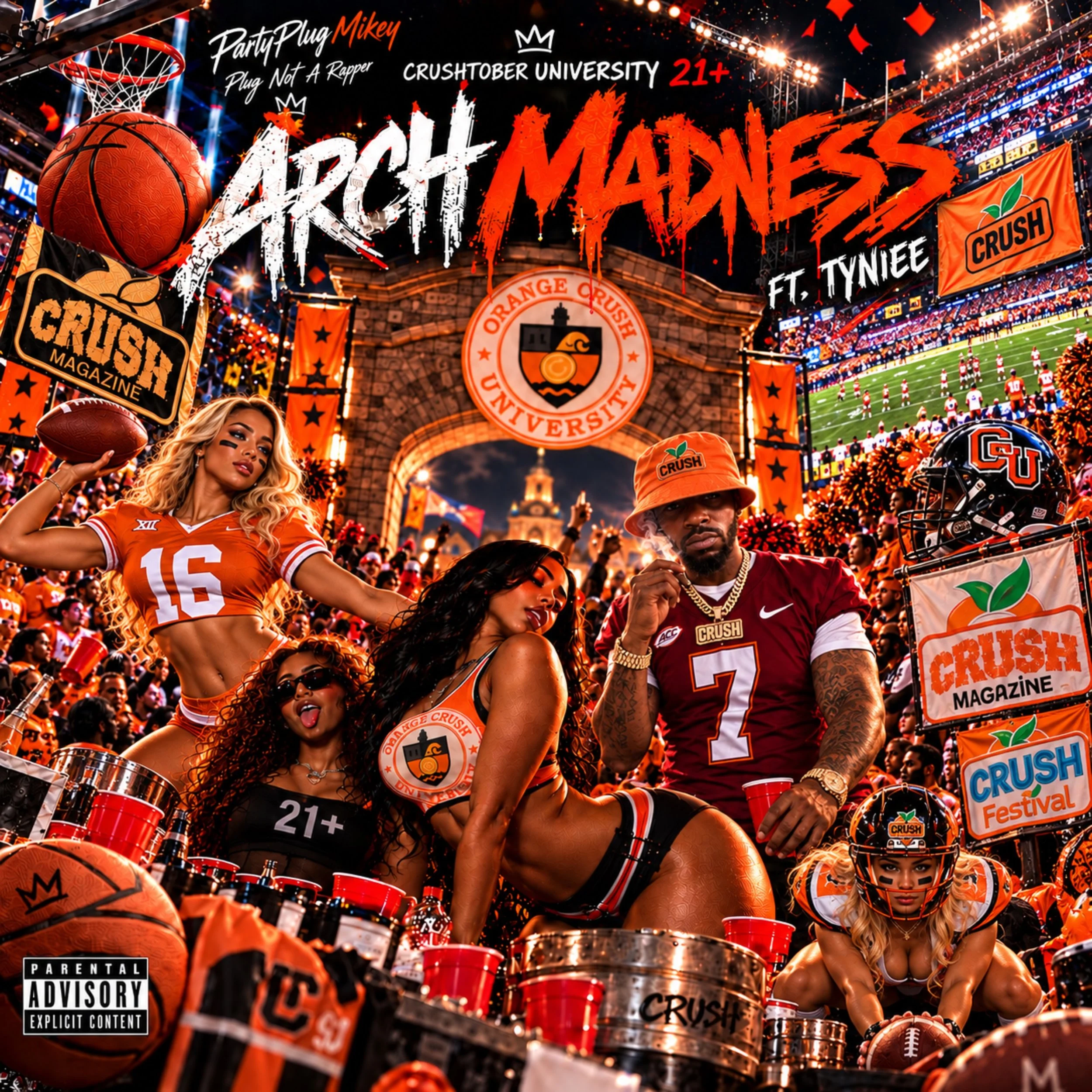
Look at the “Arch Madness” artwork and there’s an almost cartoonishly huge celebration happening.
Basketball.
Football.
Women.
Red cups.
Stadium lights.
Orange everywhere.
A fictional university.
CRUSH Festival.
Homecoming energy stacked on top of homecoming energy.
You could reasonably expect the song underneath that image to be bright, fast and almost pep-rally-like.
It isn’t.
The actual record has considerably more nighttime in it.
The melodic atmosphere is shadowy. The bass is heavy. The percussion is aggressive without becoming overcrowded. Vocally, neither artist sounds like they’re trying to turn this into a school-spirit record.
And that’s precisely why the artwork and audio complement each other.
The cover is 3 p.m. homecoming.
The record is 11:47 p.m. homecoming.
Same weekend.
Completely different decisions.
THE LOW END IS DOING MORE THAN MAKING THE RECORD LOUD
On a record like this, bass isn’t decoration.
It’s architecture.
“Arch Madness” leaves enough frequency and rhythmic space around its low end that the bass becomes part of how you perceive the size of the song. When it hits, everything suddenly feels wider.
That makes the record naturally compatible with the environments its branding depicts:
cars, tailgates, clubs, parties, campus functions and large speakers.
The percussion provides the opposite sensation.
Where the bass stretches, the drums snap.
Where the low end makes the record feel broad, the higher rhythmic elements keep it moving forward.
And because the melodic material isn’t fighting for attention with either one, the vocals remain exposed enough that personality stays at the front of the mix.
That’s crucial for a collaboration.
You can hear the people, not just the production.
THIS ISN’T “COLLEGE RAP.” IT’S RAP HAPPENING AT COLLEGE.
There’s a meaningful difference.
“Arch Madness” isn’t trying to imitate a marching band.
It isn’t stuffing fight-song horns into the production just because the artwork has football players.
It isn’t turning the concept into a gimmick.
Instead, CRUSHTOBER supplies the environment, while Atlanta rap supplies the musical language.
That’s a smarter division of labor.
The visuals can give you Orange Crush University.
The album can give you homecoming.
The marketing can give you basketball and football.
But when the speakers turn on?
The record still has to knock.
And “Arch Madness” understands the assignment.
WHY THE TWO VOICES MATTER
The collaboration also helps explain why “Arch Madness” makes sense as a single, rather than simply being another name buried inside the eventual CRUSHTOBER tracklist.
Plug and Tyniee aren’t sonically identical.
That’s the point.
One voice establishes the world.
The other disrupts it.
Then the production holds everything together.
The beat’s relative simplicity gives both artists enough room to remain recognizable instead of forcing them toward the exact same cadence or vocal character.
That creates something collaborations sometimes miss:
chemistry through contrast.
You shouldn’t finish the record forgetting somebody was featured.
The feature should alter your memory of the song.
Tyniee does.
THE COVER IS DAYLIGHT. THE SONG IS AFTER DARK.
That’s ultimately the easiest way to understand “Arch Madness.”
The artwork gives you the spectacle:
the stadium, the jerseys, the women, the university, the game, the crowd.
The audio gives you what happens when everybody leaves their seats.
The bass gets louder.
The campus gets darker.
The plans get less organized.
The outfits get better.
Nobody knows exactly where the next function is.
Everybody somehow claims they’re already on the way.
And somewhere in the middle of it, Plug Not A Rapper and Tyniee are trading personalities over an Atlanta record that moves slowly enough to swagger and hits hard enough to travel outside the room.
That’s “Arch Madness.”
Not halftime.
After hours.
Not the student section.
The section after the section.
Not March Madness.
CRUSHTOBER madness.
PLUG NOT A RAPPER FT. TYNIEE — “ARCH MADNESS”
From CRUSHTOBER UNIVERSITY 21+
Plug Not A Rapper on Apple Music
Tyniee on Apple Music
CRUSH MAGAZINE® | ATLANTA
Where the game ends, CRUSHTOBER starts.
CRUSH MAGAZINE Plug Not A Rapper & Tyniee Turn Homecoming Into a Contact Sport on “Arch Madness” The Atlanta collaborators collide on a larger-than-life CRUSHTOBER UNIVERSITY 21+ single
CRUSH MAGAZINE
Plug Not A Rapper & Tyniee Turn Homecoming Into a Contact Sport on “Arch Madness”
The Atlanta collaborators collide on a larger-than-life CRUSHTOBER UNIVERSITY 21+ single built for packed stands, crowded sections and whatever happens after the game.
By CRUSH Magazine | Atlanta, GA | October 2026
There’s a particular type of Atlanta night when nobody really knows where they’re going next—they just know they’re not going home.
The game ended an hour ago. Traffic is disrespectful. Somebody’s still wearing a jersey they never played in. The group chat has turned into addresses, screenshots and “where y’all at?” The function you were headed to isn’t even the function anymore.
That’s the atmosphere surrounding “Arch Madness,” the new single from Atlanta-based Plug Not A Rapper featuring fellow Atlanta artist Tyniee.
This isn’t presented like a polite collaboration.
It looks like somebody gave homecoming a budget and told it to lose control.
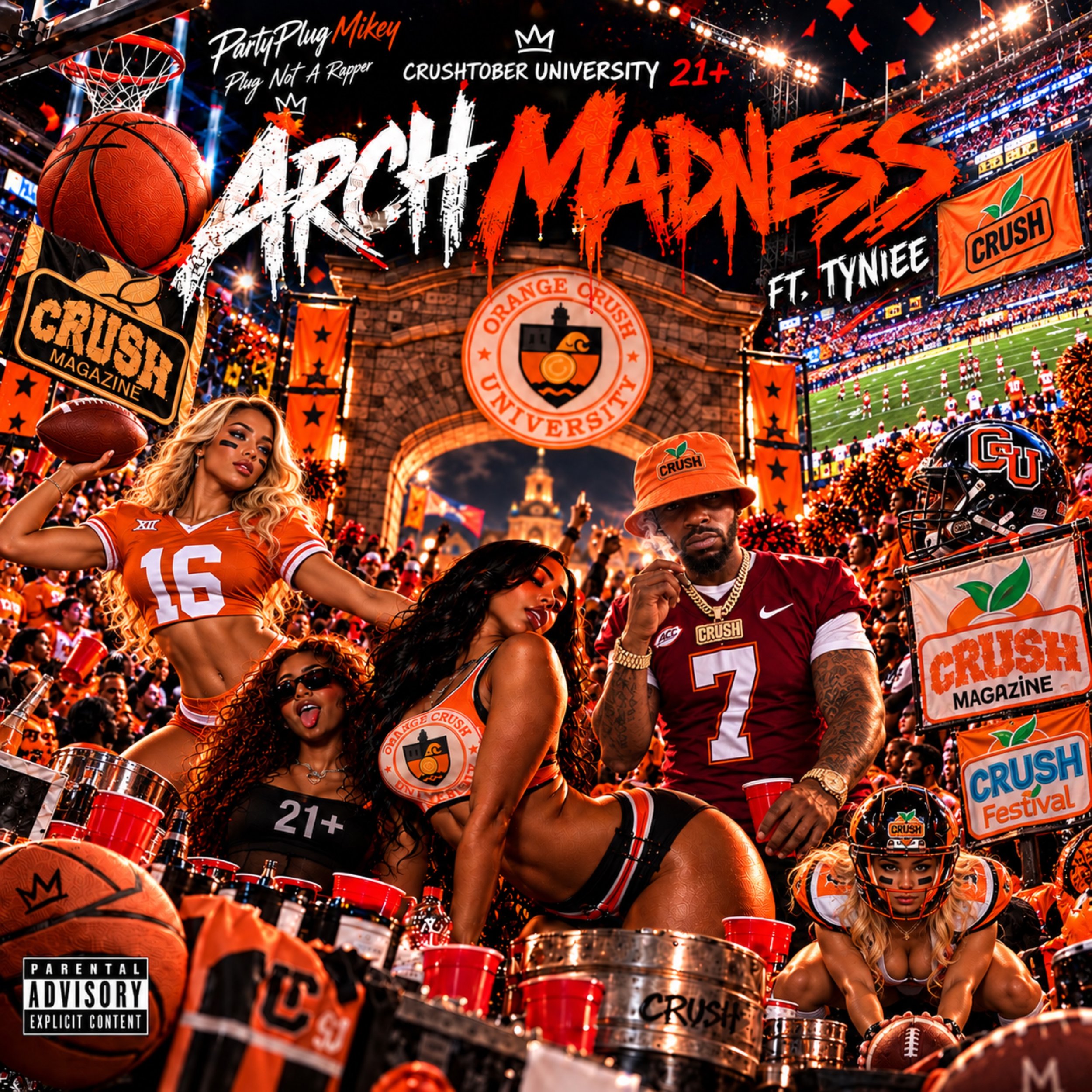
The artwork alone is sensory overload: stadium lights cutting through an orange-and-black night, basketball and football colliding in the same universe, packed stands, jerseys, models, red cups, CRUSH Magazine banners and the giant gates of the fictional Orange Crush University looming over everything.
At the center of all that noise sits the title:
ARCH MADNESS.
And underneath it:
FT. TYNIEE.
The record arrives as its own single while also belonging to Plug Not A Rapper’s larger CRUSHTOBER UNIVERSITY 21+ project—an album concept that treats college culture less like a setting and more like an entire adult playground.
For Plug, that makes “Arch Madness” another extension of a catalog that has become increasingly interested in building worlds around the music.
For Tyniee, it puts one of Atlanta’s emerging female voices directly in the middle of that world.
And somehow, the collision makes sense.
PLUG HAS BEEN BUILDING TOWARD SOMETHING BIGGER THAN SONGS
Open Plug Not A Rapper’s Apple Music catalog and the first thing that jumps out isn’t one song.
It’s volume.
His Apple Music page currently stretches across multiple albums and eras, including Not Like Them Rap Nz, Baddies Island, Mapouka Twerk Doctor, F.R.1.E.N.D. Z.8.N.E., Mr CRUSH, Home Screen** and, most recently, Crush Culture Society. (music.apple.com)
Released September 3, 2026, the eight-song Crush Culture Society includes “Founder,” “Open2Real,” “Motion Witness Wireless,” “Sum Fine S***s,” “The Temptations,” “Type Action Word,” “Gold Bottles” and “New Era Eve,” with Party Plug Mikey appearing throughout the project. Several of those records currently populate Plug Not A Rapper’s Top Songs section on Apple Music. (music.apple.com)
That catalog tells you something about the artist before anybody explains him.
Plug doesn’t appear particularly interested in behaving like the traditional rapper who disappears for two years, drops twelve songs and starts another album cycle.
The universe keeps getting bigger.
And Party Plug Mikey—the personality increasingly attached to that music—operates almost like the human face walking through all of those different rooms.
That distinction becomes especially important with CRUSHTOBER.
Because “Arch Madness” doesn’t feel like somebody randomly decided to make a basketball song.
It feels like Plug built a university just so he could throw the homecoming.
THEN TYNIEE WALKS ON CAMPUS
Tyniee’s Apple Music catalog tells a different story.
Where Plug’s page shows years of albums, Tyniee’s visible Apple Music footprint is concentrated around a newer run of 2026 singles and collaborations.
Her latest release currently listed by Apple Music is “Wop Wop” featuring Mohogany, released May 29, 2026. That follows “Slappp” featuring Mohogany and “Nasty Dancerz” featuring Jo & Coco. (music.apple.com)
She’s also already moving through other artists’ records.
Apple Music currently connects Tyniee to Mohogany’s “No Competition” and 10k.Caash’s “Show Us Ya Hoe,” with those collaborations appearing among the songs highlighted on her profile. (music.apple.com)
There’s a pattern there.
Tyniee’s catalog is being built in motion.
She’s appearing beside other artists, bringing them into her records and stepping into theirs.
“Arch Madness” simply takes that instinct and puts it on a considerably larger fictional campus.
And aesthetically, she fits.
This isn’t a feature that feels stapled onto a Plug record because somebody needed another name on the tracklist.
The female energy is already baked into CRUSHTOBER’s DNA.
The women aren’t standing behind the concept.
They’re cheerleaders, athletes, party girls, models, alumni, students and personalities occupying the same exaggerated universe as everybody else.
So when Tyniee enters “Arch Madness,” she isn’t visiting.
She already looks like she goes here.
“ARCH MADNESS” UNDERSTANDS THAT HOMECOMING ISN’T REALLY ABOUT THE GAME
That’s probably the smartest part of the concept.
Ask anybody who has really done homecoming.
Basketball matters.
The bands matter.
The campus matters.
But everybody knows the game is only one part of the itinerary.
Homecoming is the hotel lobby at midnight.
It’s somebody yelling across the parking lot because they haven’t seen you since graduation.
It’s old classmates suddenly looking different.
It’s alumni behaving suspiciously like undergrads again.
It’s three functions in one night.
“I’m five minutes away.”
Knowing damn well nobody is five minutes away.
That is the cultural territory CRUSHTOBER is reaching for.
And “Arch Madness” gives that world its sports spectacle.
Basketball language is right there in the title, but the artwork deliberately refuses to stay inside one gym. Football is happening. The stadium is alive. The crowd is spilling everywhere.
This isn’t March Madness recreated literally.
It’s homecoming madness interpreted through CRUSH.
ATLANTA MEETS ATLANTA—WITHOUT MAKING THE SAME RECORD TWICE
The collaboration becomes more interesting when you look at where the two artists are coming from.
Plug arrives with the sprawling catalog.
Tyniee arrives with the tighter emerging run.
Plug’s recent music increasingly connects to a larger branded ecosystem.
Tyniee’s current Apple Music presence shows an artist building visibility through singles and collaborations.
Those aren’t competing identities.
They’re complementary ones.
“Arch Madness” creates a meeting point.
And because the song is being positioned as both a standalone single and part of CRUSHTOBER UNIVERSITY 21+, it gets two lives.
Plug Not A Rapper ft. Tyniee — “Arch Madness.”
No album homework required.
No need to understand the entire CRUSH mythology.
Press play.
Then the second life begins when the listener reaches CRUSHTOBER.
Suddenly “Arch Madness” isn’t an isolated collaboration anymore.
It’s one building on the campus.
That distinction matters.
A good single can introduce a song.
A well-built album can explain where that song lives.
AND THE COVER TELLS YOU EXACTLY WHERE THIS ONE LIVES
Some covers whisper.
This one absolutely does not.
It screams from across the parking lot.
Orange dominates the frame. Stadium lights burn overhead. A basketball nearly jumps out of the image. Football helmets sit beside red cups and drums. Women occupy the foreground like they’re simultaneously headed to the game, the photoshoot and the after-party.
CRUSH Magazine is there.
CRUSH Festival is there.
Orange Crush University is there.
CRUSHTOBER UNIVERSITY 21+ is stamped across the top.
And Party Plug Mikey stands in the middle of it wearing No. 7—the same number “Arch Madness” occupies in the current CRUSHTOBER sequence.
That’s not minimalist cover art.
It’s world-building through excess.
The image is supposed to feel crowded because homecoming feels crowded.
It’s supposed to look loud because the weekend is loud.
It’s supposed to make you wonder what the hell is happening because, by Saturday night, that’s usually the correct question.
TWO ARTISTS. ONE CAMPUS. NO QUIET HOURS.
For Plug Not A Rapper, “Arch Madness” continues a remarkably active release period following Crush Culture Society.
For Tyniee, it adds another collaboration to a 2026 Apple Music catalog already connected with Mohogany, Jo & Coco, and 10k.Caash. (music.apple.com)
But catalog statistics only explain the setup.
The record itself has a simpler assignment:
Make people want to be wherever this cover is happening.
That’s what the best homecoming records understand.
You don’t sell the address.
You sell the feeling that everybody else already has it.
And somewhere inside the lights, jerseys, women, bands, traffic, parties and absolute lack of responsible decision-making, Plug Not A Rapper and Tyniee have found their meeting place.
Not a classroom.
Not quite an arena.
Definitely not home.
Orange Crush University.
Enrollment appears to be open.
Attendance?
That might be mandatory.
PLUG NOT A RAPPER FT. TYNIEE — “ARCH MADNESS”
From CRUSHTOBER UNIVERSITY 21+
Plug Not A Rapper on Apple Music
Tyniee on Apple Music
CRUSH MAGAZINE® | ATLANTA
Music. Culture. Nightlife. CRUSH.
CRUSH MAGAZINE the label prod. “ARCH MADNESS”: PLUG NOT A RAPPER TAPS TYNIEE FOR A CRUSHTOBER HOMECOMING MOMENT ATLANTA, GA — CRUSH Magazine
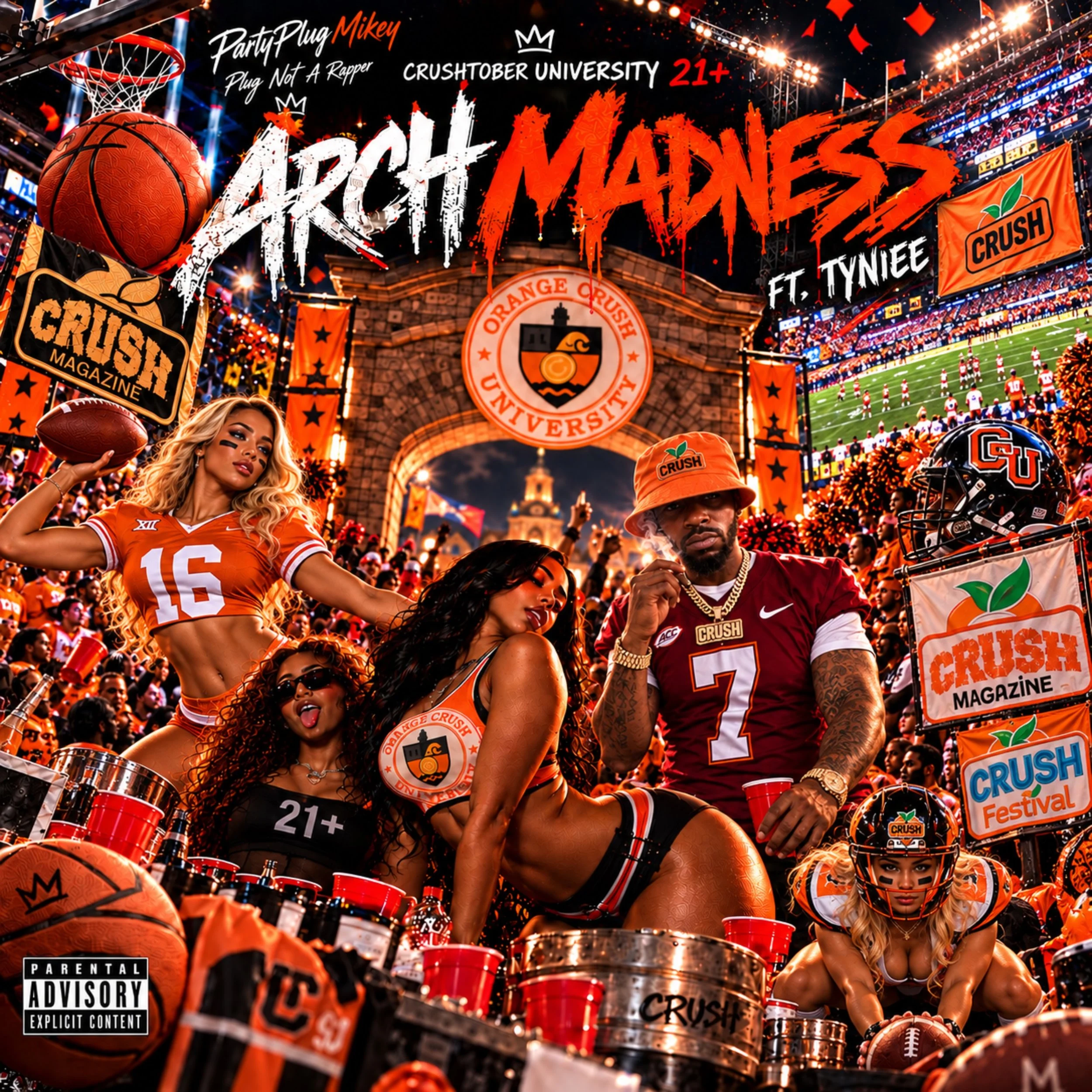
CRUSH MAGAZINE
WELCOME TO “ARCH MADNESS”: PLUG NOT A RAPPER TAPS TYNIEE FOR A CRUSHTOBER HOMECOMING MOMENT
ATLANTA, GA — CRUSH Magazine
The lights are on. The stands are packed. Homecoming is in motion.
And somewhere between the arena, the tailgate and the after-party sits “Arch Madness,” the new collaboration from Plug Not A Rapper featuring Tyniee, presented as a single from the expanding world of CRUSHTOBER UNIVERSITY 21+.
This time, the story isn’t simply that two Atlanta-based artists made a song together. “Arch Madness” represents two independent catalogs meeting at a particularly active point in each artist’s 2026 run.
PLUG NOT A RAPPER IS COMING OFF
CRUSH CULTURE SOCIETY
Plug Not A Rapper on Apple Music
Apple Music currently identifies Crush Culture Society as Plug Not A Rapper’s latest release, arriving September 3, 2026. The eight-track Hip-Hop/Rap project includes “Founder,” “Open2Real,” “Motion Witness Wireless,” “Sum Fine S***s,” “The Temptations,” “Type Action Word,” “Gold Bottles” and “New Era Eve,” all featuring Party Plug Mikey.
That project didn’t arrive in isolation. Apple Music currently displays a catalog stretching from 2022’s Not Like Them Rap Nz** through Baddies Island, Mapouka Twerk Doctor, F.R.1.E.N.D. Z.8.N.E. and the 2026 releases Mr CRUSH, Home Screen and Crush Culture Society.
Even the current Top Songs section tells part of the story. “New Era Eve,” “Gold Bottles,” “Type Action Word,” “The Temptations,” “Sum Fine S***s,” “Motion Witness Wireless,” “Open2Real” and “Founder” occupy prominent positions on the Apple Music profile.
“Arch Madness” is the next expansion—not another introduction.
TYNIEE BRINGS A DIFFERENT 2026 ENERGY
Tyniee on Apple Music
Tyniee enters “Arch Madness” from a different position.
Her Apple Music page currently identifies “Wop Wop” featuring Mohogany, released May 29, as her latest release. Her 2026 singles also include “Slappp” featuring Mohogany and “Nasty Dancerz” featuring Jo & Coco.
And collaboration is already an important part of the catalog Apple Music presents around her.
Tyniee appears on Mohogany’s “No Competition” and 10k.Caash’s “Show Us Ya Hoe,” while both records currently appear among her Top Songs alongside her own “Wop Wop,” “Slappp” and “Nasty Dancerz.”
That makes “Arch Madness” another new connection—but this one opens into an entirely different universe.
THE FEATURE IS BIGGER THAN A NAME AFTER “FT.”
Look at the artwork.
Basketball is crashing through the foreground. Football occupies the stadium. Models wear the colors. Orange Crush University towers over the center. CRUSH Magazine and CRUSH Festival branding live inside the environment.
And directly across the top:
ARCH MADNESS
FT. TYNIEE
That’s intentional.
Tyniee isn’t being presented as a hidden album feature discovered after somebody presses play.
She’s part of the billing.
For Plug Not A Rapper, that creates a new artist connection immediately following Crush Culture Society. For Tyniee, it places her emerging 2026 catalog inside a much larger CRUSHTOBER concept.
And for the listener, there is only one requirement:
Show up.
THIS IS WHAT ORANGE CRUSH UNIVERSITY SOUNDS LIKE
“Arch Madness” takes the familiar language of college athletics and throws it into the CRUSH universe.
Basketball.
Football.
Homecoming.
Women.
Fashion.
Nightlife.
Music.
Competition.
Campus culture.
The artwork deliberately refuses to choose between the arena and the party because CRUSHTOBER UNIVERSITY 21+ is supposed to contain both.
That distinction separates “Arch Madness” from a generic sports-themed record.
The sports aren’t the entire concept.
College culture is.
And CRUSHTOBER pushes that culture beyond the daytime game and into what happens when everybody leaves the stadium.
FIRST THE SINGLE. THEN THE ALBUM.
That’s where the release becomes particularly important.
“Arch Madness” gets its own life as a Plug Not A Rapper featuring Tyniee single before occupying its place within CRUSHTOBER UNIVERSITY 21+.
The single introduces the collaboration.
The album supplies the surrounding world.
That means someone discovering the song through Tyniee can encounter Plug Not A Rapper and eventually the larger CRUSHTOBER catalog. Someone already following Plug’s run can encounter Tyniee through a prominently billed collaboration.
Apple Music currently presents those artists as two distinct catalogs. Plug’s profile is album-heavy and stretches across several years; Tyniee’s currently visible catalog is concentrated around a developing collection of 2026 singles and features.
“Arch Madness” is where those catalogs meet.
CRUSHTOBER IS GETTING BIGGER
The timing matters.
Plug Not A Rapper’s Apple Music catalog already shows three separate 2026 albums—Mr CRUSH, Home Screen and Crush Culture Society—before the arrival of the CRUSHTOBER era.
Home Screen alone arrived June 5 as a 13-song project, while Crush Culture Society followed September 3 with eight songs.
So “Arch Madness” doesn’t have to carry the burden of establishing that there is a world behind Plug Not A Rapper.
The world is already being built.
Its job is to open another entrance.
And this entrance has stadium lights over it.
ARCH MADNESS
PLUG NOT A RAPPER FT. TYNIEE
CRUSHTOBER UNIVERSITY 21+
Two Atlanta artists.
Two developing catalogs.
One collaboration.
Welcome to Orange Crush University.
Welcome to Arch Madness.
CRUSH MAGAZINE ARCH MADNESS: PLUG NOT A RAPPER & TYNIEE BRING TWO ATLANTA ARTIST WORLDS INTO CRUSHTOBER UNIVERSITY 21+ ATLANTA, GA | CRUSH MAGAZINE | OCTOBER 2026 Homecoming season has a new sound
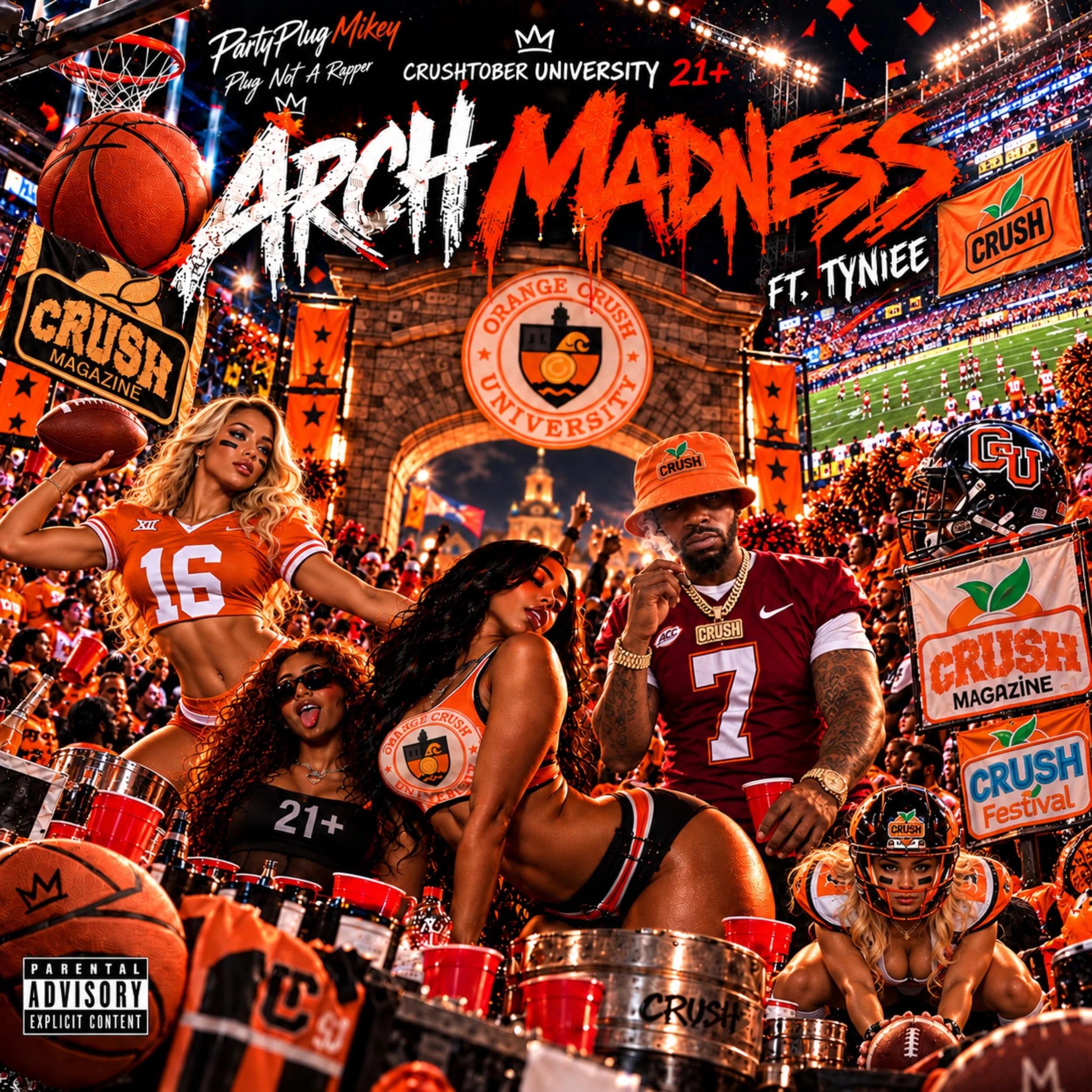
CRUSH MAGAZINE
ARCH MADNESS: PLUG NOT A RAPPER & TYNIEE BRING TWO ATLANTA ARTIST WORLDS INTO CRUSHTOBER UNIVERSITY 21+
ATLANTA, GA | CRUSH MAGAZINE | OCTOBER 2026
Homecoming season has a new soundtrack.
“Arch Madness,” the forthcoming collaboration from Plug Not A Rapper featuring Tyniee, arrives as a standalone single while also serving as a featured moment on CRUSHTOBER UNIVERSITY 21+.
The record brings together two Atlanta-based artists whose current Apple Music catalogs tell noticeably different stories—and that’s precisely what makes the collaboration interesting.
PLUG NOT A RAPPER: BUILDING A CATALOG INTO A WORLD
Plug Not A Rapper on Apple Music currently shows an increasingly deep independent Hip-Hop/Rap catalog.
Apple Music lists September 3, 2026’s Crush Culture Society as the artist’s latest release: an eight-song project containing “Founder,” “Open2Real,” “Motion Witness Wireless,” “Sum Fine S***s,” “The Temptations,” “Type Action Word,” “Gold Bottles” and “New Era Eve.” Those songs prominently feature Party Plug Mikey, with several currently occupying the artist’s Top Songs section.
But Crush Culture Society is only the latest chapter. Apple Music currently displays a run of full-length Plug Not A Rapper releases including Home Screen, Mr CRUSH, F.R.1.E.N.D. Z.8.N.E., (B.B.L.‘S) Bad Baddies Love’ Sex, Mapouka Twerk Doctor, Baddies Island and Not Like Them Rap Nz**.
That history matters for “Arch Madness.”
Plug isn’t approaching this collaboration as an artist introducing his first record. He’s bringing Tyniee into an already-developed catalog where collaborations, nightlife, personality and recurring identities have become part of the music’s language.
TYNIEE: A 2026 RUN BUILT AROUND COLLABORATION
Tyniee on Apple Music shows a much newer 2026 release footprint.
Apple Music currently lists “Wop Wop” featuring Mohogany as Tyniee’s latest release, dated May 29, 2026. Her Singles & EPs section also includes “Slappp” featuring Mohogany and “Nasty Dancerz” featuring Jo & Coco.
Her footprint extends beyond her own releases. Tyniee appears on Mohogany’s “No Competition” and on 10k.Caash’s “Show Us Ya Hoe,” both of which currently appear among Tyniee’s Top Songs on Apple Music.
There’s another Atlanta connection worth noticing: Tyniee’s 2026 catalog repeatedly intersects with Mohogany, whose Apple Music catalog includes the album The East Atlanta Princess. Tyniee appears on Mohogany’s “No Competition,” while Mohogany appears on Tyniee’s “Wop Wop” and “Slappp.”
Now “Arch Madness” expands that collaborative footprint into the CRUSH universe.
TWO CATALOGS. ONE RECORD.
That’s the real story behind this release.
On one side is Plug Not A Rapper, arriving with years of releases and a particularly active 2026 album run.
On the other is Tyniee, whose visible Apple Music catalog shows a concentrated 2026 emergence built through singles and collaborations.
“Arch Madness” gives those two catalogs a direct intersection.
And the title couldn’t arrive in a more fitting environment.
The single’s artwork turns Orange Crush University into an oversized college-sports fantasy: basketball, football, stadium lights, homecoming crowds, CRUSH Magazine, CRUSH Festival imagery and the CRUSHTOBER UNIVERSITY 21+ identity all occupying the same frame.
This isn’t presented as a quiet feature.
It’s presented as an event.
FROM SINGLE TO CRUSHTOBER
“Arch Madness” is designed to live twice without becoming two different records.
First comes the single moment: Plug Not A Rapper and Tyniee standing together, with a dedicated visual identity and a release that can introduce each artist’s audience to the other.
Then comes the album moment, when “Arch Madness” becomes part of the larger CRUSHTOBER UNIVERSITY 21+ experience.
That distinction matters creatively.
As a single, “Arch Madness” is the destination.
Inside CRUSHTOBER, it’s part of the campus.
The surrounding world expands from one collaboration into homecoming, college nightlife, sports, fashion, parties and the larger Orange Crush University concept.
ATLANTA MEETS CRUSHTOBER
Atlanta has never lacked artists.
What separates this collaboration’s presentation is the attempt to connect the music to something larger than a conventional feature release.
The cover doesn’t simply say:
Plug Not A Rapper ft. Tyniee.
It says:
ARCH MADNESS.
It says:
CRUSHTOBER UNIVERSITY 21+.
It places both artists inside a fictionalized university-scale environment surrounded by sports, nightlife, media and CRUSH branding.
And behind that visual world are two real Apple Music catalogs continuing to develop in 2026.
For Tyniee, “Arch Madness” adds another collaboration to a year already containing records with Mohogany, Jo, Coco and appearances alongside other artists.
For Plug Not A Rapper, it follows a September release in Crush Culture Society and joins a catalog that Apple Music already shows extending across multiple albums, singles, videos and featured collaborations.
Now those paths meet.
Class is in session.
Homecoming is outside.
And “Arch Madness” is coming.
PLUG NOT A RAPPER FT. TYNIEE — “ARCH MADNESS”
A CRUSHTOBER UNIVERSITY 21+ SINGLE
Listen to Plug Not A Rapper on Apple Music
Listen to Tyniee on Apple Music
CRUSH Magazine — Culture. Music. Homecoming. CRUSH.
CRUSH MAGAZINE NO TWO CRUSH STOPS SHOULD LOOK THE SAME The Visual Rule for 2026–2027: Keep the Identity. Change the World Around It.
CRUSH MAGAZINE
NO TWO CRUSH STOPS SHOULD LOOK THE SAME
The Visual Rule for 2026–2027: Keep the Identity. Change the World Around It.
By the end of this season, somebody should be able to see a CRUSH photograph without reading the caption and have two immediate reactions:
“That’s CRUSH.”
And:
“That has to be Miami.”
Or Savannah.
Or Atlanta.
Or Jacksonville.
Or Tybee.
That combination is the goal.
A recognizable brand inside environments that remain completely themselves.
Because there is a difference between having a visual identity and making everything look identical.
CRUSH needs the first.
Never the second.
ORANGE IS THE THREAD — NOT THE ENTIRE FABRIC
Orange is powerful because people can recognize it quickly.
The CRUSH logos matter.
The microphone matters.
The magazine identity matters.
The founder matters.
Recurring models and personalities matter.
Typography matters.
Certain graphic treatments matter.
But CRUSH should never walk into a city and paint over everything that makes that place visually interesting.
The environment is production design we didn’t have to invent.
Use it.
CRUSH provides the signature.
The city provides the canvas.
OCTOBER 2 — GEORGIA STATE SHOULD FEEL URBAN
The first stop begins in Atlanta.
Let Atlanta exist.
Concrete.
Glass.
Traffic.
Street crossings.
Downtown movement.
Campus architecture.
Parking decks.
Students moving between buildings.
Restaurants.
Streetwear.
Cars.
City light.
CRUSH shouldn’t need an enormous setup to announce itself.
Put the real CRUSH Magazine logo on the microphone.
Put the camera in somebody’s face.
Let the city do the rest.
The Georgia State chapter should feel fast.
Moving.
Young.
Immediate.
Like CRUSH just walked into the middle of something already happening.
OCTOBER 3 — ATHENS SHOULD IMMEDIATELY BREAK THE PATTERN
Twenty-four hours later, the audience should know we’ve gone somewhere else.
Different school.
Different traditions.
Different architecture.
Different crowd.
Different relationship with football.
Different colors surrounding us.
Different rhythm.
Don’t find the Atlanta-looking corner of Athens.
Find Athens.
That’s the assignment.
The transition itself becomes visually interesting:
Yesterday looked like this.
Today looks like this.
Same CRUSH camera.
Different world.
OCTOBER 9–10 — MOREHOUSE + SPELMAN SHOULD FEEL TIMELESS
The AUC deserves visual patience.
Not every shot needs frantic social-media movement.
Portraits matter here.
Details matter.
Alumni matter.
Tradition matters.
Tailoring.
Dresses.
Greek life.
Generational photographs.
Campus architecture.
Groups of friends.
Old friends seeing each other again.
Young students becoming part of traditions older than themselves.
Some images should feel like they could belong in a magazine today.
Others should feel like somebody might find them 30 years from now and immediately understand why they mattered.
SAVANNAH SHOULD FEEL WARMER BEFORE WE EVER REACH THE BEACH
Savannah has texture.
Use it.
Trees.
Brick.
Historic architecture.
Coastal light.
Porches.
Neighborhoods.
Cars.
Campus life.
The particular way afternoon sunlight falls across the city.
Savannah State gives us Homecoming energy.
The city around it gives us another layer.
CRUSH Magazine should be capable of photographing both.
JACKSONVILLE SHOULD FEEL LIKE HOME BASE
This is where the visual grammar changes.
We aren’t visitors anymore.
The studio gives CRUSH control.
Lighting can be intentional.
Sets can be intentional.
Branding can be intentional.
The environment can be built.
Then Halloween changes everything again.
Darkness.
Orange light.
Fire.
Costumes.
Smoke where safe and appropriate.
Performance lighting.
Basketball under night lighting.
Crowds.
Studio interiors.
Outdoor activity.
Reflections.
Shadows.
Movement.
Jacksonville should contain some of the most controlled imagery of the fall because CRUSH controls the environment.
HALLOWEEN NEEDS ONE PHOTOGRAPH THAT DEFINES THE WEEKEND
Not a flyer.
A photograph.
Something real.
Maybe the bonfire is behind the crowd.
Maybe Mikey and Trojan are facing each other.
Maybe it’s a massive costume portrait.
Maybe a basketball moment happens at exactly the right second.
Maybe a model creates an image nobody planned.
We cannot determine what the defining photograph will be before the weekend happens.
But the photographers should understand the assignment:
Find it.
Every major CRUSH event should eventually have one image that becomes inseparable from the memory.
SUNDAY SHOULD LOOK CLEANER THAN SATURDAY
This distinction can become part of the visual identity.
Saturday is chaos.
Motion.
Crowds.
Performance.
Fire.
Competition.
Costumes.
Night.
Sunday is editorial.
Controlled portraits.
Clean interviews.
Magazine photography.
Products.
Artists sitting down.
Models intentionally styled.
Winner portraits.
Sponsor material.
Studio imagery.
The audience should almost be able to identify the day from the image.
STATESBORO SHOULD FEEL LIKE WE JUST LEFT SOMETHING HUGE
November 6–7.
The Halloween imagery is still fresh.
That’s useful.
Now change the world again.
Daylight.
College environment.
Georgia Southern.
Road-trip energy.
The contrast itself becomes part of the storytelling.
One week:
Fire and costumes in Jacksonville.
The next:
Homecoming in Statesboro.
That is visual range.
THEN WINTER CHANGES THE CAMERA
November through February doesn’t need to imitate October.
Slow down.
Black backgrounds.
Studio portraits.
Close-ups.
Editorial photography.
Interviews.
Details.
Products.
Faces.
Work.
Editing rooms.
Microphones.
Computers.
Merchandise.
People creating.
The visual world becomes more intimate because the physical world becomes more intimate.
Winter is where CRUSH gets close.
THEN MIAMI BLOWS THE FRAME OPEN
March should feel like somebody opened the curtains.
Water.
Sun.
Palm trees.
Hotels.
Cars.
Swimwear.
Street fashion.
Pools where access is permitted.
Boats where legitimately available.
Nightlife.
Architecture.
Color.
Morning.
Late night.
Movement.
The images should feel warmer immediately.
Not because we put a Miami filter over them.
Because we actually photographed Miami.
MIAMI SHOULD HAVE DAY AND NIGHT PERSONALITIES
Daytime CRUSH Miami:
Water.
Skin.
Fashion.
Sun.
Movement.
Travel.
Bright environments.
Nighttime CRUSH Miami:
Cars.
Restaurants.
Parties.
City lights.
Fashion.
Music.
Interviews.
Street movement.
The same trip can visually contain two completely different worlds.
Use both.
DO NOT FAKE LUXURY
This is important.
If there is a beautiful car, photograph it appropriately.
If there is legitimate boat access, use it.
If there is a great hotel environment where filming is permitted, capture it.
But don’t build the entire Miami identity around pretending CRUSH owns things it doesn’t.
Actual confidence photographs better than borrowed status.
A strong portrait beside the ocean can be more powerful than forcing a fake millionaire scene.
CRUSH should look aspirational without looking dishonest.
APRIL SHOULD LOOK LIKE TYBEE — NOT MIAMI PART TWO
Now the ocean appears again.
But differently.
That’s important.
Miami:
Metropolitan tropical energy.
Tybee:
Georgia beach culture.
Beach houses.
Sand.
Daylight.
Festival crowds.
Music.
Ocean.
Coastal lifestyle.
Savannah proximity.
Groups.
Families.
Friends.
Artists.
Models.
Festival production.
The photography should become wider.
Tybee is about space.
THE CRUSH BEACH MUSIC FESTIVAL NEEDS SCALE
This is where aerial imagery, when legally and safely obtainable, becomes useful.
Crowds against the beach.
Stage against the environment.
Orange branding against sand and water.
Wide shots proving where we are.
Then go close.
Artist.
Audience.
Model.
Food.
Merchandise.
Friends.
Sweat.
Sand.
Details.
The festival needs both:
proof of scale and proof of humanity.
MEMORIAL DAY ATLANTA SHOULD LOOK LIKE SUMMER ARRIVED EARLY
When CRUSH returns to Atlanta, don’t recreate October.
The calendar changed.
Show it.
Warmer weather.
Different clothing.
Different daylight.
Different activities.
Different energy.
Atlanta in May should not resemble Atlanta during Homecoming.
This is another way CRUSH proves the world is moving forward.
Even returning cities evolve.
JUNETEENTH JACKSONVILLE SHOULD NOT LOOK LIKE HALLOWEEN
Same city.
Potentially some of the same people.
Completely different chapter.
Halloween:
Night.
Fire.
Costumes.
Competition.
October.
Juneteenth:
Summer.
Daylight.
Celebration.
Community.
Culture.
Black entrepreneurship.
Music.
Family.
History.
Jacksonville.
This return can demonstrate the full range of Crush Network Studios and the surrounding CRUSH community.
Same home.
Different season.
THE MODELS SHOULD NEVER LOOK COPY-PASTED
This deserves its own rule.
The women of CRUSH should not be treated like interchangeable bodies placed around logos.
Each woman should be photographed like an individual.
Different skin tones.
Different hair.
Different styling.
Different personalities.
Different body types.
Different expressions.
Different strengths.
Different ways of carrying fashion.
And whenever possible:
Names.
Interviews.
Stories.
Creative interests.
Businesses.
Music.
Education.
Personal style.
Modeling becomes much more interesting when audiences know who’s actually in the photograph.
SEXY AND USEFUL CAN EXIST IN THE SAME IMAGE
CRUSH doesn’t need to choose between beautiful imagery and meaningful imagery.
A model can look incredible while:
Holding the magazine microphone.
Interviewing an artist.
Wearing merchandise.
Demonstrating a CRUSH product.
Hosting.
Participating in a shoot.
Creating an editorial.
Representing a sponsor.
Showing fashion.
Becoming part of a recurring series.
Beauty attracts attention.
Personality retains it.
Function creates more ways to use the content.
The strongest CRUSH models should be capable of all three.
MERCHANDISE SHOULD LIVE IN THE WORLD
Don’t photograph every shirt against a blank wall.
Put it on people.
At Homecoming.
At the studio.
Around the bonfire.
In Miami.
At Tybee.
In Atlanta.
In Jacksonville.
Let merchandise accumulate memories.
A CRUSH shirt photographed in four cities becomes more interesting than the same shirt photographed four times in a studio.
THE LOGOS NEED DISCIPLINE
CRUSH has real logos.
Use them.
Don’t constantly invent substitute logos because a new graphic needs decoration.
Recognition comes from repetition.
The CRUSH Festival identity.
The CRUSH Magazine identity.
Their legitimate variations.
Those assets should become increasingly familiar.
The creative work happens around the identity.
The identity itself doesn’t need to be reinvented every Tuesday.
THE WEBSITE SHOULD FEEL LIKE WALKING THROUGH THE SEASON
Open Georgia State.
Urban.
Open Savannah.
Coastal Southern texture.
Open Halloween.
Fire and darkness.
Open winter editorials.
Studio.
Open Miami.
Water and light.
Open Tybee.
Beach and festival scale.
Open Atlanta.
Summer city.
Open Juneteenth.
Jacksonville celebration.
Now the website itself becomes visual travel.
That’s much more powerful than every article using the same template image.
SOME PHOTOGRAPHS SHOULD HAVE NO LOGO AT ALL
Because the photograph should be strong enough.
This is where CRUSH Magazine separates itself from ordinary promotional media.
Every beautiful photograph doesn’t need six logos, a website address and an event date stamped across somebody’s face.
Sometimes:
Photograph.
Headline.
Story.
That’s enough.
Editorial confidence includes knowing when not to advertise.
SHOOT VERTICAL AND HORIZONTAL
The world watches vertically.
The archive still needs horizontal.
Shoot both.
Vertical:
Reels.
TikTok.
Stories.
Shorts.
Mobile.
Horizontal:
Website.
Magazine layouts.
YouTube.
Press.
Documentary.
Future campaigns.
Historical archive.
Don’t let today’s platform requirements destroy tomorrow’s usable media.
SHOOT THE CLEAN VERSION TOO
If an incredible photograph happens, capture variations when possible.
One with branding.
One without.
One wide.
One close.
One subject looking at camera.
One candid.
One vertical.
One horizontal.
Five extra minutes during production can create years of flexibility.
AND PHOTOGRAPH THE THINGS NOBODY THINKS ARE IMPORTANT YET
The first CRUSH Magazine microphone.
The first Homecoming setup.
The packed trunk.
The studio before Halloween.
The first BonfireCRUSH wristband.
The merchandise boxes.
The handwritten schedule.
The photographer changing batteries.
The empty basketball area.
The stage before anybody performs.
The models getting ready.
The first person through the door.
The last person leaving.
The road sign.
The gas receipt.
The sand-covered equipment after Tybee.
The studio after Juneteenth.
These images won’t always win Instagram that night.
Twenty years from now, they may be priceless.
THAT IS THE VISUAL STANDARD
CRUSH should never look cheap because it’s moving quickly.
CRUSH should never look fake because it’s trying to look expensive.
CRUSH should never erase a city because it wants the logo to dominate.
And CRUSH should never become so aesthetically controlled that reality disappears.
We want both.
Editorial beauty and documentary truth.
BY JUNETEENTH, PUT THE IMAGES BESIDE EACH OTHER
Georgia State.
UGA.
Morehouse.
Spelman.
Savannah State.
Halloween BonfireCRUSH.
Georgia Southern.
Winter at Crush Network Studios.
Miami.
Tybee Island.
Atlanta.
Jacksonville.
If the strategy worked, every chapter should look different.
Different weather.
Different architecture.
Different clothes.
Different people.
Different light.
Different energy.
Different memories.
But somewhere inside every frame is an unmistakable thread.
Orange.
The real logos.
The magazine.
The people we’ve come to recognize.
The photography.
The attitude.
The perspective.
CRUSH.
That’s the visual goal for 2026–2027.
Not twelve destinations forced into one aesthetic.
Twelve different worlds photographed through one unmistakable point of view.
CRUSH MAGAZINE FROM JACKSONVILLE TO MIAMI: THE WINTER BUILD When the Fall Tour Ends, CRUSH Doesn’t Go Quiet. It Goes to Work. There will be a moment after Georgia Southern Homecoming when the road
CRUSH MAGAZINE
FROM JACKSONVILLE TO MIAMI: THE WINTER BUILD
When the Fall Tour Ends, CRUSH Doesn’t Go Quiet. It Goes to Work.
There will be a moment after Georgia Southern Homecoming when the road finally gets quiet.
No campus to reach the next morning.
No Halloween costumes.
No Homecoming crowd waiting around the corner.
No bonfire burning outside Crush Network Studios.
The cameras will have memory cards full of footage.
The phones will be full.
The hard drives will be filling.
The CRUSH Magazine website will have stories waiting to be published.
And for the first time since October began, CRUSH will have enough distance to look backward.
That moment is not the end of the season.
It may be one of its most important transitions.
Because November through February is when CRUSH has to prove something:
Can we turn moments into momentum?
FALL CREATES THE RAW MATERIAL
Think about what CRUSH potentially has by mid-November.
Georgia State.
UGA.
Morehouse.
Spelman.
Savannah State.
Halloween BonfireCRUSH.
Mikey vs. Trojan.
Basketball.
Models.
Artists.
Vendors.
Crush Network Studios.
Georgia Southern.
Thousands of photographs and clips could exist across those experiences.
Dozens of people may have entered the network.
Some will have been interviewed.
Some photographed.
Some may have performed.
Some may have competed.
Some may have become unexpectedly important to the story.
Fall creates the raw material.
Winter determines whether CRUSH knows what to do with it.
DO NOT DISAPPEAR
This is the first rule.
One of the fastest ways to kill momentum is to build toward an event for weeks, have the event, post a recap and disappear.
CRUSH should do the opposite.
The morning after something happens, another story begins.
What didn’t people see?
Who deserves a full interview?
Who was the person in that photograph?
What happened backstage?
What did the winner say afterward?
What happened to the artist we met three weeks earlier?
Who wants a rematch?
Which model needs her own editorial?
What business should we profile?
What footage hasn’t been released?
The archive should constantly produce new questions.
NOVEMBER IS THE AFTERMATH
November should feel like CRUSH Magazine opening every drawer.
The obvious content goes first.
Recaps.
Highlights.
Winners.
Performances.
Best photographs.
But then go underneath.
The Stories Behind the Weekend.
The artist nobody expected.
The model who stole the camera.
The vendor with the best story.
The basketball player everybody remembers.
The photographer responsible for a favorite image.
The making of the event.
The studio before and after.
The road from Savannah to Jacksonville.
The trip from Jacksonville to Statesboro.
November is when the audience realizes:
CRUSH recorded much more than we originally showed you.
DECEMBER IS FOR PEOPLE
By December, stop making every headline about events.
The events introduced us.
Now introduce the people.
One week could belong to a model.
Another to an artist.
Another to an entrepreneur.
Another to a photographer.
Another to somebody CRUSH met completely by accident.
Give people space.
Not:
“Here are 47 people from Halloween.”
One person.
One face.
One story.
One reason to care.
That’s how characters emerge from crowds.
CRUSH MAGAZINE SHOULD BEGIN CREATING ITS OWN STARS
Not celebrities manufactured through fake hype.
Recognizable people.
There is a difference.
A recognizable CRUSH personality is simply somebody audiences have seen enough times to remember.
Maybe they first appeared at Homecoming.
Then Halloween.
Then an interview.
Then a photoshoot.
Then a studio appearance.
Eventually, readers don’t need the introduction.
They know the face.
That is incredibly valuable.
JANUARY IS FOR THE BUILDERS
A new year changes the editorial tone.
January is naturally forward-looking.
Perfect.
Who is building something in 2027?
Artists releasing music.
Models expanding portfolios.
Entrepreneurs launching businesses.
Creators developing platforms.
Students approaching graduation.
Photographers growing.
CRUSH itself preparing for another phase.
The magazine can move from:
“Look what happened.”
to:
“Look what’s coming.”
THE STUDIO SHOULD BECOME MORE VISIBLE DURING WINTER
When the tour slows, Crush Network Studios becomes more important.
The physical world of CRUSH shouldn’t disappear because the calendar has fewer major travel dates.
Show the building being used.
Artist interviews.
Model shoots.
Podcasts.
Creative sessions.
Product photography.
Meetings.
Merchandise.
Rehearsals.
Behind the scenes.
People arriving.
People creating.
The studio should gradually become familiar enough that audiences recognize rooms before being told where they are.
That’s environmental branding.
A BUILDING CAN BECOME A CHARACTER
Certain spaces become famous because audiences repeatedly see important things happen inside them.
The couch.
The wall.
The hallway.
The interview chair.
The photography corner.
The outside area.
The entrance.
The sign.
The parking lot.
Don’t constantly redesign everything for content.
Let some locations repeat.
Eventually audiences associate those locations with CRUSH.
“Oh, they’re back at the studio.”
That’s recognition.
WINTER IS ALSO WHEN CRUSH GETS ORGANIZED
The glamorous answer is content.
The important answer is infrastructure.
Back up everything.
Label everything.
Organize photographs by date.
Organize footage by city.
Match names to faces.
Record social handles correctly.
Separate raw footage from edits.
Track usage permissions.
Track vendors.
Track artists.
Track models.
Track sponsors.
Track leads.
Track collaborators.
Track what performed well.
Track what didn’t.
The CRUSH archive should become easier to use every month, not harder.
STUDY WHAT THE AUDIENCE ACTUALLY CARED ABOUT
Fall will provide information.
Use it.
Which interview format performed?
Which questions got strong answers?
Did people care more about fashion or music?
Which models generated interest?
Which artist clips got replayed?
Did basketball travel online?
Did behind-the-scenes footage outperform polished content?
Did people respond to founder content?
What did people share privately?
What brought traffic to the website?
What made people inquire about participating?
Don’t guess when the audience has already provided evidence.
BUT DON’T LET ANALYTICS ERASE INSTINCT
A magazine isn’t an algorithm.
Some important stories won’t immediately produce huge numbers.
Publish them anyway.
A powerful photograph might matter more historically than commercially.
An emerging entrepreneur with 900 followers may be more interesting than somebody with 90,000.
A thoughtful interview might grow slowly.
An archive needs depth.
CRUSH should understand performance data without allowing performance data to become the editor-in-chief.
THEN THE TEMPERATURE STARTS CHANGING
Somewhere around February, the imagery begins shifting.
The audience should feel it before CRUSH even says it directly.
More sunlight.
More travel imagery.
Water.
Palm trees.
Spring clothes.
Miami references.
Packing.
Planning.
Models.
Music.
Movement.
The winter chapter starts ending.
Something warmer is coming.
THE ROAD TO MIAMI SHOULD FEEL DIFFERENT FROM THE ROAD TO JACKSONVILLE
Jacksonville is home.
Miami is expansion.
That’s a completely different story.
The Road to BonfireCRUSH asks:
“What happens when everybody comes into our world?”
The Road to Miami asks:
“What happens when our world enters somewhere bigger and different?”
That creates natural tension.
Will the visual identity travel?
Will new people respond?
Who will CRUSH meet?
What parts of the brand translate immediately?
What changes?
What stays?
Those are real questions.
Document them.
DON’T JUST ANNOUNCE MIAMI — BUILD TOWARD IT
The preparation is content.
Who is going?
What are we shooting?
What is CRUSH Magazine looking for?
Which models are traveling?
Which artists are involved?
What businesses could participate?
What does the wardrobe look like?
What equipment is needed?
What locations matter?
What is the budget?
What’s the plan?
What could go wrong?
Let the audience see enough preparation that arrival feels like payoff.
THIS IS WHERE RETURNING CHARACTERS BECOME POWERFUL
Imagine someone CRUSH met during October is packing for Miami in March.
That is a story.
Not because traveling to Miami is extraordinary by itself.
Because the audience remembers where the relationship began.
Georgia State → Jacksonville → Miami.
That’s progression.
Or:
Savannah State → CRUSH Magazine shoot → Miami.
Progression.
Or:
BonfireCRUSH artist → studio interview → Miami appearance.
Progression.
The audience watches the network move people.
BUT MIAMI NEEDS NEW PEOPLE TOO
CRUSH cannot arrive with a closed circle.
That defeats the entire purpose of expansion.
Meet Miami.
Models.
Artists.
Photographers.
Businesses.
Creators.
DJs.
Entrepreneurs.
Hosts.
Athletes.
Personalities.
Local culture should enter the CRUSH network.
The trip succeeds when CRUSH returns home with more relationships than it left with.
MIAMI SHOULD LOOK EXPENSIVE WITHOUT REQUIRING EVERYTHING TO BE EXPENSIVE
This is a creative challenge.
Great visual production doesn’t always require maximum spending.
Use environment.
Morning light.
Ocean.
Architecture.
Cars already present.
Street scenes.
Hotels where appropriate.
Pools where permitted.
Fashion.
Movement.
Night.
Neon.
Palm trees.
Reflections.
Water.
A strong photographer can make geography do enormous production work.
Miami itself provides production value.
Use it intelligently.
THE MODELS SHOULD CHANGE WITH THE ENVIRONMENT
Homecoming fashion isn’t Miami fashion.
Halloween isn’t Miami.
Tybee isn’t Miami.
That’s exactly why the visual journey works.
The styling should evolve.
The poses should evolve.
The settings should evolve.
The energy should evolve.
But CRUSH identity remains underneath.
That’s how a brand proves it has range.
THE MUSIC SHOULD CHANGE TOO
Every chapter deserves a different sonic texture.
Homecoming has marching bands, DJs, college records and tailgate energy.
Halloween has darker, louder nighttime energy.
Winter can become smoother and more reflective.
Miami should feel warm.
Rhythmic.
Fast.
Sexy.
Bright.
International.
The soundtrack helps audiences feel geography even when they’re watching on a phone.
MIAMI IS NOT THE FINALE
This is crucial.
Miami is the opening of the spring/summer chapter.
Because after Miami:
Tybee.
Then:
Atlanta.
Then:
Jacksonville.
Miami should create appetite for the rest of the season.
Not exhaust it.
WHAT WE FIND IN MIAMI SHOULD TRAVEL TO TYBEE
This is where the network becomes genuinely interesting.
A photographer.
A model.
A creator.
A relationship.
A brand.
A visual idea.
A musical connection.
Something from Miami should continue.
Not everything.
Something.
That continuation tells the audience these cities aren’t isolated campaigns.
They’re connected.
THEN TYBEE CHANGES THE QUESTION
Miami asks:
Can CRUSH expand?
Tybee asks:
Can CRUSH build tradition?
That’s a bigger question.
Because Tybee isn’t supposed to be a one-time experiment.
The annual CRUSH Beach Music Festival is part of the long-term CRUSH identity.
That means every spring should leave material for the next spring.
THIS IS WHY WINTER MATTERS SO MUCH
Without winter, the season becomes:
Homecoming.
Halloween.
Gap.
Miami.
That gap is dangerous.
With a functioning media platform, there is no gap.
There is:
Homecoming.
Halloween.
Stories.
Profiles.
Studio.
Unreleased footage.
People.
Business.
Behind the scenes.
Year-end reflection.
New-year building.
Miami preparation.
Then Miami.
The story never actually stops.
Only the setting changes.
CRUSH SHOULD ENTER MARCH STRONGER THAN IT LEFT NOVEMBER
That’s the standard.
More organized.
More recognizable.
More content.
More relationships.
Better production.
Better workflows.
Better website.
Better archive.
Better sponsor materials.
Better understanding of the audience.
More developed personalities.
Clearer visual identity.
If CRUSH simply waits through winter, nothing compounds.
If CRUSH builds through winter, Miami receives four additional months of development.
AND THAT IS HOW A SEASON BECOMES A YEAR-ROUND BRAND
The public may see major dates.
Behind those dates should be continuous activity.
Planning.
Production.
Editing.
Publishing.
Relationship building.
Sales.
Design.
Photography.
Writing.
Studio work.
Partnership development.
Talent discovery.
Archiving.
Preparation.
That’s the machine underneath the spectacle.
NOVEMBER → DECEMBER → JANUARY → FEBRUARY → MARCH
Five months.
Not an intermission.
A transformation.
November processes what happened.
December introduces the people.
January introduces what they’re building.
February begins the transition.
March takes the expanded world to Miami.
And when the first CRUSH camera points toward palm trees, water and another new face, the audience should understand something:
This isn’t a brand waking back up for spring.
CRUSH never went to sleep.
The cameras simply moved indoors long enough to turn the fall into an archive, the archive into a platform, the platform into relationships—
and those relationships into the next chapter.
CRUSH MAGAZINE THE ROAD TO BONFIRECRUSH Every Homecoming Stop Is Leading Somewhere — And on Halloween Weekend, the People, Stories and Energy We Find on the Road Meet in
CRUSH MAGAZINE
THE ROAD TO BONFIRECRUSH
Every Homecoming Stop Is Leading Somewhere — And on Halloween Weekend, the People, Stories and Energy We Find on the Road Meet in Jacksonville
The first CRUSH camera turns on in Atlanta.
But the first major destination is Jacksonville.
That distinction explains the entire fall.
Georgia State isn’t Halloween BonfireCRUSH.
UGA isn’t Halloween BonfireCRUSH.
Morehouse and Spelman aren’t Halloween BonfireCRUSH.
Savannah State isn’t Halloween BonfireCRUSH.
Those are CRUSH Homecoming Pop-Ups—opportunities to document college culture, meet people, create media and expand the network.
Then something changes.
October 31.
The cameras aren’t entering somebody else’s Homecoming anymore.
The doors open at Crush Network Studios.
And CRUSH becomes the host.
Welcome to the Road to BonfireCRUSH.
THE ROAD STARTS BEFORE THE EVENT EXISTS IN PUBLIC
Most people will experience Halloween BonfireCRUSH when they arrive.
CRUSH Magazine should begin documenting it long before that.
The empty studio.
The first planning conversation.
The flyer.
The first artist registration.
The first model confirmed.
The first vendor.
The first basketball entry.
The first sponsor conversation.
The merchandise.
The equipment.
The sound checks.
The outdoor layout.
The content plan.
The problems.
The changes.
The things that don’t work.
The things that suddenly become better than originally imagined.
An event doesn’t begin when the doors open.
That’s simply when the audience enters the story.
ATLANTA: FIND SOMEBODY
October 2.
Georgia State.
The first assignment is simple:
Find somebody worth remembering.
Not necessarily somebody famous.
Somebody interesting.
Maybe it’s an artist.
Maybe a model.
Maybe a creator.
Maybe an entrepreneur.
Maybe somebody hilarious.
Maybe somebody who plays basketball.
Maybe somebody who looks into the CRUSH Magazine camera and immediately understands how to own it.
The best possible outcome isn’t:
“We handed out 500 flyers.”
It’s:
“Remember that person we met at Georgia State?”
Now the audience has somebody to follow.
ATHENS: ADD SOMEBODY ELSE
October 3.
Different environment.
Different culture.
Different people.
The Road to BonfireCRUSH gains another character.
Maybe Georgia State introduced the artist.
Athens introduces the athlete.
Maybe Atlanta gave us a model.
Athens gives us a photographer.
Nobody needs to be artificially assigned a role.
Reality decides.
CRUSH simply needs to recognize what’s interesting when it appears.
THE AUC: THE WORLD GETS BIGGER
October 9–10.
Morehouse.
Spelman.
Atlanta again.
By this point, CRUSH should no longer feel like it’s beginning from zero every morning.
There is already footage.
Already photography.
Already a developing visual language.
Already people we’ve met.
Now we’re searching deeper.
Who has music?
Who owns something?
Who designs?
Who creates?
Who can host?
Who can perform?
Who should be photographed?
Who would make an incredible Sunday interview?
Who has a personality people need to see twice?
The Road to BonfireCRUSH becomes more interesting every time the answer is a person instead of a promotional message.
SAVANNAH: THE LAST MAJOR HOMECOMING CHAPTER BEFORE JACKSONVILLE
October 16–17.
Savannah State.
Now Halloween is close enough to feel real.
Two weeks.
The story should tighten.
The audience has seen CRUSH moving.
Now Jacksonville starts appearing more frequently.
The studio.
The bonfire.
The basketball.
The models.
The costumes.
The performances.
The Versuz battles.
Mikey.
Trojan.
The weekend begins moving from concept toward reality.
But Savannah still needs to be Savannah.
Don’t turn the entire weekend into an advertisement.
Document Homecoming.
Meet people.
Let Jacksonville appear naturally as the next chapter.
THEN THE CAMERAS TURN TOWARD HOME
After weeks of documenting other environments, CRUSH returns to its own.
Crush Network Studios.
Jacksonville, Florida.
This transition should feel different on camera.
The road signs change.
Florida.
Jacksonville.
Then:
The building.
The doors.
The rooms.
The outdoor area.
The equipment.
The preparation.
For the first time during the fall run, CRUSH isn’t simply arriving.
CRUSH is preparing for everybody else to arrive.
THAT REVERSAL IS THE STORY
During Homecoming:
CRUSH enters the crowd.
At BonfireCRUSH:
The crowd enters CRUSH.
That’s a powerful narrative transition.
For weeks, CRUSH Magazine asks:
“Who are you?”
Now the people we’ve met get to see:
“This is who we are.”
SATURDAY: SPECTACLE
October 31.
Halloween.
The first responsibility is simple:
Give people something worth remembering.
Outside:
Fire.
Music.
Basketball.
Halloween games.
Models.
Food.
Vendors.
Merchandise.
People moving between experiences.
Inside:
Halloween party.
Performances.
Versuz battles.
Costume modeling.
Music.
Competition.
And the headline:
MIKEY VS. TROJAN — BATTLE #1.
Everything doesn’t need to happen simultaneously.
The experience needs rhythm.
Build.
Release.
Build again.
Then headline.
THE BONFIRE IS MORE THAN FIRE
Visually, it can become one of the defining images of the weekend.
People gathered around orange light.
Night sky.
Costumes.
CRUSH branding.
Music.
Conversation.
Photography.
Reaction.
The bonfire gives the outdoor experience a center.
People need places to naturally gather.
The camera needs them too.
THE BASKETBALL COURT CREATES ITS OWN CHARACTERS
Somebody will talk too much.
Somebody will underestimate somebody.
Somebody will arrive dressed like they’re not playing and then dominate.
Somebody will have friends screaming from the sideline.
Somebody will want a rematch.
Somebody will become the crowd favorite.
This is why basketball belongs inside the larger content strategy.
The game gives CRUSH something unscripted.
Nobody knows the ending.
That creates tension.
THE MODELS SHOULD MOVE THROUGH THE WORLD
Not stand in one corner.
The models can help connect the visual environment.
Inside.
Outside.
Bonfire.
Merchandise.
Costumes.
Magazine portraits.
Sponsor imagery.
Social content.
Group photography.
Individual editorials.
The goal isn’t simply having beautiful women present.
It’s producing beautiful, useful, recognizable media with personalities audiences can become familiar with.
THE PERFORMERS GIVE THE NIGHT SOUND
Every event eventually develops a soundtrack.
CRUSH should document which records actually move people.
Which artist surprises the room?
Which hook gets repeated?
Who performs like the room is ten times larger?
Who gets the strongest reaction?
Who looks incredible on camera?
Who has the song people ask about Sunday?
Those are editorial questions too.
THEN COMES THE HEADLINE
Mikey vs. Trojan.
Battle #1.
Don’t tell the audience how to feel about it beforehand.
Build the anticipation.
Document both sides.
Let them speak.
Let people predict.
Then record what actually happens.
The winner matters.
The performances matter.
But the real value is creating a complete record of Chapter One.
Because if there is ever a Chapter Two, the first footage becomes exponentially more valuable.
AND THEN SATURDAY ENDS
People leave.
The music stops.
The parking lot clears.
The floor needs cleaning.
Costumes come off.
Everybody checks their phones.
Somebody is still arguing about the battle.
Somebody is celebrating a basketball win.
Somebody is uploading photographs.
Somebody met somebody.
Somebody exchanged numbers.
Somebody had a terrible game.
Somebody gave the performance of their life.
Somebody CRUSH barely knew that morning is suddenly one of the most interesting people from the entire night.
Photograph this part too.
The aftermath is part of the story.
THEN SUNDAY DOES SOMETHING MOST EVENTS NEVER DO
It asks everybody to come back.
Not to recreate Saturday.
To process it.
November 1 is Media Day + Outdoor Showcase.
Now CRUSH has actual stories to discuss.
Who won?
What happened?
What surprised people?
What did Mikey think?
What did Trojan think?
What does the basketball champion have to say?
Which artist wants to talk about their performance?
Which model wants a full editorial?
Which business made connections?
What moment is everybody replaying?
Sunday gives Saturday context.
THE STUDIO BECOMES AN EDITORIAL FACTORY
One room:
Artist interview.
Another:
Model photography.
Another:
Podcast.
Outside:
Basketball.
Somewhere else:
Merchandise shoot.
Then:
Winner interview.
Sponsor content.
Performance clip.
Costume editorial.
Mikey and Trojan post-battle content.
CRUSH Magazine portrait.
Now the same people who were part of the spectacle become subjects of the media.
That’s the transformation.
THIS IS WHERE HOMECOMING CHARACTERS SHOULD REAPPEAR
Imagine the audience recognizes someone.
“Wait—that’s the girl from Savannah.”
Perfect.
“That’s dude from the Georgia State interview.”
Perfect.
“Didn’t we see him at Morehouse?”
Perfect.
Those reactions mean the season has continuity.
For the first time, the Homecoming Pop-Ups and Jacksonville aren’t separate pieces of content.
They’re one story.
AND JACKSONVILLE SHOULD ADD ITS OWN PEOPLE
The city cannot merely receive personalities from elsewhere.
Jacksonville has its own artists.
Models.
Basketball players.
Businesses.
Creators.
Photographers.
Entrepreneurs.
Personalities.
BonfireCRUSH should allow traveling CRUSH connections to collide with the Jacksonville community.
That’s when the network expands in both directions.
THEN SOMETHING IMPORTANT HAPPENS
November 1 ends.
But CRUSH suddenly has far more media than it had October 1.
Think about what may now exist:
Homecoming interviews.
Homecoming portraits.
Campus footage.
Travel footage.
Model content.
Artist content.
Basketball content.
Halloween photography.
Performances.
Mikey vs. Trojan footage.
Podcasts.
Vendor stories.
Studio content.
Behind-the-scenes footage.
Sunday interviews.
CRUSH now has material capable of feeding weeks or months of storytelling.
The fall tour has produced an archive.
AND SIX DAYS LATER, CRUSH LEAVES AGAIN
Georgia Southern.
November 6–7.
This may be one of the most important narrative choices of the fall.
Because BonfireCRUSH isn’t allowed to become a finale.
The cameras go right back outside.
But now something is different.
CRUSH arrives in Statesboro carrying the history of the previous month.
That’s momentum.
THE ROAD TO BONFIRECRUSH THEN BECOMES THE ROAD FROM BONFIRECRUSH
Before Halloween:
Who are we going to find?
After Halloween:
Who did we find—and where are they going next?
That transition creates an entire second season of editorial possibilities.
FOLLOW THE ARTIST
What happened after the performance?
Did streams move?
Did they release something?
Did they make a connection?
Did they return to the studio?
FOLLOW THE MODEL
Did she get the photographs?
What did she do with them?
Did another opportunity emerge?
Will we see her in Miami?
Tybee?
FOLLOW THE BASKETBALL WINNER
Still talking?
Good.
Maybe somebody wants the title.
Now there is a story.
FOLLOW THE BUSINESSES
Did the weekend help?
Are they returning?
What are they building?
FOLLOW MIKEY AND TROJAN
What does Battle #1 mean after everyone has watched the footage?
Not before.
After.
Let history develop naturally.
THAT’S HOW ONE WEEKEND BECOMES BIGGER THAN ONE WEEKEND
The event is finite.
The story doesn’t have to be.
That’s the entire CRUSH media advantage.
A traditional party begins when the doors open and dies when the lights come on.
BonfireCRUSH can begin weeks earlier through the Road to Jacksonville.
Then live physically for two days.
Then live digitally for months.
Then become historical material for whatever happens next.
THE ROAD IS THE PRODUCT TOO
This is what audiences should eventually understand about CRUSH.
The destination matters.
But so does becoming invested before arrival.
Watching the flyer become reality.
Watching unknown people become familiar.
Watching the studio transform.
Watching competitors prepare.
Watching models get selected.
Watching artists enter.
Watching the team travel.
Watching problems get solved.
Watching the crowd arrive.
Watching what happens.
Then watching what it creates.
That’s a complete story.
OCTOBER 2 → OCTOBER 31
Atlanta.
Athens.
Atlanta.
Savannah.
Then Jacksonville.
Every stop adds something.
A face.
A story.
A relationship.
A clip.
A photograph.
A possibility.
Then Halloween brings those possibilities into one CRUSH environment.
And on November 1, the cameras ask what it all meant.
That’s the Road to BonfireCRUSH.
Not four weeks of telling people to buy something.
Four weeks of building a world people might actually want to enter.
And when the doors finally open in Jacksonville:
the audience shouldn’t feel like they’re arriving at a random event.
They should feel like they’re stepping inside the story they’ve been watching all month.
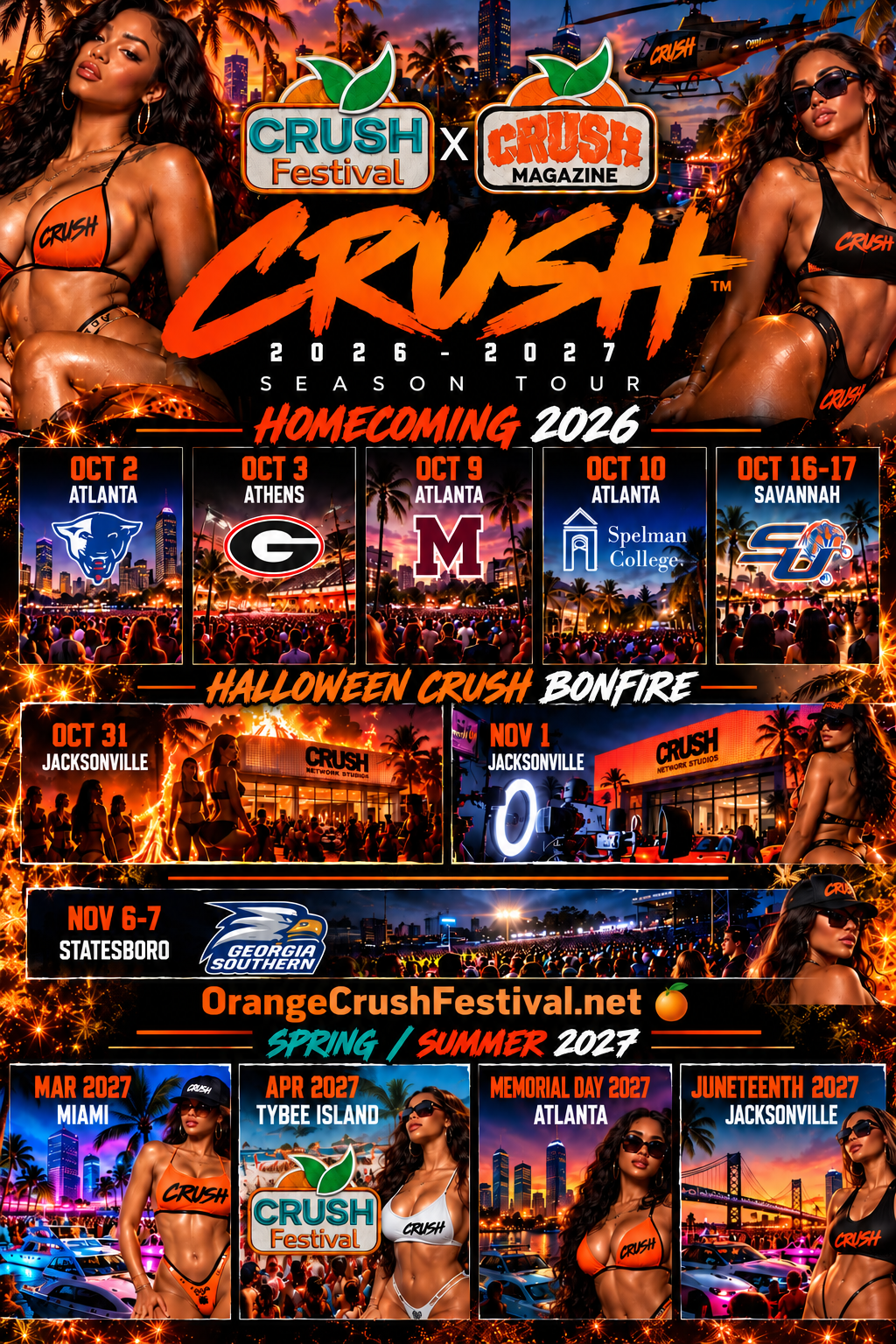
CRUSH MAGAZINE THE SOUTH ISN’T FLYOVER COUNTRY CRUSH Is Building a Cultural Circuit Across Cities That Already Influence What America Wears, Plays, Listens To and Celebrates
CRUSH MAGAZINE
THE SOUTH ISN’T FLYOVER COUNTRY
CRUSH Is Building a Cultural Circuit Across Cities That Already Influence What America Wears, Plays, Listens To and Celebrates
For years, entertainment has been described as though culture only comes from a handful of places.
New York.
Los Angeles.
Maybe Miami.
Maybe Atlanta.
Everything else becomes a market somebody visits after the important work is finished.
CRUSH sees the map differently.
Look at the 2026–2027 route.
Atlanta.
Athens.
Savannah.
Jacksonville.
Statesboro.
Miami.
Tybee Island.
These places aren’t connected because somebody randomly dropped pins onto a map.
They’re connected by people.
College students.
Black culture.
Music.
Sports.
Tourism.
Fashion.
Beaches.
Nightlife.
Entrepreneurship.
Migration.
Family.
Alumni networks.
Interstates.
And generations of Southern people moving between cities while carrying culture with them.
CRUSH isn’t attempting to invent that movement.
We’re building media and experiences around movement that already exists.
THE SOUTH ALREADY MOVES
Ask somebody from Savannah where their people live.
Atlanta.
Jacksonville.
Orlando.
Miami.
Charlotte.
Somewhere else in Georgia.
Ask somebody in Jacksonville.
You’ll hear Georgia connections immediately.
Ask Atlanta during Homecoming season.
People arrive from everywhere.
College makes those relationships even denser.
People leave home.
Meet people from another city.
Graduate.
Relocate.
Return for Homecoming.
Start companies.
Build families.
Travel back.
Attend festivals.
Bring friends.
Culture moves with them.
That movement is the foundation underneath the CRUSH circuit.
THIS IS WHY HOMECOMING IS THE PERFECT BEGINNING
Homecoming is already a migration.
People come back.
That’s literally the point.
Former students return to places where important chapters of their lives happened.
Current students meet generations that came before them.
Families travel.
Friends reunite.
Businesses activate.
Hotels fill.
Restaurants get busy.
Outfits get planned.
Music gets louder.
Old stories get repeated.
New stories begin.
CRUSH enters the season inside an existing tradition of movement.
Not above it.
Inside it.
GEORGIA STATE OPENS THE DOOR
Atlanta begins the tour.
But CRUSH shouldn’t photograph Atlanta like someone who has never seen a city before.
The skyline isn’t the story by itself.
People are.
A student rushing across campus.
A creator filming between classes.
An entrepreneur carrying inventory.
A group deciding where they’re going next.
A model who didn’t come intending to model.
A musician who has a song nobody on the CRUSH team has heard yet.
Atlanta gives us density.
There is always another person.
Another business.
Another room.
Another event.
Another connection.
That’s why it functions as a major connector inside the CRUSH world.
THEN ATHENS REMINDS US THAT SOUTHERN CULTURE ISN’T ONE THING
Leave Atlanta.
The landscape changes.
The pace changes.
The school changes.
The colors change.
The relationship with football changes.
The nightlife changes.
The traditions change.
That’s important.
CRUSH should never flatten “the South” into one aesthetic.
There isn’t one.
There are hundreds.
College towns.
Coastal cities.
Major metros.
Historic neighborhoods.
Beach communities.
Military communities.
Tourism economies.
Black colleges.
Large public universities.
Small businesses.
Major entertainment industries.
Rural communities sitting between everything.
The differences make the circuit richer.
THE AUC TELLS ANOTHER SOUTHERN STORY
Morehouse and Spelman introduce history that cannot be replicated by simply putting college students in front of a camera.
There is institutional memory.
Black academic tradition.
Family history.
Alumni networks.
Professional networks.
Greek life.
Fashion.
Atlanta.
Generational achievement.
Homecoming becomes reunion, celebration and cultural continuity at the same time.
CRUSH Magazine doesn’t need to manufacture significance there.
It needs enough editorial maturity to recognize what already exists.
THEN SAVANNAH CHANGES THE TEXTURE AGAIN
Savannah doesn’t look like Atlanta.
It shouldn’t.
That’s the advantage.
The architecture changes.
The trees change.
The history changes.
The pace changes.
The relationship with the coast becomes visible.
Savannah State adds its own culture.
Then the road continues toward Tybee.
Now CRUSH has entered a completely different visual and cultural vocabulary without leaving Georgia.
That’s how diverse this region already is.
JACKSONVILLE IS WHERE GEORGIA AND FLORIDA BEGIN TALKING TO EACH OTHER
Jacksonville’s position matters.
North Florida.
Close enough to Georgia for constant movement.
Large enough to sustain its own identity.
Coastal.
Military.
Sports.
Music.
Neighborhood culture.
Tourism moving through.
Florida moving north.
Georgia moving south.
And for CRUSH:
Crush Network Studios.
That permanent location gives the larger circuit an anchor.
People traveling through the CRUSH world now have somewhere to physically return.
THE INTERSTATE IS PART OF THE STORY
Not glamorous enough?
We disagree.
The highway may become one of the most important recurring visual motifs of the entire season.
Atlanta.
Athens.
Savannah.
Jacksonville.
Statesboro.
Then eventually Miami.
Cars loaded with equipment.
Camera cases.
Clothes.
Merchandise.
People sleeping.
Gas stations.
Food stops.
Arguments about music.
Weather changing.
City signs appearing.
Orange sunsets through windshields.
The highway proves something important:
This world is physically connected.
We’re not teleporting between social-media posts.
We’re traveling.
DOCUMENT THE MILES
The mileage becomes part of the mythology.
Not because driving is inherently exciting.
Because effort is.
Every destination looks different when audiences understand what it took to get there.
The early morning departure.
The late-night return.
The equipment being packed again.
The same people exhausted in another city.
That creates authenticity no promotional graphic can reproduce.
STATESBORO MATTERS BECAUSE THE CIRCUIT SHOULD INCLUDE COLLEGE TOWNS TOO
Not every important cultural environment needs skyscrapers.
Georgia Southern brings the season into another type of Southern college setting.
And because Statesboro comes immediately after Halloween BonfireCRUSH, the audience arrives with context.
Jacksonville just happened.
Now CRUSH is moving again.
That continuity makes the road itself part of the narrative.
THEN WINTER GIVES THE SOUTH TIME TO WATCH ITSELF
CRUSH Magazine should spend the winter publishing what the cameras found.
Not simply:
“Look where we went.”
Go deeper.
What did Atlanta teach us?
Who did Athens introduce?
What did Homecoming look like through different generations?
Who did we meet in Savannah?
What happened in Jacksonville?
Who surprised us in Statesboro?
What businesses were building?
What artists were emerging?
What did people wear?
What did people say?
Now the tour becomes cultural documentation.
THEN WE FOLLOW THE WEATHER SOUTH
March.
Miami.
The geography makes sense.
Winter begins loosening its grip.
Spring travel begins.
People want water.
Sun.
Nightlife.
Movement.
CRUSH heads farther south.
And suddenly the visual language explodes again.
MIAMI DOESN’T NEED TO PRETEND TO BE ATLANTA
It shouldn’t.
Miami needs to look like Miami.
The water should matter.
The architecture should matter.
The languages should matter.
The Caribbean influence should matter.
The Latin influence should matter.
The fashion should matter.
The nightlife should matter.
The neighborhoods should matter.
The people who actually live there should matter.
CRUSH doesn’t become more culturally sophisticated by making every city conform to CRUSH.
CRUSH becomes more sophisticated by developing an identity strong enough to enter different cultures without erasing their differences.
THEN WE COME BACK NORTH TO THE COAST
April.
Tybee Island.
This isn’t Miami-lite.
It isn’t supposed to be.
Tybee has its own rhythm.
Savannah nearby.
Georgia coast.
Beach houses.
Ocean.
Daylight.
Families.
Visitors.
Locals.
Music.
Festival energy.
And the annual CRUSH Beach Music Festival.
Miami expands the spring world.
Tybee brings CRUSH back to one of its core traditions.
THAT RETURN MATTERS
A tour that only moves forward can eventually feel disconnected.
CRUSH keeps returning.
Atlanta.
Savannah/Tybee.
Jacksonville.
Those returns create roots.
The goal isn’t to arrive, extract attention and disappear.
It’s to develop history.
Year One.
Year Two.
Year Three.
The same restaurant.
The same beach.
The same studio.
The same photographer.
The same family.
The same model.
The same vendor.
The same supporter.
And new people joining them.
That’s how a destination begins feeling like home.
MEMORIAL DAY TAKES THE STORY BACK TO ATLANTA
By then, Atlanta has already seen CRUSH during Homecoming.
But months have passed.
The weather changed.
The audience changed.
CRUSH changed.
Miami happened.
Tybee happened.
Jacksonville happened.
Now the city receives a different version of the brand.
That allows the audience to experience growth instead of simply hearing claims about growth.
JUNETEENTH BRINGS THE CIRCUIT BACK TO JACKSONVILLE
And that return has symbolic weight inside the CRUSH architecture.
The season traveled.
The media traveled.
The people traveled.
The brand expanded.
Then the circuit comes back to the city containing its permanent physical infrastructure.
Jacksonville isn’t simply another pin.
It’s where the map has a building.
That matters.
THIS CIRCUIT CAN CREATE SOMETHING BIGGER THAN TOURISM
Tourism says:
Visit.
Spend.
Leave.
A cultural circuit can create exchange.
An Atlanta photographer works in Jacksonville.
A Savannah model travels to Miami.
A Jacksonville artist performs at Tybee.
A Miami creator meets someone from Atlanta.
A Georgia Southern entrepreneur becomes a CRUSH Magazine story.
A Morehouse or Spelman connection becomes a business relationship months later.
Now cities aren’t merely destinations.
They’re exchanging people and ideas.
THAT EXCHANGE CAN BECOME ECONOMIC
Travel creates spending.
But networks create opportunity.
The more connected the markets become, the more CRUSH can potentially facilitate:
Creative bookings.
Vendor opportunities.
Artist performances.
Modeling work.
Photography.
Video production.
Sponsorship.
Advertising.
Hospitality partnerships.
Brand collaborations.
Merchandise.
Media.
Events.
The economic value isn’t simply what CRUSH earns.
It’s also what participants can earn around the ecosystem.
AND IT CAN BECOME CULTURAL
Someone from Miami discovers a Savannah artist.
Someone in Atlanta discovers a Jacksonville model.
Someone from Jacksonville decides to attend Tybee.
Someone who discovers CRUSH at Homecoming visits the studio.
Someone who attends the festival begins following CRUSH Magazine.
Now media is moving culture between markets.
That’s one of the oldest functions of a magazine.
CRUSH simply gets to do it in real time.
THIS IS WHY CRUSH NEEDS JOURNALISM, NOT JUST PROMOTION
Promotion tells audiences:
“Look at us.”
Journalism asks:
“What are we looking at?”
Those are completely different instincts.
CRUSH Magazine should become curious about the region it travels through.
What does Homecoming mean here?
What does fashion look like here?
What music is actually playing?
What businesses are growing?
What are students talking about?
What does nightlife look like?
What does the beach mean to this community?
Who has been doing important work without recognition?
Who remembers how this city used to be?
What’s changing?
What should be preserved?
Those questions make the tour worth documenting even for somebody who never buys a ticket.
THE MAGAZINE CAN BECOME A TIME CAPSULE OF THE SOUTH IN 2026–2027
Think beyond next week’s engagement numbers.
Imagine opening the archive in 2046.
What were people wearing?
What cars were outside?
What songs were playing?
What slang were students using?
What did Homecoming look like?
What businesses were just starting?
What did Jacksonville look like around Crush Network Studios?
Who was modeling?
Who was performing?
What did Miami look like during that spring?
What happened at Tybee?
What did people care about?
Who were they becoming?
Good cultural documentation increases in value as the moment gets farther away.
THAT IS A DIFFERENT KIND OF IMPACT
CRUSH wants entertainment.
Absolutely.
Big crowds.
Great music.
Beautiful imagery.
Models.
Parties.
Basketball.
Beach weekends.
Travel.
Fun.
But entertainment doesn’t have to be disposable.
The camera can preserve the people around it.
The magazine can name them.
The studio can give them somewhere to create.
The events can give them somewhere to meet.
The circuit can give them somewhere to travel.
And the archive can prove they were there.
ATLANTA → SAVANNAH/TYBEE → JACKSONVILLE → MIAMI
These are the four core CRUSH markets.
Around them:
Athens.
Statesboro.
College campuses.
Highways.
Beaches.
Studios.
Neighborhoods.
Hotels.
Restaurants.
Parking lots.
Tailgates.
Stages.
Sidewalks.
Businesses.
Homes.
And thousands of people moving between all of it.
The map isn’t empty space between event dates.
The map is the story.
And from Homecoming 2026 through Juneteenth 2027, CRUSH Magazine intends to document what happens when one expanding cultural ecosystem begins connecting it.
Not from a newsroom hundreds of miles away.
Not after somebody else decides what mattered.
From the road.
From the campuses.
From the studio.
From the beach.
From inside the South while it’s happening.
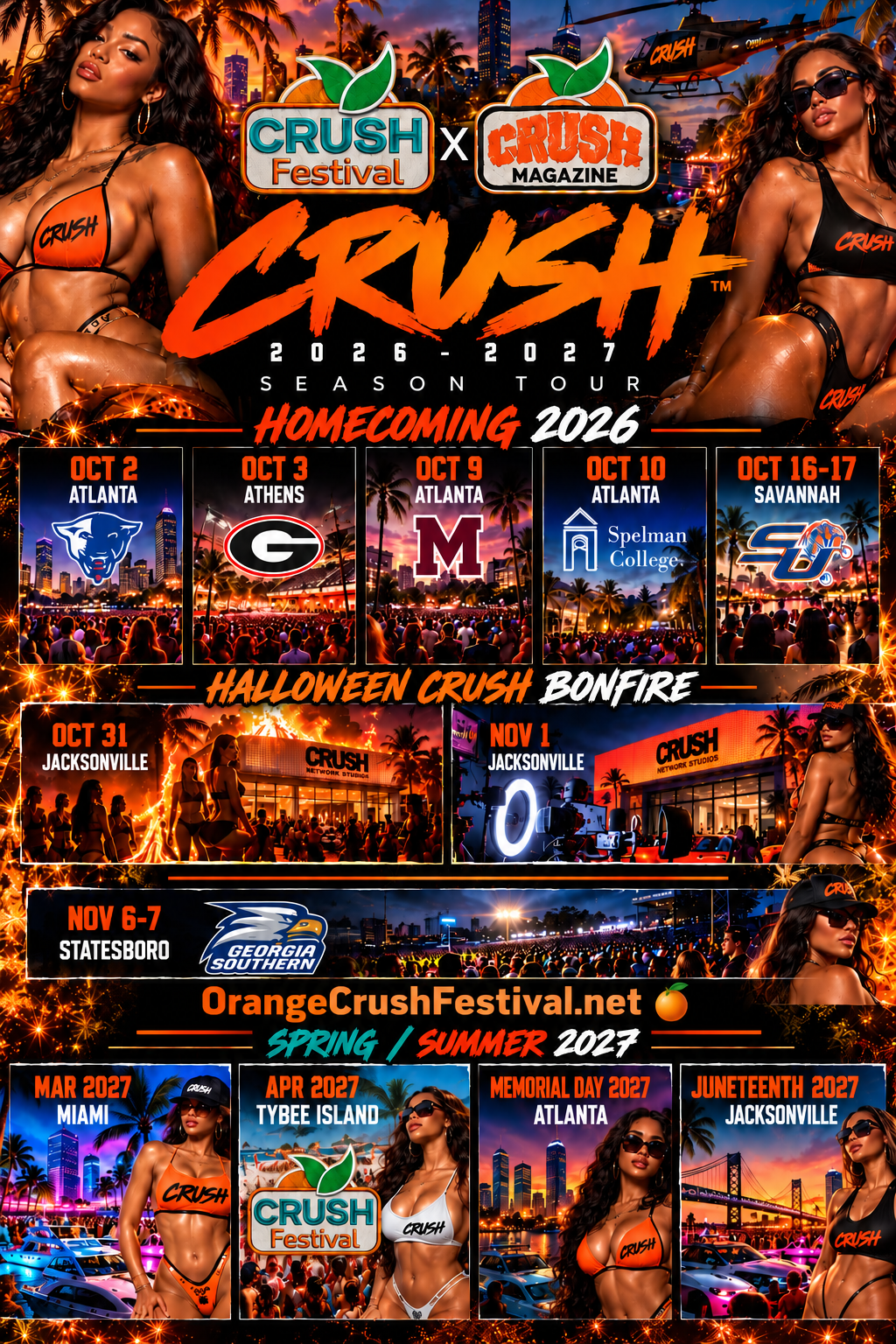
CRUSH MAGAZINE THE BUSINESS BEHIND THE CULTURE CRUSH Isn’t Building a Season That Only Looks Good — It’s Building One Designed to Create Real Economic Opportunity
CRUSH MAGAZINE
THE BUSINESS BEHIND THE CULTURE
CRUSH Isn’t Building a Season That Only Looks Good — It’s Building One Designed to Create Real Economic Opportunity
Culture gets photographed.
Business often happens just outside the frame.
Somebody paid the photographer.
Somebody printed the shirts.
Somebody booked the DJ.
Somebody sold the food.
Somebody rented equipment.
Somebody bought a vendor space.
Somebody designed the graphics.
Somebody booked a hotel.
Somebody filled the gas tank.
Somebody paid for admission.
Somebody sponsored the experience.
Somebody edited the video after everybody else went home.
Every cultural event creates an economy around it.
The question for CRUSH is bigger than:
How much money can one event make?
The better question is:
How many different people can create value because the CRUSH ecosystem exists?
That is where the 2026–2027 season becomes much more than entertainment.
CRUSH HAS MULTIPLE BUSINESSES LIVING INSIDE ONE WORLD
Look closely.
There is media.
There are events.
There is a magazine.
There is a permanent studio.
There is merchandise.
There are artist opportunities.
There are model opportunities.
There are vendor opportunities.
There are sponsorship opportunities.
There are photography and video opportunities.
There are destination experiences.
There is advertising.
There is content production.
There are partnerships.
There is intellectual property.
And there is an audience connecting all of it.
The opportunity is not to force every piece to make money in exactly the same way.
It’s to make the pieces support one another.
THE MAGAZINE CREATES ATTENTION
CRUSH Magazine has a powerful economic function even when the reader never pays for an article.
It creates attention.
An artist gets featured.
People discover the music.
A model gets profiled.
People discover her work.
A business gets documented.
Potential customers discover the company.
An event gets covered.
People become interested in the next one.
A city gets photographed.
People imagine traveling there.
Attention is not automatically revenue.
But almost every revenue stream needs attention first.
That makes media the top of the ecosystem.
EVENTS TURN ATTENTION INTO PARTICIPATION
Reading is passive.
Attendance is active.
Once someone decides:
“I want to be there,”
the economic relationship changes.
Admission.
VIP.
Food.
Merchandise.
Vendor purchases.
Travel.
Transportation.
Photography.
Experiences.
Future bookings.
Now the audience isn’t simply consuming media.
They’re entering the physical economy surrounding CRUSH.
THE STUDIO MAKES PARTICIPATION POSSIBLE BETWEEN EVENTS
This is why Crush Network Studios matters so much.
A festival may happen once a year.
A major activation may happen one weekend.
A studio can potentially create throughout the year.
Photography.
Video.
Interviews.
Podcasts.
Artist media.
Model shoots.
Product shoots.
Rehearsals.
Content days.
Small activations.
Editorial productions.
Business content.
CRUSH doesn’t have to wait for the next giant weekend to create economic activity.
The infrastructure can keep working.
HALLOWEEN BONFIRECRUSH IS THE BUSINESS MODEL IN MINIATURE
Look at everything that can coexist inside one weekend.
General admission.
VIP.
Artists.
Versus performers.
Basketball competitors.
Models.
Magazine shoots.
Vendors.
Sponsors.
Food.
Drinks.
Merchandise.
Photography.
Video.
Media packages.
Interviews.
Advertising.
Future content.
Each customer doesn’t need to purchase everything.
Different people enter through different doors.
That’s the advantage of a multi-experience property.
THE ARTIST ISN’T JUST A PERFORMER
An emerging artist has several possible relationships with CRUSH.
They might perform.
Battle.
Be interviewed.
Purchase a media package.
Get photographed.
Appear in CRUSH Magazine.
Collaborate with another artist.
Create content at Crush Network Studios.
Appear at another CRUSH event.
Potentially become valuable enough that CRUSH eventually wants to book them directly.
The relationship can evolve.
That’s much healthier than treating every artist like a one-time transaction.
THE MODEL ISN’T JUST AN IMAGE
The same principle applies.
A model might enter through a public showcase.
Then book a magazine shoot.
Then become a recurring CRUSH face.
Then appear in merchandise content.
Then work with a sponsor.
Then travel for another activation.
Then appear at Tybee.
Then build her own audience through the exposure and material she created.
The economic relationship can change as her value and role change.
That creates room for progression.
THE VENDOR ISN’T JUST RENTING A TABLE
A strong vendor program should help businesses sell.
That sounds obvious.
But events sometimes become obsessed with collecting vendor fees and forget why vendors participate.
The vendor needs customers.
Visibility.
Good placement.
Content.
Connections.
A reason to return.
If somebody pays CRUSH to vend and has a strong weekend, that business may return.
If they lose money repeatedly, eventually they won’t.
Long-term vendor revenue depends on vendor value.
SPONSORSHIP SHOULD BE MORE THAN A LOGO AT THE BOTTOM
A sponsor isn’t buying six inches on a flyer.
At least, that shouldn’t be the most valuable thing they’re buying.
They’re purchasing access to an environment and its media.
Imagine a business sponsoring the basketball component.
Now its name can potentially live around:
Registration.
Pre-event promotion.
Court signage.
Player interviews.
Highlights.
Winner content.
Photography.
Recap video.
CRUSH Magazine coverage.
Social posts.
That’s a package.
The physical event lasts hours.
The media can extend the sponsorship for weeks.
THIS IS WHERE CRUSH MAGAZINE BECOMES COMMERCIAL INFRASTRUCTURE
The magazine gives partnerships a second life.
Instead of:
Sponsor → Event → Finished.
The relationship becomes:
Sponsor → Promotion → Event → Content → Article → Recap → Archive → Future Campaign.
One investment can create multiple touchpoints.
That increases the potential value of the partnership without requiring the event itself to become cluttered with advertising.
MERCHANDISE SELLS MEMORY
A shirt is cotton until somebody attaches a memory to it.
HALLOWEEN BONFIRECRUSH — 2026.
Now it’s a receipt.
MIKEY VS. TROJAN — BATTLE #1.
Receipt.
CRUSH BEACH MUSIC FESTIVAL — TYBEE.
Receipt.
CRUSH UNIVERSITY — HOMECOMING 2026.
Receipt.
People don’t only buy merchandise because they like logos.
They buy proof that they belong to something.
That’s why event-specific merchandise can become powerful.
THE BEST MERCHANDISE BECOMES CONTENT AFTER THE EVENT
Someone wears the Halloween shirt in Miami.
Photograph it.
Someone wears an old Tybee shirt at the next festival.
Photograph it.
A model styles CRUSH merchandise unexpectedly.
Photograph it.
An artist performs in it.
Film it.
Now merchandise becomes mobile advertising without feeling like an advertisement.
TRAVEL CREATES AN ECONOMY CRUSH DOESN’T HAVE TO OWN
When people move between markets, money moves too.
Hotel rooms.
Airbnbs.
Gas.
Flights.
Restaurants.
Bars.
Parking.
Transportation.
Beauty appointments.
Clothing.
Food.
Entertainment.
Beach supplies.
Local businesses.
CRUSH does not need to own every transaction.
The larger opportunity is eventually creating relationships with businesses already serving those needs.
Hotels.
Restaurants.
Transportation companies.
Clothing brands.
Beauty businesses.
Hospitality partners.
Local attractions.
Now the tour becomes commercially relevant beyond the venue.
THIS IS WHY THE FOUR-MARKET STRATEGY MATTERS
Atlanta.
Savannah/Tybee.
Jacksonville.
Miami.
Repeated activity creates partnership potential.
A business is more likely to understand CRUSH if the relationship isn’t:
“Give us money for this random Saturday.”
Instead:
“Here is the season. Here are the markets. Here is the audience. Here is the content system. Here are the opportunities.”
That’s a completely different conversation.
LOCAL MONEY SHOULD HAVE A CHANCE TO STAY LOCAL
CRUSH can grow while creating opportunities around itself.
Hire local photographers when appropriate.
Work with local vendors.
Feature local businesses.
Find local models.
Interview local artists.
Use local creators.
Buy local services.
Document the people doing the work.
That doesn’t mean every dollar stays inside one city.
It’s a traveling ecosystem.
But CRUSH should leave more behind than discarded wristbands.
A $20 TRANSACTION CAN BECOME A MULTI-YEAR RELATIONSHIP
This is where customer lifetime value becomes more interesting than one-night revenue.
Someone’s first CRUSH interaction might be inexpensive.
Admission.
A shirt.
A photograph.
Then they follow the magazine.
Months later, they attend Tybee.
Later, they buy VIP.
Then they bring friends.
Then their company becomes a vendor.
Years later, maybe that company sponsors something.
The original transaction wasn’t the full value.
It was the introduction.
THAT MEANS WE HAVE TO TREAT PEOPLE LIKE RELATIONSHIPS — NOT RECEIPTS
The fastest way to damage an ecosystem is to monetize every interaction too aggressively.
Not everything needs an immediate price.
Somebody can simply be interviewed.
Somebody can simply be discovered.
Somebody can simply have a great time.
Somebody can receive value first.
Trust creates future economic possibilities.
Extraction destroys them.
CRUSH needs both commercial discipline and cultural credibility.
FREE CONTENT CAN CREATE PAID OPPORTUNITY
CRUSH Magazine photographs an emerging designer.
The designer shares it.
Their customers discover CRUSH.
Later, the designer purchases a vendor package.
Then maybe a campaign.
Then maybe sponsorship.
Nobody had to force the first interaction into a sale.
Media created the relationship.
That’s a functioning funnel without making people feel like they’re trapped inside one.
PAID SERVICES SHOULD STILL FEEL LIKE REAL VALUE
If an artist purchases a media package, the product should be useful.
If a model purchases a shoot, the photographs should strengthen her portfolio.
If a vendor pays for placement, the environment should give them a legitimate opportunity to reach customers.
If a sponsor invests, deliver what was promised.
If someone buys VIP, make VIP visibly different.
If someone buys merchandise, make the product worth wearing again.
Revenue without value is short-term.
CRUSH is trying to build annual traditions.
Annual traditions require people to return.
THE CREATIVE WORKFORCE IS PART OF THE IMPACT
There is another economic layer that rarely appears on the flyer.
Production labor.
Photographers.
Videographers.
Editors.
Graphic designers.
Engineers.
DJs.
Hosts.
Writers.
Security.
Event staff.
Makeup artists.
Stylists.
Production assistants.
Content managers.
Stage personnel.
Sound personnel.
Clean-up crews.
The bigger CRUSH becomes, the more important it becomes to build reliable professional relationships with people capable of executing the work.
The ecosystem behind the camera matters just as much as the ecosystem in front of it.
CRUSH CAN HELP PEOPLE BUILD PORTFOLIOS
Not every economic benefit arrives immediately as cash.
A photographer needs work worth showing.
A model needs professional images.
A videographer needs strong footage.
An artist needs performance content.
A young host needs interviews.
A writer needs published stories.
A business needs marketing material.
CRUSH can create environments where portfolios grow.
That has professional value beyond CRUSH itself.
THE ARCHIVE BECOMES AN ASSET
Every original photograph and piece of footage that CRUSH properly owns or has appropriate rights to use can potentially create future value.
Future campaigns.
Documentaries.
Anniversary pieces.
Advertising.
Historical retrospectives.
Social content.
Sponsor presentations.
Festival promotion.
Website design.
Merchandise storytelling.
Media pitches.
The archive reduces the need to constantly manufacture generic visual material.
CRUSH begins marketing CRUSH with actual CRUSH history.
INTELLECTUAL PROPERTY MATTERS TOO
Names matter.
Logos matter.
Event concepts matter.
Recurring formats matter.
Original photography matters.
Video matters.
Editorial work matters.
Merchandise designs matter.
The stronger the ecosystem becomes, the more important it becomes to document ownership, permissions, agreements and usage rights correctly.
Culture is creative.
Creative assets can have commercial value.
Treat them accordingly.
THE BIGGEST BUSINESS ASSET MAY STILL BE TRUST
People return to places where they believe they’ll receive value.
Artists return if they’re treated professionally.
Models return if they’re respected.
Vendors return if business makes sense.
Sponsors return if promises are delivered.
Audiences return if they enjoy themselves.
Creators return if the collaboration helps them.
Cities welcome organizations that behave responsibly.
That means reputation compounds just like money.
Every CRUSH interaction is either adding to that account or withdrawing from it.
THE SEASON SHOULD CREATE MULTIPLE KINDS OF PROFIT
Financial profit matters.
CRUSH is a business ecosystem.
But there are other forms of return.
Content profit: more usable media than existed before.
Relationship profit: more valuable connections.
Audience profit: more people who understand CRUSH.
Talent profit: more artists, models and creators inside the network.
Knowledge profit: better understanding of what works.
Brand profit: stronger recognition.
Community profit: more useful connections between people.
Historical profit: an archive that becomes more valuable with time.
A strong stop should produce several of these simultaneously.
THEN THE MONEY CAN COMPOUND WITH THE CULTURE
Homecoming builds attention.
Attention feeds Halloween.
Halloween creates content.
Content feeds winter.
Winter builds anticipation.
Miami expands the audience.
Miami feeds Tybee.
Tybee strengthens the festival identity.
The festival creates more content and commerce.
Atlanta reconnects the network.
Jacksonville brings the season home.
Then the archive promotes the next season.
The next season doesn’t start from zero.
That’s where the economics become interesting.
THE LONG-TERM VISION ISN’T ONE SOLD-OUT EVENT
A sold-out event would be valuable.
But one successful night is still one successful night.
The larger opportunity is building a system where:
CRUSH Magazine creates attention.
CRUSH events convert attention into experience.
Crush Network Studios converts relationships into production.
CRUSH Festival creates annual destination culture.
Merchandise turns participation into identity.
Sponsors connect businesses to the audience.
Content carries everything beyond the physical event.
The archive makes every year easier to explain than the year before.
That is an ecosystem.
BY JUNETEENTH 2027, THE BALANCE SHEET SHOULDN’T BE THE ONLY RECEIPT
Count the revenue.
Absolutely.
Count the expenses too.
Know whether the events made money.
Know what each customer acquisition cost.
Know what merchandise sold.
Know which packages worked.
Know which sponsorships delivered.
But also count:
People hired.
Businesses featured.
Vendors supported.
Artists documented.
Models photographed.
Creators paid.
Partnerships formed.
Returning customers.
Returning talent.
Content produced.
Cities connected.
Stories published.
Those numbers tell us what CRUSH actually built.
CULTURE AND COMMERCE DON’T HAVE TO BE ENEMIES
Commerce can fund culture.
Culture can create commerce.
The relationship becomes unhealthy only when one destroys the other.
CRUSH needs money to build.
People need genuine value to keep participating.
Businesses need customers.
Artists need opportunities.
Creators need work.
Audiences need experiences worth paying for.
Sponsors need measurable value.
The strongest version of the CRUSH economy works because those interests can overlap.
THAT IS THE BUSINESS BEHIND THE TOUR
From Homecoming to Halloween.
From Jacksonville to Miami.
From Miami to Tybee.
From Tybee to Atlanta.
From Atlanta back to Jacksonville.
Every stop should create more than photographs.
It should create circulation.
Attention circulates.
People circulate.
Content circulates.
Opportunity circulates.
Money circulates.
Relationships circulate.
And the stronger those pathways become, the less CRUSH depends on any single event, personality, post or revenue stream.
That’s when an entertainment brand starts becoming something larger.
Not simply a company that sells access to culture.
A platform capable of creating culture, documenting it, connecting the people inside it—and building real economic opportunity around what they create together.
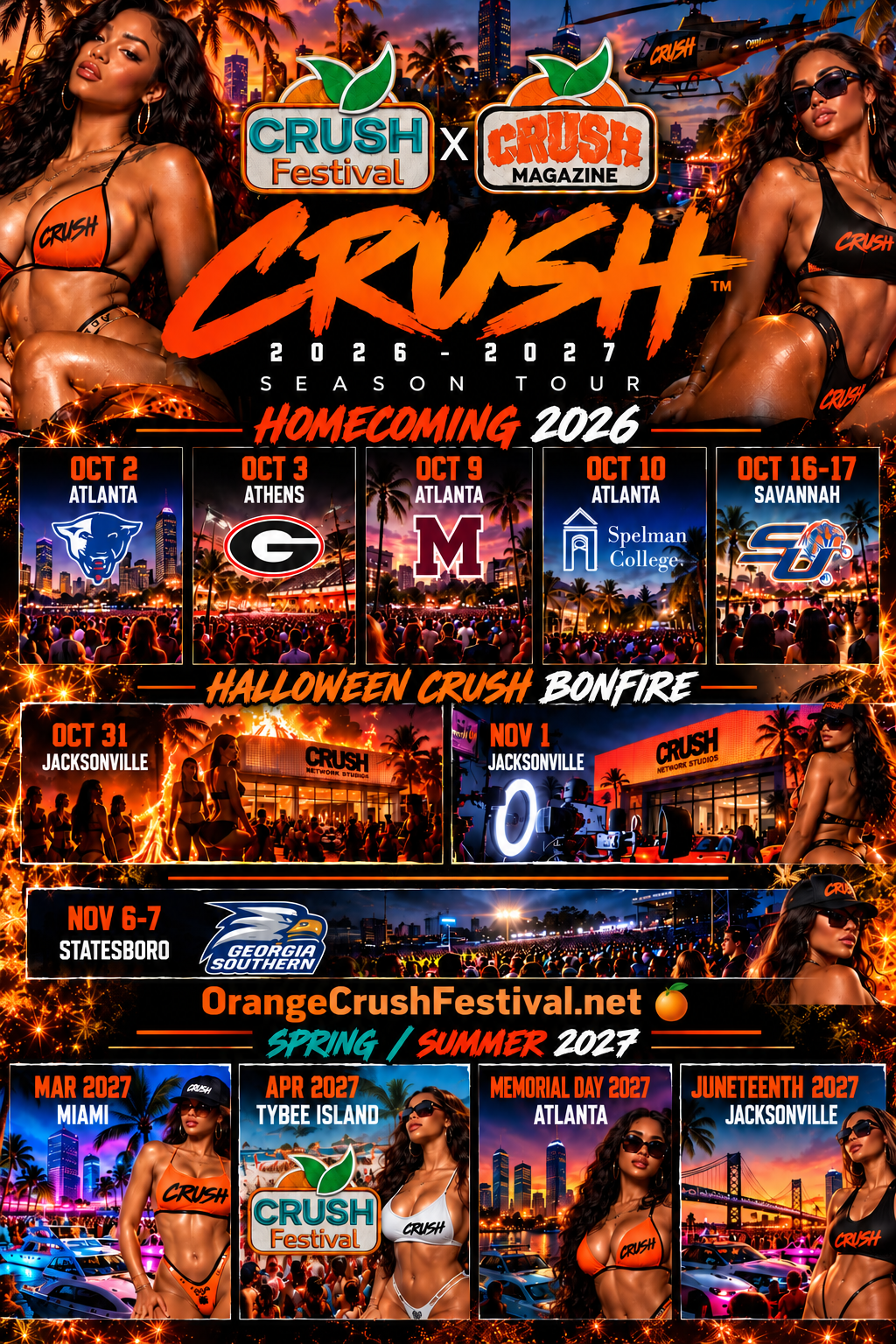
CRUSH MAGAZINE THE BUSINESS BEHIND THE CULTURE CRUSH Isn’t Building a Season That Only Looks Good — It’s Building One Designed to Create Real Economic Opportunity
CRUSH MAGAZINE
THE BUSINESS BEHIND THE CULTURE
CRUSH Isn’t Building a Season That Only Looks Good — It’s Building One Designed to Create Real Economic Opportunity
Culture gets photographed.
Business often happens just outside the frame.
Somebody paid the photographer.
Somebody printed the shirts.
Somebody booked the DJ.
Somebody sold the food.
Somebody rented equipment.
Somebody bought a vendor space.
Somebody designed the graphics.
Somebody booked a hotel.
Somebody filled the gas tank.
Somebody paid for admission.
Somebody sponsored the experience.
Somebody edited the video after everybody else went home.
Every cultural event creates an economy around it.
The question for CRUSH is bigger than:
How much money can one event make?
The better question is:
How many different people can create value because the CRUSH ecosystem exists?
That is where the 2026–2027 season becomes much more than entertainment.
CRUSH HAS MULTIPLE BUSINESSES LIVING INSIDE ONE WORLD
Look closely.
There is media.
There are events.
There is a magazine.
There is a permanent studio.
There is merchandise.
There are artist opportunities.
There are model opportunities.
There are vendor opportunities.
There are sponsorship opportunities.
There are photography and video opportunities.
There are destination experiences.
There is advertising.
There is content production.
There are partnerships.
There is intellectual property.
And there is an audience connecting all of it.
The opportunity is not to force every piece to make money in exactly the same way.
It’s to make the pieces support one another.
THE MAGAZINE CREATES ATTENTION
CRUSH Magazine has a powerful economic function even when the reader never pays for an article.
It creates attention.
An artist gets featured.
People discover the music.
A model gets profiled.
People discover her work.
A business gets documented.
Potential customers discover the company.
An event gets covered.
People become interested in the next one.
A city gets photographed.
People imagine traveling there.
Attention is not automatically revenue.
But almost every revenue stream needs attention first.
That makes media the top of the ecosystem.
EVENTS TURN ATTENTION INTO PARTICIPATION
Reading is passive.
Attendance is active.
Once someone decides:
“I want to be there,”
the economic relationship changes.
Admission.
VIP.
Food.
Merchandise.
Vendor purchases.
Travel.
Transportation.
Photography.
Experiences.
Future bookings.
Now the audience isn’t simply consuming media.
They’re entering the physical economy surrounding CRUSH.
THE STUDIO MAKES PARTICIPATION POSSIBLE BETWEEN EVENTS
This is why Crush Network Studios matters so much.
A festival may happen once a year.
A major activation may happen one weekend.
A studio can potentially create throughout the year.
Photography.
Video.
Interviews.
Podcasts.
Artist media.
Model shoots.
Product shoots.
Rehearsals.
Content days.
Small activations.
Editorial productions.
Business content.
CRUSH doesn’t have to wait for the next giant weekend to create economic activity.
The infrastructure can keep working.
HALLOWEEN BONFIRECRUSH IS THE BUSINESS MODEL IN MINIATURE
Look at everything that can coexist inside one weekend.
General admission.
VIP.
Artists.
Versus performers.
Basketball competitors.
Models.
Magazine shoots.
Vendors.
Sponsors.
Food.
Drinks.
Merchandise.
Photography.
Video.
Media packages.
Interviews.
Advertising.
Future content.
Each customer doesn’t need to purchase everything.
Different people enter through different doors.
That’s the advantage of a multi-experience property.
THE ARTIST ISN’T JUST A PERFORMER
An emerging artist has several possible relationships with CRUSH.
They might perform.
Battle.
Be interviewed.
Purchase a media package.
Get photographed.
Appear in CRUSH Magazine.
Collaborate with another artist.
Create content at Crush Network Studios.
Appear at another CRUSH event.
Potentially become valuable enough that CRUSH eventually wants to book them directly.
The relationship can evolve.
That’s much healthier than treating every artist like a one-time transaction.
THE MODEL ISN’T JUST AN IMAGE
The same principle applies.
A model might enter through a public showcase.
Then book a magazine shoot.
Then become a recurring CRUSH face.
Then appear in merchandise content.
Then work with a sponsor.
Then travel for another activation.
Then appear at Tybee.
Then build her own audience through the exposure and material she created.
The economic relationship can change as her value and role change.
That creates room for progression.
THE VENDOR ISN’T JUST RENTING A TABLE
A strong vendor program should help businesses sell.
That sounds obvious.
But events sometimes become obsessed with collecting vendor fees and forget why vendors participate.
The vendor needs customers.
Visibility.
Good placement.
Content.
Connections.
A reason to return.
If somebody pays CRUSH to vend and has a strong weekend, that business may return.
If they lose money repeatedly, eventually they won’t.
Long-term vendor revenue depends on vendor value.
SPONSORSHIP SHOULD BE MORE THAN A LOGO AT THE BOTTOM
A sponsor isn’t buying six inches on a flyer.
At least, that shouldn’t be the most valuable thing they’re buying.
They’re purchasing access to an environment and its media.
Imagine a business sponsoring the basketball component.
Now its name can potentially live around:
Registration.
Pre-event promotion.
Court signage.
Player interviews.
Highlights.
Winner content.
Photography.
Recap video.
CRUSH Magazine coverage.
Social posts.
That’s a package.
The physical event lasts hours.
The media can extend the sponsorship for weeks.
THIS IS WHERE CRUSH MAGAZINE BECOMES COMMERCIAL INFRASTRUCTURE
The magazine gives partnerships a second life.
Instead of:
Sponsor → Event → Finished.
The relationship becomes:
Sponsor → Promotion → Event → Content → Article → Recap → Archive → Future Campaign.
One investment can create multiple touchpoints.
That increases the potential value of the partnership without requiring the event itself to become cluttered with advertising.
MERCHANDISE SELLS MEMORY
A shirt is cotton until somebody attaches a memory to it.
HALLOWEEN BONFIRECRUSH — 2026.
Now it’s a receipt.
MIKEY VS. TROJAN — BATTLE #1.
Receipt.
CRUSH BEACH MUSIC FESTIVAL — TYBEE.
Receipt.
CRUSH UNIVERSITY — HOMECOMING 2026.
Receipt.
People don’t only buy merchandise because they like logos.
They buy proof that they belong to something.
That’s why event-specific merchandise can become powerful.
THE BEST MERCHANDISE BECOMES CONTENT AFTER THE EVENT
Someone wears the Halloween shirt in Miami.
Photograph it.
Someone wears an old Tybee shirt at the next festival.
Photograph it.
A model styles CRUSH merchandise unexpectedly.
Photograph it.
An artist performs in it.
Film it.
Now merchandise becomes mobile advertising without feeling like an advertisement.
TRAVEL CREATES AN ECONOMY CRUSH DOESN’T HAVE TO OWN
When people move between markets, money moves too.
Hotel rooms.
Airbnbs.
Gas.
Flights.
Restaurants.
Bars.
Parking.
Transportation.
Beauty appointments.
Clothing.
Food.
Entertainment.
Beach supplies.
Local businesses.
CRUSH does not need to own every transaction.
The larger opportunity is eventually creating relationships with businesses already serving those needs.
Hotels.
Restaurants.
Transportation companies.
Clothing brands.
Beauty businesses.
Hospitality partners.
Local attractions.
Now the tour becomes commercially relevant beyond the venue.
THIS IS WHY THE FOUR-MARKET STRATEGY MATTERS
Atlanta.
Savannah/Tybee.
Jacksonville.
Miami.
Repeated activity creates partnership potential.
A business is more likely to understand CRUSH if the relationship isn’t:
“Give us money for this random Saturday.”
Instead:
“Here is the season. Here are the markets. Here is the audience. Here is the content system. Here are the opportunities.”
That’s a completely different conversation.
LOCAL MONEY SHOULD HAVE A CHANCE TO STAY LOCAL
CRUSH can grow while creating opportunities around itself.
Hire local photographers when appropriate.
Work with local vendors.
Feature local businesses.
Find local models.
Interview local artists.
Use local creators.
Buy local services.
Document the people doing the work.
That doesn’t mean every dollar stays inside one city.
It’s a traveling ecosystem.
But CRUSH should leave more behind than discarded wristbands.
A $20 TRANSACTION CAN BECOME A MULTI-YEAR RELATIONSHIP
This is where customer lifetime value becomes more interesting than one-night revenue.
Someone’s first CRUSH interaction might be inexpensive.
Admission.
A shirt.
A photograph.
Then they follow the magazine.
Months later, they attend Tybee.
Later, they buy VIP.
Then they bring friends.
Then their company becomes a vendor.
Years later, maybe that company sponsors something.
The original transaction wasn’t the full value.
It was the introduction.
THAT MEANS WE HAVE TO TREAT PEOPLE LIKE RELATIONSHIPS — NOT RECEIPTS
The fastest way to damage an ecosystem is to monetize every interaction too aggressively.
Not everything needs an immediate price.
Somebody can simply be interviewed.
Somebody can simply be discovered.
Somebody can simply have a great time.
Somebody can receive value first.
Trust creates future economic possibilities.
Extraction destroys them.
CRUSH needs both commercial discipline and cultural credibility.
FREE CONTENT CAN CREATE PAID OPPORTUNITY
CRUSH Magazine photographs an emerging designer.
The designer shares it.
Their customers discover CRUSH.
Later, the designer purchases a vendor package.
Then maybe a campaign.
Then maybe sponsorship.
Nobody had to force the first interaction into a sale.
Media created the relationship.
That’s a functioning funnel without making people feel like they’re trapped inside one.
PAID SERVICES SHOULD STILL FEEL LIKE REAL VALUE
If an artist purchases a media package, the product should be useful.
If a model purchases a shoot, the photographs should strengthen her portfolio.
If a vendor pays for placement, the environment should give them a legitimate opportunity to reach customers.
If a sponsor invests, deliver what was promised.
If someone buys VIP, make VIP visibly different.
If someone buys merchandise, make the product worth wearing again.
Revenue without value is short-term.
CRUSH is trying to build annual traditions.
Annual traditions require people to return.
THE CREATIVE WORKFORCE IS PART OF THE IMPACT
There is another economic layer that rarely appears on the flyer.
Production labor.
Photographers.
Videographers.
Editors.
Graphic designers.
Engineers.
DJs.
Hosts.
Writers.
Security.
Event staff.
Makeup artists.
Stylists.
Production assistants.
Content managers.
Stage personnel.
Sound personnel.
Clean-up crews.
The bigger CRUSH becomes, the more important it becomes to build reliable professional relationships with people capable of executing the work.
The ecosystem behind the camera matters just as much as the ecosystem in front of it.
CRUSH CAN HELP PEOPLE BUILD PORTFOLIOS
Not every economic benefit arrives immediately as cash.
A photographer needs work worth showing.
A model needs professional images.
A videographer needs strong footage.
An artist needs performance content.
A young host needs interviews.
A writer needs published stories.
A business needs marketing material.
CRUSH can create environments where portfolios grow.
That has professional value beyond CRUSH itself.
THE ARCHIVE BECOMES AN ASSET
Every original photograph and piece of footage that CRUSH properly owns or has appropriate rights to use can potentially create future value.
Future campaigns.
Documentaries.
Anniversary pieces.
Advertising.
Historical retrospectives.
Social content.
Sponsor presentations.
Festival promotion.
Website design.
Merchandise storytelling.
Media pitches.
The archive reduces the need to constantly manufacture generic visual material.
CRUSH begins marketing CRUSH with actual CRUSH history.
INTELLECTUAL PROPERTY MATTERS TOO
Names matter.
Logos matter.
Event concepts matter.
Recurring formats matter.
Original photography matters.
Video matters.
Editorial work matters.
Merchandise designs matter.
The stronger the ecosystem becomes, the more important it becomes to document ownership, permissions, agreements and usage rights correctly.
Culture is creative.
Creative assets can have commercial value.
Treat them accordingly.
THE BIGGEST BUSINESS ASSET MAY STILL BE TRUST
People return to places where they believe they’ll receive value.
Artists return if they’re treated professionally.
Models return if they’re respected.
Vendors return if business makes sense.
Sponsors return if promises are delivered.
Audiences return if they enjoy themselves.
Creators return if the collaboration helps them.
Cities welcome organizations that behave responsibly.
That means reputation compounds just like money.
Every CRUSH interaction is either adding to that account or withdrawing from it.
THE SEASON SHOULD CREATE MULTIPLE KINDS OF PROFIT
Financial profit matters.
CRUSH is a business ecosystem.
But there are other forms of return.
Content profit: more usable media than existed before.
Relationship profit: more valuable connections.
Audience profit: more people who understand CRUSH.
Talent profit: more artists, models and creators inside the network.
Knowledge profit: better understanding of what works.
Brand profit: stronger recognition.
Community profit: more useful connections between people.
Historical profit: an archive that becomes more valuable with time.
A strong stop should produce several of these simultaneously.
THEN THE MONEY CAN COMPOUND WITH THE CULTURE
Homecoming builds attention.
Attention feeds Halloween.
Halloween creates content.
Content feeds winter.
Winter builds anticipation.
Miami expands the audience.
Miami feeds Tybee.
Tybee strengthens the festival identity.
The festival creates more content and commerce.
Atlanta reconnects the network.
Jacksonville brings the season home.
Then the archive promotes the next season.
The next season doesn’t start from zero.
That’s where the economics become interesting.
THE LONG-TERM VISION ISN’T ONE SOLD-OUT EVENT
A sold-out event would be valuable.
But one successful night is still one successful night.
The larger opportunity is building a system where:
CRUSH Magazine creates attention.
CRUSH events convert attention into experience.
Crush Network Studios converts relationships into production.
CRUSH Festival creates annual destination culture.
Merchandise turns participation into identity.
Sponsors connect businesses to the audience.
Content carries everything beyond the physical event.
The archive makes every year easier to explain than the year before.
That is an ecosystem.
BY JUNETEENTH 2027, THE BALANCE SHEET SHOULDN’T BE THE ONLY RECEIPT
Count the revenue.
Absolutely.
Count the expenses too.
Know whether the events made money.
Know what each customer acquisition cost.
Know what merchandise sold.
Know which packages worked.
Know which sponsorships delivered.
But also count:
People hired.
Businesses featured.
Vendors supported.
Artists documented.
Models photographed.
Creators paid.
Partnerships formed.
Returning customers.
Returning talent.
Content produced.
Cities connected.
Stories published.
Those numbers tell us what CRUSH actually built.
CULTURE AND COMMERCE DON’T HAVE TO BE ENEMIES
Commerce can fund culture.
Culture can create commerce.
The relationship becomes unhealthy only when one destroys the other.
CRUSH needs money to build.
People need genuine value to keep participating.
Businesses need customers.
Artists need opportunities.
Creators need work.
Audiences need experiences worth paying for.
Sponsors need measurable value.
The strongest version of the CRUSH economy works because those interests can overlap.
THAT IS THE BUSINESS BEHIND THE TOUR
From Homecoming to Halloween.
From Jacksonville to Miami.
From Miami to Tybee.
From Tybee to Atlanta.
From Atlanta back to Jacksonville.
Every stop should create more than photographs.
It should create circulation.
Attention circulates.
People circulate.
Content circulates.
Opportunity circulates.
Money circulates.
Relationships circulate.
And the stronger those pathways become, the less CRUSH depends on any single event, personality, post or revenue stream.
That’s when an entertainment brand starts becoming something larger.
Not simply a company that sells access to culture.
A platform capable of creating culture, documenting it, connecting the people inside it—and building real economic opportunity around what they create together.
CRUSH MAGAZINE WE’RE NOT CHASING ONE VIRAL MOMENT The 2026–2027 CRUSH Season Is Designed to Create Hundreds of Chances for Culture to Catch Fire
CRUSH MAGAZINE
WE’RE NOT CHASING ONE VIRAL MOMENT
The 2026–2027 CRUSH Season Is Designed to Create Hundreds of Chances for Culture to Catch Fire
Everybody wants the clip.
The one that escapes your existing audience.
The one that hits a million views.
The one celebrities repost.
The one that reaches group chats you aren’t in.
The one that suddenly puts thousands of new eyes on the brand.
CRUSH wants that moment too.
But there is a problem with building an entire strategy around going viral:
Nobody can schedule virality.
You can schedule Georgia State.
You can schedule UGA.
You can schedule Morehouse and Spelman.
You can schedule Savannah State.
You can schedule Halloween BonfireCRUSH.
You can schedule Georgia Southern.
You can plan Miami.
You can build toward Tybee.
You can prepare Atlanta.
You can return to Jacksonville.
But you cannot write:
“7:42 PM — Go Viral.”
So CRUSH is building something smarter.
We’re creating opportunity density.
Instead of betting the season on one perfect piece of content, we’re putting cameras inside hundreds of situations where something great could happen.
ONE DAY SHOULD NEVER EQUAL ONE POST
This is one of the rules of the new CRUSH media system.
If CRUSH spends an entire day at Homecoming and comes home with one recap video, we left enormous value on the street.
One day contains dozens of stories.
The arrival.
The first outfit.
The tailgate.
The funniest interview.
The best answer.
The person everybody knows.
The entrepreneur.
The model.
The artist.
The food.
The alumni.
The DJ.
The cars.
The dancing.
The fashion.
The arguments about which school has the best Homecoming.
The night.
The aftermath.
The ride home.
Each is potentially its own piece of media.
A single weekend can become a miniature season.
THE GOAL ISN’T TO POST EVERYTHING
It’s to capture enough that we have choices.
That’s different.
The camera should be greedy.
The editor should be selective.
Shoot 100 moments.
Maybe 30 deserve publishing.
Maybe five are exceptional.
Maybe one becomes enormous.
We don’t know until the material exists.
That’s why production volume matters.
You cannot edit footage you never captured.
EVERY STOP NEEDS ITS OWN HERO MOMENT
Georgia State should produce something unmistakably Georgia State.
Athens should produce something unmistakably Athens.
Morehouse and Spelman should produce something that could only come from the AUC.
Savannah State needs its own defining imagery.
Jacksonville needs a moment people associate with Halloween BonfireCRUSH.
Statesboro needs something unexpected.
Miami needs imagery impossible to confuse with Georgia.
Tybee needs the ocean.
Atlanta needs its return.
Jacksonville needs the finale.
The tour becomes memorable when each chapter has a photograph, quote, person or moment that instantly brings the entire stop back.
BUT THE SMALL MOMENTS MAY WIN
This is where media gets unpredictable.
CRUSH might spend hours filming an elaborate performance.
The viral clip could be somebody’s grandmother dancing outside.
A beautiful model shoot could take an hour.
The biggest photograph might be a candid shot taken between poses.
A planned interview could be excellent.
The funniest moment could happen while the microphone is being handed over.
The basketball championship could be intense.
The internet might become obsessed with the losing player’s excuse.
That’s why CRUSH cameras need to stay awake between the obvious moments.
Culture frequently happens in the margins.
THE MICROPHONE IS A CONTENT MACHINE
One microphone can create an entire publishing system.
Ask everybody one question.
“Who won Homecoming already?”
Twenty answers.
Twenty personalities.
Twenty clips.
Then another question:
“What school really has the best Homecoming?”
Now rivalry enters.
Another:
“Rate your Homecoming fit out of 10.”
Another:
“What’s the most expensive thing you have on?”
Another:
“What makes somebody CRUSH Magazine material?”
Another:
“Where are we going after this?”
Simple questions.
Different people.
Unpredictable answers.
That’s repeatable content.
THEN BREAK THE FORMAT
Repetition creates recognition.
Too much repetition creates boredom.
So once audiences understand the CRUSH interview style, interrupt it.
No question.
Hand somebody the microphone.
“You have 15 seconds. Say whatever you want.”
Now what happens?
We don’t know.
Perfect.
FIND THE PERSON WHO CAN TAKE OVER THE CAMERA
Every tour eventually encounters somebody whose personality is bigger than the original plan.
Recognize that.
If somebody is naturally hilarious, let them interview somebody.
If a model has an incredible personality, don’t limit her to photographs.
If an artist is charismatic, let the camera follow them for ten minutes.
If a student knows everybody on campus, let them guide CRUSH through the environment.
Some of the strongest formats may be discovered accidentally.
CRUSH CAM SHOULD MAKE ORDINARY MOMENTS LOOK IMPORTANT
Not everything needs dialogue.
Five seconds.
A heel stepping out of a car.
A fraternity strolling.
A model turning toward the camera.
A grill smoking.
A marching band passing.
Jewelry catching sunlight.
A drink pouring.
A convertible pulling up.
A DJ’s hand hitting the mixer.
A basketball going through the net.
A bonfire igniting.
A microphone being switched on.
A studio light turning on.
Ocean water touching somebody’s feet.
Miami at sunrise.
Tybee at sunset.
CRUSH CAM.
Short.
Beautiful.
Recognizable.
These become visual punctuation throughout the season.
THEN THERE’S THE CONTENT THAT SHOULD TAKE ITS TIME
Not everything should be 12 seconds.
CRUSH Magazine needs depth too.
The three-minute interview.
The 10-minute conversation.
The photo essay.
The artist performance.
The model editorial.
The behind-the-scenes film.
The founder diary.
The documentary episode.
The event recap.
The long-form story.
Short-form creates entrances.
Long-form creates rooms.
CRUSH needs both.
EVERY PERSON CAN CREATE MULTIPLE ASSETS
Consider one strong model discovered at Homecoming.
One encounter could generate:
Portrait.
Full-body fashion image.
Walking video.
Five-second CRUSH CAM.
Quick interview.
Longer interview.
Behind-the-scenes footage.
Magazine profile.
Story post.
Quote graphic.
Website feature.
Future casting content.
Then, if she returns:
Jacksonville content.
Studio content.
Miami content.
Tybee content.
Now one relationship has produced an entire media trail.
This is why people matter more than random posting volume.
THE SAME IS TRUE FOR AN ARTIST
First interview:
“What’s the record we need to hear?”
Clip of the record.
Artist portrait.
Performance footage.
Reaction footage.
Backstage footage.
Studio interview.
Magazine article.
Freestyle.
CRUSH performance.
Future event appearance.
Now CRUSH doesn’t merely have “artist content.”
It has a developing story.
HALLOWEEN SHOULD BE A CONTENT FACTORY
Halloween BonfireCRUSH contains an unusually high concentration of visually useful elements.
Costumes.
Fire.
Night.
Basketball.
Music.
Models.
Competition.
Performances.
Food.
Merchandise.
Vendors.
Studio interiors.
Halloween production design.
Mikey vs. Trojan.
That means the weekend should be documented from multiple perspectives.
Wide.
Close.
Vertical.
Horizontal.
Professional photography.
Candid photography.
Performance video.
Reaction video.
Backstage.
Outside.
Inside.
Before.
During.
After.
Saturday.
Sunday.
One weekend should generate material capable of living far beyond November 1.
SUNDAY EXISTS BECAUSE MOMENTS DESERVE SECOND LIVES
This is the genius of separating spectacle from media.
Saturday catches people emotionally.
Sunday catches them intentionally.
Saturday:
“That was crazy.”
Sunday:
“Tell us what happened.”
Saturday:
Performance.
Sunday:
Interview.
Saturday:
Costume.
Sunday:
Editorial.
Saturday:
Basketball.
Sunday:
Winner portrait.
Saturday:
Battle.
Sunday:
Reaction.
Saturday produces the question.
Sunday records the answer.
THEN DON’T RELEASE EVERYTHING MONDAY
This is another mistake brands make.
Huge weekend.
Forty posts.
Three days later:
Nothing.
CRUSH should think like a television network.
Some material goes immediately.
Some within 24 hours.
Some during the following week.
Some becomes a magazine feature.
Some becomes a compilation.
Some gets saved for winter.
Some resurfaces before the next event.
Some gets reposted six months later because the person became important.
The archive should have a release strategy.
OLD CONTENT CAN BECOME NEW CONTENT
Suppose CRUSH interviews an unknown artist in October.
In March, that artist has a breakout record.
Open the archive.
Suppose a model first appears at Savannah State.
She becomes a major recurring CRUSH personality.
Repost the first photograph.
Suppose Mikey and Trojan eventually have another battle.
Bring back Battle #1.
Suppose somebody returns to Homecoming in 2027.
Show 2026 beside 2027.
Time adds value to media.
CRUSH should exploit that responsibly.
THE WEBSITE SHOULD HOLD WHAT SOCIAL MEDIA CAN’T
Social feeds move too fast.
Yesterday becomes ancient.
CRUSH Magazine can preserve context.
The complete story.
Full photo galleries.
Profiles.
Longer interviews.
Event archives.
City pages.
Recurring personalities.
Festival history.
Studio stories.
People should be able to discover CRUSH in May 2027 and understand what happened in October 2026.
That’s how a media property develops depth.
VIRAL ATTENTION NEEDS A DESTINATION
Imagine the perfect scenario.
A CRUSH Homecoming clip reaches 3 million people.
Great.
Now what?
If there’s nothing behind it, most of those people leave.
But imagine they click and find:
CRUSH Magazine.
Another interview.
The model from the clip.
The artist standing beside her.
Halloween BonfireCRUSH.
Crush Network Studios.
Miami.
Tybee.
The festival.
Merchandise.
Upcoming events.
A full season.
Now one viral clip becomes an entrance into an existing universe.
Virality is more valuable when something is waiting behind the door.
THAT’S WHY WE BUILD BEFORE WE BLOW
This season isn’t about pretending CRUSH already has everything.
It’s about creating the infrastructure capable of handling attention when attention arrives.
Content system.
Website.
Magazine.
Studio.
Events.
Talent network.
Visual identity.
Archive.
Merchandise.
Relationships.
Cities.
Audience.
Then when something catches fire, CRUSH doesn’t have to invent the rest overnight.
The world already exists.
THE NUMBERS WE WANT ARE BIG
There is nothing wrong with saying that.
We want views.
We want shares.
We want reach.
We want traffic.
We want attendance.
We want revenue.
We want people talking.
We want sold-out experiences.
We want CRUSH images traveling far beyond the cities where they were captured.
But numbers without retention disappear.
The larger objective is:
Turn attention into recognition.
Recognition into curiosity.
Curiosity into participation.
Participation into relationships.
Relationships into community.
Community into tradition.
That’s the ladder.
TEN MILLION RANDOM VIEWS CAN’T REPLACE TEN THOUSAND PEOPLE WHO CARE
The strongest outcome is having both.
Reach and depth.
Big moments and recurring supporters.
Viral clips and an archive.
New people and returning people.
Public attention and real relationships.
That’s what makes media durable.
SO WE’RE GOING TO GIVE OURSELVES AS MANY CHANCES AS POSSIBLE
Every campus.
Every city.
Every model.
Every artist.
Every interview.
Every basketball game.
Every outfit.
Every entrepreneur.
Every drive.
Every studio session.
Every performance.
Every sunrise.
Every sunset.
Every mistake.
Every unexpected moment.
Not because everything deserves to be published.
Because somewhere inside all that reality are the moments that do.
And we won’t know which ones until they happen.
THE CRUSH CAMERA STARTS ROLLING IN OCTOBER
From there:
Atlanta → Athens → Atlanta → Savannah → Jacksonville → Statesboro.
Then:
Miami → Tybee → Atlanta → Jacksonville.
Different environments.
Different people.
Different stories.
Same expanding archive.
By Juneteenth 2027, CRUSH shouldn’t be looking back at one piece of content that made the season successful.
We should be looking at an entire body of work.
Hundreds of published moments.
Thousands of captured moments.
Faces audiences now recognize.
Stories people remember.
Places connected through media.
And hopefully, somewhere inside all of it, a few moments that traveled farther than anybody expected.
Because CRUSH isn’t betting everything on becoming viral tomorrow.
We’re building enough culture that the internet gets hundreds of opportunities to discover us.
And when it does:
there will already be a whole world waiting behind the clip.