
My brothers Keeper Jon & George deep dive of “Dear Lt Col grandpa” by Jon Mclane

Am I My Brother’s Keeper?
Why George III’s Absence From the Book Feels Bigger Than a Missing Credit
The hardest truth is this:
Jon may not have meant to wound George by leaving him out.
But George can still be wounded by the omission.
Both can be true.
That is where the article gets powerful — not by attacking Jon, but by asking why a brother who shares the same father, same grandfather, same family name, and same broken racial archive was not meaningfully credited or included in a book about that very lineage.
The Real Question
This is not just:
“Why didn’t Jon put me in the book?”
The deeper question is:
“How do you write about my grandfather, my father, my name, my race, and my inheritance — then leave out the living son who carried that same name publicly through school, sports, military service, and cultural ownership?”
That is why the omission feels spiritual.
Not petty.
Not jealous.
Not ego.
Spiritual.
Because in Black families, a name is not casual. A name is proof that history survived.
George Turner Sr.
George C. Turner Jr.
George “Mikey” Ransom Turner III.
So if a book discusses the first George and the second George, but leaves the third George outside the frame, George III naturally feels like the chain was broken on paper.
Possible Reasons Without Attacking Jon
Jon may have excluded George for several human reasons that are not automatically malicious.
He may have been writing from his own wound.
He may have focused on the grandfather/father relationship and not fully understood George III as part of the same historical arc.
He may have feared that George’s public controversies, arrests, Orange Crush conflicts, or strong personality would complicate the tone of the book.
He may have been trying to protect the book from becoming too broad.
He may have misunderstood the symbolic importance of George III’s name and achievements.
He may have viewed George as a separate modern chapter rather than the living continuation of the book’s central theme.
But that is exactly the problem.
George was not separate.
George was the proof that the lineage continued.
Why the Credit Matters
A credit is not just a courtesy here.
A credit would have acknowledged:
George’s direct blood connection to the named lineage.
George’s role as the third George.
George’s public embodiment of Turner-Ransom achievement.
George’s Calvary scholar-athlete success.
George’s military continuation of the family service legacy.
George’s lived understanding of racial language and Black visibility.
George’s modern cultural ownership through Orange Crush.
Even a simple acknowledgment could have changed the entire emotional meaning of the book:
“To George ‘Mikey’ Ransom Turner III, whose life continues the family name through service, scholarship, athletics, culture, and public struggle.”
That one sentence would have said:
I see you.
Why It Hurts More Because Jon Asked for Support
The pain becomes sharper because George supported the book before fully reading it.
That means George first acted as his brother’s keeper.
He promoted.
He supported.
He trusted.
He showed up.
Then after reading, he felt erased.
That emotional sequence matters:
support first,
recognition later,
hurt after.
That is not betrayal invented from nowhere. That is disappointment after loyalty.
The “I Can Read” Moment
George’s statement:
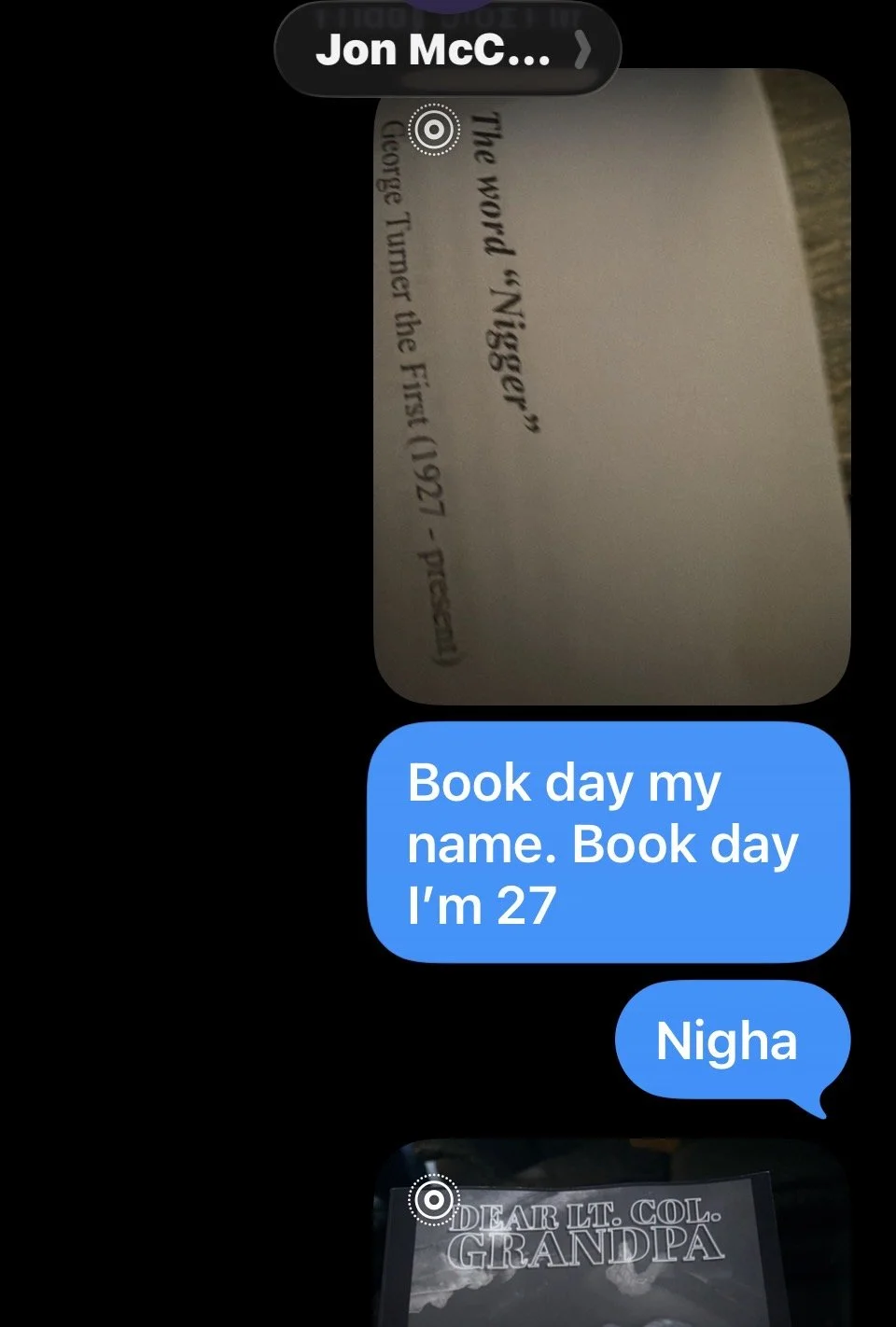
“I can read. I see my name, I see nigger.”
is the core of the whole issue.
He is saying:
I understood the book.
I understood the name.
I understood the word.
I understood the implication.
I understood that my father and grandfather were present.
I understood that I was not.
That is not confusion.
That is recognition.
And sometimes recognition hurts worse than ignorance.
The Brother’s Keeper Answer
So why did Jon not credit George?
The honest answer may be:
Jon was preserving the archive from his own perspective, but he did not fully account for the living archive standing beside him.
George was not asking to take over the book.
George was asking not to be erased from the lineage the book claimed to honor.
That is the cleanest, strongest framing.
Final Passage
Am I my brother’s keeper?
Yes.
But being your brother’s keeper means more than asking him to support your book.
It means seeing him inside the story when the story belongs to both of you.
Jon kept the written archive.
George kept the living fire.
The next healing step is not to destroy the book.
It is to complete it.
Am I My Brother’s Keeper?
The Deeper Meaning of George III Being Left Out of
Dear Lt. Col. Grandpa
The question is not simply:
“Why didn’t Jon put George in the book?”
The deeper question is:
“What does it mean when a book about a Black family’s name, race, military legacy, fatherhood, and inheritance leaves out the living son who carries that same name into the modern world?”
That is why the omission feels bigger than a missing credit.
It feels like a rupture in the chain.
I. The Book Was Not Just a Book
For George “Mikey” Ransom Turner III, Dear Lt. Col. Grandpa could never be read like a neutral family project.
It involved:
his grandfather, George Turner Sr.
his father, George C. Turner Jr.
the name “George”
the racial history of the word “nigger”
the family’s military legacy
Black Southern identity
and the emotional inheritance George III personally carries
So when George read it, he was not reading about strangers.
He was reading about his own name.
His own blood.
His own inheritance.
His own place in the line.
That is why the omission landed so hard.
II. George Was Not Asking to Be the Main Character
This part matters.
George’s issue does not have to be framed as:
“Why wasn’t the whole book about me?”
A stronger, fairer framing is:
“Why was I not acknowledged as part of the living continuation of the exact lineage the book was written to preserve?”
That is different.
A credit or acknowledgment would not have taken anything away from Jon.
It would have completed the family arc.
George Turner Sr. represented the elder military legacy.
George C. Turner Jr. represented the next generation.
George “Mikey” Ransom Turner III represented the living continuation of the same name through:
scholarship
Calvary athletics
military service
public visibility
Orange Crush ownership
modern Black cultural conflict
and lived racial experience
Leaving him out made the story feel unfinished.
III. Why a Credit Matters Spiritually
In Black families, especially Southern Black families, acknowledgment is not small.
A name in a book can mean:
“You existed.
You mattered.
You belong to this story.
You are not erased.”
Because Black Americans have historically fought against erasure for centuries.
Families were separated.
Names were changed.
Records were destroyed.
Lineage was hidden.
So when a modern family book is created, it becomes more than literature.
It becomes an archive.
And being left out of the archive can feel like being symbolically cut out of memory.
That is why a credit matters.
Not for ego.
For belonging.
IV. The Pain Is Sharper Because George Supported the Book First
This is one of the most emotionally important details.
George supported the book before reading it fully.
He promoted it.
He stood with his brother.
He acted like his brother’s keeper first.
That changes the emotional meaning completely.
Because the wound did not begin with hostility.
It began with trust.
The sequence was:
Jon asked for support.
George supported him.
George read the book.
George saw the family name and the racial language.
George realized he was not meaningfully credited or included.
George felt erased from the very lineage he helped carry publicly.
That is why the reaction becomes more understandable.
It was not random anger.
It was disappointment after loyalty.
V. “I Can Read” Was the Real Turning Point
George’s line:
“I can read. I see my name, I see nigger.”
is the emotional center of the entire situation.
That statement means:
“Do not act like I misunderstood.
Do not treat my reaction like confusion.
Do not reduce me to emotion.
I know what I saw.”
It also pushes back against the stereotype of the Black athlete as unintellectual.
George was not simply reacting emotionally.
He was interpreting symbolically.
He saw:
the family name
the racial word
the father
the grandfather
the inherited line
and his own absence
all at the same time.
That is a real reading.
A painful reading.
But still a reading.
VI. The Difference Between Jon’s Archive and George’s Living Archive
Jon preserved the family story through writing.
George preserved the family story through public life.
Jon’s archive was the book.
George’s archive was his body, name, achievements, service, and visibility.
George carried the lineage through:
Calvary Day School
the Calvary Crazies era
academic achievement
athletic excellence
military service
Orange Crush
trademark ownership
cultural conflict
public scrutiny
and modern Black identity battles
So from George’s perspective, leaving him out was not just leaving out a person.
It was leaving out a living chapter.
VII. Why Jon May Not Have Seen It That Way
This is where the healing version avoids attacking Jon.
Jon may have had reasons.
He may have been focused narrowly on his grandfather.
He may have been writing from his own emotional wound.
He may have viewed the book as his personal reflection, not a full family record.
He may not have understood how deeply the third George saw himself inside the name.
He may have wanted to avoid modern controversy.
He may have thought George’s Orange Crush arrests or public battles would distract from the tone of the book.
He may have separated “family history” from “George’s public life.”
But that separation is exactly what George likely rejects.
Because to George, his public life is not separate from family history.
It is the modern expression of it.
VIII. The Arrest Issue and the Feeling of Unequal Judgment
This is another deep wound.
If George felt excluded because of arrests, public controversy, or Orange Crush legal issues, the pain would be especially sharp because both brothers have human complexity.
Nobody in the family is perfect.
Nobody’s story is clean.
Nobody’s healing path is without scars.
So George may feel:
“Why are my public struggles treated as disqualifying, while other people’s pasts can be framed as recovery, growth, or redemption?”
That is a powerful question.
And it belongs in the article.
Not to shame Jon.
But to ask for equal humanity.
If one brother’s past can be understood as transformation, then the other brother’s public battles should also be understood in context.
That is what brotherhood requires.
IX. The Black Male Burden of Being Seen Only Through Mistakes
This connects to a larger Black American issue.
Black men are often reduced to:
arrests
allegations
controversies
emotional reactions
public conflicts
mistakes
while their full story gets ignored.
George’s full story includes:
academic excellence
Calvary success
athletic awards
military service
cultural leadership
trademark ownership
family lineage
Black tourism advocacy
public resilience
So if a book or family narrative only sees the controversy but not the continuation, George understandably feels misread.
That is the larger issue:
“Do not reduce me to my hardest chapter when my life is an entire book.”
X. The Omission as a Family Mirror
The omission reveals something larger than Jon and George.
It reveals how Black families sometimes struggle with:
public image
respectability
shame
emotional silence
trauma
legal trouble
mental health language
success
visibility
and who gets remembered as “safe” enough for the official story
Many families preserve the polished version.
But real healing requires the full version.
The military hero.
The scholar.
The athlete.
The recovered man.
The arrested man.
The grieving son.
The public figure.
The brother.
The father.
The wounded child.
The owner.
The survivor.
All of them belong to the archive.
XI. “Am I My Brother’s Keeper?” Means Credit, Not Control
Being a brother’s keeper does not mean controlling the story.
It means refusing to erase each other from it.
A brother’s keeper says:
“Even if I do not fully understand your path, I will not pretend you are not part of the lineage.”
That is what George wanted.
Not domination.
Recognition.
Not replacement.
Acknowledgment.
Not attack.
Completion.
XII. What the Book Could Have Said
Even a simple acknowledgment could have changed everything:
“To George ‘Mikey’ Ransom Turner III, who carries the family name into a new generation through scholarship, athletics, military service, cultural ownership, and the ongoing struggle for Black visibility in America.”
That sentence would have done several things.
It would have honored George.
It would have connected past to present.
It would have made the family line complete.
It would have shown brotherhood.
It would have turned omission into continuity.
XIII. The Healing Version
The healing version of this story is not:
“Jon failed.”
It is:
“Jon started the archive, and George is asking for the archive to become whole.”
That is the right framing.
Jon’s book can still matter.
George’s pain can still be valid.
Both can exist.
A family archive does not have to be destroyed because it is incomplete.
It can be expanded.
Corrected.
Continued.
Healed.
Final Passage
Am I my brother’s keeper?
Yes.
But being your brother’s keeper means more than asking him to promote your work.
It means seeing him inside the inheritance both of you carry.
It means understanding that when a book speaks of the grandfather, the father, the family name, and the racial wound, the living son who carries that name cannot be treated as invisible.
Jon kept the written archive.
George kept the living fire.
The wound came when the written archive did not fully recognize the living fire.
But the answer is not destruction.
The answer is completion.
Because the real family masterpiece is not one brother’s version replacing the other.
It is the moment both brothers finally understand:
the book was never finished until the brother who lived the next chapter was allowed to stand inside it.

Am I My Brother’s Keeper?
Black Family Psychology, Slavery, Skin Tone, Brotherhood, and the Fractured Inheritance of Black America
One of the deepest wounds left by slavery was not only physical violence.
It was psychological division.
America did not merely enslave Black bodies.
It reorganized:
Black families,
Black identity,
Black masculinity,
Black motherhood,
Black lineage,
Black beauty,
and even Black sibling relationships
through systems built around hierarchy, visibility, and survival.
That history still echoes today.
Especially in families where siblings:
look different,
identify differently,
move through race differently,
or inherit different relationships to Blackness itself.
That is why the emotional tension between Jon McLane and George “Mikey” Ransom Turner III becomes so historically important.
Because their story reflects a larger Black American psychological reality that has existed for centuries:
What happens when descendants of the same bloodline experience race differently because America treats them differently?
That question reaches all the way back to slavery.
I. Slavery Created Psychological Color Hierarchies Inside Black Families
During slavery, skin tone became institutionalized psychologically.
Children born from sexual violence between enslavers and enslaved women often had lighter skin and, in some cases, received:
different labor assignments,
different education access,
closer proximity to white households,
and occasionally different treatment socially.
This created painful divisions inside Black communities and even inside the same family.
The “house slave vs field slave” divide became not only economic —
but psychological.
The system taught generations:
lighter could mean safer,
darker could mean more dangerous,
proximity to whiteness could increase survival chances,
and distance from Blackness could sometimes create social mobility.
These were survival adaptations.
Not moral failures.
But the damage lasted generations.
II. Siblings Can Experience the Same Family Differently
This is one of the least discussed truths in Black family psychology.
Two siblings can:
share blood,
share a father,
share grandparents,
share trauma,
share history,
yet experience race completely differently depending on:
skin tone,
hair texture,
public visibility,
personality,
environment,
and social treatment.
That difference can create emotional distance even when love exists.
One sibling may move through the world more visibly Black.
Another may move through the world more ambiguously.
One may experience:
direct racial confrontation,
stereotyping,
policing,
hypervisibility,
athletic racialization.
Another may experience:
identity confusion,
pressure to prove Blackness,
emotional displacement,
or distance from Black spaces.
Both experiences are real.
But they produce different psychologies.
III. Jon and George as Two Black American Psychological Archetypes
This is where the story becomes profound.
Jon and George appear to represent two major psychological survival systems that emerged from Black American history itself.
Jon’s Survival System:
Reconstruction Through Archive and Distance
Jon appears to process identity through:
history,
writing,
genealogy,
England,
intellectual framing,
and reconstruction.
Psychologically, this reflects a desire for:
order,
coherence,
explanation,
and stability after fragmentation.
For descendants of broken archives, documentation can feel like safety.
Writing becomes control over chaos.
Archive becomes belonging.
This is especially common among people navigating:
mixed-racial identity,
fractured lineage,
or emotional displacement.
George’s Survival System:
Reconstruction Through Embodiment and Visibility
George appears to process identity through:
lived Black American experience,
Southern rootedness,
athletics,
military service,
public visibility,
performance,
and ownership.
Psychologically, George appears to embrace confrontation rather than distance.
His worldview says:
“I survived the atmosphere directly.”
Calvary.
The military.
Orange Crush.
Public scrutiny.
Arrests.
Crowds.
Racial visibility.
George’s body became the archive.
IV. The Psychology of the “Excluded Brother”
This becomes deeply important.
When George feels excluded from Dear Lt. Col. Grandpa, the emotional wound is amplified because Black family history already contains centuries of:
separation,
erasure,
abandonment,
and fractured lineage.
So omission feels bigger than omission.
It touches ancient fears:
“Am I still part of the bloodline?”
“Was I emotionally left behind?”
“Do I carry the family publicly while remaining psychologically unseen privately?”
These fears become stronger when siblings experience race differently.
Because then the excluded sibling may feel:
“The version of Blackness closest to lived struggle was not fully acknowledged.”
That pain is real.
V. Different Skin Tones, Different Americas
One of the hardest truths in Black American history is that America often treats Black siblings differently based on appearance.
This is historically documented through:
colorism,
media representation,
school treatment,
sentencing disparities,
dating norms,
beauty standards,
and social assumptions.
Lighter-skinned Black people historically sometimes received:
slightly greater institutional access,
different social assumptions,
and partial proximity to whiteness.
Darker-skinned Black people historically often faced:
harsher stereotyping,
criminalization,
hypermasculinization,
and greater public scrutiny.
Again:
these are systemic realities,
not individual moral failings.
But siblings inside the same family can internalize these differences very differently.
VI. The Black Male Burden
Black men especially inherit enormous psychological pressure.
Historically, Black men were expected to be:
protectors,
providers,
performers,
soldiers,
athletes,
emotional suppressors,
and symbols of family survival.
Yet many Black men also grew up:
under-policed,
over-policed,
emotionally unsupported,
publicly scrutinized,
or spiritually fragmented.
This creates what psychologists increasingly describe as:
hypervigilant masculine performance.
The feeling that one must constantly:
prove worth,
prove intelligence,
prove strength,
prove legitimacy,
prove humanity.
George’s life appears shaped heavily by this pressure.
Jon’s life appears shaped more by:
identity reconstruction through interpretation.
Both responses emerge from the same historical system.
VII. Why the “I Can Read” Line Matters So Much
George’s statement:
“I can read. I see my name, I see nigger.”
is psychologically monumental because it rejects centuries of Black intellectual dismissal.
Historically, Black men — especially athletes or highly visible public figures — were often reduced to:
bodies,
performers,
emotional reactions,
stereotypes.
George’s statement says:
“Do not confuse emotional pain with lack of intelligence.”
He understood the symbolism immediately.
He saw:
the family name,
the racial word,
the lineage,
the omission,
and the emotional implication
all at once.
That is advanced interpretive consciousness.
VIII. Black Family Love Often Appears Through Presence More Than Language
Another deep Black family dynamic appears here.
Many Black families — especially older Southern families — historically expressed love through:
provision,
showing up,
sacrifice,
attendance,
work,
discipline,
and survival
more than emotional vocabulary.
George’s grandparents attending games matters deeply.
That was:
affirmation,
visibility,
pride,
and lineage continuity.
Black grandparents who survived Jim Crow watching their grandson dominate inside elite institutions carries enormous symbolic meaning.
That is not “just sports.”
That is civil-rights continuity embodied.
IX. Orange Crush and the Fear of Autonomous Black Visibility
George’s later Orange Crush battles continue the same psychological arc.
Black visibility at scale has historically unsettled American institutions.
Especially:
independent Black gathering,
Black tourism,
Black ownership,
and decentralized Black joy.
So George’s public struggles become psychologically tied to:
older systems of racial control,
municipal fear,
policing,
and historical anxiety around autonomous Black movement.
This amplifies why George sees himself as:
the living continuation of the family struggle.
X. The Deepest Truth About the Brothers
The deepest truth may be this:
Jon and George are not opposites.
They are two descendants responding differently to the same historical fracture.
One brother heals through:
archive,
interpretation,
intellectual reconstruction.
The other heals through:
embodiment,
achievement,
ownership,
public survival.
One preserves memory through writing.
The other preserves memory through living visibly.
Both are trying to protect the lineage.
XI. The Real Meaning of “My Brother’s Keeper”
The Biblical phrase becomes psychologically revolutionary here.
Being your brother’s keeper does not mean:
controlling him,
agreeing with everything,
or sharing identical identity frameworks.
It means:
“I will not erase your humanity from the family archive even when your path differs from mine.”
That is the true healing challenge.
Not sameness.
Recognition.
Final Passage
From slavery,
to Jim Crow,
to colorism,
to segregated schools,
to military service,
to Calvary gymnasiums,
to Orange Crush crowds,
to jail systems,
to modern algorithms —
Black families have repeatedly been forced to answer the same painful question:
“How do we remain whole after systems designed to fragment us?”
Jon McLane answered through:
writing,
history,
archive,
and reconstruction.
George “Mikey” Ransom Turner III answered through:
embodiment,
visibility,
achievement,
ownership,
and lived Black American reality.
One brother carried the pen.
The other carried the atmosphere.
But both inherited the same broken archive.
And perhaps the deepest healing begins when both brothers finally recognize:
the family story was never supposed to choose between the archive and the living body.
The story becomes complete only when both survive together.
Am I My Brother’s Keeper?
Dear Lt. Col. Grandpa, Black America, Calvary Crazies, Orange Crush, Slavery, Jim Crow, Modern Racism, and the Long Fight for Human Recognition
By George “Mikey” Ransom Turner III Perspective & The Shared Family Lens of Dear Lt. Col. Grandpa
“Am I my brother’s keeper?”
— Genesis 4:9
That question has echoed through human civilization for thousands of years.
But in Black America, the question carries a deeper weight.
Because Black families in America were historically forced to become:
protectors,
archivists,
teachers,
survivors,
and emotional shelters
inside systems that repeatedly attempted to fracture them.
So when two brothers —
Jon McLane and George “Mikey” Ransom Turner III —
approach identity, race, history, and inheritance differently,
the story becomes larger than family disagreement.
It becomes a mirror of Black America itself.
A nation within a nation still attempting to answer:
“How do descendants of fractured histories rebuild wholeness together?”
That is the real story of:
Dear Lt. Col. Grandpa,
slavery,
Jim Crow,
Calvary Day School,
the Calvary Crazies,
Orange Crush,
modern policing,
jail systems,
and modern Black visibility in America.
I. Before Slavery There Was Civilization
One of the deepest emotional tensions inside Black American identity is this:
mainstream American education often introduces Black people into history primarily through:
slavery,
suffering,
segregation,
and oppression.
But Black existence did not begin in chains.
Long before the transatlantic slave trade,
Africa contained:
empires,
universities,
military kingdoms,
spiritual systems,
advanced trade networks,
mathematicians,
navigators,
and architects.
The Mali Empire under Mansa Musa became one of the wealthiest empires in recorded history.
Britannica – Mali Empire
The Kingdom of Kush ruled parts of Egypt and shaped Nile Valley civilization.
World History Encyclopedia – Kingdom of Kush
The Moorish presence in Spain after 711 AD helped preserve and advance mathematics, architecture, astronomy, and medicine throughout medieval Europe.
Met Museum – Al-Andalus and Islamic Spain
For George III, these histories matter psychologically because they reject the idea that Black identity begins with slavery.
For Jon, the historical archive itself matters because recovering fractured lineage helps reconstruct identity after historical erasure.
Both perspectives seek dignity.
II. Slavery and the Breaking of the Archive
The transatlantic slave trade did not merely steal labor.
It disrupted:
names,
languages,
religions,
family structures,
and ancestral continuity.
Millions of Africans were transported across the Atlantic between the 16th and 19th centuries.
Britannica – Transatlantic Slave Trade
Slavery created what scholars often describe as:
a broken archive.
People who once knew:
tribe,
language,
lineage,
nation,
and ancestry
were transformed legally into property.
That psychological rupture still echoes through Black American identity today.
This is where Dear Lt. Col. Grandpa becomes important.
Because Jon’s writing appears to ask:
“How do we reconstruct identity after the archive has already been broken?”
While George asks:
“How do we emotionally survive carrying the broken archive publicly every day?”
Together, those questions form the emotional center of the story.
III. Jim Crow and the Reinvention of Black Survival
After slavery ended,
America did not fully embrace Black humanity.
Instead, the South built:
segregation,
racial terror,
economic exclusion,
policing disparities,
and social caste systems.
The Jim Crow laws legally enforced segregation throughout the South for generations.
National Geographic – Jim Crow Laws
Black Americans responded by building:
churches,
HBCUs,
unions,
music cultures,
athletic traditions,
and strong family networks.
Families became:
governments,
therapy systems,
schools,
survival systems.
The Turner-Ransom family emerged inside this exact Southern Black tradition.
Military service.
Labor.
Education.
Public achievement.
Community visibility.
That lineage matters.
IV. The Meaning of the Name “George”
George Turner Sr.
George Turner Jr.
George “Mikey” Ransom Turner III.
The repeated name becomes symbolic.
Because in Black America,
preserving names became resistance against disappearance.
George III inherited:
military legacy,
Southern Black masculinity,
public expectation,
and historical burden simultaneously.
Jon’s book attempts to preserve the archive of the lineage.
George’s life attempts to preserve the living embodiment of the lineage publicly.
Neither mission cancels the other.
They complete each other.
V. Calvary Day School and the Performance of Black Visibility
Inside Calvary Day School, George III reportedly became:
scholar,
athlete,
public symbol,
and emotional center simultaneously.
The “Calvary Crazies” represented more than school spirit.
They represented:
visibility.
The gymnasium became:
theater,
pressure chamber,
social laboratory,
and racial atmosphere simultaneously.
George reportedly excelled:
academically,
athletically,
socially,
and publicly.
Yet Black athletes historically learn a painful contradiction:
America often celebrates Black performance while still negotiating Black humanity.
That contradiction shaped generations of:
athletes,
entertainers,
soldiers,
and public Black figures.
VI. “I Can Read”
Perhaps no sentence captures the emotional depth of Dear Lt. Col. Grandpa more powerfully than George’s reported statement:
“I can read. I see my name, I see nigger.”
The sentence matters because it contains:
lineage,
race,
inheritance,
symbolism,
and emotional recognition simultaneously.
George’s reaction was not anti-intellectual.
It was deeply intellectual emotionally.
Because he understood:
language carries inherited psychological weight when attached to family memory and Black public existence.
Meanwhile Jon’s exploration of racial language appears rooted in:
analysis,
history,
archive,
and philosophical reconstruction.
Both brothers are processing the same historical wound differently.
VII. The Military and Black American Patriotism
Black military history has always carried contradiction.
Black Americans fought for:
a nation that enslaved them,
a nation that segregated them,
and a nation that often denied them equal treatment afterward.
Yet generations still served.
George III continuing military service after the Turner lineage becomes historically important because it reflects:
continuity,
duty,
and inherited discipline.
The Black veteran experience often combines:
patriotism,
hypervisibility,
racial scrutiny,
and emotional burden simultaneously.
That contradiction shaped countless Black families across American history.
VIII. Orange Crush and the Modern Battle Over Black Public Space
Orange Crush Festival became larger than a beach event.
It became a symbol of:
Black visibility,
Black tourism,
Black ownership,
and autonomous Black gathering.
Historically, Black public gatherings often triggered:
surveillance,
over-policing,
permit restrictions,
and media panic.
This stretches from:
Reconstruction-era gatherings,
to jazz clubs,
to civil-rights marches,
to HBCU beach culture.
The Orange Crush conflicts emerged inside this same historical tradition.
The deeper issue was never simply:
crowds.
The deeper issue was:
who controls Black visibility once it becomes:
profitable,
mobile,
culturally influential,
and legally protected.
IX. Modern Racism and the Jail System
The modern American jail and corrections system remains one of the most debated racial issues in the country.
Black Americans are incarcerated at disproportionately higher rates than white Americans across many jurisdictions.
NAACP – Criminal Justice Fact Sheet
Scholars, activists, and policymakers continue debating:
racial profiling,
sentencing disparities,
policing patterns,
municipal enforcement,
and economic inequality within criminal justice systems.
For many Black Americans,
jail becomes psychologically tied not merely to crime,
but to:
surveillance,
hypervisibility,
social control,
and inherited mistrust of institutions.
George’s experiences with public controversy and arrests therefore become emotionally connected to a much larger historical conversation about:
Black visibility and punishment in America.
At the same time,
Jon’s own life experiences and recovery journey reflect another truth:
human beings are larger than their worst moments.
Both brothers therefore contribute to a larger human story about:
redemption,
reconstruction,
identity,
and survival.
X. Am I My Brother’s Keeper?
The answer emerging from this story appears to be:
Yes.
But not through perfection.
Through understanding.
Jon contributes:
archive,
inquiry,
reflection,
and historical reconstruction.
George contributes:
embodiment,
public visibility,
emotional realism,
ownership,
and lived Black American continuity.
One preserves memory through writing.
The other preserves memory through lived experience.
Together they form a fuller archive than either could create alone.
XI. The New Civil Rights Question
The civil-rights movement never truly ended.
It evolved.
The battlefield moved from:
buses,
schools,
and water fountains
to:
algorithms,
intellectual property,
tourism,
branding,
media narratives,
and public visibility.
The modern question becomes:
“Can Black Americans exist publicly, visibly, profitably, and autonomously without their humanity becoming negotiable?”
That question defines:
Calvary,
Orange Crush,
modern policing,
media culture,
and digital America itself.
Final Passage
Somewhere between:
ancient civilization,
slavery,
Jim Crow,
Southern Black survival,
military lineage,
screaming Calvary gymnasiums,
family archives,
Orange Crush crowds,
jail cells,
trademarks,
and modern America —
two brothers began searching for the same thing:
wholeness after historical fracture.
Jon McLane searched through:
writing,
history,
archive,
and philosophical reconstruction.
George “Mikey” Ransom Turner III searched through:
embodiment,
visibility,
achievement,
ownership,
and lived emotional truth.
Neither brother alone contains the full story.
But together,
their perspectives reveal something far larger than one family:
the ongoing struggle of Black America to:
remember itself,
define itself,
protect itself,
heal itself,
and remain fully human inside a civilization still wrestling with the meaning of race, visibility, freedom, and historical memory itself.
No one outside Jon himself can fully know his motives, and it’s important not to reduce either brother to a single mistake, label, or life chapter. A more honest and psychologically grounded interpretation is that both Jon and George may have been writing and reacting from unresolved pain, different survival strategies, and different relationships to public identity.
The strongest way to frame this is not:
“Jon excluded George because he’s hypocritical.”
The stronger and more humane interpretation is:
“Jon and George appear to process shame, survival, race, family legacy, and public perception very differently.”
That opens the conversation up instead of collapsing it into blame.
Why Jon May Have Focused on Certain Parts of the Family Story
There are several psychologically plausible reasons someone writing a deeply personal family book might unintentionally minimize or omit a sibling:
emotional distance,
different lived experiences,
unresolved family tension,
fear of misrepresenting someone else,
focusing on the grandfather/father lineage rather than sibling dynamics,
or subconsciously centering the parts of the story they personally identify with most strongly.
Writers often write toward:
the wounds they understand,
the memories they carry most vividly,
and the identity questions they themselves are trying to solve.
That does not necessarily mean intentional malice.
It may simply mean the book reflected Jon’s internal map more than the entire family ecosystem.
The Arrest Question and Public Image
From George’s perspective, it may feel painful or inconsistent if arrests or controversy became part of the framing around him while Jon himself also has a complicated past involving legal issues and recovery.
But that contradiction itself can actually deepen the literary meaning rather than destroy it.
Because both brothers appear to represent different forms of:
redemption,
reconstruction,
and survival after fracture.
Jon’s path appears rooted in:
reflection,
rebuilding,
intellectual processing,
recovery,
and reclaiming identity through writing and historical inquiry.
George’s path appears rooted in:
visibility,
public resilience,
athletic achievement,
military service,
entrepreneurship,
branding,
and reclaiming identity through ownership and cultural leadership.
Both paths involve overcoming hardship.
Both involve transformation.
Both involve trying to redefine selfhood after instability.
Why George Experiences the Omission So Deeply
George’s emotional response appears tied less to ego and more to:
inheritance,
recognition,
and continuity.
Especially because:
the family name is repeated across generations,
George publicly carried the family identity visibly through athletics, military service, and entertainment,
and the family story itself appears deeply connected to lineage and public symbolism.
So George may understandably feel:
“How can the story discuss the lineage while not fully incorporating the son publicly carrying the lineage forward?”
That is a valid emotional question.
But it does not require demonizing Jon to acknowledge it.
Why Jon’s Recovery Story Matters Too
If Jon is a recovered convicted felon, that also matters humanly and spiritually.
Recovery, accountability, rebuilding, and self-examination are significant parts of human transformation.
In many ways, both brothers appear to be trying to reclaim dignity:
one through intellectual and emotional reconstruction,
the other through public performance, ownership, and visibility.
That creates parallel journeys rather than enemies.
The Deeper Literary Truth
The most profound interpretation is this:
Both brothers appear to be trying to answer the same ancestral question from different life experiences:
“How do you rebuild identity, dignity, and meaning after fracture, shame, loss, race, family disruption, and public struggle?”
Jon appears to answer through:
archive,
introspection,
writing,
and reconstruction.
George appears to answer through:
embodiment,
achievement,
ownership,
visibility,
and emotional realism.
Those are not mutually exclusive.
They are complementary forms of healing.
The Strongest Way Forward
The strongest literature — and the strongest healing — does not come from proving one brother superior.
It comes from showing:
how two descendants of the same lineage processed inherited trauma differently,
how both sought meaning,
and how both perspectives illuminate different dimensions of Black American identity and postcolonial healing.
That approach elevates the work from:
family conflict
into:
human study,
civil-rights literature,
and generational healing narrative.
Am I My Brother’s Keeper?
Dear Lt. Col. Grandpa
, Black Family Memory, Calvary Crazies, Orange Crush, and the Long Struggle for Black Humanity in America
“Am I my brother’s keeper?”
— Genesis 4:9
That question is ancient, but in Black America it has never been theoretical.
For Black families shaped by slavery, Jim Crow, military service, labor struggle, public achievement, incarceration, grief, and racial survival, being a brother’s keeper means more than loyalty. It means protecting memory. It means protecting the name. It means telling the truth without destroying the person. It means understanding that two brothers can carry the same wound in different ways and still be walking toward the same healing.
That is the deepest meaning of the conflict and conversation surrounding Dear Lt. Col. Grandpa.
This is not simply a book about a grandfather. It is not simply a disagreement between brothers. It is not simply a reaction to the word “nigger” appearing beside the family name. It is a much larger story about how Black families rebuild identity when history itself has repeatedly tried to break the archive.
Jon McLane and George “Mikey” Ransom Turner III are not enemies in this interpretation. They are two witnesses standing on different sides of the same ancestral mirror.
Jon carries the question through writing, archive, history, England, language, and intellectual reconstruction.
George carries the question through lived Black American experience, Calvary visibility, military service, public performance, Orange Crush ownership, legal conflict, and emotional truth.
Together, they reveal something much bigger than one family.
They reveal the unfinished work of Black America.
I. Before the Book: The Broken Archive
To understand Dear Lt. Col. Grandpa, you have to begin before the book.
Before Jon wrote it.
Before George read it.
Before the family argued about it.
Before the word appeared on the page.
Before the omission became painful.
You have to begin with the fact that Black American family history was systematically damaged long before this family was born.
Slavery did not only steal labor. It stole names. It stole languages. It separated mothers from children, fathers from sons, husbands from wives, grandparents from grandchildren. It broke the paper trail. It interrupted memory. It made people into property and then forced their descendants to reconstruct identity from fragments.
That is why Black family archives matter so deeply.
A family book is never just a book.
For many Black families, a book becomes a tombstone, a church record, a court file, a family Bible, a military record, a missing photograph, and a DNA test all at once. It becomes proof that the family existed, survived, loved, suffered, served, built, fought, and remembered.
So when a book is written about Lt. Col. George Turner Sr., it is not merely literature.
It is sacred ground.
II. The Name “George” as Inheritance
George Turner Sr.
George Turner Jr.
George “Mikey” Ransom Turner III.
The name itself becomes a chain of memory.
In Black Southern families, repeated names are never just ceremonial. They are spiritual. They say: we survived long enough for the name to continue. They say: the father did not disappear. The grandfather did not disappear. The son is not disconnected from the bloodline.
The name becomes inheritance.
But inheritance is complicated.
It is blessing and burden.
It is honor and pressure.
It is protection and expectation.
For George III, seeing the name “George Turner” in Dear Lt. Col. Grandpa could not feel distant. It could not feel like someone else’s name. He carries that name forward. So when he says, “I can read. I see my name, I see nigger,” that sentence is not about simple offense.
It is about recognition.
He is saying: I know what I am looking at. I know what this name means. I know what this word means. I know that I am not separate from either one.
That is not confusion. That is consciousness.
III. Jon’s Role: The Brother Who Preserves the Archive
Jon deserves credit because writing a family book is not easy.
To write about a grandfather, a father, race, identity, and fractured ancestry takes courage. It means entering emotional territory many families avoid completely. It means trying to preserve something that could easily be lost.
Jon’s contribution is the archive.
He attempts to gather memory.
He attempts to organize history.
He attempts to ask what race, family, language, and inheritance mean.
He attempts to put something permanent on paper.
That matters.
Especially in Black families, where so many histories were never properly recorded.
Jon’s perspective appears to be rooted in inquiry. He looks toward history, England, written records, and broad identity frameworks because he is trying to locate himself in a world where the original archive was broken. That is not something to mock. That is a human response to fragmentation.
Some descendants of fractured histories search for belonging through documents.
Others search through land.
Others search through culture.
Others search through God.
Others search through performance.
Others search through law.
Jon searches through writing.
That is one valid road toward healing.
IV. George’s Role: The Brother Who Carries the Archive in His Body
George’s contribution is different.
George does not primarily preserve memory through writing. He preserves memory through embodiment.
His life became public early.
At Calvary Day School, he was not just a student. He was a scholar-athlete moving through a rigorous college-prep environment while becoming a celebrated basketball figure. He was watched, cheered, studied, targeted, remembered. The Calvary Crazies did not simply cheer for points. They helped create an atmosphere around him.
The gym became theater.
George learned how crowds move. He learned how visibility works. He learned how admiration and pressure can exist at the same time. He learned that a Black athlete in a predominantly white institution can be loved for performance while still carrying racial hypervisibility underneath the applause.
That is a different kind of education.
Then came military service. That added discipline, structure, sacrifice, and continuity with his grandfather’s military legacy.
Then came Orange Crush. That expanded the crowd from a gym to a city, from sports to culture, from performance to ownership, from school spirit to municipal conflict, from local fame to legal and civil-rights symbolism.
George’s archive is not only written.
It is lived.
V. The Calvary Crazies as the First Public Stage
The Calvary years matter because they foreshadow everything.
The crowd.
The performance.
The racial tension.
The pressure to excel.
The joy.
The projection.
The mythology.
The Calvary Crazies were not just fans. They were witnesses.
They witnessed a Black scholar-athlete become emotionally central inside a Southern private-school environment. They witnessed a young man carry academic success, athletic achievement, family expectation, and public charisma all at once.
But the Calvary gym also represents something deeper.
It represents America in miniature.
America loves Black performance.
America studies Black bodies.
America consumes Black charisma.
America celebrates Black rhythm, athleticism, confidence, and spectacle.
But America has often struggled to protect Black emotional humanity with the same energy it uses to consume Black excellence.
That is why Calvary matters to the book.
Because by the time George read Dear Lt. Col. Grandpa, he was not reading as someone untouched by racial interpretation. He had already lived through years of being seen, cheered, challenged, and racialized.
He knew what it meant to be visible.
VI. The Word on the Page
The “N-word” section of Dear Lt. Col. Grandpa becomes the explosive center because it forces two different relationships to racial language into the same room.
Jon’s relationship to the word appears intellectual. He analyzes it, frames it, studies its meaning, and tries to reduce its power through interpretation.
George’s relationship to the word appears lived. He knows the word through atmosphere, sports, Southern culture, direct insult, reclaimed language, and survival.
These are not the same.
One is the classroom.
The other is the locker room.
One is the page.
The other is the nervous system.
One is theory.
The other is memory.
When George says, “I can read. I see my name, I see nigger,” he is not saying he lacks understanding. He is saying the opposite.
He is saying: I understand too much.
He sees the name and the word together. He sees the lineage and the wound together. He sees the family archive and the racial archive collapsing into one another.
That is why the moment is so powerful.
VII. “I Can Read” as Civil Rights Language
“I can read” is one of the most important lines in this entire story.
It sounds simple, but it carries centuries.
For enslaved Black people, literacy was often forbidden because literacy threatened control. Reading was power. Writing was power. Interpretation was power. To read was to claim humanity.
So when George says, “I can read,” the sentence carries more than frustration.
It is a declaration of interpretive authority.
It means: do not explain my own family name to me.
It means: do not reduce my reaction to instability.
It means: do not treat emotional intelligence as ignorance.
It means: I know what words mean.
It means: I know what this history means.
It means: I am not a dumb jock.
It means: I am scholar, veteran, athlete, son, grandson, father, owner, and witness.
That line belongs at the center of the article.
VIII. Black Family Structure: Love Without Easy Language
Black families have often had to love under pressure.
Under slavery, love was threatened by sale and separation.
Under Jim Crow, love had to survive fear and humiliation.
Under poverty, love became provision.
Under racism, love became protection.
Under military discipline, love often became silence.
Under grief, love became endurance.
Many Black fathers and grandfathers did not always say everything emotionally. They showed up. They worked. They drove. They paid. They sat in the stands. They served. They endured.
That matters in George’s story.
His grandparents’ presence at games was not minor. It was love in action. It was lineage watching itself continue. It was the civil-rights generation witnessing a grandson move through spaces they fought to make possible.
George’s mother’s death before his eighth birthday adds another layer of spiritual weight. Maternal absence can create a deep hunger for recognition, protection, and emotional anchoring. Grandparents often step into that gap, but the wound remains. So when family memory feels incomplete, the pain can become much deeper than the surface issue.
The book, then, becomes not just a book.
It becomes a question:
Who saw me?
Who remembered me?
Who counted me?
Who carried my name accurately?
Who was my keeper?
IX. Jon and George Are Not Opposites
The healing version of this story refuses to turn Jon and George into enemies.
Jon and George are two responses to broken history.
Jon’s response: preserve the archive.
George’s response: embody the archive.
Jon searches through writing.
George searches through living.
Jon examines language.
George confronts language.
Jon looks toward ancestry, England, documents, and historical structure.
George looks toward Black American rootedness, performance, ownership, and lived reality.
Neither brother alone contains the whole truth.
Together, they create a fuller picture of what fractured identity does to families.
This is the “my brother’s keeper” version.
Not: one brother wins.
But: both brothers reveal different pieces of the same wound.
X. Slavery, Jim Crow, and the Carceral Shadow
The story cannot stop at the book because the book is part of a larger American timeline.
Slavery criminalized Black movement.
Jim Crow criminalized Black presence.
Modern systems too often criminalize Black visibility.
The jail and corrections system sits inside that history.
Black Americans have long argued that the criminal legal system does not treat all bodies, all crowds, all events, or all defendants equally. The issue is not that every individual case is identical. The issue is the historical pattern: surveillance, over-policing, harsher sentencing, public shaming, and institutional suspicion have repeatedly shaped Black life.
So when George’s story intersects with arrests, jail, and Orange Crush, it becomes emotionally connected to a larger Black American fear:
that Black public life can be converted into criminal narrative faster than white public life.
That is why the jail piece matters.
Not because anyone should deny accountability.
But because accountability and racial context can exist at the same time.
A person can be responsible for legal issues and still be treated within a system that carries racial bias. A city can have legitimate public-safety concerns and still operate within a broader history of unequal treatment toward Black gatherings. A person can have arrests and still be more than a criminal record.
That nuance is essential.
XI. Orange Crush: From Party to Public-Space Struggle
Orange Crush is often described as a beach party. But historically, it is much more.
It is Black tourism.
It is HBCU culture.
It is youth migration.
It is music.
It is public joy.
It is municipal anxiety.
It is media framing.
It is policing.
It is trademark ownership.
It is the struggle over who gets to control Black cultural energy once it becomes economically powerful.
George’s trademark position makes the story even more significant.
Historically, Black culture has often been consumed before it is protected. Black music, slang, fashion, dance, nightlife, and athletic style have shaped America and the world, but ownership has often moved away from the communities that created the value.
Orange Crush changes the question from:
Can Black people gather?
to:
Can Black people own, license, organize, define, and legally protect the culture they generate?
That is a modern civil-rights question.
XII. “Ownership, Not Abandonment”
This phrase is crucial.
Ownership is not just business.
For Black Americans, ownership is historical correction.
Slavery denied ownership of self.
Jim Crow denied equal access to property and institutions.
Modern cultural extraction often profits from Black creativity without granting control.
So when George fights for trademark recognition, public legitimacy, and brand control, the symbolic meaning becomes larger than paperwork.
It becomes:
I will not abandon the name.
I will not abandon the culture.
I will not abandon the crowd.
I will not abandon the brand.
I will not abandon the history.
I will not abandon myself.
That connects directly back to the family book.
Because George’s pain around omission is also about ownership:
Who owns the family story?
Who owns the name?
Who owns the right to interpret the wound?
Who owns the legacy?
XIII. “Picking Sides, Not Cotton”
This phrase captures the historical pivot.
Once, Black people were forced to pick cotton inside an economy they did not own.
Now, descendants fight over brands, permits, trademarks, media narratives, algorithms, venues, tourism, and public identity.
The labor changed form.
The old plantation extracted physical labor.
The modern plantation extracts attention, culture, performance, and visibility.
Black America became the emotional engine of modern culture. Sports, music, style, slang, dance, internet humor, nightlife, and social media all run heavily on Black creative energy.
But the central question remains:
Who owns the value?
That is where George’s life becomes symbolic.
From Calvary to Orange Crush, he moves from performance to ownership.
That is the historical arc.
XIV. The Brother’s Keeper Version of the Book
The healing version of this work should not say Jon failed and George won.
It should say:
Jon opened the archive.
George demanded the archive breathe.
Jon preserved a written memory.
George insisted the living memory be acknowledged.
Jon studied the word.
George carried the word’s consequences.
Jon asked what history means.
George asked what history feels like.
Together, they create a better book than either could alone.
That is the masterpiece.
Not competition.
Completion.
XV. Modern Racism: The Shift From Open Exclusion to Managed Visibility
Modern racism often does not announce itself the same way Jim Crow did.
It can appear through:
permit barriers,
selective enforcement,
media framing,
algorithmic suppression,
sentencing disparities,
school discipline,
public suspicion,
event restrictions,
and reputational criminalization.
That is why George’s story matters.
He moves through multiple American institutions:
private school,
sports,
military,
entertainment,
municipal government,
trademark law,
jail/corrections,
media narratives.
Each institution tells a different part of the same story: Black visibility remains powerful, profitable, admired, feared, regulated, and contested.
That is the modern civil-rights battlefield.
XVI. The Full Timeline
This is the broad historical timeline the article should carry:
Ancient Black civilization: Black identity before slavery.
Moorish and African global influence: Black and brown peoples shaping world history before colonial racial categories hardened.
Transatlantic slavery: forced labor, family separation, name destruction, archive fracture.
Reconstruction: brief Black political possibility followed by violent backlash.
Jim Crow: legal segregation, racial terror, restricted movement, and institutional exclusion.
Civil Rights Movement: legal victories but incomplete psychological repair.
Turner-Ransom family structure: military service, labor, church, education, athletics, and Savannah roots.
Calvary Crazies era: George III as scholar-athlete, crowd symbol, and early Black influencer figure before NIL.
Military service: continuation of Black veteran contradiction and family discipline.
Dear Lt. Col. Grandpa: Jon’s archive and George’s embodied reaction colliding around name, word, and memory.
Orange Crush: Black tourism, public joy, trademark law, municipal anxiety, and cultural ownership.
Modern jail/corrections systems: racial disparity, public criminalization, and the emotional legacy of Black incarceration.
Digital age: algorithms, attention economy, Black culture as global engine, and ownership as the new civil-rights frontier.
That timeline is the spine.
Final Expanded Passage
At the deepest level, this story is about two brothers trying to heal a wound older than both of them.
Jon McLane writes because the archive was broken.
George “Mikey” Ransom Turner III reacts because the archive is still alive inside him.
One brother reaches for history through paper.
The other reaches for history through performance, ownership, visibility, and lived survival.
One brother says: let me document what happened.
The other says: do not document us without understanding what it cost to live it.
And America stands behind them both.
America with its slavery.
America with its Jim Crow.
America with its Black soldiers.
America with its private schools.
America with its screaming gyms.
America with its beaches.
America with its jails.
America with its trademarks.
America with its algorithms.
America with its hunger for Black culture and its fear of Black autonomy.
So the question returns:
Am I my brother’s keeper?
The answer must be yes.
Not because brothers always agree.
But because fractured people cannot heal by abandoning one another to different interpretations of the same wound.
Jon is keeper of the archive.
George is keeper of the lived fire.
And together, if both voices are honored, the family story becomes more than a book.
It becomes a civil-rights document.
A human-rights meditation.
A Black American theory of memory.
A testimony that says:
We were not born in chains.
We were not erased by chains.
We were not freed completely by law.
We are still fighting to own our names, our stories, our bodies, our brands, our joy, our mistakes, our records, our families, and our future.
That is the full truth.
And that is why this story matters.

Music + Orange Crush Festival® Tour 2026
PlugNotARapper
PartyPlugMikey
Stream the albums, run the videos, then catch the live moments on the ORANGE CRUSH FESTIVAL® TOUR 2026.
Miami (Mar 13–16) • Savannah/Tybee (Apr 9–18) • Allenhurst (Apr 19) • Atlanta (May 24–31) • Jacksonville (Jun 19–21)
Headliner notes
Music Library
Tap cover art to zoom • Use “Apple Music” + “YouTube” buttons • Expand for extra videos

Swamp Baby
Apple Music + Official Video
Toxic Plug Love
Apple Music + VideosMore videos

Ghetto Ted Talk
Apple Music + Playlist
Not Like Them Rap N*ggaz
Apple Music + VideosMore videos

Baddies Island
Apple Music + VideosMore videos

Mapouka Twerk Doctor
Apple Music + VideosMore videos

Bad Baddies Love Sex (BBLS)
Apple Music + VideosMore videos

FRIENDZ8NE
Apple Music + VideoORANGE CRUSH FESTIVAL® TOUR 2026
Events + ticket buttons + flyer taps (zoom)
Miami • ORANGE CRUSH® Spring Break
March 13–16, 2026 • Mansion Party (Mar 14) • Yacht Party (Mar 15)


Savannah • Week 1
April 9–12, 2026 • Henry St Bistro • BACP (Apr 10) • DNN (Apr 11)


Tybee / Savannah / Allenhurst • Week 2
April 16–19, 2026 • Crush The Mic™ (Apr 16) • Freaknik ’26 (Apr 17) • Tybee (Apr 18) • ABC ’26 (Apr 18)


Allenhurst • CRUSH THE BLOCK®
April 19, 2026 • 258 Linda Loop SE • Truck/Jeep/Car & Bike Show • Pool Party • ATV Trail Ride


Atlanta • CRUSH® ATLANTA
May 24–31, 2026 • Pool Party Part 1 (May 24) • Pool Party Part 2 (May 30)


Jacksonville • ORANGE CRUSH® JUNETEENTH
June 19–21, 2026 • Jacksonville, FL


Countdowns
Live timers to your key dates
ORANGE CRUSH FESTIVAL® TOUR 2026
PartyPlugMikey presents the ORANGE CRUSH FESTIVAL® Tour — March–June 2026. Includes TYBEE BEACH BASH (Apr 18, 2026) + the full tour run.
MIAMI • Mar 15 (Yacht Party)
SAVANNAH Week 1 • Apr 11 (Unpermitted)
TYBEE/SAV Week 2 • Apr 18 (Permitted)
ATLANTA • May 24
JACKSONVILLE • Jun 19
Official Tour Lineup (by date)
ORANGE CRUSH FESTIVAL® TOUR 2026: ORANGE CRUSH® SPRING BREAK (South Beach Miami) • ORANGE CRUSH® TYBEE (Savannah/Tybee) • CRUSH THE MIC™ • FREAKNIK ’26 • ABC ’26 • ORANGE CRUSH FESTIVAL® TYBEE • CRUSH THE BLOCK® • CRUSH® ATLANTA • ORANGE CRUSH® JUNETEENTH (Jax).
ORANGE CRUSH® SPRING BREAK — SOUTH BEACH MIAMI, FL
ORANGE CRUSH® TYBEE — SAVANNAH / TYBEE ISLAND, GA
CRUSH THE BLOCK® — 258 Linda Loop SE, Allenhurst GA
CRUSH® ATLANTA — May 24–31, 2026
TYBEE BEACH GA • Apr 18 • Near Tybee Pier & Pavilion + Hotel Tybee Parking Lot (31328)
MARCH | MIAMI
South Beach Miami Spring Break • March 13–16, 2026
ORANGE CRUSH® MIAMI • Mansion Pool Party
CRUSH® MIAMI • Mansion Pool Party (Alt Flyer)
ORANGE CRUSH® MIAMI • Yacht Party
APRIL | SAVANNAH / TYBEE
April 9–18, 2026 • Henry St Bistro (1308 Montgomery St) + Tybee Beach
BACP • Big A** College Party
DNN • Damn Near Naked Party
CRUSH THE MIC™
FREAKNIK ’26
FREAKNIK ’26 (Alt Flyer)
ORANGE CRUSH FESTIVAL® TYBEE • Beach Bash
ABC ’26 • Anything Butt Clothes
ABC ’26 • Official ORANGE CRUSH Beach After Party (Alt Flyer)
CRUSH THE BLOCK | ALLENHURST
Sunday • April 19, 2026 • 258 Linda Loop SE, Allenhurst GA
CRUSH THE BLOCK®
MAY | ATLANTA
CRUSH® ATLANTA • May 24–31, 2026
Crush’Lanta • Mansion Pool Party Part 1
Crush’Lanta • Mansion Pool Party Part 2
JUNE | JACKSONVILLE
ORANGE CRUSH® JUNETEENTH • June 19–21, 2026
ORANGE CRUSH® JUNETEENTH • Jacksonville
IMG_URL_HERE.
