
ORANGE CRUSH: AN ORAL HISTORY OF A SOUTHERN CULTURAL PHENOMENON
ORANGE CRUSH: AN ORAL HISTORY OF A SOUTHERN CULTURAL PHENOMENON
Before the hashtags, viral videos and algorithms, there was word of mouth. Before everybody carried a camera, there were stories. And before Orange Crush became a name capable of stirring nostalgia, controversy and conversation, it was something much simpler:
Black college students finding each other.
By CRUSH Magazine
There are certain events people remember by year.
There are others they remember by feeling.
Orange Crush belongs to the second category.
Ask enough people about it and eventually somebody’s face changes.
They don’t immediately give you a date.
They tell you what they were wearing.
They remember the car they drove.
They remember who rode with them.
They remember squeezing too many people into a hotel room because nobody was spending all that money just to sleep.
They remember the music before they remember the address.
They remember traffic.
They remember rims.
They remember swimsuits.
They remember cameras coming out before cameras lived permanently inside everyone’s hand.
They remember Savannah.
They remember Tybee.
And almost inevitably, they smile.
“You had to be there.”
Those five words may explain Orange Crush better than any advertisement ever could.
Because long before Orange Crush became something debated in government meetings, covered by news organizations, discussed across social media or transformed into a modern entertainment brand, it existed through participation.
People made it important by showing up.
And then they went home and told somebody else.
BEFORE “VIRAL” HAD A NAME
There was a time when thousands of young people could descend on a destination without an algorithm telling them where to go.
No TikTok.
No Instagram Story.
No influencer campaign.
No location tag broadcasting the party in real time.
Information traveled differently.
A flyer.
A phone call.
A dorm-room conversation.
A promoter.
A DJ.
A friend at another school.
A cousin who had gone the year before.
Somebody saying:
“You coming to Crush?”
That was enough.
Orange Crush emerged from the world of Black college social culture in Savannah, Georgia—a city already carrying generations of Black history, Gullah Geechee influence, Southern tradition, tourism, music, military life and college culture.
Savannah provided the gathering place.
Nearby Tybee Island provided the beach.
And generations of young Black people supplied the energy.
What developed over time became larger than a single party.
Orange Crush became a ritual.
THE ROAD TO TYBEE
Part of the Orange Crush experience happened before anybody touched the sand.
You had to get there.
For generations of attendees, the journey itself became part of the memory.
Cars packed with friends.
Music turned all the way up.
Gas-station stops.
Last-minute outfits.
Phones ringing.
People trying to figure out where everybody else was.
And traffic.
Lots of traffic.
The road toward Tybee could become its own moving car show.
Paint.
Rims.
Convertibles.
Motorcycles.
SUVs packed with people.
License plates arriving from different corners of Georgia and beyond.
Some people came for the beach.
Some came for the party.
Some came because everybody else was coming.
And some came simply because Orange Crush had become one of those experiences young people wanted to say they had lived at least once.
WHAT WE WORE
Every generation leaves behind a uniform.
Look through photographs associated with different Orange Crush eras and the evolution of Black Southern style becomes visible.
Oversized clothes gave way to fitted eras.
Airbrushed shirts had their moment.
Designer labels changed.
Sneakers changed.
Hair changed.
Swimsuits changed.
Sunglasses changed.
Cars changed.
Phones changed.
But one thing remained remarkably consistent:
People came to be seen.
The beach was a runway without pretending to be one.
There were no velvet ropes separating the audience from the spectacle.
The audience was the spectacle.
Everybody had a role.
The person with the loudest car.
The friend who somehow knew everybody.
The DJ.
The promoter.
The photographer.
The woman whose outfit people remembered after the weekend ended.
The guy doing something ridiculous enough to become a story for the ride home.
Orange Crush produced characters without casting them.
THE SOUND OF CRUSH
You can understand an era by listening to what came through its speakers.
Orange Crush evolved alongside Southern hip-hop.
As Atlanta became one of the world’s most important music capitals and Southern rap transformed popular culture, the soundtrack surrounding Black college life changed with it.
Bass mattered.
Car speakers mattered.
Mixtapes mattered.
DJs mattered.
Songs could become attached permanently to summers, relationships, road trips and specific weekends.
Long before streaming platforms could instantly identify what everybody was listening to, songs traveled through cars, clubs, burned CDs, radio, mixtapes and people simply asking:
“What song is that?”
For many attendees, remembering Orange Crush means remembering sound.
Not just music.
Engines.
Crowds.
Waves.
Laughter.
Arguments.
People yelling across parking lots.
The strange collective roar created when thousands of individual weekends occupy the same place.
THE CAMERA CHANGED EVERYTHING
Early Orange Crush existed in an era when experiences could disappear.
Maybe somebody brought a disposable camera.
Maybe somebody had a camcorder.
Maybe somebody developed pictures weeks later.
Maybe the wildest thing that happened all weekend was never photographed at all.
That scarcity gave early memories a particular power.
People had to tell stories.
Then technology changed.
Digital cameras became common.
Camera phones improved.
Facebook albums documented entire weekends.
Twitter accelerated information.
Instagram transformed attendees into photographers.
Snapchat made documentation instantaneous.
TikTok eventually turned moments into globally distributable clips.
Orange Crush moved from something you heard about to something you could watch unfold from hundreds of miles away.
That changed the event.
It also changed memory itself.
The older Orange Crush becomes, the more important its surviving photographs, flyers, videos and firsthand accounts become.
They are no longer simply party memorabilia.
They are cultural artifacts.
SAVANNAH WAS NEVER JUST THE BACKDROP
To understand Orange Crush, you have to understand Savannah.
Savannah is one of America’s most visually recognizable cities, but its beauty has always existed alongside deeper histories.
Black Savannah is not decoration around the city’s tourism industry.
It is foundational to the city itself.
Families.
Churches.
Neighborhoods.
Longshoremen.
Educators.
Artists.
Athletes.
Entrepreneurs.
Students.
Military families.
Gullah Geechee culture.
Historically Black institutions.
Generations of people whose lives existed beyond the postcard version of Savannah.
Orange Crush entered that ecosystem.
The event’s relationship with the region would eventually become complicated, particularly as attendance, traffic, public safety, sanitation, policing, tourism, government policy and competing ideas about access to public space entered the conversation.
Those tensions are part of the history too.
An honest archive cannot preserve only the beautiful photographs.
It must preserve the arguments.
WHEN A PARTY BECOMES A PUBLIC QUESTION
Large gatherings inevitably create logistical challenges.
Orange Crush became no exception.
As crowds grew and media attention increased, discussions surrounding the event expanded beyond entertainment.
Who was responsible for managing crowds?
Who benefited economically?
Who paid for public services?
How should local government respond?
How should law enforcement interact with attendees?
What obligations belonged to organizers, businesses, municipalities and individual visitors?
And underneath some of those practical questions existed more complicated conversations about race, class, tourism, belonging and who gets to occupy desirable public space.
Different people experienced those questions differently.
Residents could view the same weekend differently from visitors.
Business owners could view it differently from government officials.
Attendees could view police presence differently from residents requesting enforcement.
Promoters could disagree with one another.
Politicians could disagree with promoters.
Even people who loved Orange Crush could disagree about what Orange Crush should become.
There is no honest history of the event without acknowledging those contradictions.
Orange Crush could represent freedom to one person and disruption to another.
For some, it was business.
For others, tradition.
For others, headache.
For others, homecoming.
Sometimes it was all four at once.
THE STORIES THAT NEVER MADE THE NEWS
Public coverage of large gatherings naturally gravitates toward what can be counted.
Traffic.
Arrests.
Crowd estimates.
Police presence.
Trash.
Emergency calls.
Economic impact.
But statistics cannot explain why people become nostalgic.
The real Orange Crush archive also lives inside ordinary stories.
The friends who still laugh about the trip twenty years later.
The couple who met during Crush.
The person who saw the ocean for the first time.
The student who saved money for weeks to afford the weekend.
The DJ who remembers playing to the biggest crowd of his young career.
The photographer who unknowingly documented people who would later become parents, executives, artists, soldiers, teachers and business owners.
The outfit somebody wishes they could erase from photographic history.
The car that barely made it back home.
The friend everybody lost for three hours before cell phones made finding people easy.
The hotel floor.
The parking lot.
The cookout.
The argument.
The crush.
The person who became family.
History is usually written around important people.
Culture is remembered through everybody else.
A GENERATION GREW UP
Perhaps the strangest thing about Orange Crush today is simple:
The young people became adults.
Students became parents.
Parents became grandparents.
Party promoters became business owners.
Aspiring artists became professionals.
People who once spent an entire weekend trying to avoid responsibility eventually acquired mortgages, careers, marriages, divorces, children and calendars filled with obligations.
Then somebody posts an old Orange Crush photograph.
And suddenly they’re 21 again.
That is the power of nostalgia.
It doesn’t merely remind us of an event.
It reminds us of who we were when the event happened.
The photograph isn’t valuable because there was a beach behind us.
It’s valuable because the person standing beside us may no longer be in our life.
The car may be gone.
The hairstyle definitely should be gone.
The body might not cooperate with that outfit anymore.
The friend group scattered.
The relationship ended.
Someone passed away.
Somebody became successful.
Somebody disappeared.
Everybody grew older.
But the photograph stayed young.
FROM EVENT TO CULTURAL PROPERTY
The modern Orange Crush story is also a story about branding.
Names that begin as colloquial references can eventually acquire enormous commercial and cultural value.
Events become intellectual property.
Flyers become marketing campaigns.
Promoters become companies.
Social media handles become assets.
Archives become content.
Nostalgia becomes economically valuable.
And once something carries cultural equity, questions surrounding ownership, stewardship, licensing, commercialization and historical credit become increasingly important.
CRUSH Magazine will document those questions as part of this continuing history while distinguishing between documented records, personal recollections, legal claims and editorial interpretation.
Because preserving culture requires more than celebrating it.
It requires getting the record right.
THE ARCHIVE
That is why CRUSH Magazine is building the CRUSH Archive.
We are collecting:
Old Orange Crush photographs.
Original flyers.
Tickets.
T-shirts.
Magazine clippings.
Newspaper coverage.
Camcorder footage.
Digital-camera pictures.
Facebook-era photographs.
Promotional material.
DJ memories.
Artist memories.
Student memories.
Resident memories.
Business-owner memories.
Organizer memories.
And stories from people who were simply there.
Not everything submitted will tell the same version of history.
That’s the point.
Culture rarely belongs to one memory.
An archive becomes meaningful when thousands of fragments begin creating a larger picture.
“YOU HAD TO BE THERE.”
Maybe that’s still the most accurate description.
Orange Crush cannot be reduced to traffic.
It cannot be reduced to controversy.
It cannot be reduced to a promoter.
It cannot be reduced to a government meeting.
It cannot be reduced to a flyer.
It cannot be reduced to a single generation.
And it certainly cannot be reduced to a weekend.
Because weekends end.
Culture travels.
It travels through photographs.
Through music.
Through slang.
Through clothes.
Through businesses.
Through stories.
Through children hearing their parents talk about what Savannah used to feel like.
Through somebody discovering an old picture and asking:
“Where was this?”
And somebody answering:
“Orange Crush.”
Then comes the inevitable follow-up.
“What was Orange Crush like back then?”
The person holding the photograph smiles.
They look at themselves twenty years younger.
They look at the people beside them.
They remember something that isn’t visible inside the picture.
And usually the answer sounds something like this:
You had to be there.
THE CRUSH ARCHIVE
Were you there?
CRUSH Magazine is documenting Orange Crush across generations. Former students, attendees, DJs, artists, photographers, promoters, residents, business owners and others who witnessed the culture are invited to preserve their stories.
Photographs matter.
Flyers matter.
Videos matter.
Memories matter.
Names matter.
Dates matter.
Even the small stories matter.
Because today’s nostalgia is tomorrow’s history.
CRUSH Magazine — Culture. Memory. Ownership
Music + Orange Crush Festival® Tour 2026
PlugNotARapper
PartyPlugMikey
Stream the albums, run the videos, then catch the live moments on the ORANGE CRUSH FESTIVAL® TOUR 2026.
Miami (Mar 13–16) • Savannah/Tybee (Apr 9–18) • Allenhurst (Apr 19) • Atlanta (May 24–31) • Jacksonville (Jun 19–21)
Headliner notes
Music Library
Tap cover art to zoom • Use “Apple Music” + “YouTube” buttons • Expand for extra videos

Swamp Baby
Apple Music + Official Video
Toxic Plug Love
Apple Music + VideosMore videos

Ghetto Ted Talk
Apple Music + Playlist
Not Like Them Rap N*ggaz
Apple Music + VideosMore videos

Baddies Island
Apple Music + VideosMore videos

Mapouka Twerk Doctor
Apple Music + VideosMore videos

Bad Baddies Love Sex (BBLS)
Apple Music + VideosMore videos

FRIENDZ8NE
Apple Music + VideoORANGE CRUSH FESTIVAL® TOUR 2026
Events + ticket buttons + flyer taps (zoom)
Miami • ORANGE CRUSH® Spring Break
March 13–16, 2026 • Mansion Party (Mar 14) • Yacht Party (Mar 15)


Savannah • Week 1
April 9–12, 2026 • Henry St Bistro • BACP (Apr 10) • DNN (Apr 11)


Tybee / Savannah / Allenhurst • Week 2
April 16–19, 2026 • Crush The Mic™ (Apr 16) • Freaknik ’26 (Apr 17) • Tybee (Apr 18) • ABC ’26 (Apr 18)


Allenhurst • CRUSH THE BLOCK®
April 19, 2026 • 258 Linda Loop SE • Truck/Jeep/Car & Bike Show • Pool Party • ATV Trail Ride


Atlanta • CRUSH® ATLANTA
May 24–31, 2026 • Pool Party Part 1 (May 24) • Pool Party Part 2 (May 30)


Jacksonville • ORANGE CRUSH® JUNETEENTH
June 19–21, 2026 • Jacksonville, FL


Countdowns
Live timers to your key dates
ORANGE CRUSH FESTIVAL® TOUR 2026
PartyPlugMikey presents the ORANGE CRUSH FESTIVAL® Tour — March–June 2026. Includes TYBEE BEACH BASH (Apr 18, 2026) + the full tour run.
MIAMI • Mar 15 (Yacht Party)
SAVANNAH Week 1 • Apr 11 (Unpermitted)
TYBEE/SAV Week 2 • Apr 18 (Permitted)
ATLANTA • May 24
JACKSONVILLE • Jun 19
Official Tour Lineup (by date)
ORANGE CRUSH FESTIVAL® TOUR 2026: ORANGE CRUSH® SPRING BREAK (South Beach Miami) • ORANGE CRUSH® TYBEE (Savannah/Tybee) • CRUSH THE MIC™ • FREAKNIK ’26 • ABC ’26 • ORANGE CRUSH FESTIVAL® TYBEE • CRUSH THE BLOCK® • CRUSH® ATLANTA • ORANGE CRUSH® JUNETEENTH (Jax).
ORANGE CRUSH® SPRING BREAK — SOUTH BEACH MIAMI, FL
ORANGE CRUSH® TYBEE — SAVANNAH / TYBEE ISLAND, GA
CRUSH THE BLOCK® — 258 Linda Loop SE, Allenhurst GA
CRUSH® ATLANTA — May 24–31, 2026
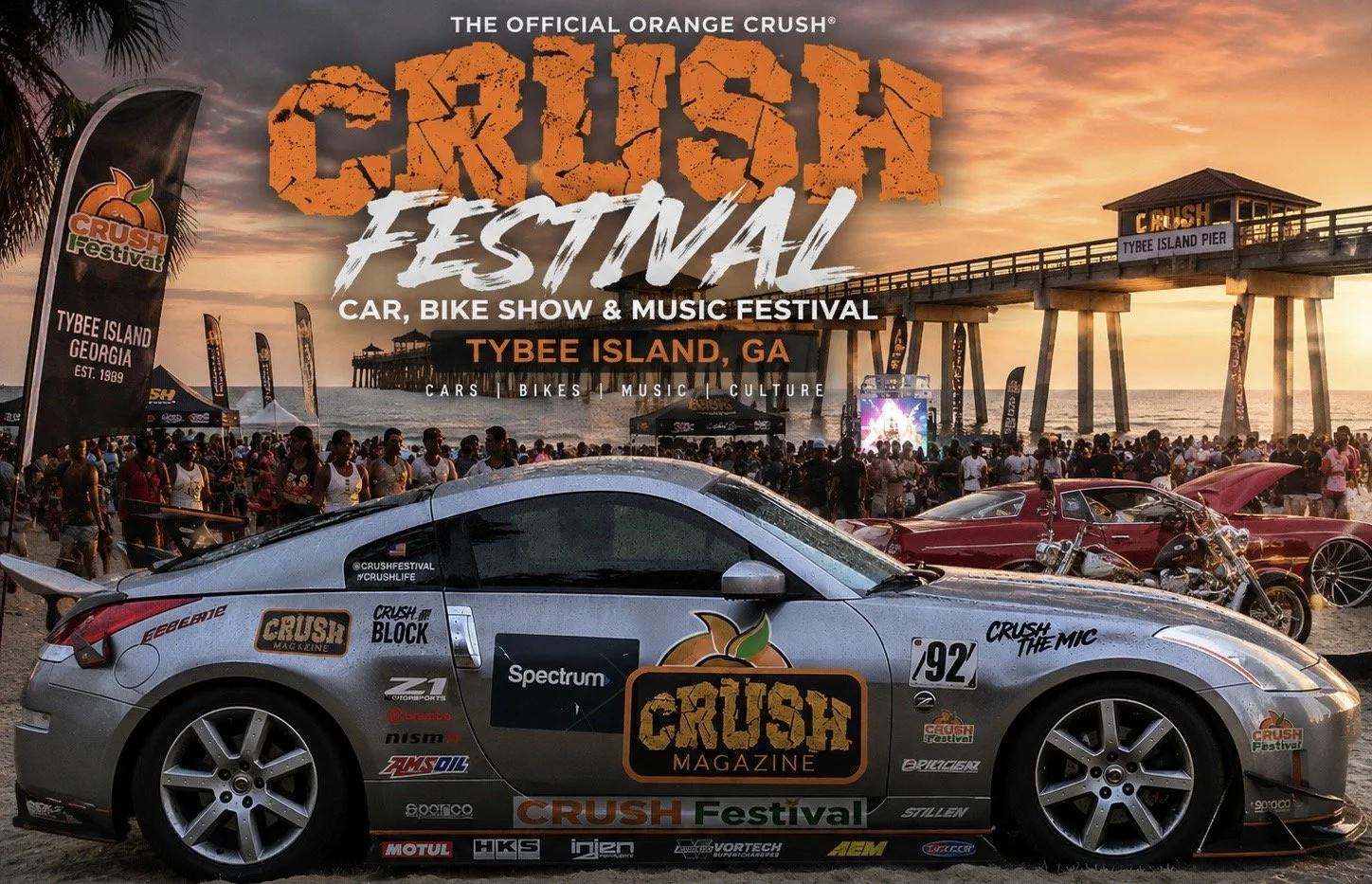
TYBEE BEACH GA • Apr 18 • Near Tybee Pier & Pavilion + Hotel Tybee Parking Lot (31328)
MARCH | MIAMI
South Beach Miami Spring Break • March 13–16, 2026
ORANGE CRUSH® MIAMI • Mansion Pool Party
CRUSH® MIAMI • Mansion Pool Party (Alt Flyer)
ORANGE CRUSH® MIAMI • Yacht Party
APRIL | SAVANNAH / TYBEE
April 9–18, 2026 • Henry St Bistro (1308 Montgomery St) + Tybee Beach
BACP • Big A** College Party
DNN • Damn Near Naked Party
CRUSH THE MIC™
FREAKNIK ’26
FREAKNIK ’26 (Alt Flyer)
ORANGE CRUSH FESTIVAL® TYBEE • Beach Bash
ABC ’26 • Anything Butt Clothes
ABC ’26 • Official ORANGE CRUSH Beach After Party (Alt Flyer)
CRUSH THE BLOCK | ALLENHURST
Sunday • April 19, 2026 • 258 Linda Loop SE, Allenhurst GA
CRUSH THE BLOCK®
MAY | ATLANTA
CRUSH® ATLANTA • May 24–31, 2026
Crush’Lanta • Mansion Pool Party Part 1
Crush’Lanta • Mansion Pool Party Part 2
JUNE | JACKSONVILLE
ORANGE CRUSH® JUNETEENTH • June 19–21, 2026
ORANGE CRUSH® JUNETEENTH • Jacksonville
IMG_URL_HERE.
