
ORANGE Crush UNIVERSITY
Social Impact Organization
Orange Crush University (OCU): Empowering Tomorrow’s Leaders Today
Orange Crush University is a social impact educational platform dedicated to empowering students, veterans, and community members through innovative programs in technology, blockchain, civic engagement, and cultural leadership. Partnering with colleges, universities, and local organizations, OCU delivers workshops, research initiatives, and hands-on learning experiences designed to bridge education with real-world opportunities.
OCU champions inclusivity and innovation by integrating cutting-edge blockchain technology like CRUSH COIN with academic and community projects. Through these efforts, OCU nurtures the next generation of creators, leaders, and changemakers—building skills, confidence, and pathways to success while honoring cultural heritage and community values.
Mission-Driven Structure
Orange Crush University is structured as a 501(c)(3) nonprofit organization focused on education, empowerment, and innovation within underserved communities, especially students and veterans. Its organizational framework supports effective program delivery, community collaboration, and sustainable growth.
Organizational Components
Board of Directors:
Responsible for governance, strategic direction, and ensuring alignment with the nonprofit’s mission and regulatory compliance.Executive Leadership Team:
Oversees day-to-day operations, fundraising, partnerships, and program management.Program Departments:
Organized by key focus areas:Education & Curriculum Development: Designs and delivers workshops, seminars, and certificate programs focused on blockchain, technology, leadership, and cultural studies.
Student & Veteran Engagement: Develops outreach and support services tailored to students and veterans, facilitating access to resources, mentorship, and career pathways.
Research & Innovation: Conducts applied research in blockchain technology, decentralized finance, and community development in partnership with academic institutions.
Community Relations & Outreach: Manages partnerships with universities, local organizations, and government entities, coordinating events, volunteer programs, and public relations.
Program Implementation
Partnerships with Academic Institutions:
OCU collaborates with colleges and universities to integrate its curriculum into existing programs and provide credit-eligible courses, internships, and research opportunities.Workshops and Seminars:
Regular in-person and virtual events provide practical skills in blockchain use, crypto banking, civic engagement, and entrepreneurial development.Blockchain Integration:
Students and community members use CRUSH COIN as a practical tool within OCU programs to learn cryptocurrency transactions, decentralized finance, and digital governance.Community Pilot Projects:
OCU runs localized initiatives, such as environmental sustainability projects on Tybee Island through Orange Crush Tybee, to provide hands-on learning and community impact.
Sustainability & Funding
OCU sustains operations through diversified funding sources including grants, sponsorships, donations, and revenues from related CRUSH Brand activities such as the festival and crypto platform. Financial transparency and impact reporting are prioritized to maintain trust and accountability.
Growth and Scalability
OCU’s modular program design allows for scalable replication across new regions, partnerships, and demographic groups, enabling broad impact while maintaining quality and mission focus.

Student Engagement
The Orange Crush Festival Student Engagement Team is a statewide leadership and cultural innovation initiative that empowers students across Georgia’s colleges and universities to take an active role in shaping one of the South’s most influential cultural events. Built on a foundation of community, creativity, and civic responsibility, this student-led team serves as the front line for campus outreach, digital media campaigns, educational programming, and sustainability efforts connected to the Orange Crush Festival.
http://StudentEngagement.OrangeCrushFestival.org
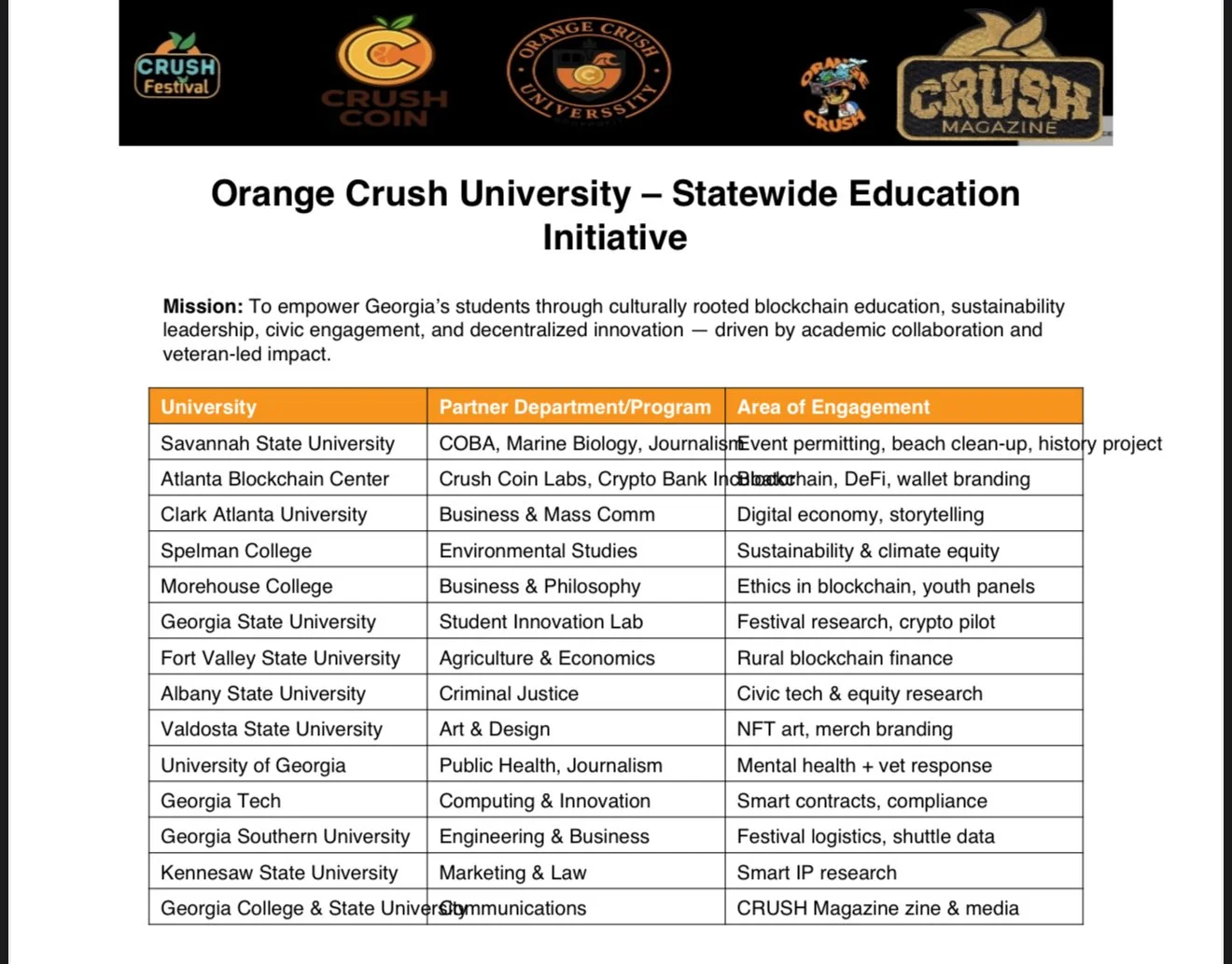
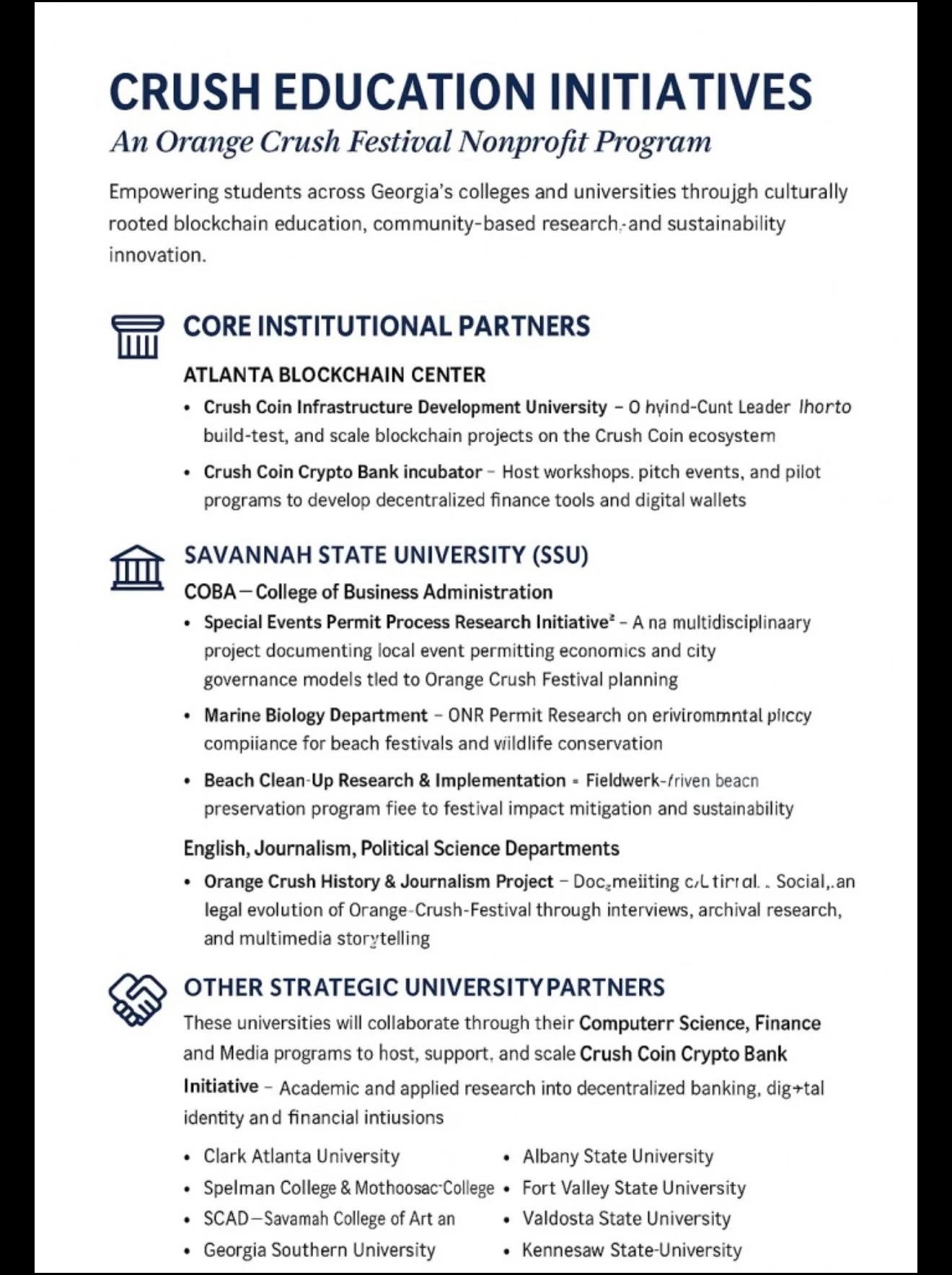
Representing institutions from Savannah State and Spelman to Georgia State, Albany State, Georgia Tech, and the Atlanta Blockchain Center, students engage in hands-on projects that merge real-world experience with grassroots impact. From developing blockchain education initiatives like the Crush Coin Crypto College Challenge, to leading research on special event permitting and organizing beach sustainability programs, team members gain exclusive access to leadership development, creative opportunities, and civic engagement.
With a focus on student voice, cultural preservation, and innovation, the Engagement Team is the heart of Orange Crush’s next generation — building legacy, influence, and impact far beyond the shoreline.
http://StudentEngagement.OrangeCrushFestival.org
CRUSH Student Engagement
Orange Crush Festival (OCF)
&
Orange Crush University (OCU)
Purpose and Philosophy
At OCU, student engagement is central to our mission of empowerment and education. We believe that active participation transforms learning into leadership and innovation. Our programs are designed to not only educate but also to inspire students to become changemakers within their communities and the broader CRUSH ecosystem.
Key Components of Student Engagement
Collaborative Learning Experiences:
Students participate in interactive workshops, hackathons, and seminars focused on blockchain technology, civic leadership, cultural history, and creative expression. These hands-on experiences deepen understanding and encourage practical application.Leadership Development:
Through mentorship programs, student advisory councils, and project-based learning, students are empowered to take ownership of initiatives, develop soft skills, and gain real-world leadership experience.Internships and Research Opportunities:
OCU partners with academic departments and industry leaders to provide internships and research projects, enabling students to contribute to ongoing blockchain development, festival planning, and community outreach.Cultural and Social Events:
Students are integral to organizing and participating in cultural festivals, panel discussions, and networking events—building community and celebrating HBCU heritage.Digital Engagement Platforms:
OCU leverages online portals and social media to maintain continuous engagement, providing access to resources, forums, and collaborative tools that connect students across campuses and regions.
Impact and Outcomes
Students gain valuable skills in technology, communication, and leadership.
Increased awareness and participation in blockchain and decentralized finance.
Stronger ties to community initiatives and cultural heritage preservation.
Enhanced pathways for academic and professional advancement.
How Students Can Get Involved
Join OCU programs through university partnerships.
Volunteer for festival events and community projects.
Contribute to CRUSH Magazine as writers, artists, or editors.
Participate in student councils and advisory boards.
Engage with CRUSH Coin through educational challenges and pilot programs.

-
Month-by-Month Breakdown
August 2025: Orientation & “Next Steps” Check-In
Objective: Re-orient participants to the year’s pillars and confirm immediate volunteer tasks.
Live Zoom Session (60 min):
Welcome & Overview (10 min)
OCU Leadership summarizes the year’s four pillars: Education & Tech Innovation, Civic & Community Leadership, Veteran Support, Environmental Stewardship.
Tybee Island Official provides a high-level permit timeline.
Student Leadership Panel (10 min)
Student representatives from each partner HBCU share their broad goals for the academic year.
OCU Board Overview (10 min)
Board members each briefly outline their area of focus (Finance, Nonprofit Compliance, Legal).
Breakout Groups (20 min)
Group A (OCU & Tybee Officials): Create a one-page “OCU-Tybee Partnership Charter” outline—key mutual expectations.
Group B (Students & Board): List three “Immediate Volunteer Tasks” (e.g., organizing Drive folders, testing Zoom invites).
Report-Back & Assignment (10 min)
Each breakout shares top two action items.
Deliverable (due Sept 1): Each student writes a 1–2 sentence personal goal in a shared Google Doc.
September 2025: Beach Stewardship “Status Update”
Objective: Review current erosion data, plan two short volunteer cleanups using existing resources.
Live Zoom Session (60 min):
Recap & Introductions (5 min)
Presentation: “State of the Beaches” (15 min)
Tybee Coastal Management Official shares current erosion data via public PDF.
OCU Sustainability Lead shares last year’s beach cleanup statistics (volunteer-collected trash, photos).
Interactive Site Map Walkthrough (10 min)
Screen-share the high-resolution site map (PDF) and annotate erosion hotspots and dune restoration plots using Zoom’s annotation tool.
Breakout Groups (20 min)
Group A (OCU & Tybee Officials): Discuss conditional permit considerations; refine existing permit text if needed (no new drafting).
Group B (Students & Board): Plan two one-hour community cleanups—choose dates and assign student volunteers.
Report-Back & Assignment (10 min)
Deliverable (due Oct 1): Sign up sheet in Google Sheets for cleanup volunteers; no new “Virtual Campaign” required—just a simple social-media post template.
October 2025: Veteran Outreach Check-In
Objective: Showcase ongoing veteran programming and finalize a simple festival-day veterans’ resource outline.
Live Zoom Session (60 min):
Recap & Introductions (5 min)
Presentation: “OCU Veteran Support Pillar” (15 min)
VA Outreach Representative presents current “Crush for Vets” workshop outcomes.
OCU Board Finance Member reviews 2025 veteran hiring stats.
Live Workshop Demo (10 min)
OCU facilitator leads a short excerpt of a virtual mental health session (participants can observe).
Breakout Groups (20 min)
Group A (Veteran Reps & Board): Draft a one-paragraph note for the existing Safety Plan describing the “Veteran Resource Station” location and services on festival day.
Group B (Students & OCU): Brainstorm topics for a “Veteran Voices Podcast” episode series (identify 2–3 ideas).
Report-Back & Assignment (10 min)
Deliverable (due Nov 1): A one-paragraph “Veteran Resource Station Outline” in a shared Google Doc.
November 2025: HBCU Civic Outreach (SSU Focus)
Objective: Highlight student achievements in blockchain & civic engagement; plan a basic “Virtual Voter Info Booth.”
Live Zoom Session (60 min):
Recap & Introductions (5 min)
Student Panel: “Crush Crypto Club” Achievements (15 min)
SSU student leaders share short case studies of blockchain pilot projects (use existing slides).
Breakout Groups (20 min)
Group A (Students & Board): Plan a simple “Virtual Voter Info Booth” for the festival website—create a Google Form for sign-ups and information.
Group B (Tybee Officials & OCU): Outline talking points for volunteers staffing the physical voter booth at the festival (no printed toolkits; just a shared Google Doc).
Report-Back & Assignment (10 min)
Deliverable (due Dec 1): Shared Google Form link for voter booth volunteers.
December 2025: HBCU Media & Civic Engagement (CAU Focus)
Objective: Coordinate festival content planning with student media groups; establish a minimal “Virtual Press Pass” policy.
Live Zoom Session (60 min):
Recap & Introductions (5 min)
Presentation: CAU Civic Leaders Program (15 min)
CAU student ambassadors and faculty share programming outcomes (use existing digital zine highlights).
Breakout Workshop: “Festival Content Planning” (20 min)
Group A (Students & Board): Brainstorm three article titles for the Spring 2026 issue of the digital zine; capture ideas in a Google Doc.
Group B (Students & Tybee Officials): Outline the “Virtual Press Pass Policy”—a short process description to be added to the shared Drive.
Report-Back & Assignment (10 min)
Deliverable (due Jan 1): One Google Doc listing final article titles and authors; one-paragraph “Press Pass Policy” note.
January 2026: “Crush Coin” Basics (Simplified)
Objective: Finalize basic token FAQ and website copy for “Crush Coin”—no new technical approvals required.
Live Zoom Session (60 min):
Recap & Introductions (5 min)
Presentation: “Crush Coin Overview” (15 min)
Blockchain Center Developer shares a short demo of wallet setup (existing slides).
Breakout Groups (20 min)
Group A (Tech & Legal): Draft a one-page “Crush Coin FAQ” in Google Docs covering wallet installation and basic redemption.
Group B (Students & Blockchain Center): Create a one-page “Token Info” draft for the festival website (text-only page).
Report-Back & Assignment (10 min)
Deliverable (due Feb 1): Shared Google Docs for “Crush Coin FAQ” and “Festival Token Info.”
February 2026: West Savannah Youth Center Check-In
Objective: Update on youth center outcomes; develop a simple “Financial Literacy 101” module in Slides.
Live Zoom Session (60 min):
Recap & Introductions (5 min)
Presentation: Youth Center Outcomes (15 min)
Youth Center Director reviews program improvements (use existing report).
Interactive Workshop (20 min)
Group A (Students & Youth Staff): Build a 5-slide “Financial Literacy 101” deck in Google Slides (use simple templates).
Report-Back & Assignment (10 min)
Deliverable (due Mar 1): Share link to the completed “Financial Literacy 101” Slides deck.
March 2026: Festival Logistics & Volunteer Training
Objective: Conduct a final “Dashboard Walkthrough” and confirm volunteer roles via simple online forms.
Live Zoom Session (60 min):
Recap & Introductions (5 min)
Dashboard Walkthrough (20 min)
OCU Operations Lead screenshares the existing Festival Readiness Dashboard (Google Sheet).
Breakout Training Simulations (20 min)
Group A (Safety & ADA Volunteers): Practice reading role descriptions in the shared Volunteer Roles Sheet—no printed materials.
Group B (Media & Crypto Volunteers): Review the “Crush Coin FAQ” and discuss on-site token redemption process (references Google Docs).
Report-Back & Assignment (10 min)
Deliverable (due Apr 1): Volunteers complete a one-question “Role Confirmation” Google Form.
April 2026: Capstone & Final Review
Objective: Present key outcomes and lock in final permit readiness—no new documents or printed reports.
Live Zoom Session (60 min):
Recap & Overview (10 min)
OCU Leadership provides a high-level summary of all student-led projects and volunteer assignments.
Tybee Official confirms final permit status (verbal affirmation).
Festival Readiness Dashboard Snapshot (20 min)
Operations Lead shares a screenshot of the final Dashboard (everyone can view in Drive).
Open Discussion & Feedback (20 min)
Tybee Official, OCU Board Chair, and student leaders discuss any last-minute adjustments (all recorded in a shared Google Doc).
Closing Remarks & Next Steps (10 min)
OCU Leadership thanks participants, announces informal in-person kickoff on Tybee Island (details TBA).
Volunteers reminded to check final festival assignments via the Dashboard.
Post-Session Deliverable (due Apr 15):
Festival Readiness Dashboard Screenshot archived in Drive (no separate report).
Final Readiness Statement in a one-paragraph Google Doc.
Expanded Notes
Removed or Deferred Items
No new micro-grant proposals; rely on existing scholarship funds.
No formal “Conditional Permit Language” drafting—use previously submitted permit.
No new multimedia outputs (videos, printed reports); use existing slides and public resources.
No guest honoraria; all presenters volunteer time.
No additional sponsor or fundraising campaigns beyond existing commitments.
Resources
Zoom Meeting Links: Provided in advance via calendar invites.
Shared Google Drive Folder: Contains all pre-reading packets, slide decks, Google Docs, and spreadsheet templates.
Volunteer Sign-Up Sheets: Simple Google Sheets with columned lists for names and assigned roles.
Office Hours: Optional 30-minute drop-in sessions each month for questions.
Why This Works
Cost-Effective: Uses only free platforms and volunteer time.
Reuses Materials: Leverages existing reports and slide decks—minimizing new preparation.
Maintains Engagement: Monthly sessions keep momentum without overloading participants.
Ensures Festival Readiness: By April 2026, the Dashboard, volunteer confirmations, voter booth plan, and veteran resource outline are complete.
-
Local businesses and vendors can get involved in several low-cost, low-barrier ways without needing new approvals or budgets:
Vendor Registration:
• Submit a simple Google Form (linked on our website) to reserve a booth space.
• No application fees beyond the mandatory licensing fee outlined in our MOU with the City.
• Once approved, vendors receive a one-page “Vendor Guidelines” PDF (traffic flow, waste disposal, setup/teardown times).In-Kind Partnerships:
• Offer in-kind services—such as supplying water stations, portable restrooms, or sound-check assistance—in exchange for promotional “Featured Vendor” status.
• Coordinate directly via email (sponsor@orangecrushfestival.org) to confirm mutual expectations and signage requirements.Local Business Promotions:
• Advertise “Orange Crush Festival Specials” (e.g., 10% off spring break menus, themed cocktail offerings).
• Submit a short description and logo via the “Local Promo” Google Doc; we’ll post it on our festival website and social channels at no extra cost.Volunteer Support:
• Businesses can encourage employees to sign up for 1–2-hour volunteer shifts (e.g., helping with social media coverage or manning the community complaint hotline).
• Sign ups happen through our “Volunteer Roles” Google Sheet—no formal training sessions needed beyond a 10-minute Zoom briefing.